ATLANTA (AP) — When Donald Trump delivered the first White House address of his second presidency Wednesday night, all major U.S. networks beamed his image and voice onto their airwaves, cable feeds and online platforms.
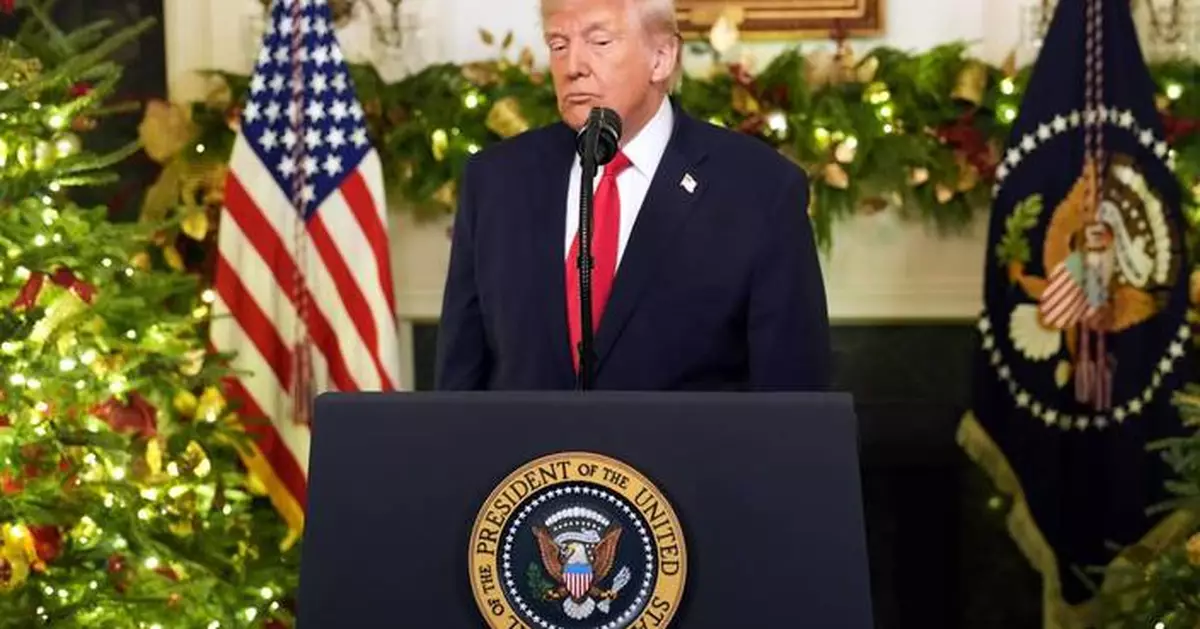
Americans ended up watching the Republican president stand in the Diplomatic Reception Room and deliver 18 minutes of aggressive, politically motivated arguments that misstated facts, blamed the nation’s ills on his predecessor, exaggerated the results of his nearly 11 months in office and amplified his characteristically gargantuan, immeasurable promises about what's to come.
This was no commander in chief announcing a military action or discussing a critical national issue. It was a politician's defiant insistence that he’s doing a better job than polls suggest most Americans believe. And the spectacle raises the question of whether network executives should grant airtime to the leader of the free world for a clearly political speech simply because he asks.
“It's not that the Oval Office and the White House haven't been used for political speeches before,” said former NBC executive Mark Lukasiewicz, who is dean of Hofstra University's communications school after more than a decade leading NBC's special broadcasts, including presidential addresses.
“But, as with a great deal of what Donald Trump does as president, this was outside the norm,” Lukasiewicz said, adding that news executives are reluctant to flout the historical standard that “when the president feels he needs to speak to the nation, you need to let him speak.”
The uneasy dynamics were further intensified because Trump spoke the same day that the Federal Communications Commission chairman, Brendan Carr, told members of Congress that his agency, which has regulatory authority over media companies, is not in fact an independent agency as has been understood through generations of Republican and Democratic administrations. That's on top of Trump’s penchant for browbeating individual journalists who cover him and suing news organizations to the tune of multimillion-dollar settlements, notably from CBS and ABC.
Lukasiewicz, who left NBC soon after Trump's 2016 election, said "it is hard to imagine that those factors aren’t on the minds of news executives and network executives making these decisions.”
The White House did not immediately reply to questions Thursday about the process that led to Wednesday’s address. The networks also did not respond to Associated Press inquiries. Spokespeople at MS NOW and CNN, cable networks whose prime-time programming already is oriented to political coverage, declined comment.
Presidential addresses often begin with the White House press secretary or communications director contacting networks' Washington bureau chiefs, asking for a specific amount of time and offering a general description of the topic. Lukasiewicz recalled that when President Barack Obama told the nation that 9/11 mastermind Osama bin Laden had been killed on his orders, his aides had told networks the president wanted to discuss a major national security matter.
Such conversations are relayed up to network executives, who must weigh whether to preempt or delay programming, decisions that can affect advertising revenue. Networks typically grant the time, reasoning that they’re relatively rare and historically have involved substantial matters.
Trump, who relishes talking directly to voters via social media and regularly talks to reporters on Air Force One and elsewhere, has made fewer requests for network time than many of his predecessors; he had not asked at all since returning to the White House in January.
Still, it’s not a guaranteed yes, with Obama and President Joe Biden being denied requests in recent decades.
The president disclosed his plans Tuesday on Truth Social, his social media platform. That announcement came hours after his declaration, also on Truth Social, that the U.S. would accelerate its actions against Venezuela and boats the Trump administration insists are running drugs that reach U.S. soil.
Taken together, those posts triggered chatter in Washington and beyond about official wartime actions. Some newsrooms predictably linked his planned speech to his Venezuela commentary. Presidents, after all, regularly make major military announcements in addresses from the White House: John F. Kennedy on the Cuban Missile Crisis, Lyndon Johnson on Vietnam, Jimmy Carter on the Iran hostages, Ronald Reagan on the Cold War and U.S. maneuvers in Latin America.
Presidents also have made plenty of U.S.-centered speeches, many fairly described as a politician pitching his preferred domestic policies with an unchecked megaphone.
Network leaders notably rejected Obama in 2014 when he wanted to talk about immigration policy while Congress was at an impasse over the matter. Lukasiewicz recalled being part of the executive team that rejected Obama's request to speak during his first term on the Affordable Care Act becoming law.
In 2022, Biden spoke at length on his concerns about American democracy — but several networks did not carry his remarks from Philadelphia. By itself, the topic could be framed as a national concern above partisanship. Biden’s effort, though, was complicated by the fact that he was talking about Trump and Trump's supporters who ransacked the U.S. Capitol on Jan. 6, 2021, at a time when they were being investigated and prosecuted.
It's not clear when — or if — the White House shared the substance of Trump's remarks with network leaders. People familiar with how the process has worked in previous administrations said it would be defensible, since it was Trump's first address this term, for networks to grant his request even without clarity about the topic.
By Wednesday afternoon and early evening, White House aides and some executive branch agencies had telegraphed to some journalists that the speech would be more oriented to the state of the nation nearly a year into Trump’s presidency — a framing that would still put the speech within historical norms. Trump, however, went beyond those traditional boundaries.
The United States was “laughed at” before he resumed the presidency in January, Trump insisted. He blamed Biden and Democrats for “the worst (inflation) in the history of our country,” but said “everything ... is falling rapidly.” Biden-era inflation was not the worst in history, inflation rates began falling before he left office and, though they are now at or much closer to historically routine levels, that still means prices are rising.
The White House also offered charts that only Fox opted to show.
Trump accused immigrants in Minnesota of stealing “billions and billions” of dollars and used the language of war to call Biden-era immigration levels an “invasion.” He claimed he'd secured $18 trillion in foreign business investments to the U.S. when his own White House puts the number closer to half that. He said he scored a landslide in 2024 — despite his Electoral College vote share ranking in the bottom third through 230 years of victorious presidents.
Asked whether the display could give TV executives pause in the future, Lukasiewicz pointed back to business realities.
“I don’t know,” he said. “Those overlaying factors of the incredible pressure that this president can bring, and has shown himself completely willing to bring on these organizations and their corporate parents when he’s unhappy — that's still part of part of the equation."
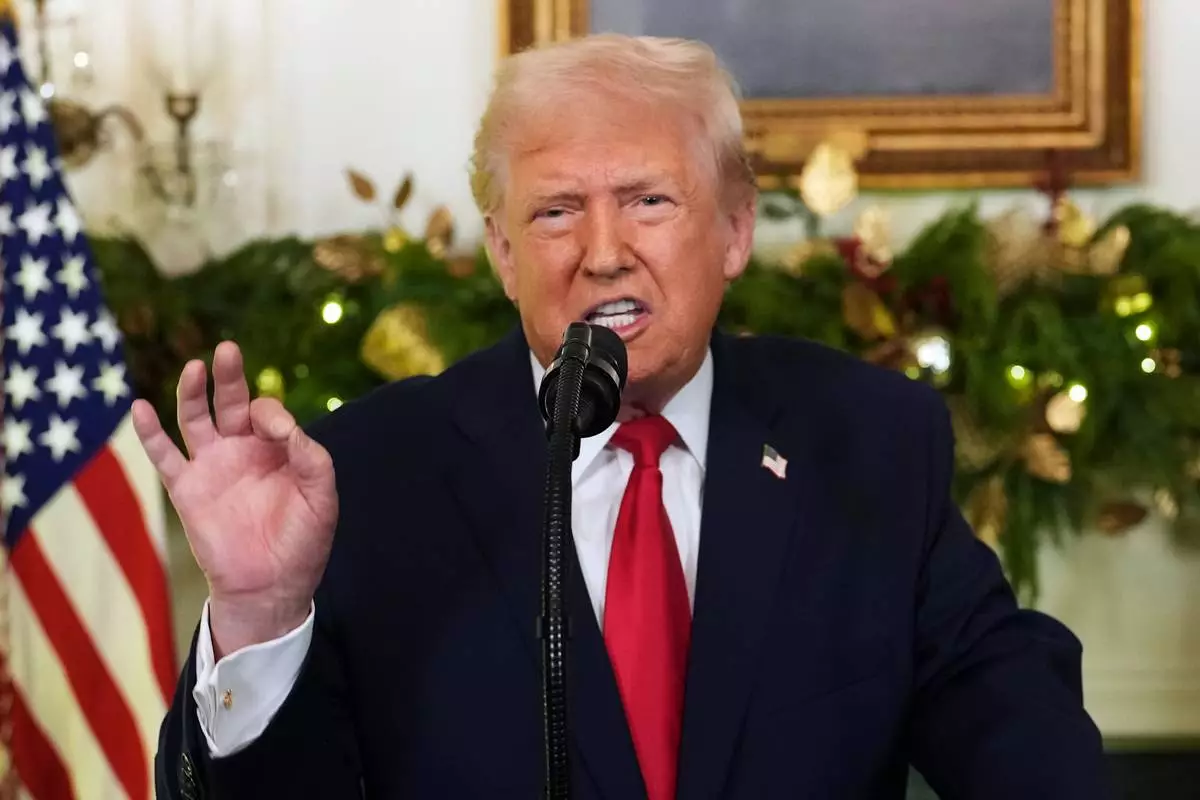
President Donald Trump speaks during an address to the nation from the Diplomatic Reception Room at the White House, Wednesday, Dec. 17, 2025, in Washington. (Doug Mills/The New York Times via AP, Pool)
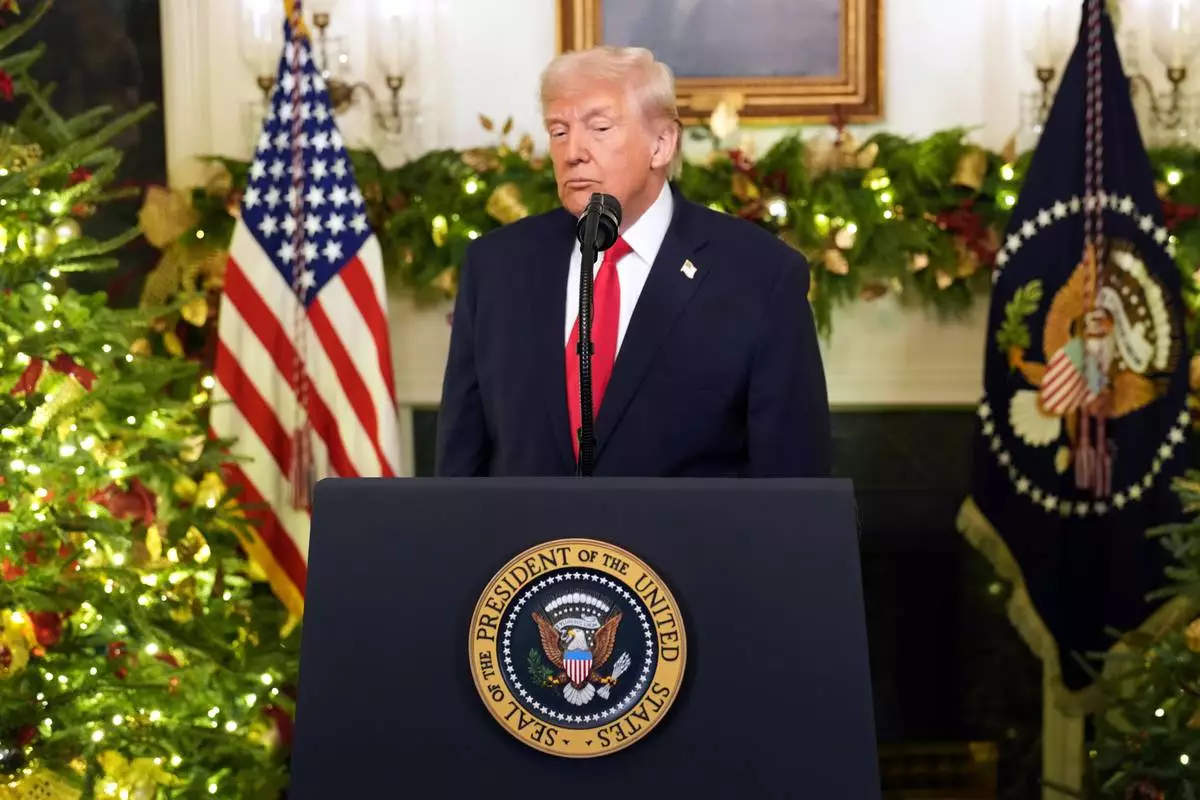
President Donald Trump finishes his remarks in an address to the nation from the Diplomatic Reception Room at the White House, Wednesday, Dec. 17, 2025, in Washington. (Doug Mills/The New York Times via AP, Pool)