Australian Prime Minister Anthony Albanese on Friday announced that a national firearm buyback scheme will be established to reduce the number of guns in the community following the Bondi Beach shooting.
Albanese said at a press conference in Canberra that the federal government will establish a national buyback to purchase and destroy surplus, newly banned and illegal firearms.
The scheme will mimic a buyback that was established in response to the fatal shooting of 35 people at Port Arthur in the island state of Tasmania in 1996.
The fatal shooting of 15 people at Bondi Beach on Sunday night was Australia's most deadly mass shooting since the 1996 attack, which prompted a major overhaul of the country's gun laws.
Albanese said there are currently over four million firearms in Australia, more than there were at the time of the Port Arthur massacre.
Australia's states and territories will be responsible for collection, processing and payments under the buyback, and the Australian Federal Police will be responsible for destroying the surrendered firearms.
Albanese said he expects hundreds of thousands of firearms will be collected and destroyed.
Previously on Monday Australia's leaders at a snap National Cabinet meeting agreed to take decisive action to strengthen gun laws following the Bondi Beach shooting.

Australian PM announces national gun buyback following Bondi Beach shooting

Australian PM announces national gun buyback following Bondi Beach shooting

Australian PM announces national gun buyback following Bondi Beach shooting
Global business leaders gathering in Beijing for the China Development Forum 2026 said that they remain optimistic about China's role as a key driver of growth and are committed to deepening their presence in the Chinese market.
Themed "China in its 15th Five-Year Plan period: advancing high-quality development and creating new opportunities together", the two-day forum, which kicked off on Sunday, highlighted China as a key engine of global development as the country begins its 15th Five-Year Plan (2026-2030).
Patrick Pouyanne, chairman and CEO of TotalEnergies, a French energy giant, acknowledged the growing barriers in global energy cooperation, but stressed that both China and Europe share a common path toward green energy.
"We have observed more barriers, in fact, we see a lot of, I would say, non-cooperative attitude, I am still convinced, in particular, in the field of energy. But in fact, both China and Europe have exactly the same strategy, which is going to more green energy, which is a way to combine security with supply and China is leading the way," he said.
Philippe Delorme, president and CEO of KONE Corporation, a global leader in the elevator and escalator industry, said that Finnish Prime Minister Petteri Orpo's visit to China from January 25 to 28 has reinforced trust, mirroring the strong relationships KONE has built with its Chinese partners.
"Prime Minister Orpo went to China to reinforce the trust that has been built over time, which is actually very parallel to the trust that KONE has been building with the China-based ecosystem and its customers," he said.
Judy Marks, CEO and president of American elevator maker Otis emphasized the company's strong commitment to China, highlighting the access and enthusiasm she experiences on every visit.
"Well, every time I come to China, my agenda is packed, and I want it that way. I want to see our colleagues, I want to see our business partners, I want to see government officials. And guess what, in China, every time we have that access. It's always an exciting time in China. We're investing and we're here to stay," she said.
Rogier Janssens, president of Merck China, talked about his professional journey of returning to China, drawn by the country's rapid pace of development and the opportunities he sees unfolding.
"I am not new to China. I'm also not new to Merck. I ran the healthcare business for Merck between '17 and '22 out of Beijing. It's interesting. Actually, at some point in time, I was thinking about after 35 years of working in the pharmaceutical industry, I thought maybe I needed to slow down a little bit and take it easy. Maybe I'd take a job at the headquarters or something like that. But in reality, I thought no. There needs to be a bit more excitement and I'm super excited about what I'm seeing and hearing. I mean the speed of China, the way things are development so rapidly here," he said.
Since its inception in 2000, the China Development Forum has become one of the country's major platforms for dialog among Chinese government officials, global business leaders, international organizations, and scholars.
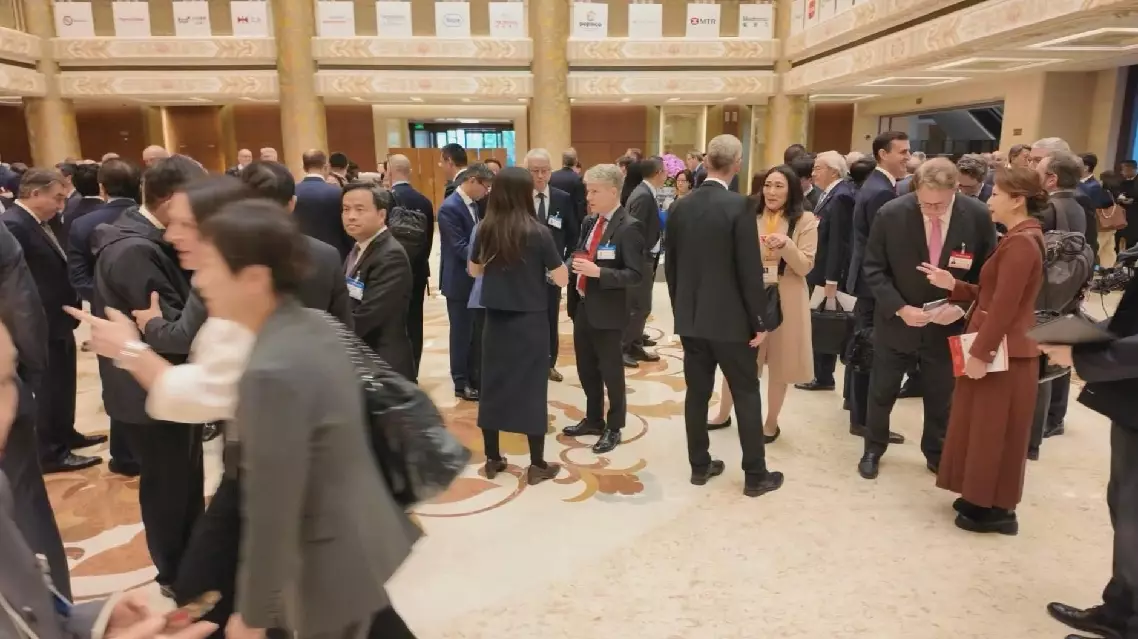
Global business leaders express confidence in China's market