As China on Thursday launched special customs operations in its entire southern tropical island province of Hainan to build it into the world's largest Free Trade Port (FTP) by area, an innovative classroom in the province is already preparing the workforce of tomorrow.
At the Hainan Bielefeld University of Applied Sciences (BiUH), a German lecturer is training students through hands-on, cross-continental learning designed to meet the automation and efficiency demands of key trade hubs like the Yangpu Port -- a major deep-water port in Hainan.
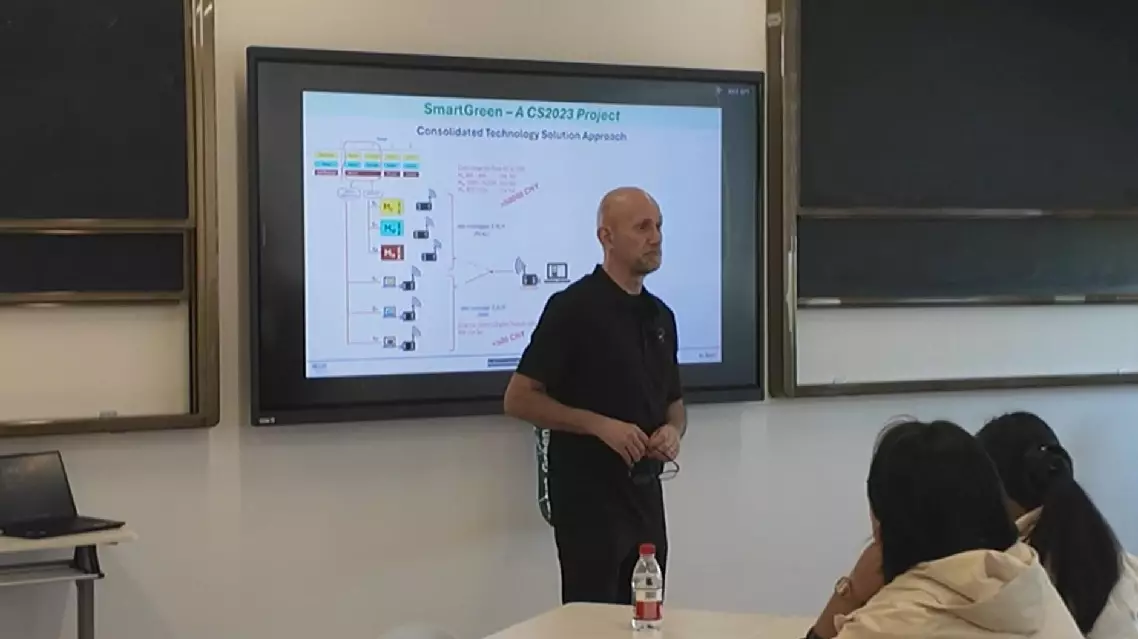
In a learning environment resembling a corporate workshop more than a traditional lecture hall, Lecturer Dirk Klann challenges students with real-world business scenarios drawn from his nearly four decades of experience at the Frankfurt Airport and the Port of Hamburg.
One distinctive assignment requires completing a procurement task worth 50,000 yuan (around 7,101.01 U.S. dollars) with only a 4,000-yuan (around 568.08 U.S. dollars) budget, teaching students to navigate practical constraints.
In the lead-up to the special customs operations launch, Klann's third-year students -- including Chen Rui -- embarked on internships in Germany, equipped with the practical methodologies honed in their Hainan classrooms.
The shift from campus workshops to factory floors did not alter their core problem-solving approach. Klann consistently refrains from giving direct answers, instead guiding students through step-by-step diagnostics grounded in classroom principles.
"What we learn during internship at enterprises is still somewhat related to the lessons we are learning from the classroom. For me, I will take the problems I encounter during my internship back to the next semester's classes to solve them. When I chose this university, I was drawn precisely to its novel 'practice-embedded' model," said Chen, a third-year student at BiUH.
This "practice-embedded" approach is part of the German academic DNA of BiUH, the first higher education institution in China to be independently operated by a German public university.
Located in Danzhou City, home to the vital Yangpu Port, the university lies at the heart of the Hainan FTP's trade infrastructure. With the advancement of island-wide special customs operations, Klann sees direct applications for his students' skills in this evolving port environment.
"I expect that the volume in Yangpu Port will increase over time and when you need to deal with a higher volume of cargo going through the port, you need to have also higher degree of automation. And this technology that we use here is the same one that you can apply in the port to support automating processes, increasing the throughput and not having the cost rising too much," said Lecturer Klann.
The educational innovation at BiUH reflects Hainan's broader push to establish itself as an international education innovation hub, transforming the province's connection with the rest of the world into a two-way thoroughfare for talent and expertise.
"And we've just received approval for five new degree programs: electrical engineering, mechanical engineering, mechatronics, software engineering and business administration. BiUH's degree programs are closely aligned with both the goals of the Free Trade Port and the need of industry. Our goal at BiUH is consistently educating highly qualified professionals for German and Chinese companies, graduates who are interculturally competent and can thrive in an internationally oriented economy," said Prof. Dr. Ingeborg Schramm-Wolk, German president of BiUH.
"Practice-embedded" classroom in south China's Hainan bridges Europe, Asia for future port talent cultivation