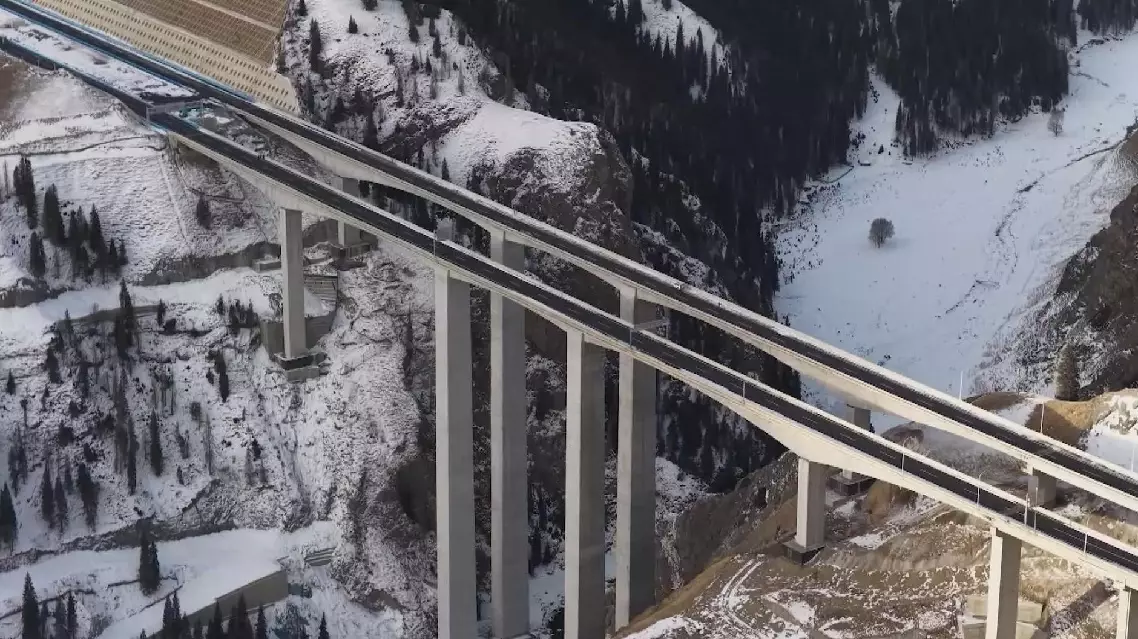
A key section of the Urumqi-Yuli Expressway, which connects Urumqi, capital of northwest China's Xinjiang Uygur Autonomous Region, with Yuli County in southern Xinjiang, was successfully delivered on Friday.
The segment links Urumqi to Baluntai Town in the Bayingolin Mongol Autonomous Prefecture, traversing the most complex terrain along the entire route and presenting the highest engineering challenges.
"The Urumqi-Yuli Expressway, which winds through the Tianshan Mountains, features complex geography, a high bridge-to-tunnel ratio, and challenging construction conditions. Notably, it also includes the world's longest expressway tunnel, the Tianshan Shengli Tunnel, which posed numerous world-class challenges to the construction. The construction team overcame these difficulties to complete the section, which has now passed acceptance inspection," said Zhou Zheng, a general manager of the Urumqi-Yuli Expressway public–private partnership project of China Communications Construction Company.
The 319.7-kilometer Urumqi-Yuli Expressway, designed to connect northern and southern Xinjiang, is set to open to traffic by the end of December.
As a key link connecting with other trunk expressways in the region, it is expected to significantly boost the flow of trade, logistics, and cultural tourism resources across Xinjiang.
Key section of major trunk expressway in Xinjiang delivered
The International Monetary Fund (IMF) has lowered its global economic growth forecasts for 2026 to 3.1 percent in the World Economic Outlook (WEO) report published on Tuesday, while keeping its projection for 2027 at 3.2 percent.
This marks a deceleration from the estimated 3.4 percent growth achieved in 2025. Before the outbreak of the Middle East conflict, the bottom-up forecasts for global growth would have been 3.4 percent in 2026 and 3.2 percent in 2027.
The forecast incorporates the impact of the war and assumes that it will be limited in duration, intensity and scope, with disruptions fading by mid-2026.
Under the reference forecast, global headline inflation is expected to increase to 4.4 percent in 2026 and decline to 3.7 percent in 2027.
If the conflict and the ensuing spike in oil prices last longer, global economic growth in 2026 will fall to 2.5 percent, while global inflation will climb to 5.4 percent, according to the report.
In extreme cases, global economic growth in 2026 could drop to two percent, the report warned.
To be specific, the U.S. economy is projected to grow by 2.3 percent in 2026 and 2.1 percent in 2027, although higher trade barriers introduced since April 2025 are expected to continue to weigh on activity.
In the euro area, growth is projected to decline from 1.4 percent in 2025 to 1.1 percent in 2026 before edging up to 1.2 percent in 2027. The forecasts for 2026 and 2027 are each 0.2 percentage point lower than those compared in the January 2026 WEO Update.
The 2026 growth forecast for emerging market and developing economies is revised down by 0.3 percentage point, to 3.9 percent, while the outlook for advanced economies remains broadly unchanged. With risks still tilted to the downside since the January 2026 WEO Update, the IMF suggested a comprehensive policy package combining domestic measures with coordinated international actions to strengthen resilience and foster adaptability.
It also stated in the report that "trade restrictions play a limited role in correcting imbalances but can worsen output," and urged countries to cooperate and take coordinated actions to restore stability to international economic relations.
IMF lowers global growth forecast for 2026 to 3.1 pct