NEW YORK (AP) — The Trump administration has awarded a $1.6 million, no-bid contract to a Danish university to study hepatitis B vaccinations on newborns in Africa that is raising ethical concerns.
The unusual contract was awarded to scientists who have been cited by anti-vaccine activists and whose work has been questioned by leading public health experts. Some experts have suggested the research plan is unethical, because it will withhold vaccines that work from newborns at significant risk of infection.
The contract did not undergo a customary ethics review, The Associated Press has learned.
The Centers for Disease Control and Prevention awarded the grant to a research team at the University of Southern Denmark that has been lauded by U.S. Health Secretary Robert F. Kennedy Jr., according to a federal notice posted this week.
One of the team's leaders is Christine Stabell Benn, a consultant for a Kennedy-appointed committee that recently voted to stop recommending a dose of hepatitis B vaccine for all U.S. newborns.
The study is to begin early next year in Guinea-Bissau, an impoverished West African nation where hepatitis B infection is common. The researchers are funded for five years to study 14,000 newborns.
It’s to be a randomized controlled trial, with some infants given the hepatitis B vaccine at birth and some not. Children will be tracked for death, illness and long-term developmental outcomes.
Most of the children will be followed for less than two years to look for side effects, but the first 500 enrolled will be followed for five years to look for behavior and brain development problems. There is no placebo involved, according to a copy of the study protocol prepared earlier this year that was obtained by the AP.
Hepatitis B can be passed from an infected mother to a baby. It also can be spread by other infected people a baby comes in contact with.
Research and widespread medical consensus holds that the hepatitis B vaccine protects newborns, so withholding it from some babies — in this case, Black babies — has raised ethical alarms.
Medical evidence is clear that the vaccine protects infants from developing liver disease and an early death. The well-documented infection risk far outweighs hypothetical concerns about side effects, said Dr. Boghuma K. Titanji, an Emory University infectious diseases doctor.
She called the study “unconscionable,” and said it likely will exacerbate existing vaccine hesitancy in Africa and elsewhere.
“There’s so much potential for this to be a harmful study,” said Titanji, who is from Cameroon.
Benn did not respond to an email seeking comment about the proposal. An automatic response said she is out of the office until early January.
But, in a statement, the research team said the study “will be the first and likely the only one of its kind.”
They said it takes advantage of an unusual window of opportunity: Guinea-Bissau doesn't currently recommended a birth dose of the hep B vaccine, but the nation will be implementing universal vaccination of newborns in 2027.
Vaccine skeptics and opponents have suggested that all the vaccine's possible side effects were inadequately studied before the CDC began recommending it for newborns in 1991. Public health experts counter that over more than three decades no serious side effect has been documented.
The award is highly unusual. The CDC did not announce a research funding opportunity and invite proposals.
The proposal was unsolicited and the award did not go through customary review, said a CDC official with knowledge of the decision. Department of Health and Human Services officials told CDC officials to approve it and said HHS would provide special funding for it, the CDC official said.
In private communications channels, CDC staffers were expressing outrage about the award, said the official, who is not authorized to talk about it and spoke on condition of anonymity.
Some of those CDC scientists have compared the work to the infamous Tuskegee Study, which the agency oversaw in its later stages. In that decades-long study, health workers withheld treatment from unsuspecting Black men infected with syphilis so doctors could track the horrible ravages of the disease.
Like Tuskegee, this study involves the prospect of researchers watching people grow ill when a medical intervention could have kept them healthy, Titanji echoed.
“It is an apt comparison,” she said.
The new study's researchers say the trial was approved by a national ethics committee in Guinea-Bissau. But it did not undergo a customary ethics review within the CDC, the agency official told the AP.
In a statement, HHS spokesman Andrew Nixon said "we will ensure the highest scientific and ethical standards are met.”
Public health scientists noted questions have been raised in the past about research led by Benn and her husband, Peter Aaby, in their Bandim Health Project.
Other Danish researchers who reviewed Aaby and Benn's work have described questionable research practices. Earlier this year, former CDC Director Dr. Tom Frieden wrote an editorial calling a 2017 study co-authored by Aaby and Benn “fundamentally flawed."
Several researchers had harsh words about the latest award.
“Aaby and Benn are doing the Guinea-Bissau HBV vaccine depravation trial," Carl Bergstrom, a University of Washington evolutionary biologist, wrote in a post on Bluesky. "Did RFK Jr. just call up the first name in the antivax yellow pages?”
Dr. Angela Rasmussen, a virus expert at the University of Saskatchewan, said Kennedy was giving taxpayers' money to his “cronies” for a “grossly unethical study that will expose African babies to hep B for no reason.”
The Associated Press Health and Science Department receives support from the Howard Hughes Medical Institute’s Science and Educational Media Group and the Robert Wood Johnson Foundation. The AP is solely responsible for all content.
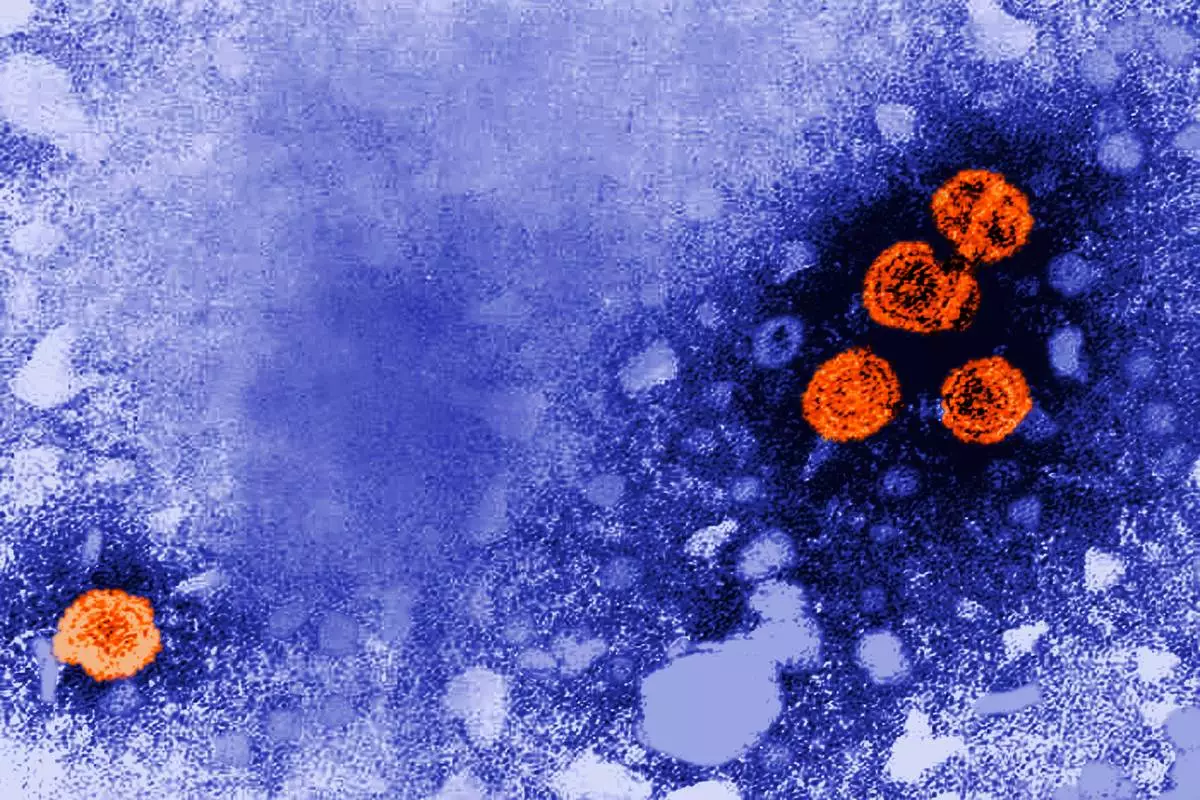
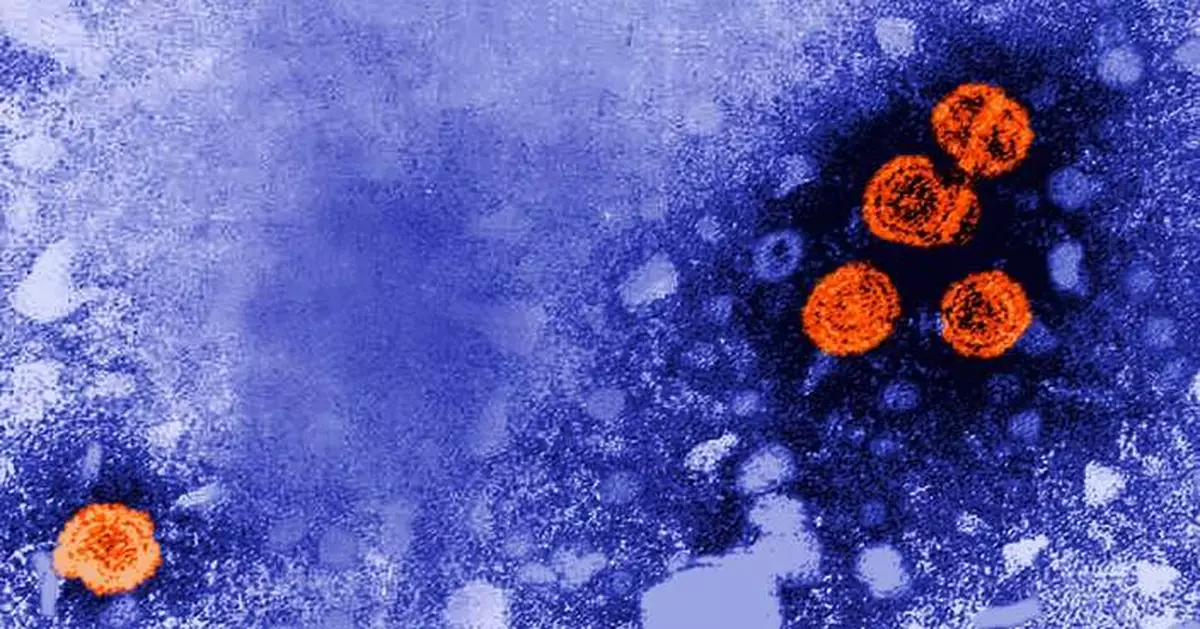
FILE - This 1981 electron microscope image made available by the U.S. Centers for Disease Control and Prevention shows hepatitis B virus particles, indicated in orange. (Dr. Erskine Palmer/CDC via AP, File)
PARIS (AP) — Millions of people across Europe were exposed to extreme and exceptionally high temperatures on Tuesday, with 40 fatalities from drowning recorded in France in the past week as residents seek relief from the searing heat.
Temperatures will remain high around the clock in France, the European nation most affected so far by the early summer heat wave. The national weather service, Meteo France, placed 54 departments, about half the country, under a red heat wave alert.
Italy, Spain, and Britain were also hit.
Human-caused climate change is tied to increasingly extreme weather, and U.N. climate agency projections say the next five years should shatter more heat records.
French Prime Minister Sébastien Lecornu said that the 40 people who died by drowning since last Thursday were mainly young people.
In a country without widespread air conditioning, schools, public transportation and sporting events have been impacted. In Paris, the Eiffel Tower adjusted its operations to the scorching weather, closing in the afternoon instead of late at night as it usually does. The Louvre museum said it would close two hours earlier than normal from Wednesday through Saturday.
“Although parts of its historic building are naturally resilient, the museum remains vulnerable and is not sufficiently adapted to climate change,” it said. “Heat buildup is greatest toward the end of the day and is further intensified by high visitor numbers.”
Extreme conditions are expected to last at least until the end of the week, with daytime highs above 40 degrees Celsius (104 degrees Fahrenheit) in many towns.
“Further record-breaking temperatures are expected, including some that could surpass all previous records, regardless of the time of year,” Meteo France said.
The heat wave is exceptionally intense, coming very early in the summer, “but with a still uncertain duration,” the weather service said. It has already been compared to the August 2003 heat wave, when the highest temperatures in over half a century caused an estimated 15,000 deaths, many of them among older people in apartments and retirement homes without air conditioning.
Europe is the world’s fastest-warming continent, with temperatures increasing twice as fast as the global average since the 1980s, according to the European Union’s Copernicus Climate Change Service. Over the last four years, more than 200,000 people across Europe died from heat-related causes, and most of those deaths were preventable, the World Health Organization’s Europe office said this month.
The above-average temperatures can cause heat exhaustion and life-threatening heat stroke.
Across the English Channel from France, hundreds of British schools say they are shuttering or closing early this week because of expected record heat, while many train services have been reduced to avoid heat-related problems on the rail lines.
The Met Office, the U.K. weather agency, issued a red extreme heat warning for Wednesday and Thursday, with forecasts suggesting June’s all-time daily temperature record could be broken.
Temperatures of around 37 degrees C (98.6 F) are expected in southern England, with up to 35 C (95 F) in southeast Wales. The peak of the heat wave is now forecast for Wednesday and Thursday, when highs could reach 39 C (102.2 F) in London or southern England. Conditions are expected to ease by Friday, the Met Office said.
On Tuesday, multiple train operators across the United Kingdom, including the express train serving London Gatwick Airport, said they were canceling or reducing services this week. Railway operators urged people to “only travel if absolutely necessary” on Wednesday and Thursday.
Further south on the continent, Spain is facing a heat wave across various parts of the Iberian Peninsula.
Spain’s national weather service, Aemet, issued red alerts Tuesday for temperatures of 44 C (111 F) in southern Andalusia as well as warnings of thermometers hitting 40 C (104 F) in the normally temperate Cantabria and the Basque Country regions along its northern Atlantic coast.
Aemet meteorologist Rubén del Campo said Spain, which has experienced increasingly torrid summers of late, is only going to get hotter because of climate change as heatwaves become more frequent, longer and appear outside the traditional window of July and August.
Of the dozen heatwaves Aemet has recorded in June since it started tracking them in 1975, half have occurred since 2015, del Campo said.
Human-driven climate change is heating up the atmosphere, both above Spain and in the surrounding sea waters, he said.
Copernicus, the EU monitoring agency, found that in Europe and globally, 2024 was the hottest year on record and the continent experienced its second-highest number of “heat stress” days.
Scientists warn that climate change is exacerbating the frequency and intensity of heat and dryness, especially in southeastern Europe, making the region more vulnerable to health impacts and wildfires.
The name of the body of water between France and the U.K. has been corrected to the “English Channel.”
Associated Press journalists Sylvia Hui in London and Joseph Wilson in Barcelona, Spain, contributed to this report.

People swim in an outdoor swimming pool in London, Tuesday, June 23, 2026 as a heat wave is predicted across Britain.(AP Photo/Alberto Pezzali)
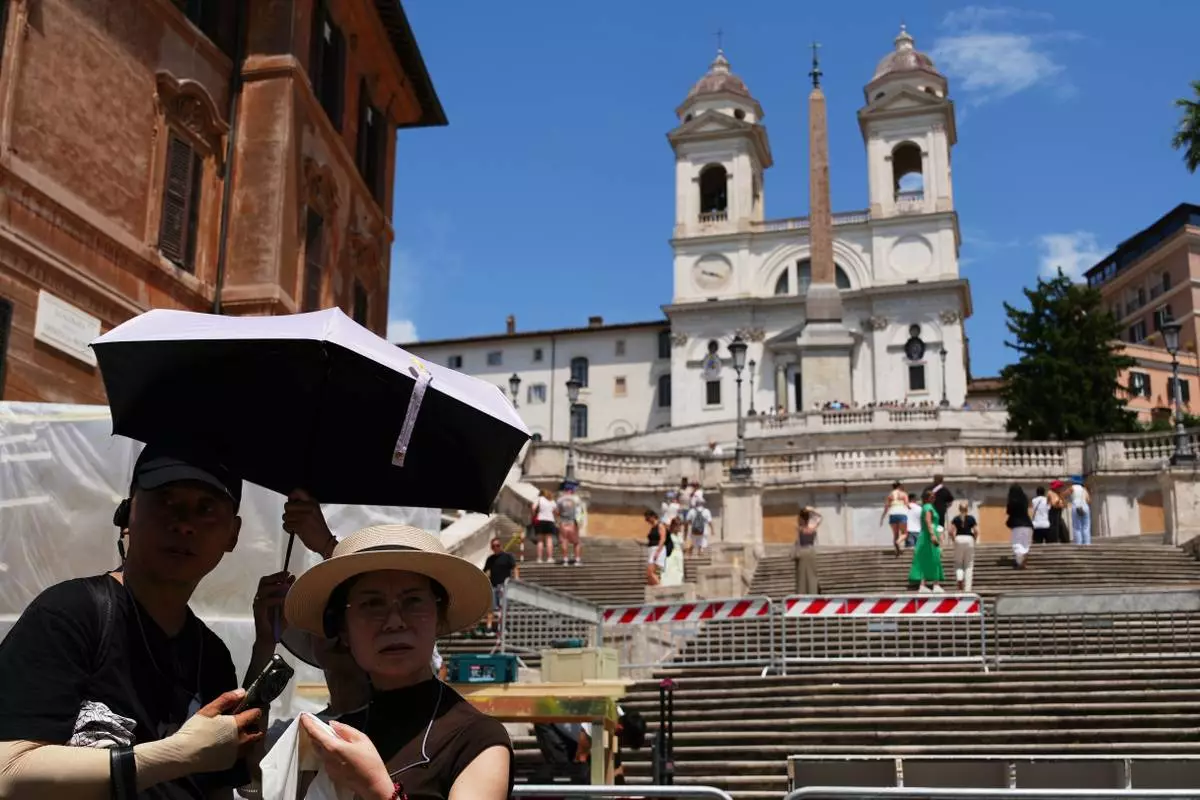
Tourists use umbrellas to shelter from the sun as they visit the historical Spanish steps in Rome, Tuesday, June 23, 2026. (AP Photo/Alessandra Tarantino)
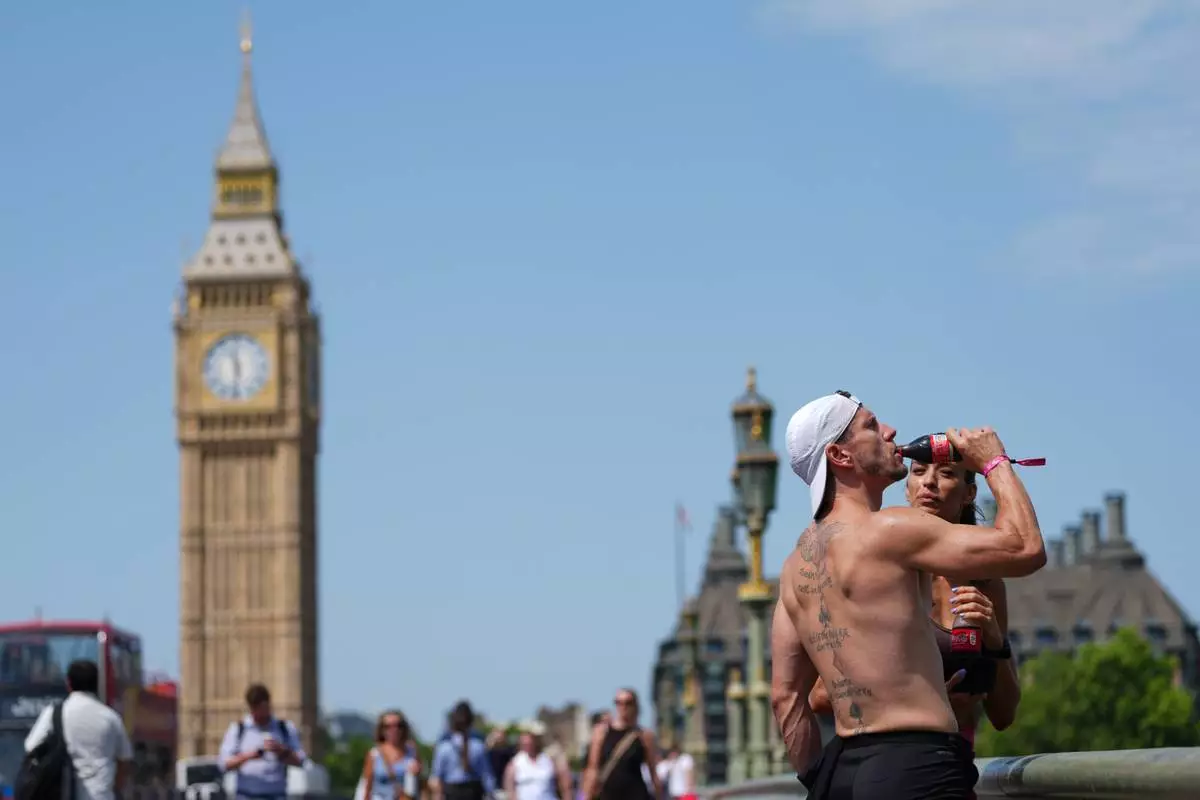
A man drinks on Westminster Bridge in London, as a heat wave is predicted Tuesday, June 23, 2026. (AP Photo/Kirsty Wigglesworth)
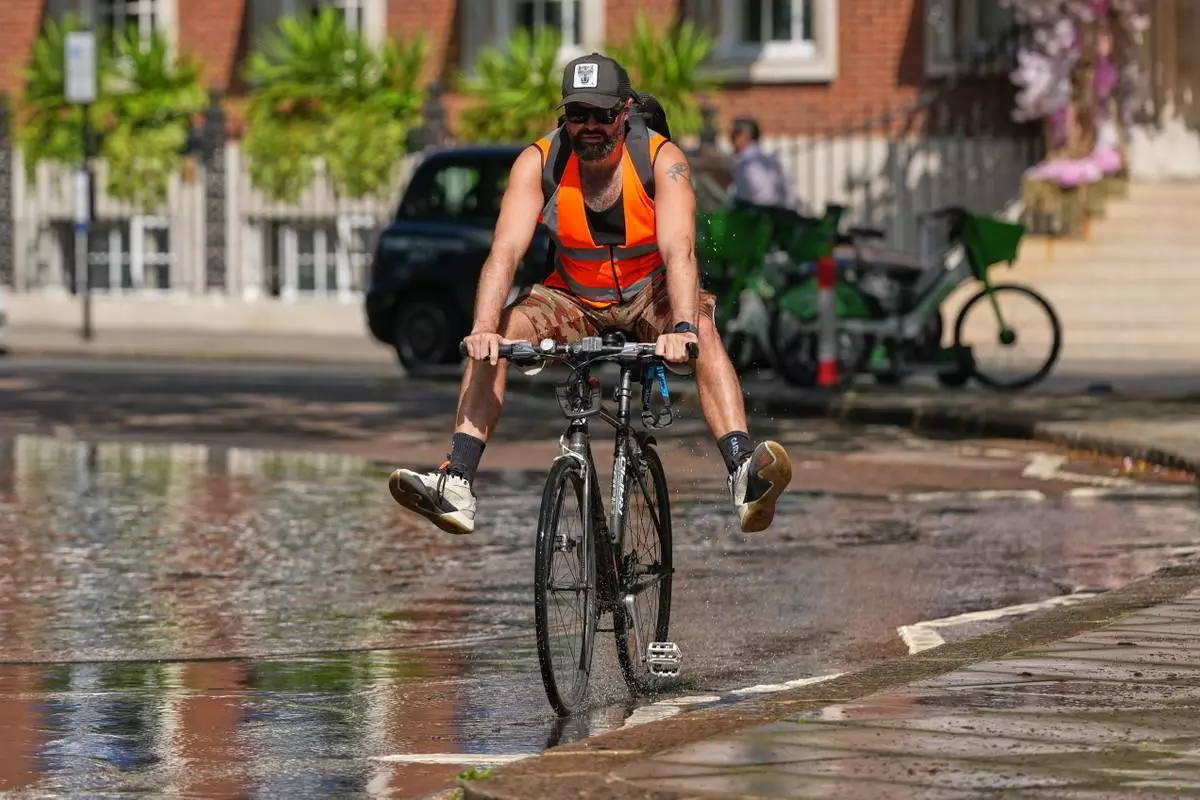
A man keeps his legs dry as he cycles through standing water in London, as a heat wave is predicted Tuesday, June 23, 2026. (AP Photo/Kirsty Wigglesworth)
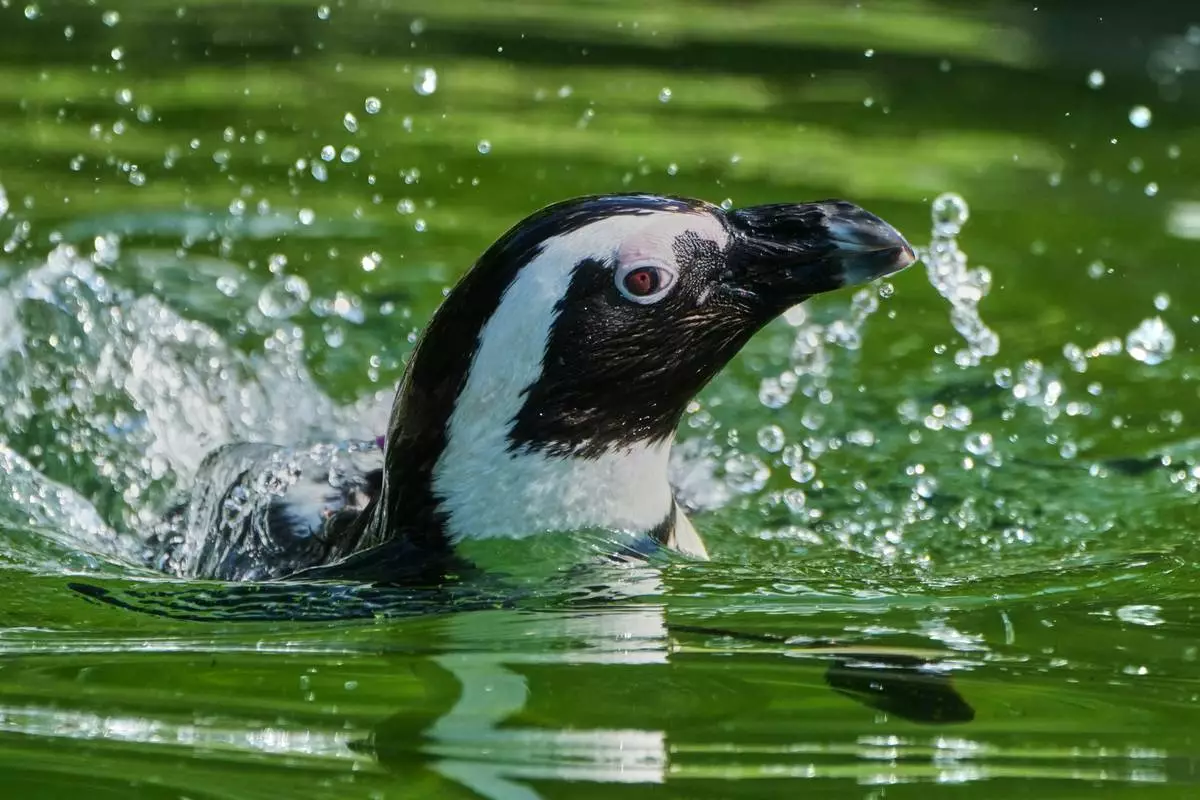
An African penguin cools off in a basin in Kronber zoo, near Frankfurt, Germany, Tuesday, June 23, 2026. (AP Photo/Michael Probst)
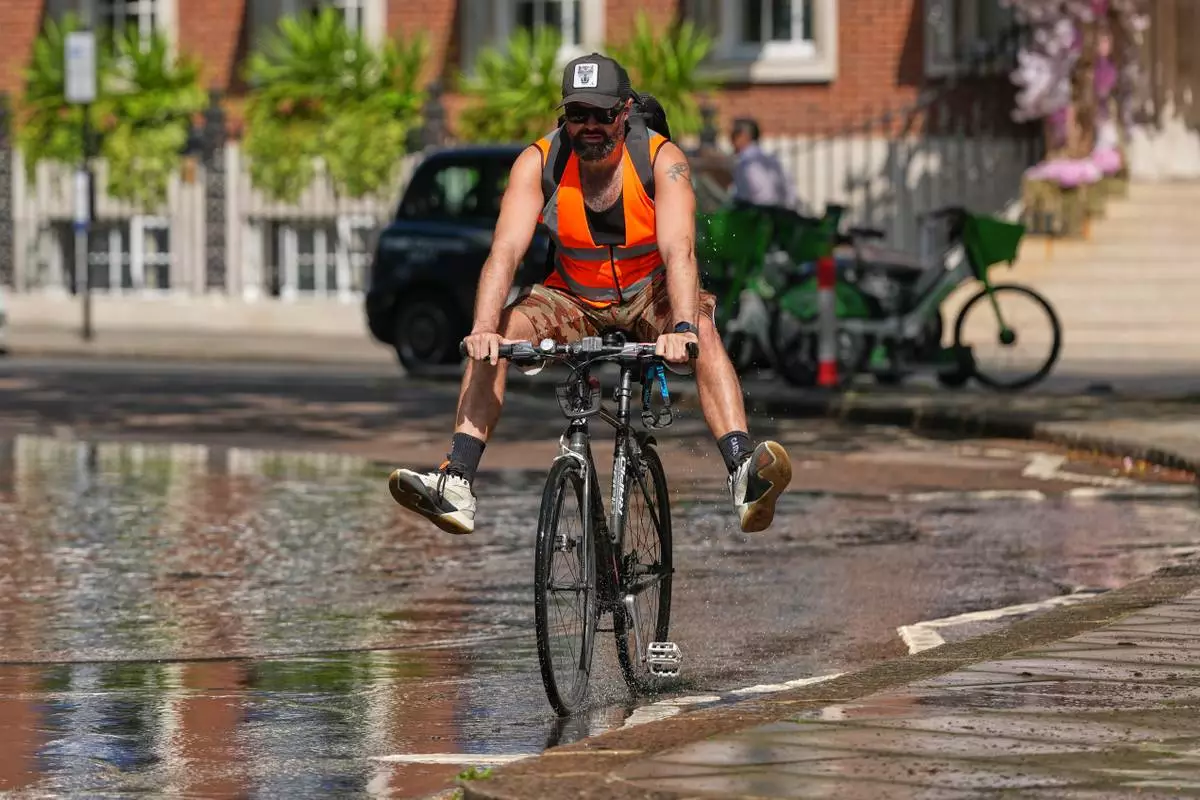
A man keeps his legs dry as he cycles through standing water in London, as a heat wave is predicted Tuesday, June 23, 2026. (AP Photo/Kirsty Wigglesworth)
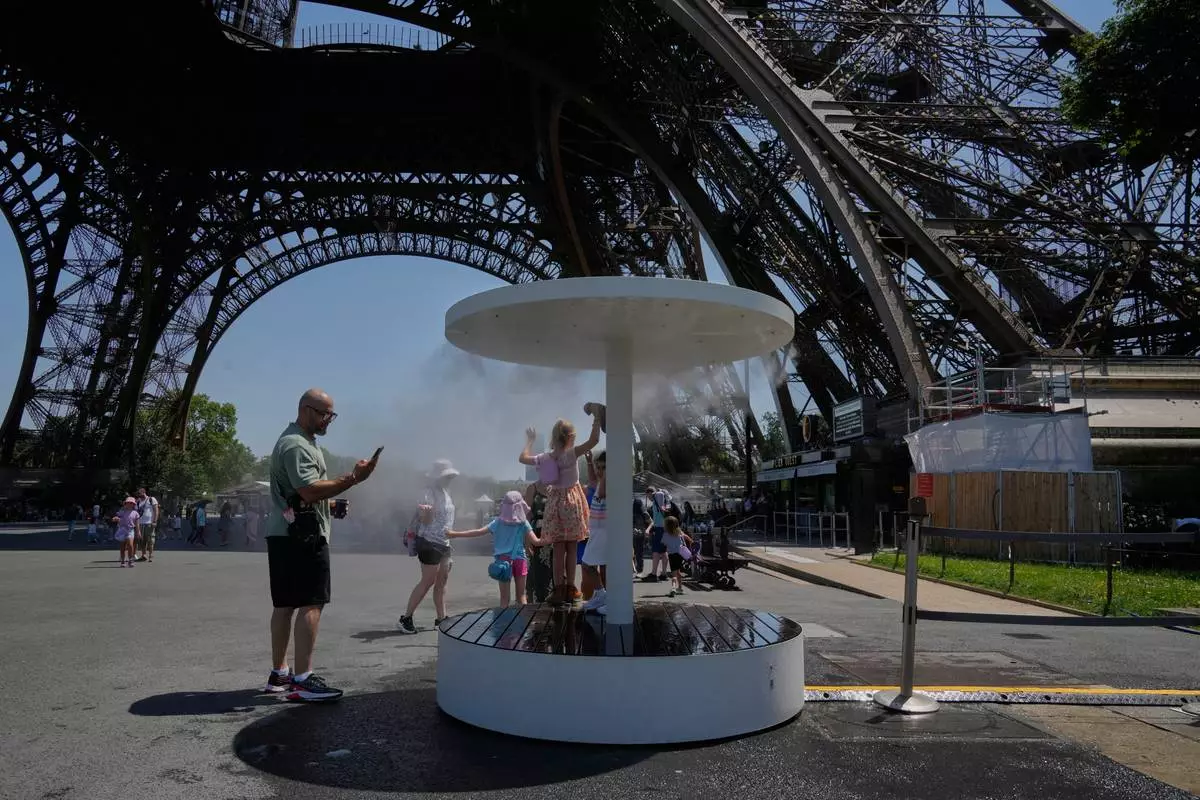
People cool off in a water spray at the Eiffel Tower in Paris, Sunday, June 21, 2026. (AP Photo/Michel Euler)
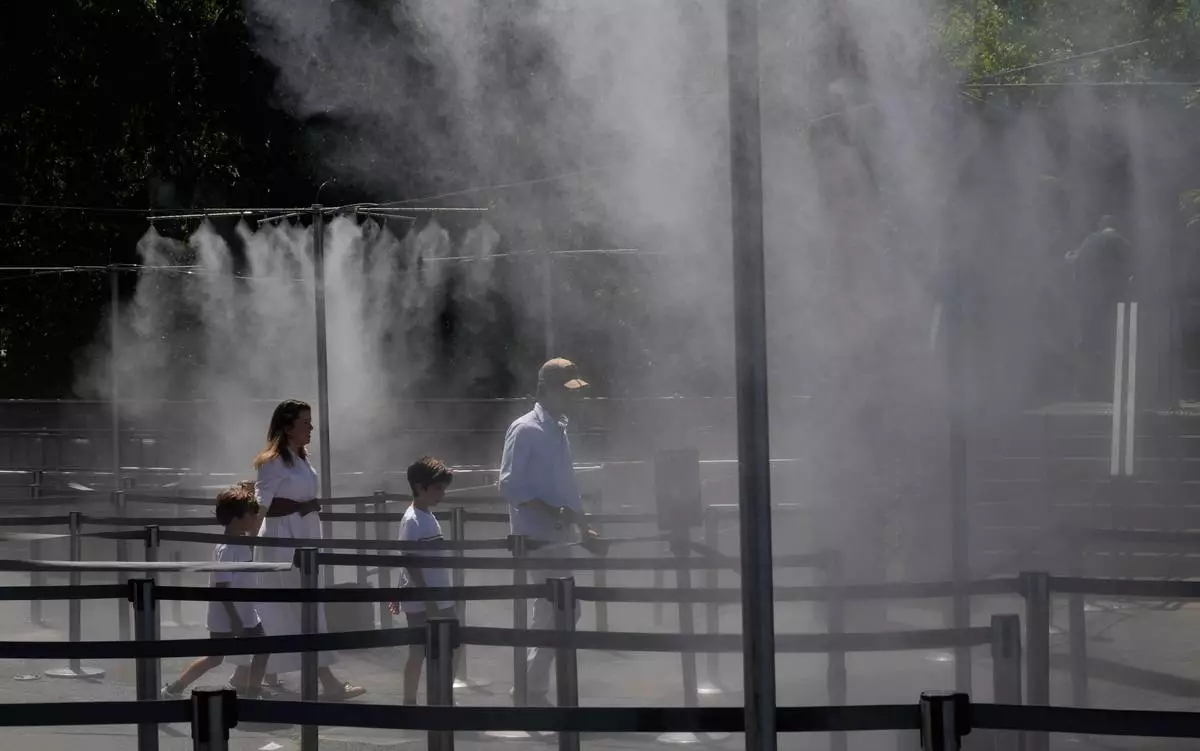
A family walks through a cooling water spray at the Eiffel Tower in Paris, Sunday, June 21, 2026. (AP Photo/Michel Euler)
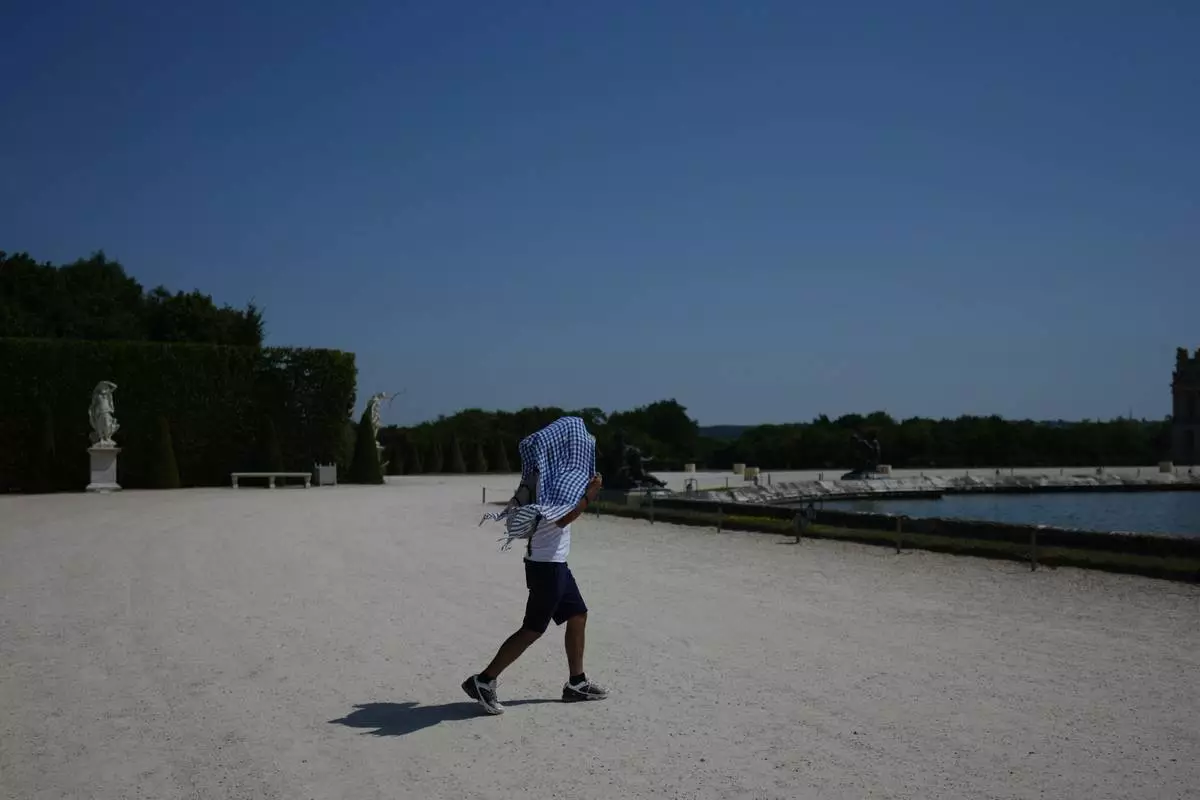
A man shields himself from the sun with a scarf as he walks in the garden of the Palace of Versailles, outside Paris, during a heat wave with temperatures soaring above 40 degrees Celsius (104 Fahrenheit), Monday, June 22, 2026. (AP Photo/Thibault Camus)

Tourists with an umbrella take a photo in Paris, as France is enduring a grueling heat wave with temperatures soaring above 40 degrees Celsius (104 Fahrenheit), Monday, June 22, 2026. (AP Photo/Christophe Ena )
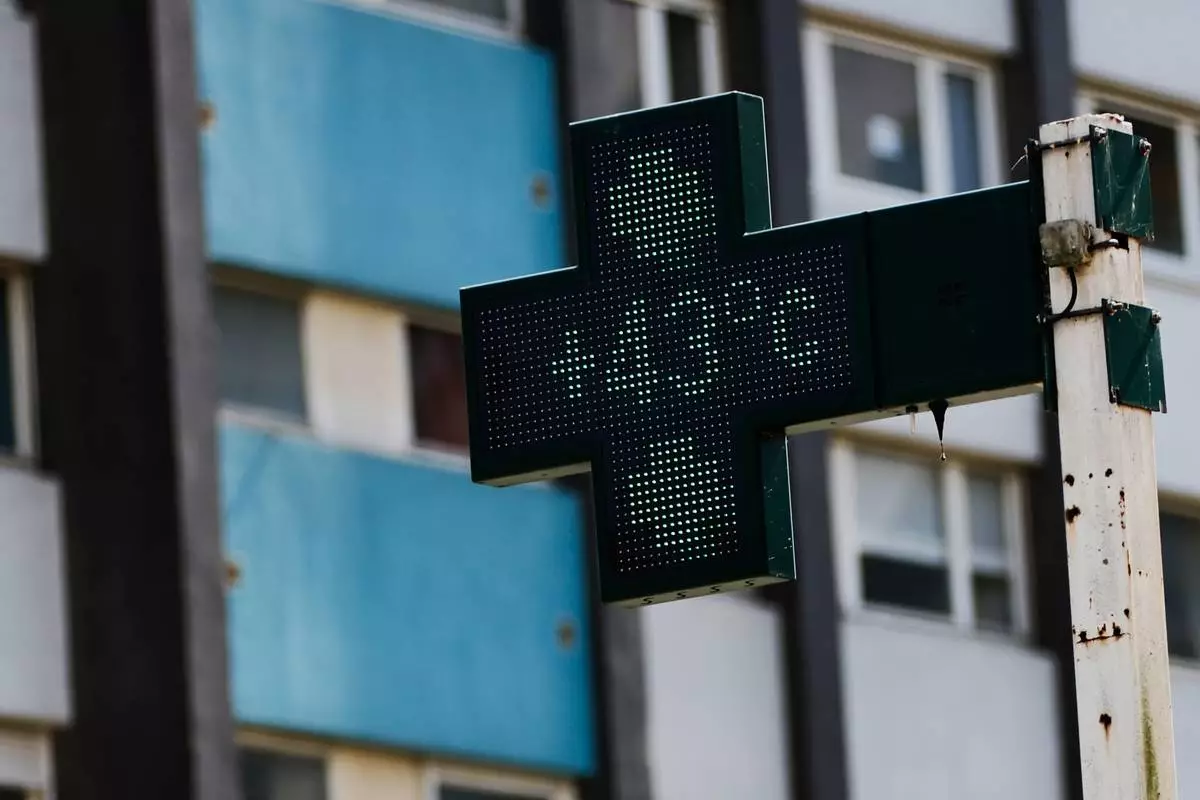
A drugstore sign shows the temperature 43 degrees Celsius (109,4 degrees Fahrenheit) in Rennes, western France, Monday, June 22, 2026. (AP Photo/Jeremias Gonzalez)