WASHINGTON (AP) — The president of the National Trust for Historic Preservation said Friday she trusts the Trump-appointed chairman of a federal planning commission to do his job and give serious review to President Donald Trump’s proposal to add a ballroom to the White House.
Carol Quillen said in an interview that she takes Will Scharf, chairman of the National Capital Planning Commission, “at his word” after he said at the panel's December meeting that the review process would be treated seriously once the White House submits the plans.
Scharf said at that meeting that he expected to receive the plans sometime this month, and the panel's review process would happen at a “normal and deliberative pace.”
Quillen said she trusted that would be the case.
“I take him at his word that the process will be conducted as it always is, deliberately and seriously, and that the commission will do its job," she said.
The White House has not responded to multiple queries about when the ballroom plans will be shared with Scharf’s panel as well as the Commission of Fine Arts. The planning commission on Friday released the agenda for its January meeting and the “East Wing Modernization Project” is listed for an “information presentation,” often the first step in its review of a project.
The National Trust last week asked a federal court to halt the ballroom construction until it is subjected to multiple independent reviews, public comment and wins approval from Congress. The government argued in court that the lawsuit was premature.
A federal judge this week denied the National Trust's request for a temporary restraining order but scheduled a January hearing on its motion for a preliminary injunction. Such a step would halt all construction until the reviews, which could take months, are completed.
Quillen said her private nonprofit organization was not asking for the Republican president's proposal to go through reviews just for the sake of doing so. She said the process inevitably leads to a better project because multiple independent parties get to comment on it.
The National Trust was chartered in part to ensure the public participates in decisions that affect the country's historic resources, she said, “and the White House is arguably the nation's most iconic building.”
She said the organization did not sue earlier because legal action is “our last resort” and because of its history of working with administrations.
In Trump's first term, the administration submitted plans to the National Capital Planning Commission for new fencing for the White House perimeter and a tennis pavilion on the south grounds.
Quillen declined to speculate about why Trump had not already done so for a White House ballroom he has long desired and has moved quickly to build since he returned to office. He complains regularly that the East Room and State Dining Room — two of the largest public spaces in the White House — are too small and has criticized the practice of hosting foreign leaders at state dinners in tents on the south grounds.
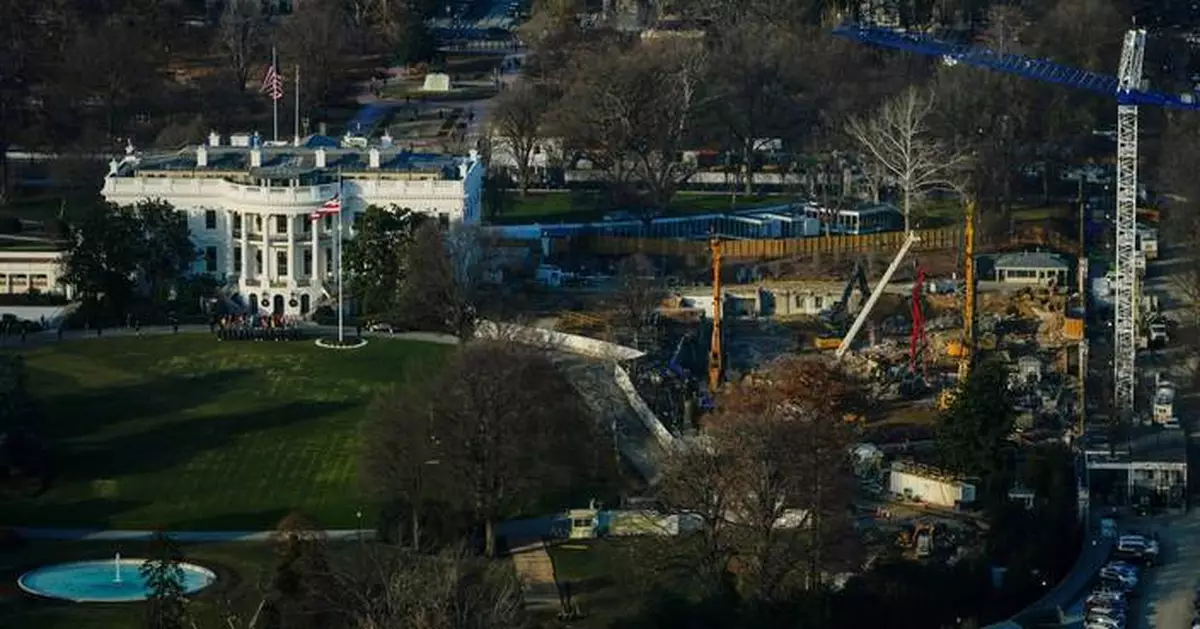
Trump has proposed building a 90,000-square-foot ballroom, big enough to accommodate 999 people, where the East Wing of the White House stood for decades until he had it torn down in October in a move that “caught us by surprise,” Quillen said.
He recently upped the construction cost estimate to $400 million, double the original $200 million price, and has said no public money will pay for it. The White House has said the ballroom will be ready before Trump's term ends in January 2029.
The National Trust asserted in its lawsuit that the ballroom plans should have been submitted to the National Capital Planning Commission, the Commission of Fine Arts and Congress before any action.
The lawsuit notes that the organization wrote to those entities and the National Park Service, which oversees the White House grounds, on Oct. 21, after the East Wing demolition began, asking for the projects to be paused and for the administration to comply with federal law. It received no response, the lawsuit said.
The government said in its written response that the ballroom plans have not been finalized despite continuing demolition and other work to prepare the site for eventual construction, which is not expected to begin until April 2026, at the earliest.
The administration also argued that Trump has authority to modify the White House and included the extensive history of changes and additions to the Executive Mansion since it was built more than 200 years ago. It also asserted that the president is not subject to statutes cited by the National Trust.
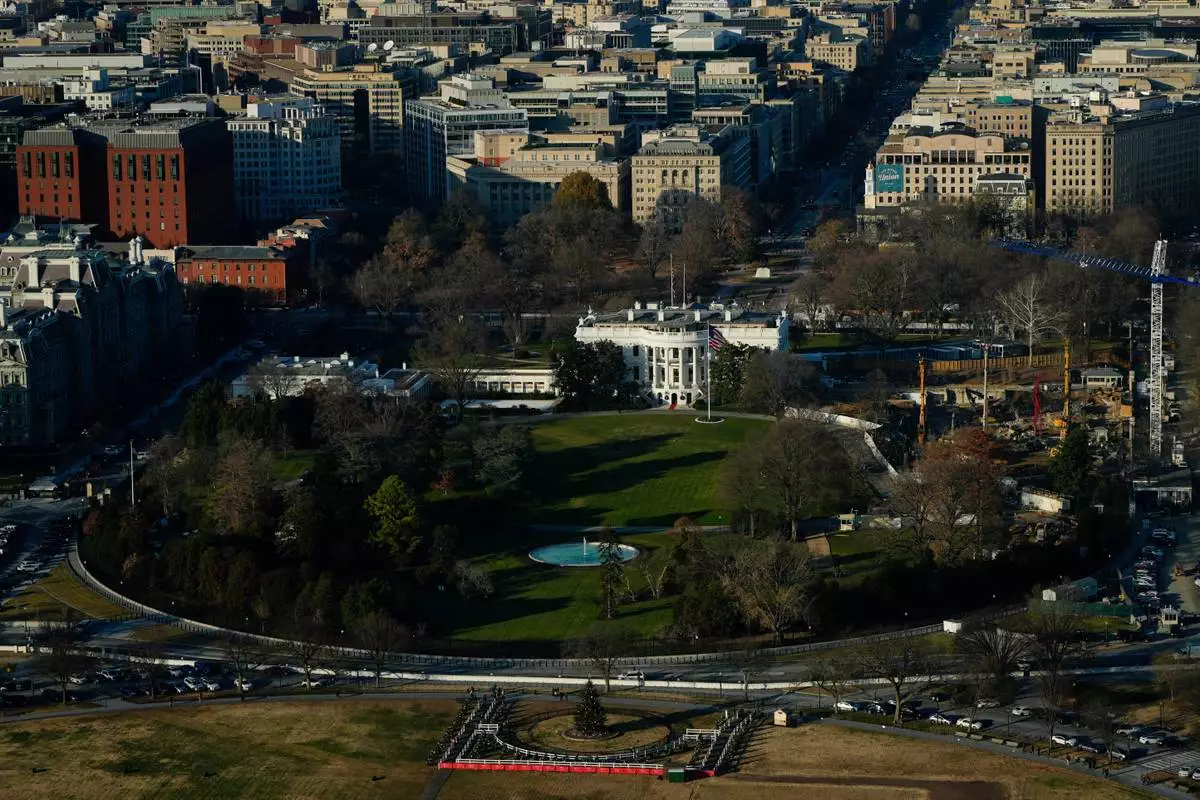
Work continues on the construction of the ballroom at the White House where the East Wing once stood, Tuesday, Dec. 16, 2025, in Washington. (AP Photo/Julia Demaree Nikhinson)
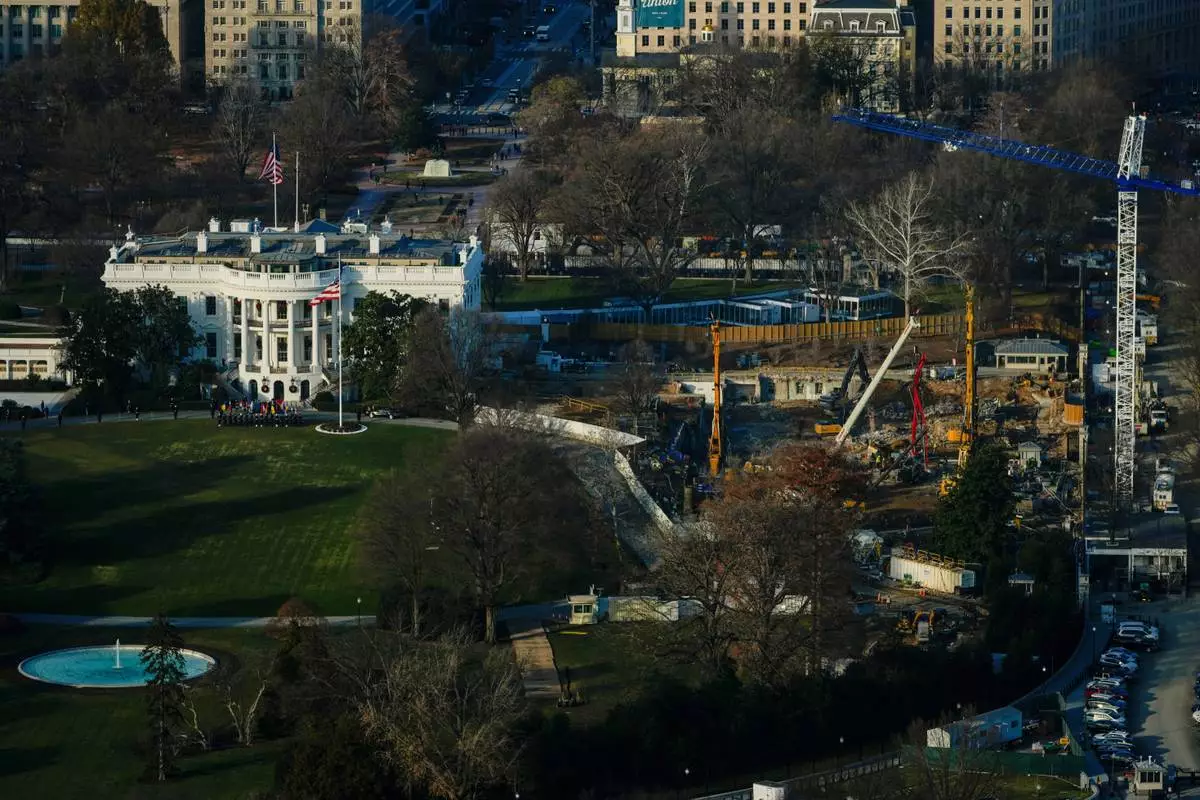
Work continues on the construction of the ballroom at the White House where the East Wing once stood, Tuesday, Dec. 16, 2025, in Washington. (AP Photo/Julia Demaree Nikhinson)
WASHINGTON (AP) — U.S. forces on Saturday stopped an oil tanker off the coast of Venezuela for the second time in less than two weeks as President Donald Trump continues to ramp up pressure on Venezuelan President Nicolás Maduro.
The pre-dawn operation comes days after Trump announced a “blockade” of all sanctioned oil tankers coming in and out of the South American country and follows the Dec. 10 seizure by American forces of an oil tanker off Venezuela’s coast.
Homeland Security Secretary Kristi Noem confirmed that the U.S. Coast Guard with help from the Defense Department stopped the oil tanker that was last docked in Venezuela. She also posted on social media an unclassified video of a U.S helicopter landing personnel on a vessel called Centuries.
A crude oil tanker flying under the flag of Panama operates under the name and was recently spotted near the Venezuelan coast, according to MarineTraffic, a project that tracks the movement of vessels around the globe using publicly available data. It was not immediately clear if the vessel was under U.S. sanctions.
“The United States will continue to pursue the illicit movement of sanctioned oil that is used to fund narco terrorism in the region,” Noem wrote on X. “We will find you, and we will stop you.”
The action was a “consented boarding,” with the tanker stopping voluntarily and allowing U.S. forces to board it, according to a U.S. official who was not authorized to comment publicly and spoke on the condition of anonymity.
The reasoning for the seizure of the Centuries is far less clear than it was with the first tanker, the Skipper, which was known to be part of a shadow fleet of tankers that operates on the fringes of the law to move sanctioned cargo and was not even flying a nation’s flag when it was seized by the U.S. Coast Guard.
White House Deputy Press Secretary Anna Kelly claimed in an online post Saturday that the Centuries was a similarly “falsely flagged vessel operating as part of the Venezuelan shadow fleet to traffic stolen oil” and that the oil it was carrying was sanctioned.
However, Dr. Salvatore Mercogliano, a maritime historian and merchant shipping expert at Campbell University, said that according to several shipping industry databases, the Centuries appeared to be operating legally.
“Everything indicates that she is a properly registered vessel,” Mercogliano said, though he did note that it's almost certain that the Centuries took on a load of sanctioned oil.
To Mercogliano, even despite the fact that the Centuries was carrying oil that was subject to sanctions, the seizure is “a big escalation.”
“This one is meant to scare other tankers away,” he added.
Venezuela’s government in a statement Saturday characterized the U.S. forces’ actions as “criminal” and vowed to not let them “go unpunished” by pursuing various legal avenues, including by filing complaints with the United Nations Security Council.
“The Bolivarian Republic of Venezuela categorically denounces and rejects the theft and hijacking of another private vessel transporting Venezuelan oil, as well as the enforced disappearance of its crew, perpetrated by United States military personnel in international waters,” according to the statement.
Trump following the first tanker seizure, of a vessel named the Skipper, this month vowed that the U.S. would carry out a blockade of Venezuela. It all comes as Trump has ratcheted up his rhetoric toward Maduro and warned that the longtime Venezuelan leader’s days in power are numbered.
And the president this week demanded that Venezuela return assets that it seized from U.S. oil companies years ago, justifying anew his announcement of a “blockade” against oil tankers traveling to or from the South American country that face American sanctions.
Trump cited the lost U.S. investments in Venezuela when asked about his newest tactic in a pressure campaign against Maduro, suggesting the Republican administration’s moves are at least somewhat motivated by disputes over oil investments, along with accusations of drug trafficking. Some sanctioned tankers already are diverting away from Venezuela.
"We’re not going to be letting anybody going through who shouldn’t be going through,” Trump told reporters earlier this week. “You remember they took all of our energy rights. They took all of our oil not that long ago. And we want it back. They took it — they illegally took it.”
U.S. oil companies dominated Venezuela’s petroleum industry until the country’s leaders moved to nationalize the sector, first in the 1970s and again in the 21st century under Maduro and his predecessor, Hugo Chávez. Compensation offered by Venezuela was deemed insufficient, and in 2014, an international arbitration panel ordered the country’s socialist government to pay $1.6 billion to ExxonMobil.
The targeting of tankers comes as Trump has ordered the Defense Department to carry out a series of attacks on vessels in the Caribbean and eastern Pacific Ocean that his administration alleges are smuggling fentanyl and other illegal drugs into the United States and beyond.
At least 104 people have been killed in 28 known strikes since early September.
The strikes have faced scrutiny from U.S. lawmakers and human rights activists, who say the administration has offered scant evidence that its targets are indeed drug smugglers and that the fatal strikes amount to extrajudicial killings.
The Coast Guard, sometimes with help from the Navy, had typically interdicted boats suspected of smuggling drugs in the Caribbean Sea, searched for illicit cargo, and arrested the people aboard for prosecution.
The administration has justified the strikes as necessary, asserting it is in “armed conflict” with drug cartels aimed at halting the flow of narcotics into the United States. Maduro faces federal charges of narcoterrorism in the U.S.
The U.S. in recent months has sent a fleet of warships to the region, the largest buildup of forces in generations, and Trump has stated repeatedly that land attacks are coming soon.
Maduro has insisted the real purpose of the U.S. military operations is to force him from power.
White House chief of staff Susie Wiles said in an interview with Vanity Fair published this week that Trump “wants to keep on blowing boats up until Maduro cries uncle.”
Madhani reported from West Palm Beach, Florida. Associated Press writer Regina Garcia Cano in Caracas, Venezuela, contributed to this report.

President Nicolas Maduro addresses supporters during a rally marking the anniversary of the Battle of Santa Ines, which took place during Venezuela's 19th-century Federal War, in Caracas, Venezuela, Wednesday, Dec. 10, 2025. (AP Photo/Ariana Cubillos)

President Donald Trump walks to speak with reporters while departing the White House as chief of staff Susie Wiles, right, looks on, Friday, Dec. 19, 2025, in Washington. (AP Photo/Julia Demaree Nikhinson)