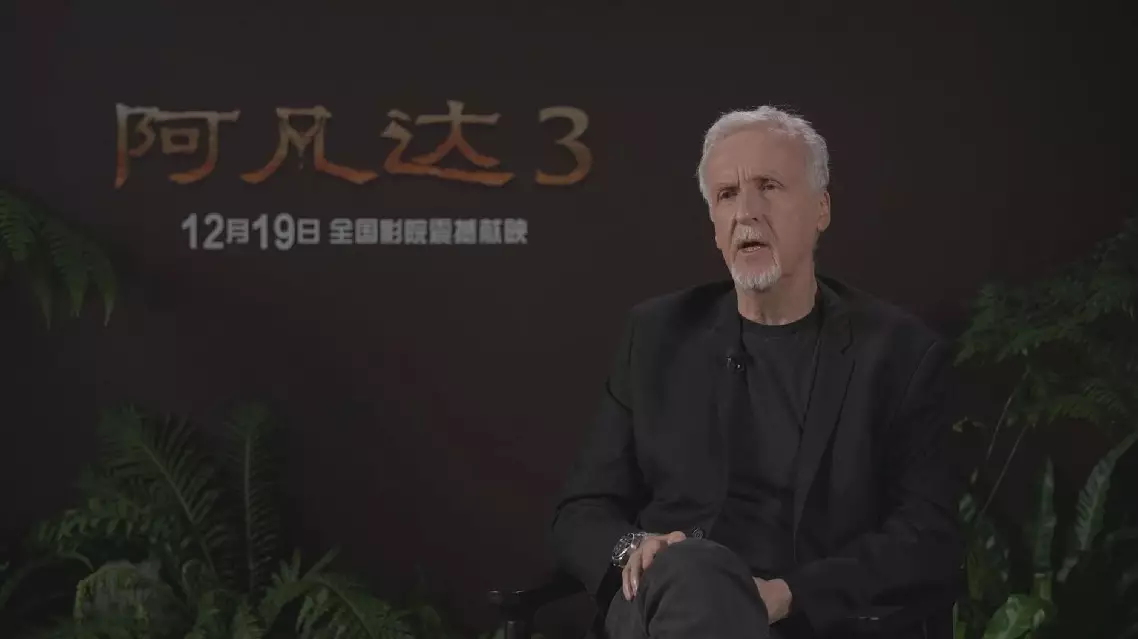
The latest film in the hit sci-fi series Avatar continues the storytelling of acceptance, identity and love, said director James Cameron.
"Avatar: Fire and Ash", the third installment in one of the most lucrative film franchises globally, opened Friday in the Chinese mainland alongside its North American release.
In an interview with China Media Group (CMG) earlier this month, Cameron said the film explores how those born different integrate into society and embrace their identity -- a topic of profound relevance in the real world.
"Jake and Neytiri, as much as it's a very romantic story with them, they're also an interracial couple. And so they have mixed-race children who maybe don't fit into their community, maybe they're judged more harshly. These are issues all over the world. I think acceptance, once again, it goes back to being seen. Does Jake see his son, Lo'ak? Does he understand the pain that he's in, the doubt, the self-blame, all of those things? Well, Jake is blinded by his own self-blame. And Neytiri is just blaming everybody. She goes to a very dark place," he said.
"So the characters are at risk. We feel for them. We want this to get resolved for them, because we like them. We care about them. I think that's just an aspect of storytelling that this film is not afraid to go into," said Cameron.
The 198-minute "Avatar: Fire and Ash," grossed 101 million yuan (about 14 million U.S. dollars) on its opening day in Chinese mainland, indicating a steady market response amid increasingly diversified audience preferences. The film accounted for more than 46 percent of total screenings on the day.
Avatar 3 tells story of acceptance, identity: director
Saudi Arabia and Pakistan have reaffirmed that they will not seek normalization of ties with Israel, rejecting U.S. President Donald Trump's call for the two countries to join the Abraham Accords.
Saudi Arabia's position on the Palestinian issue remains unchanged, a Saudi source told Al Arabiya TV on Monday.
The source affirmed the need for "an irreversible pathway to a Palestinian state".
The remarks came after U.S. President Donald Trump urged Muslim-majority and regional countries to normalize relations with Israel and join the Abraham Accords before the U.S. reaches a peace agreement with Iran.
Saudi Arabia has repeatedly said it would not normalize relations with Israel without the establishment of a Palestinian state.
Pakistani Defense Minister Khawaja Asif said on Tuesday that Pakistan will not join any agreement to normalize ties with Israel, adding that the country will not accept any deal that "conflicts with its fundamental ideologies".
Trump on Monday urged Saudi Arabia, Qatar, Egypt, Jordan, Turkey and Pakistan -- countries involved in mediating U.S.-Iran talks -- to immediately join the Abraham Accords, warning that otherwise they should not participate in the mediation.
He added that if a U.S.-Iran deal is reached, Iran should also join the agreement.
The Abraham Accords, brokered by the United States in 2020 during Trump's first term, were established between the Israeli government and Arab countries including the United Arab Emirates, Bahrain, Sudan and Morocco, aimed at rapidly advancing the normalization of relations between Israel and Arab countries.
Before the outbreak of the latest round of Israeli-Palestinian conflict in October 2023, the United States had been pushing for normalization between Saudi Arabia and Israel.
After the conflict erupted, Saudi Arabia suspended normalization talks with Israel.

Saudi Arabia, Pakistan reject Trump's Abraham Accords demand