A recent clinical trial in Shanghai has enabled a paralyzed patient to control a wheelchair and even a robotic dog using only his thoughts, in what Chinese researchers call a breakthrough for brain-computer interface (BCI) technology.
The trial was operated on a middle-aged man, who became quadriplegic after a spinal cord injury in 2022. He regained only limited head and neck movement despite more than a year of rehabilitation.
In June 2025, Chinese researchers implanted him with a minimally invasive BCI system. After two to three weeks of training, he was able to control a computer cursor and tablet using his thoughts, matching the results of the team's first clinical trial.
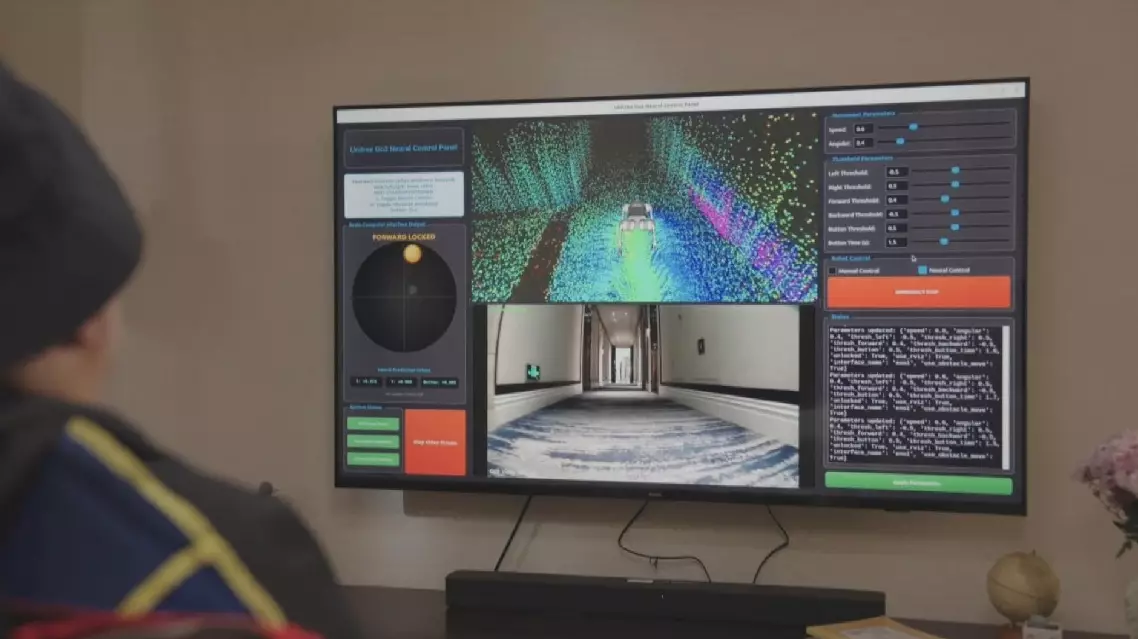
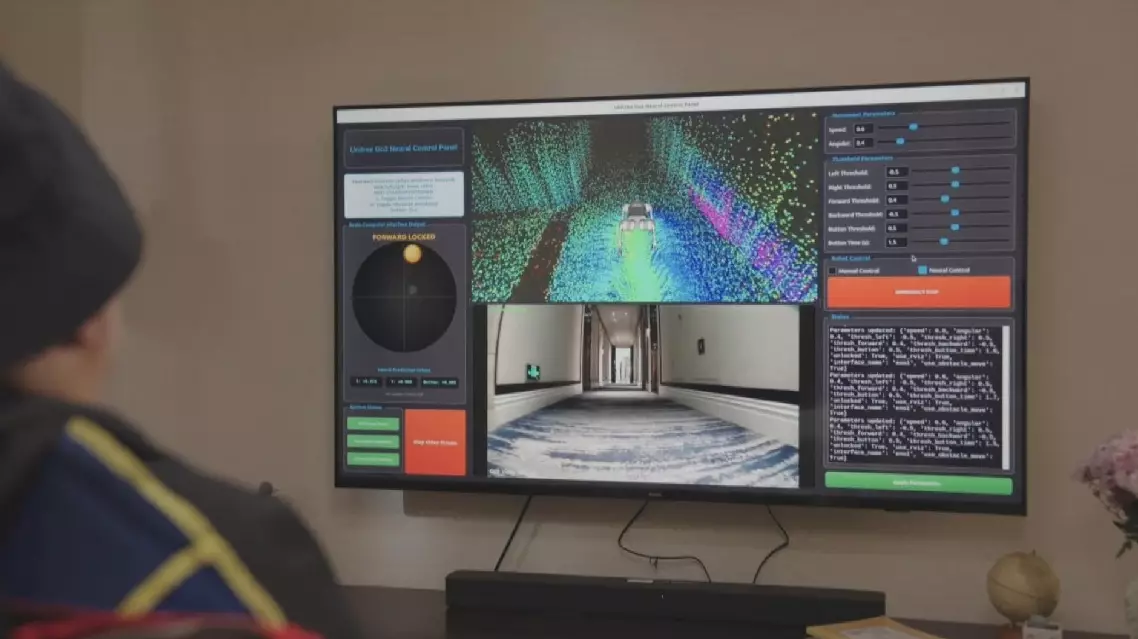
This time, researchers expanded the system from two-dimensional screen control to three-dimensional interaction with the physical world, enabling ultra-low-latency control of a power wheelchair and even a robotic dog.
"The patient can use the robotic dog as an extension of his own body, as an intelligent agent, to go downstairs and pick up deliveries. He can also control a wheelchair with his thoughts and go outside for a walk. This has greatly enriched his daily life," said Zhao Zhengtuo, a researcher from the Center for Excellence in Brain Science and Intelligence Technology (CEBSIT) under the Chinese Academy of Sciences (CAS).
It might sound jarring, but Zhao said the surgery -- the second CAS-led invasive brain-computer interface clinical trial -- is minimally invasive.
"This is our brain-computer interface system. It consists of two parts. The front-end sensor is like an extremely thin wire, about one-hundredth the thickness of a human hair. A five-to-eight-millimeter section is implanted into the brain. The processor is embedded into the skull after thinning the bone by about three to five millimeters. Overall, it is a minimally invasive procedure," said Zhao.
After the implant procedure, the patient is guided to use his thoughts.
"Although the patient cannot move his limbs, he can imagine movements, such as rotating his wrist. We map those intentions to external devices. It's like integrating the device into his body and experiencing it as part of himself," said Zhao.
Speed is a critical aspect of the technology. By customizing communication protocols, the team reduced the end-to-end delay from neural signal acquisition to command execution by external devices to under 100 milliseconds, faster than the body's natural neural delay. This creates a seamless control experience.
For now, invasive brain-computer interfaces are focused on medical use, with dozens of clinical cases already completed. China hopes to promote large-scale BCI applications for people with special needs in the foreseeable future.
"In the future, there will be more applications, including decoding language and other intentions from the brain. We might find better ways to express internal brain information through external devices," said Pu Muming, a scientific director of CEBSIT, and also a CAS academician.
Brain-computer interface trial lets paralyzed man control wheelchair and robotic dog by thoughts
Brain-computer interface trial lets paralyzed man control wheelchair and robotic dog by thoughts
The two-day European Union (EU) summit concluded in Brussels on Friday without a breakthrough on the bloc's long-term budget, as rising security commitments and soaring energy costs exposed a growing gap between Europe's ambitions and its ability to deliver.
Behind the summit's limited progress lay three pressing challenges: a budget difficult to agree upon, a growing security bill complicated by tensions with Washington, and an energy crisis testing Europe's economic resilience.
The European Commission has proposed a nearly 2-trillion-euro (2.24 trillion U.S. dollars) budget for 2028-2034, seeking to increase investment in competitiveness, defense and technology.
The Irish presidency's latest compromise would reduce the Commission's proposal by around 141 billion euros (158 billion dollars), yet the revised plan has drawn resistance from opposing camps.
European Commission President Ursula von der Leyen warned that the compromise would cut budgetary flexibility by half, leaving 99.5 percent of funds predetermined.
"This proposal puts us in a straitjacket," she said.
According to Brussels-based think tank Bruegel, six fiscally conservative countries led by Germany favor a smaller budget, while 17 "Friends of Cohesion," including Italy and Spain, seek to protect agricultural subsidies and regional development funds.
Brussels-based think tank Bruegel argued that both camps supported greater investment in common European priorities but placed national interests first.
It said that the Irish plan as the "worst possible compromise," warning that it could leave emerging priorities, including competitiveness and defense, severely underfunded while protecting traditional spending.
Fabian Zuleeg, chief executive and chief economist of the European Policy Centre, has likewise argued that Europe's expanding investment needs cannot realistically be financed through national budgets alone, calling for innovative financing arrangements, including new common borrowing.
The disagreements leave European Council President Antonio Costa facing a difficult task as he seeks a budget agreement by year-end.
Europe's fiscal pressures are compounded by a growing security bill and differences with Washington over Ukraine.
Ukrainian President Volodymyr Zelensky said at the summit that the war would cost Ukraine 155 billion euros (173 billion dollars) in 2027 and requested at least another 70 billion euros (78 billion dollars) in assistance.
The EU has already agreed on a 90-billion-euro (100 billion dollars) loan covering 2026-2027. However, Ukraine's additional financing needs remained under assessment, with European leaders seeking further input from the Commission and international financial institutions.
In its final conclusions, the European Council explicitly expressed regret over the U.S. decision to temporarily lift sanctions on Russian diesel, a move also criticized by Zelensky.
Meanwhile, recent restrictions on the U.S.-controlled Starshield satellite communications service disrupted Ukrainian military operations, exposing another vulnerability in Europe's security capabilities.
"Starlink is really necessary for Ukraine, and unfortunately in the short term Europe can't replace this capability," EU foreign policy chief Kaja Kallas acknowledged on Friday.
Analysts noted that this episode highlights Europe's reliance on critical U.S. military technologies even as transatlantic differences over Ukraine become more pronounced.
For Europe, the dilemma is increasingly apparent: greater security responsibilities require additional resources, while some of the capabilities underpinning those commitments remain beyond its immediate control.
Energy has become another source of financial strain. According to von der Leyen, the Middle East conflict has added 106 billion euros (119 billion dollars) to the EU's fossil fuel import bill, highlighting Europe's vulnerability to external energy shocks.
The International Energy Agency is accelerating the release of emergency oil stocks, including diesel, with plans to bring another 100 million barrels to the market over four months, while Brussels is pursuing temporary support for energy-intensive industries and measures to improve refining capacity.
Yet the summit exposed divisions over how far climate policies should be adjusted to ease immediate costs.
Italy, Greece and the four Visegrad countries pushed to postpone the EU's second emissions trading system, ETS2, until 2030, arguing that carbon pricing would impose further burdens on households and businesses.
However, Nordic countries resisted, concerned that weakening the system would undermine investment certainty and longer-term climate objectives.
The summit ended without an agreement on further postponement. Leaders instead requested an updated assessment of ETS2's design, impact and safeguards.
Researchers at the European Council on Foreign Relations argued that Europe's green transition was facing growing political resistance shaped by economic insecurity, competing national interests and the distribution of costs.
The dispute reflects a difficult choice: easing today's energy pressures could weaken incentives for long-term investment, while maintaining ambitious climate policies risks adding to the burden on businesses and households.
For European leaders, agreeing on common goals remains easier than deciding who should bear the costs of achieving them.
EU summit ends with mounting bills, unresolved divisions