China is mobilizing all social sectors to vigorously address declining birth rates and foster a childcare-friendly environment.
Wang Changming, a staff member at JD.com, a leading e-commerce giant based in Beijing, takes his two-year-old son to work with him every day.
The half-hour drive from home to the office provides a rare, sweet moment for the father and son. However, for many working parents in China, mornings resemble a frantic race as they drop their children off at daycare centers and rush back to their jobs.
As families migrate to larger cities, the traditional support system provided by grandparents is slowly fading. This is where companies like Wang's come into play.
His firm operates an in-house childcare center, a small but impactful change that eases Wang's daily load.
"We really needed this. Balancing work and kids is hard," Wang said.
The image of parents managing both work and childcare under one roof is still relatively rare in China, but it is gradually gaining traction.
In 2023, the country recorded approximately 9 million newborns, with a birth rate of roughly 6 per 1,000 people, than half the rate seen in 2016.
Behind these numbers lies a struggle faced by young people: the tension between self-fulfillment and starting a family. To address this, China is weaving a new social fabric that encourages raising children as a shared effort rather than a private struggle.
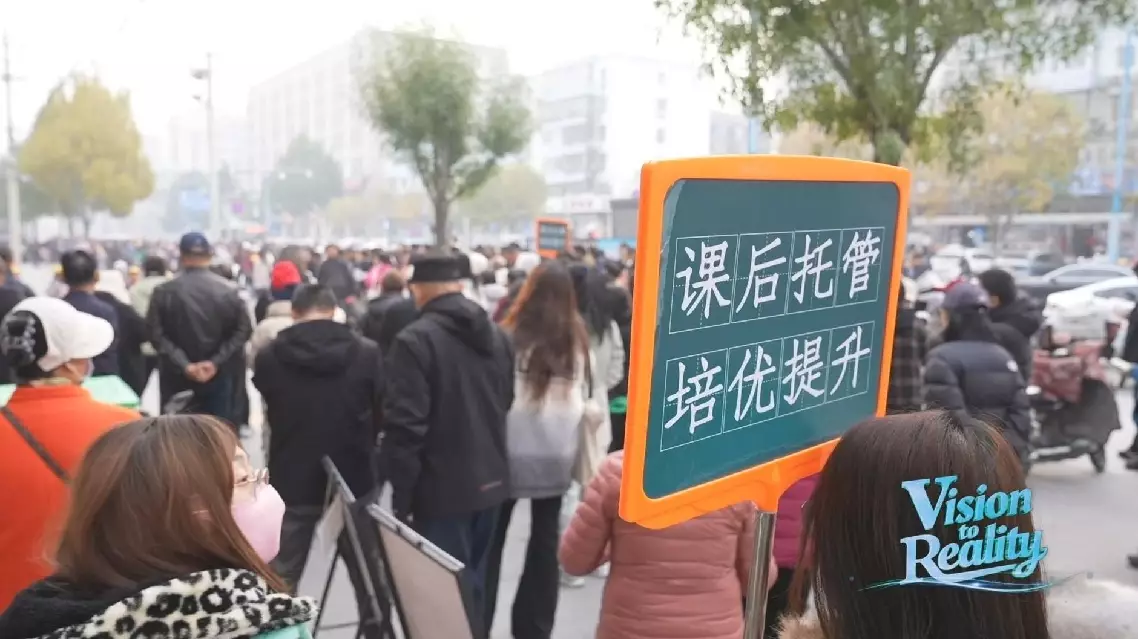
Corporate childcare is just one part of the solution, and community support also plays a crucial role. Educational pressures continue to be a significant hurdle for families considering having children, and nothing highlights this tension more sharply than homework time, as illustrated by numerous short video clips reflecting the nervous dynamics of parent-child relationships.
"[Ninety percent of] school teachers already shoulder most of the academic work. What we community do here is fill the gap that families can't always cover. A child's growth depends on more than parents and schools. It's a shared effort across the whole community," said Song Zhihe, an after-school tutor.
Song runs an after-school tutoring center where, each weekday, his staff pick children up, serve dinner, and supervise homework until their parents finish work.
He said that many parents, after long workdays, simply lack the energy or experience to guide their children effectively.
In addition to corporate and community initiatives, the Chinese government is also pushing for a more child-friendly society.
Starting in 2025, every family with a child under three will receive an annual childcare subsidy of 3,600-yuan, regardless of region or income.
From 2021 to 2024, China has invested approximately 5 billion yuan to expand public childcare nationwide. Furthermore, housing and healthcare policies are being revised to become more family-friendly.
"We can feel that the policy direction is very positive. For example, the child's daily expenses amount to about 500 yuan per month. The 3,600 yuan subsidies basically cover most of it," Wang said.
These measures signal a sharp shift from merely managing population size to enhancing family growth and well-being. Step by step, China is striving to find a new balance between work, caregiving, and the aspirations for the next generation.
China steps up effort to foster childcare-friendly environment