Local authorities across China have leveraged their unique resource endowments to unlock over 1,000 new application scenarios so far this year in emerging sectors such as the marine economy and low-altitude airspace, fueling the development of new quality productive forces and creating fresh avenues for economic growth.
Driven primarily by innovation, new quality productive forces are characterized by high technology, high efficiency and high quality, and represent an advanced form of productive forces.
Not long ago, Zhanjiang City in south China's Guangdong Province unveiled 48 comprehensive application scenarios in the sector of the marine economy. With total investments exceeding 10 billion yuan (about 1.42 billion U.S. dollars), these projects span nine key areas, including deep-sea aquaculture, marine low-carbon technologies, and marine equipment manufacturing.
The application scenarios concerned are capable of offering large-scale testing grounds for cutting-edge technologies such as deep-sea equipment technologies and artificial intelligence.
"Previously, we would develop technologies first and then seek markets. Now, every technical challenge originates directly from real-world scenario demands. Once solved, the solutions can be rapidly deployed in industry, dramatically shortening the time required to turn sci-tech achievements into applicable technologies," said Hong Pengzhi, deputy director of the Zhanjiang Bay Laboratory.
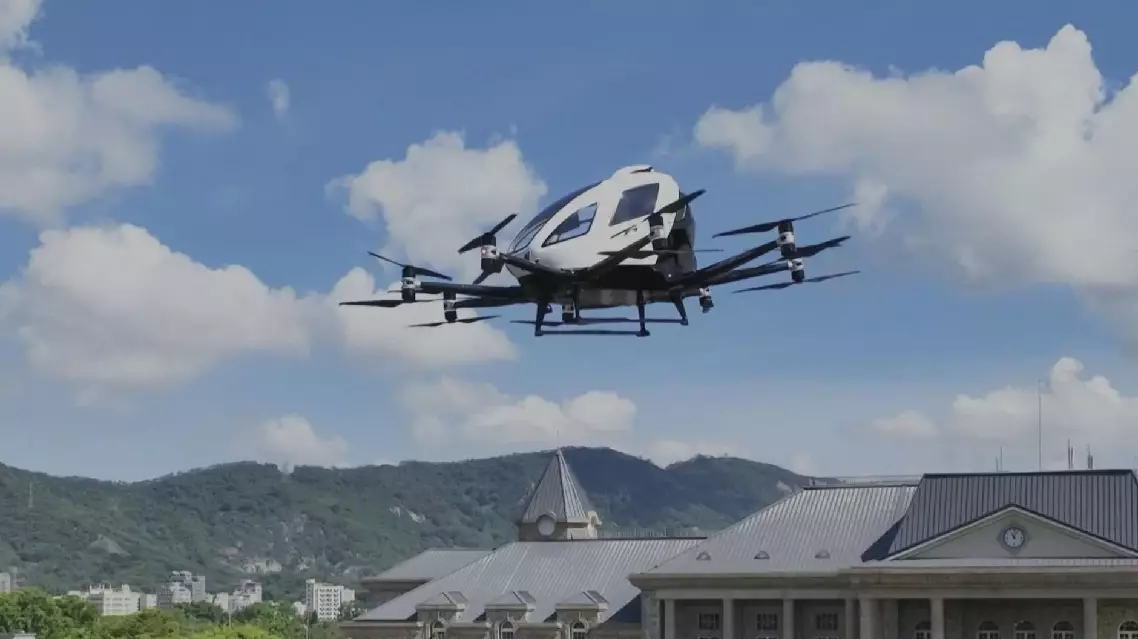
Apart from the deep sea, new scenarios in the low-altitude domain are fueling development of the low-altitude economy on "aerial race tracks" in an accelerated way. In Jingdezhen City of east China's Jiangxi Province, four new low-altitude tourism routes have been launched, allowing visitors to have a bird's eye view of the city's famous ceramic heritage.
Continued deepening of the process of opening up application scenarios is playing a role in driving rapid expansion of the scale of related industries. According to official data, China's marine economy generated 7.9 trillion yuan (about 1.12 trillion U.S. dollars) in gross output during the first three quarters of 2025, up 5.6 percent year on year.
From January to June, unmanned aerial vehicles (UAVs) logged 24.47 million flight hours, a staggering 149-percent increase over the same period of last year.
To support efforts for opening up application scenarios, local governments are all carrying out institutional innovations. For example, Guangdong has established a marine economy scenario innovation center, while Chengdu City in southwest China's Sichuan Province has allocated dedicated funds to support scenario-based applications.
"Opening up application scenarios is a key lever for unclogging the channel for converting research achievements into applicable approaches between science and technology on the one hand and industry on the other. Intensive rollout of diverse application scenarios in marine, low-altitude and urban domains not only gives full play to China's supersized consumption market advantages, but also provides real-world application environments and iterative opportunities for new technologies," said Wu Ze, deputy director of the industrial investment research office at the China Center for Information Industry Development (CCID).
Chinese regions unlock diverse application scenarios to drive new quality productive forces