A Christmas Eve Powerball drawing could add new meaning to holiday cheer as millions of players hope to cash in on the $1.7 billion prize, which comes after months without a jackpot winner.
The United States' 4th-largest jackpot on record comes after 46 consecutive draws without someone claiming to have all six numbers. The last contest with a jackpot winner was on Sept. 6. The game’s long odds have people decking the halls and doling out $2 — and sometimes more — for tickets ahead of Wednesday night's live drawing.
It's a sign the game is operating as intended. Lottery officials made the odds tougher in 2015 as a mechanism for snowballing jackpots, all the while making it easier to win smaller prizes.
The Christmas holiday is not expected to impact the drawing process should there be a winning ticket, a Powerball spokesperson said.
Here is what to know about Wednesday’s drawing:
That ticket placed in a stocking or under the tree could be worth a billion bucks — but with some caveats.
Powerball is played in 45 states, along with Washington, D.C., Puerto Rico and the U.S. Virgin Islands. Most of those areas require players to be 18 or older, though some states have steeper requirements. In Nebraska, players have to be at least 19 years old, and in Louisiana and Arizona, people can't buy tickets until they are 21.
Winning tickets also must be cashed in the states where they were bought. And players can't buy tickets in Alabama, Alaska, Hawaii, Nevada or Utah.
Other than that, lottery officials argue there is a chance a lucky Powerball ticket could be a gift that keeps on giving.
Charlie McIntyre, the New Hampshire Lottery's executive director, said Tuesday: “Just think of the stories you can tell for generations to come about the year you woke up a billionaire on Christmas.”
Wednesday's $1.7 billion jackpot has a cash value of $781.3 million.
A winner can choose to be paid the whole amount through an annuity, with an immediate payment and then annual payments over 29 years that increase by 5% each time. Most winners, however, usually choose the cash value for a lump sum.
The odds are high for the top prize, but there are smaller prizes players can reap.
At the last drawing, players in Florida, Georgia, Illinois, New York, Ohio, Pennsylvania, Tennessee and Wisconsin each won $1 million. There are also prizes outside the jackpot, ranging from a few dollars to $2 million.
One woman told Powerball officials that she already made plans for her $1 million win: “We’re going to pay off our cars and credit cards and get a bigger house!”
And Thomas Anderson of Burlington, North Carolina, said he intended to use his $100,000 Powerball win from earlier this month to go back to school, according to Powerball.
Lottery officials set the odds at 1 in 292.2 million in hopes that jackpots will roll over with each of the three weekly drawings until the pool balloons so much that more people take notice and play.
The odds used to be notably better, at 1 in 175 million. But the game was made tougher in 2015 to create the out-of-this-world bounties. The tougher odds partly helped set the stage for back-to-back record-breaking sweepstakes this year.
The last time someone won the Powerball pot was on Sept. 6, when players in Missouri and Texas won $1.787 billion, which was the second-highest top prize in U.S. history.
The U.S. has seen more than a dozen lottery jackpot prizes exceed $1 billion since 2016. The biggest U.S. jackpot ever was $2.04 billion back in 2022.
It’s hard to explain what odds of 1 in 292.2 million mean. Even if halved, they remain difficult to digest.
In the past, one math professor described the odds of flipping a coin and getting heads 28 straight times.
Tim Chartier, a Davidson College math professor in North Carolina, on Monday compared the odds of a winning lottery ticket to selecting one marked dollar bill from a stack 19 miles (31 kilometers) high.
“It’s true that if you buy 100 tickets, you are 100 times more likely to win. But in this case, ‘100 times more likely’ barely moves the probability needle,” Chartier said. “Using the time analogy, buying 100 tickets is like getting 100 guesses to name that one chosen second over nine years. Possible — but wildly improbable.”
Olivia Diaz is a corps member for The Associated Press/Report for America Statehouse News Initiative. Report for America is a nonprofit national service program that places journalists in local newsrooms to report on undercovered issues.

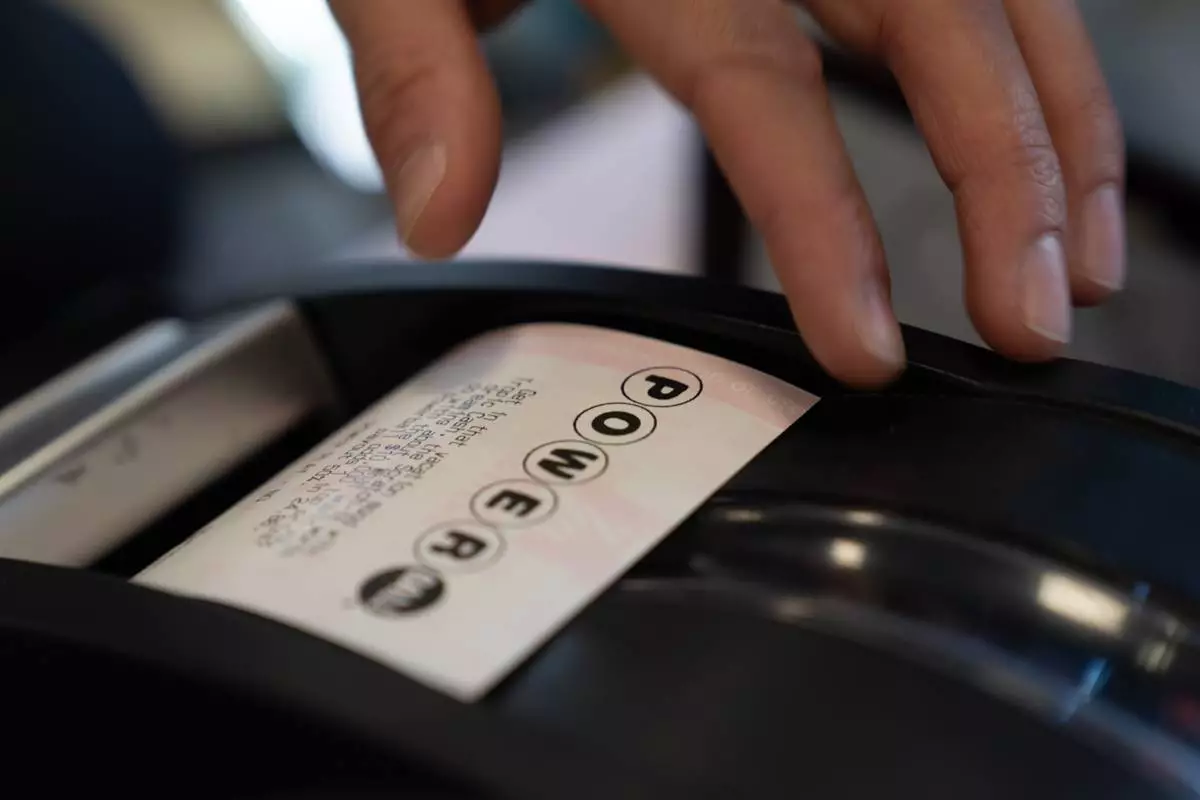
A powerball ticket is pictured Monday, Dec. 22, 2025, in Minneapolis. (AP Photo/Abbie Parr)
A convenience store employee grabs a Powerball lottery ticket for a customer on Monday, Dec. 22, 2025, in Portland, Ore. (AP Photo/Jenny Kane)

A person fills out a Powerball lottery ticket on Monday, Dec. 22, 2025, in Portland, Ore. (AP Photo/Jenny Kane)
A prominent California farmer was arrested Tuesday on suspicion of murder in the shooting death of his estranged wife in a remote mountain community in Arizona, the Navajo County Sheriff's Office said.
Michael Abatti, 63, was arrested in El Centro and booked into jail on a first-degree murder charge. He is awaiting extradition to Arizona.
Authorities say they believe he drove to Arizona on Nov. 20 and fatally shot Kerri Ann Abatti, 59, before returning home to California. She was found dead in her family’s tree-shrouded vacation home in Pinetop, Arizona, where she moved after splitting with her husband.
An attorney for Michael Abatti didn’t immediately respond to an email and text message seeking comment.
Authorities searched his home in far Southern California on Dec. 2 as part of the investigation into his wife's death.
El Centro is a city of 44,000 people just minutes from the Mexican border in the crop-rich Imperial Valley, which is the biggest user of Colorado River water and known for growing leafy greens, melons and forage crops.
Michael Abatti comes from a long line of farmers in the region bordering Arizona, and his grandfather, an Italian immigrant, was among the region’s early settlers. His father, Ben, helped start the Imperial Valley Vegetable Growers Association, and the Abatti name is known throughout the region and tied to farming enterprises, scholarship funds and leadership in local boards and groups.
Michael Abatti has grown onions, broccoli, cantaloupes and other crops in the Imperial Valley and served on the board of the powerful Imperial Irrigation District from 2006 to 2010.
Michael and Kerri Abatti were married in 1992 and had three children.
Kerri Abatti is a descendant of one of the first Latter-day Saints families to settle Pinetop in the 1880s. The community, located 190 miles (305 kilometers) northeast of Phoenix in the White Mountains, was briefly called Penrodville after Kerri’s forbearers before adopting the Pinetop name.
The couple split in 2023 and Kerri Abatti filed for divorce in proceedings that were pending in California at the time of her death.
The Abattis were sparring over finances with Kerri telling the court the couple had lived an upper-class lifestyle during more than three decades of marriage. They owned a large home in California, a vacation home in Pinetop and ranch land in Wyoming and vacationed in Switzerland, Italy and Hawaii while sending their children to private school, she said.
After the split, Kerri was granted $5,000 a month in temporary spousal support but last year asked for an increase to $30,000, saying she couldn’t maintain her standard of living as she quit her job as a bookkeeper and office manager for the family farm in 1999 to stay home with the couple’s three children. Kerri, who previously held a real estate license in Arizona, also asked for an additional $100,000 in attorney’s fees, court filings show.
“I am barely scraping by each month, am handling all of the manual labor on our large property in Arizona and continuing its upkeep,” she wrote in court filings earlier this year, adding she was living near her elderly parents. Kerri said she also needed to buy a newer car because her 2011 vehicle had more than 280,000 miles (450,600 kilometers) on it and sorely needed repairs.
Michael Abatti said in a legal filing that he couldn’t afford the increase after two bad farming years took a toll on his monthly income. He said European shifts in crop-buying to support war-plagued Ukrainian farmers and rising shipping costs were to blame along with an unusually cold and wet winter.
He said in mid-2024 it cost $1,000 to grow an acre of wheat that he could sell for $700, and that he was receiving about $22,000 a month to run the farm as the business struggled to pay its creditors in full.
“The income available at this time does not warrant any increase in the amount to which the parties stipulated, let alone an increase to $30,000 per month,” Lee Hejmanowski, Michael Abatti’s family law attorney, wrote in court papers.
Days later, Michael Abatti agreed to increase temporary spousal support payments to $6,400 a month, court filings show.
He studied in the agricultural business management program at Colorado State University in Fort Collins before returning to California, according to a 2023 book about water issues written by his college friend, Craig Morgan, titled “The Morality of Deceit.”
In 2009, Michael Abatti almost died from an infection caused by a flesh-eating bacteria and was hospitalized and placed in a medically induced coma for treatment, Morgan wrote in the book.

The home of Michael Abatti is seen Friday, Dec. 12, 2025, in El Centro, Calif. (AP Photo/Gregory Bull)

The home of Michael Abatti is seen Friday, Dec. 12, 2025, in El Centro, Calif. (AP Photo/Gregory Bull)

Water droplets from sprinklers cover an irrigated field Friday, Dec. 12, 2025, in El Centro, Calif. (AP Photo/Gregory Bull)

Water sits in a ditch Friday, Dec. 12, 2025, in El Centro, Calif. (AP Photo/Gregory Bull)

Water sits in a canal alongside irrigated fields Friday, Dec. 12, 2025, near El Centro, Calif. (AP Photo/Gregory Bull)