TD issues pilot licence for autonomous vehicles to approve trial on "Park & Fly" carpark at HZMB Hong Kong Port
The Transport Department (TD) announced today (December 25) that a pilot licence for autonomous vehicles (AVs) has been issued to approve an AV trial on specified road sections connecting the "Park & Fly" carpark at the Hong Kong-Zhuhai-Macao Bridge (HZMB) Hong Kong Port, in accordance with section 4(1) of the Road Traffic (Autonomous Vehicles) Regulation (Cap. 374AA).
The entire project connects the "Park & Fly" carpark at the HZMB Hong Kong Port to the SkyPier Terminal of the Hong Kong International Airport, with the approved road sections for the trial running from the "Park & Fly" carpark to the entrance of the Airport restricted area. During the initial stage of the trial, a backup operator will be stationed in each pilot AV at all times to take over control when necessary. The TD's label for pilot AV shall be displayed on all pilot AVs for identification by other road users. Details of the pilot licence have been uploaded to the TD's website on AV trials.
A spokesman for the TD said that the project aims to achieve carriage of passengers gradually after completing the trials. This will provide convenience for self-drive travellers under the Southbound Travel for Guangdong Vehicles (port carparks) to park at the automated "Park & Fly" carpark and transfer for a flight at the SkyPier Terminal via AVs, providing a better cross-boundary experience. Driving and road safety remain the top priority, and the Government will draw on practical experience to refine technical standards, share research findings with the industry in a timely manner, and implement these initiatives in a prudent and orderly process.
The TD welcomes interested organisations or enterprises to submit applications for a pilot licence. Upon receipt of an application, the TD will consider various factors, including the design operating range and functions of the autonomous system, relevant national or international standards/guidelines, and the road test situations, based on the Code of Practice for Trial and Pilot Use of Autonomous Vehicles before approval. Among them, the TD has been accepting submissions of the Guobiao (GB) to substantiate that the vehicles or their components comply with the relevant technical requirements and vehicle construction standards. In addition, the operation experience and performance of AV in areas outside Hong Kong (including the Mainland), such as test reports in accordance with the GB, will be taken into consideration by the TD in evaluating the performance of the vehicle automation.
The Transport Department, Photo by Bastille Post
Ombudsman probes effectiveness of Leisure and Cultural Services Department's management of indoor fitness rooms
The following is issued on behalf of the Office of The Ombudsman:
The Ombudsman, Mr Jack Chan, today (October 13) announced the launch of a direct investigation operation to examine the effectiveness of the Leisure and Cultural Services Department (LCSD)'s management of indoor fitness rooms.
The National 15th Five-Year Plan explicitly proposes to actively develop mass sports, extensively promote fitness activities for all and strengthen participation in fitness activities among young people, with a target of raising the proportion of the population regularly participating in physical exercise to approximately 40 per cent. The country will enhance the national fitness institutional system, and step up the planning and construction of venues and facilities in local communities. Hong Kong's First Five-Year Plan also proposes to drive wider participation in sports, and promote sports in the community with the goal of enhancing the overall health of the public.
Currently, the LCSD operates a total of 87 indoor fitness rooms, generally located within sports centres across various districts. However, except for holders of relevant qualifications recognised by the Physical Fitness Association of Hong Kong, China, members of the public who wish to register as a user of LCSD fitness rooms and hire fitness equipment must first attend a three-hour "Briefing on Proper Ways to Use Fitness Equipment" (Briefing Session) organised by the LCSD and then pass a written test, or complete its 12-hour "Fitness (Multi-gym) Training Course" (Training Course) with an attendance rate of at least 80 per cent. Between 2023 and 2025, the number of registered users of LCSD fitness rooms increased by 56 per cent from around 151 000 to 236 000, while the total number of user visits to fitness rooms per year increased by 50 per cent from around 4.852 million to 7.262 million.
A preliminary inquiry by the Office of The Ombudsman revealed a severe shortage of places for the Briefing Sessions and Training Courses organised by the LCSD. In 2025, the LCSD held around 1 000 Briefing Sessions throughout the year with a total of 25 000 places, but the total number of applications in the year was as many as 377 000. In the same year, the LCSD held around 2 500 Training Courses with a total of 58 500 places, but the total number of applications in the year reached 257 000. Unsuccessful applicants who cannot attend the Briefing Session or Training Course are not eligible to use the LCSD's fitness room facilities.
Mr Chan said, "Public recreation and sports facilities are of utmost importance to promoting participation in sports in the community. The high volume of applications for the LCSD's Briefing Sessions and Training Courses reflects keen public demand for use of fitness rooms. While the LCSD requires members of the public to either possess relevant qualifications or complete its fitness training before they can use its fitness rooms, no similar requirements are in place for other risky sports such as swimming. Furthermore, the supply of such training falls far short of demand. All these may be the biggest barrier for wider participation in the fitness sport and should be addressed and removed. The Office considers it necessary to review whether the qualification requirement for users still serves any practical need and whether a similar requirement is in place for public fitness rooms in the country and elsewhere."
Meanwhile, there are two types of hire charges for LCSD fitness rooms, i.e. an hourly ticket and a monthly ticket, the latter entitling the holder to unlimited use. In view of the higher demand by monthly ticket holders, most fitness rooms allocate a larger share of the quota to them. Starting from November 1, 2024, monthly ticket holders have been required to book fitness room facilities via SmartPLAY. In response to their calls for greater flexibility, the LCSD currently allows monthly ticket holders to cancel the booking via SmartPLAY up to one hour before the start of the booked session. The Office has received views that other members of the public can hardly proceed to the fitness room at such short notice, leading to wastage of the vacated place.
The Office also notes that the LCSD does not impose any penalties on monthly ticket holders for failing to take up a booked session. A monthly ticket holder who has made a booking but is absent need not take responsibility at all. Moreover, there is no cap on the number of sessions in fitness rooms that monthly ticket holders can book each day. Their actual use of the facilities is significantly less than the booked period. As a result, even though bookings are full, the actual number of users in the fitness rooms falls short of the number of hirers.
Mr Chan said, "LCSD fitness rooms are publicly funded and affordable. The facilities are scarce public resources and should be reasonably used. An appropriate balance should be struck between convenient booking and efficient use of limited public resources.
"With the promotion of fitness for all elevated to a national strategic level, the LCSD should proactively align with national development strategies by enhancing the mechanism for use of fitness rooms to foster broader participation in sports. In this light, I have decided to launch a direct investigation operation to examine the LCSD’s management of fitness rooms, including the mandatory training requirement prior to use of fitness rooms, the booking mechanism, the utilisation rate of fitness rooms, the LCSD’s monitoring measures and maintenance and repair of fitness equipment. Where necessary, pertinent recommendations will be made for improvement."
The Ombudsman welcomes views from members of the public on this topic. Written submissions should reach the Office of The Ombudsman by November 13:
Address: 30/F, China Merchants Tower, Shun Tak Centre
168–200 Connaught Road Central, Hong Kong
Fax: 2882 8149
Email: di496@ombudsman.hk
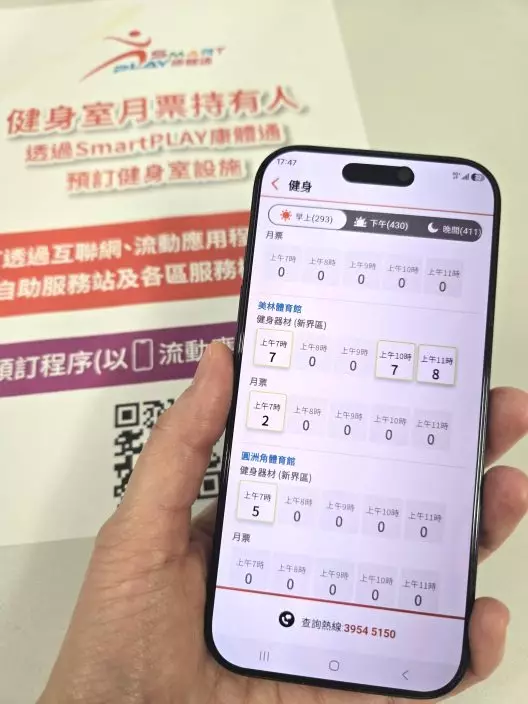
The Ombudsman, Mr Jack Chan, today (October 13) announced the launch of a direct investigation operation to examine the effectiveness of the Leisure and Cultural Services Department (LCSD)'s management of indoor fitness rooms. Photo shows available quotas for the LCSD's indoor fitness rooms. Zero represents that the relevant slot was fully booked. Source: HKSAR Government Press Releases
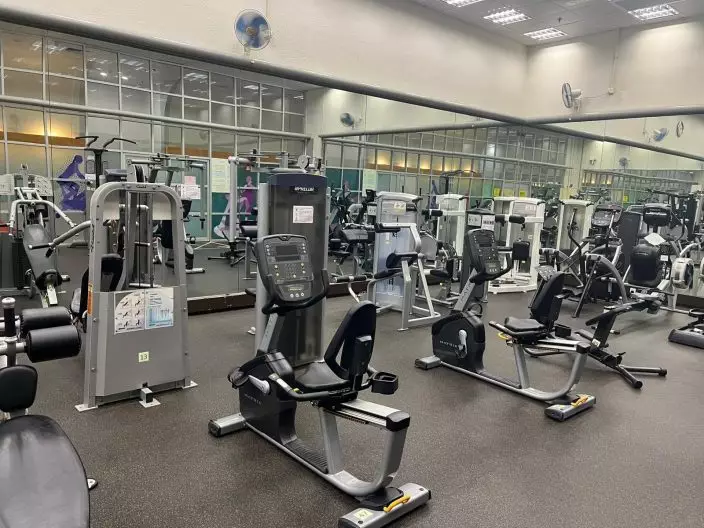
The Ombudsman, Mr Jack Chan, today (October 13) announced the launch of a direct investigation operation to examine the effectiveness of the Leisure and Cultural Services Department (LCSD)'s management of indoor fitness rooms. Photo shows an indoor fitness room of the LCSD. Source: HKSAR Government Press Releases