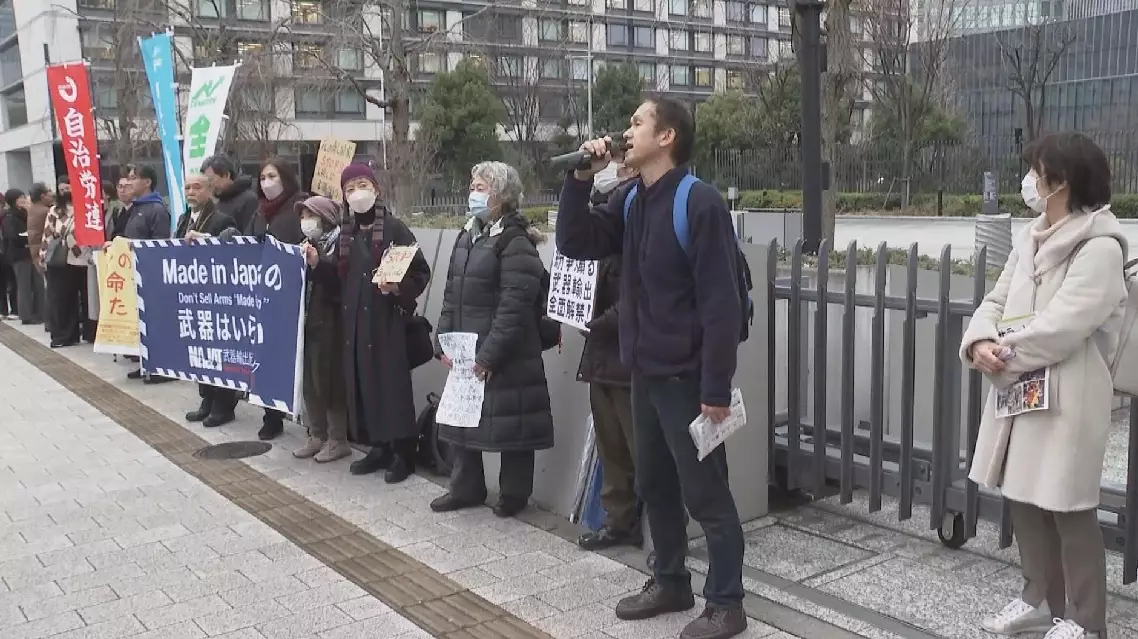
Representatives of 12 Japanese civil groups held a rally in Tokyo on Thursday, urging the government to ban all arms exports.
The demonstrators gathered in front of the Liberal Democratic Party headquarters and the National Diet building, where they submitted a formal petition. The ruling Liberal Democratic Party and its coalition partner, the Japan Innovation Party, agreed at a meeting on Monday to revise the implementation guidelines of the Three Principles on Transfer of Defense Equipment and Technology and lift restrictions that limit defense equipment transfers to five noncombat purposes. And they planned to submit the proposal to the cabinet in February next year.
The ruling coalition's plan to significantly relax restrictions on weapons exports has been met with strong opposition from domestic civil groups, as they warn that the move would put Japan on a dangerous path.
The demonstrators urged the government to strictly uphold Article 9 of Japan's pacifist constitution, which renounces the nation's right to engage in war or to resort to military force to resolve international conflicts.
"The Constitution clearly renounces war as a sovereign right and stipulates that Japan shall not possess land, sea, and air forces. However, despite the Constitution's existence as the cardinal law, they constantly adopt laws that hollow out and weaken the Constitution's spirit. And Japanese companies keep manufacturing and exporting weapons to make profits, which worries me tremendously. I keenly feel that Japan is already at a dangerous edge," said Yoko Sugiura, editor-in-chief of magazine Consumers Union of Japan.
"During the Diet debates, it was the Liberal Democratic Party that formulated the Three Non-Nuclear Principles, a system specifically embodying the ideals of Article 9 of the Constitution. The Japan Innovation Party's claim that Article 9 has nothing to do with arms exports ban and embargo is erroneous both factually and conceptually. And the issue is a very serious," said Koji Sugihara, a representative of the Network Against Japan Arms Trade, a local citizens' group.
"In the spirit of Article 9 of the Constitution, arms exports must be stopped, and the policy of prohibiting weapons must be restored. Given this clear shift to militarization, we fear that if it this goes on, there is no way to guarantee the safety of our lives. So we will continue to appeal to society to collectively ponder on how to stop this trend," said Misaki Nishimura, a representative of the Japan Peace Committee.
Japanese civil groups urge gov't to ban arms exports
The recent 2026 Zhongguancun Forum (ZGC Forum) Annual Conference in Beijing has impressed international guests with its focus on deeper integration of technological and industrial innovation, highlighting how China's innovative advances are reshaping daily life.
The five-day forum, themed "Full Integration Between Technological and Industrial Innovation," wrapped up in Chinese capital on Sunday after bringing together more than 1,000 participants from over 100 countries and regions around the world.
More than 560 cutting-edge achievements were unveiled at the event, ranging from embodied intelligent robots and brain-computer interfaces to breakthroughs in quantum applications and 6G research and development.
The venue for the forum also showcased a number of these innovative creations to visitors, who were able to enjoy a fresh cup of coffee prepared by a humanoid barista, as well as be throughly entertained by robots performing dances or even playing piano.
Given the presence of these advanced humanoid robots, international participants shared the common view that innovation is no longer confined to laboratories but is now permeating every aspect of daily life.
"The deepest impression is actually to see how much AI is across everywhere," said Anders Karlsson, vice president of Elsevier, a global leader providing advanced information and decision support to accelerate progress in science and healthcare worldwide.
"The Zhongguancun Forum has become a very international window on innovation. We can find out annually how innovation is driving [and a key] component of growth of this wonderful country," said Vincenzo Lipardi, president and co-founder of SPICI, an Italian company assisting businesses and startups with strategic consulting services.
"As a scientist and as a worker of the United Nations system, I'm really pleased to see integration of science, technology and sustainability," said Shahbaz Khan, director of the UNESCO Regional Office for East Asia.
One of the forum's key themes was around opening up and striving for greater cooperation, which demonstrated to the wider world that China's innovation aims to break down barriers and share opportunities, so as to enable the global community to advance together.
"It's my first time attending the forum. And I'm very surprised that you have a very high level of innovation. China is open to ideas. Openness is the way to make innovations," said Prof. Hussein Sherief, a member of the International Committee for Scientific and Technical Data (CODATA).
Int'l guests hail integration of technology, innovation at Beijing forum