SEOUL, South Korea (AP) — An independent counsel on Friday demanded a 10-year prison term for South Korea’s ousted President Yoon Suk Yeol in the first of seven criminal cases related to his ill-fated attempt to impose martial law in 2024 and other allegations stemming from his time in office.
The first of Yoon's trials to wrap up covers charges, including defiance of authorities’ attempts to investigate and detain him. Yoon's lawyers called the 10-year term request “excessive” and accused independent counsel Cho Eun-suk's team of being politically driven and lacking legal grounds to demand such a harsh punishment.
The court is expected to render a verdict as early as next month.
Yoon faces other trials on accusations ranging from corruption and favor trading to rebellion, a grave charge that is punishable by life imprisonment or the death penalty. The rebellion trial is also nearing an end.
Yoon’s martial law enactment brought armed troops into Seoul streets and triggered South Korea's most serious political crisis in decades.
The martial law lasted only a few hours, as lawmakers managed to enter the National Assembly and voted to lift it. Yoon was impeached by the opposition-controlled parliament in December 2024, before he was formally dismissed as president following a Constitutional Court ruling in April.
On Friday, independent counsel Cho's team requested the Seoul Central District Court to sentence Yoon to 10 years in prison on charges of obstruction of official duties, abuse of power, falsification of official documents and destruction of evidence.
Yoon holed up at his residence and hindered authorities' attempts to execute a warrant for his detention for weeks after his impeachment. The standoff caused worries about physical clashes between Yoon's presidential security service and those attempting to detain him and further deepened a national divide.
Park Eok-su, a senior investigator on Cho’s team, called Yoon's actions “an unprecedented obstruction of official duties” during Friday's court session. Yoon's lawyers have said the detainment warrant was invalid and illegal.
Yoon also faces charges that he sidestepped a legally mandated full Cabinet meeting before declaring martial law, and that he fabricated documents, including the martial law proclamation and ordered data deleted from phones used by those involved in his martial law imposition.
Yoon has denied those charges and maintained that his decree was meant to draw public support for his struggle against the main liberal opposition Democratic Party, which impeached some of his top officials and obstructed his agenda.
Wrapping up a six-month probe last week, Cho’s team said Yoon plotted for over a year to impose martial law to eliminate his political rivals and monopolize power.
Yoon's other trials deal with charges like the ex-leader ordering drone flights over North Korea to deliberately stoke tensions and justify his plans to declare martial law and committing perjury in the trial of his prime minister. Yoon also faces charges that he tried to manipulate the investigation into a marine’s drowning in 2023 and received free opinion surveys from an election broker in return for a political favor.
Yoon has said he wasn't informed of such drone flights and denied wrongdoing in the influence-peddling scandal.
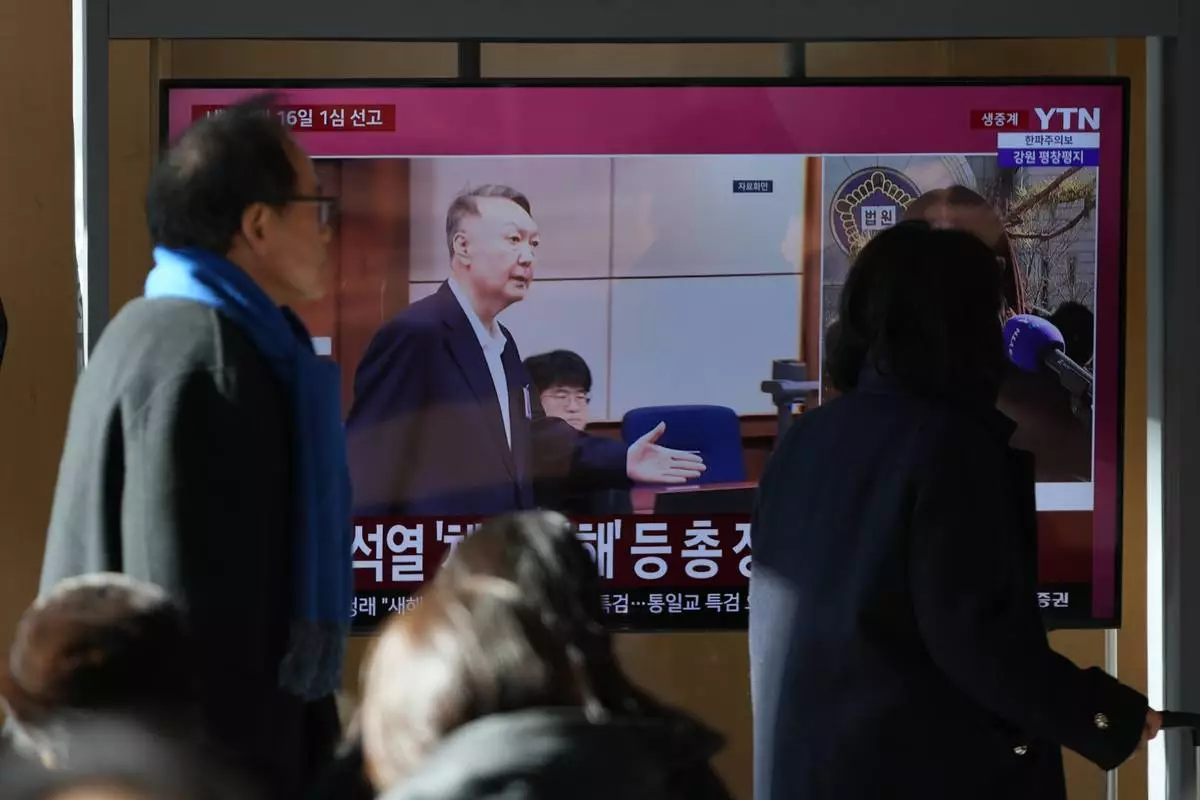
A TV screen shows a file footage of South Korea's ousted President Yoon Suk Yeol during a news program at the Seoul Railway Station in Seoul, South Korea, Friday, Dec. 26, 2025. (AP Photo/Lee Jin-man)
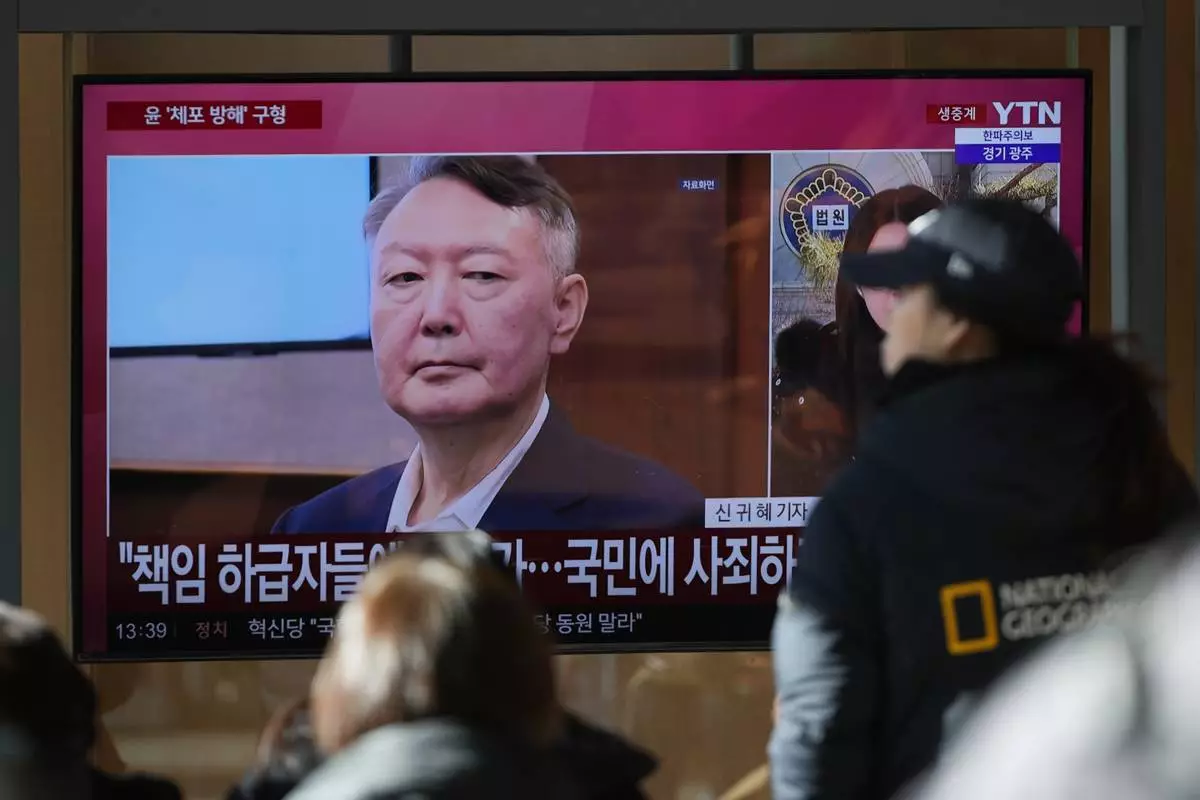
A TV screen shows a file footage of South Korea's ousted President Yoon Suk Yeol during a news program at the Seoul Railway Station in Seoul, South Korea, Friday, Dec. 26, 2025. (AP Photo/Lee Jin-man)
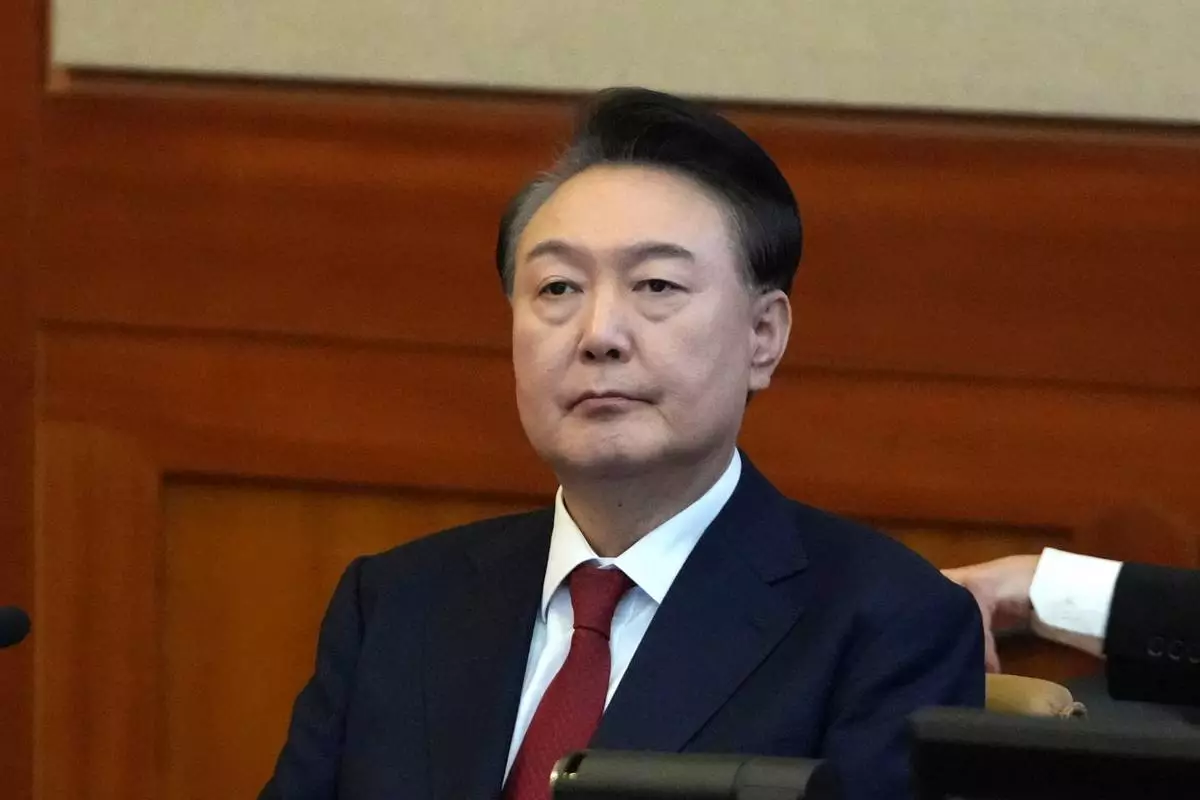
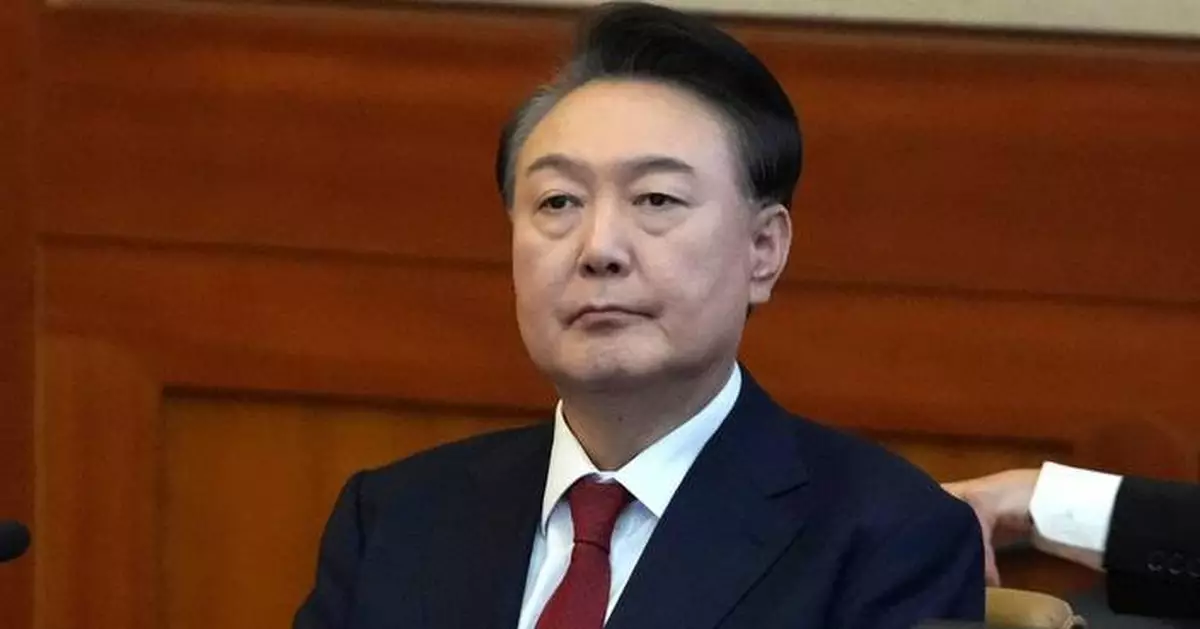
FILE - South Korea's impeached President Yoon Suk Yeol attends a hearing of his impeachment trial at the Constitutional Court in Seoul, South Korea, Feb. 11, 2025. (AP Photo/Lee Jin-man, Pool, File)
PUTRAJAYA, Malaysia (AP) — Imprisoned former Malaysian Prime Minister Najib Razak was convicted Friday following a corruption trial tied to multibillion-dollar looting of the 1MDB state investment fund.
The nation’s High Court found Najib, 72, guilty on four counts of abuse of power and 21 charges of money laundering related to more than $700 million channelled into his personal bank accounts from the 1MDB fund.
Najib's defense team was expected to make mitigation arguments before sentencing later Friday.
Najib denied any wrongdoing and maintained the funds were a political donation from Saudi Arabia and that he had been misled by rogue financiers led by Low Taek Jho. Low, thought to be the scandal’s mastermind, remains at large.
Justice Collin Lawrence Sequerah said Najib’s claim of a Saudi donation was “incapable of belief." Four letters purportedly from the Saudi donor were forged and evidence clearly showed the funds originated from 1MDB, he said.
He rejected defense arguments that Najib was an unwitting victim, duped by former 1MDB officials and Low. Witness testimonies had pointed to an “unmistakble bond” between Najib and Low, who had played a pivotal role in the scandal and operated as “the proxy, the conduit, the intermediary and the facilitator” for Najib in 1MDB, the judge said.
The judge noted that Najib failed to take steps to verify the origin of the massive funds nor took action against Low. Instead, Najib used the money despite its suspicious origins and also took steps to protect his position, including by removing the then-attorney general and anti-corruption chief investigating the case, he said.
“The accused was no country bumpkin,” said Sequerah, who took five hours to read the ruling. “Any attempt to paint the accused as an ignoramus who was hopelessly unaware of the misdeeds going around him must therefore, fail miserably.”
The ruling marked a major milestone in one of the world's largest financial scandals, which rippled across global markets and triggered investigations in the United States and other nations.
Dressed in a blue suit, Najib appeared calm and at times wrote in his notebook.
Najib, who served as prime minister from 2009 to 2018, currently is serving a prison sentence after being convicted in an earlier case linked to the 1MDB scandal, which led to his government’s defeat in 2018.
He was sentenced to 12 years in prison in 2020 for abuse of power, criminal breach of trust and money laundering involving 42 million ringgit ($10.3 million) channeled into his accounts from SRC International, a former unit of 1MDB.
He began his sentence in August 2022 after losing a final appeal, becoming Malaysia’s first former leader to be jailed. The Pardons Board, a body that advises rulers on granting clemency, halved his sentence and sharply reduced his fine in 2024.
Najib set up the 1MDB development fund shortly after taking office in 2009. He chaired 1MDB’s advisory board and held veto power as finance minister while serving as prime minister.
Between 2009 and 2014, top executives and associates of Najib looted over $4.5 billion from the fund, laundering it through countries including the U.S., Singapore and Switzerland, according to the U.S. Justice Department. Authorities alleged the funds were used to finance Hollywood films and extravagant purchases including hotels, a luxury yacht, art and jewelry. Jeff Sessions, the U.S. attorney general at the time, called it “kleptocracy at its worst.”
The scandal also hit Wall Street, with Goldman Sachs facing billions in fines for its role in raising money for 1MDB.
The scion of a prominent political family, Najib was long seen as untouchable until public anger over 1MDB led to the 2018 election defeat of his ruling party, which had governed Malaysia since the country gained independence from Britain in 1957.
Earlier this week, Najib failed in his bid to serve his graft sentence under house arrest. Malaysia’s High Court ruled Monday that a rare royal order for home arrest issued by the nation’s former king was invalid because it was not made in accordance with constitutional requirements. Najib’s lawyer has said they plan to appeal.
Originally due for release in August 2028 after his sentence reduction, Najib now faces a longer stretch behind bars.
Najib’s wife, Rosmah Mansor, also was sentenced to 10 years in prison and a massive fine in 2022 in a separate graft case. She has been released on bail pending an appeal.
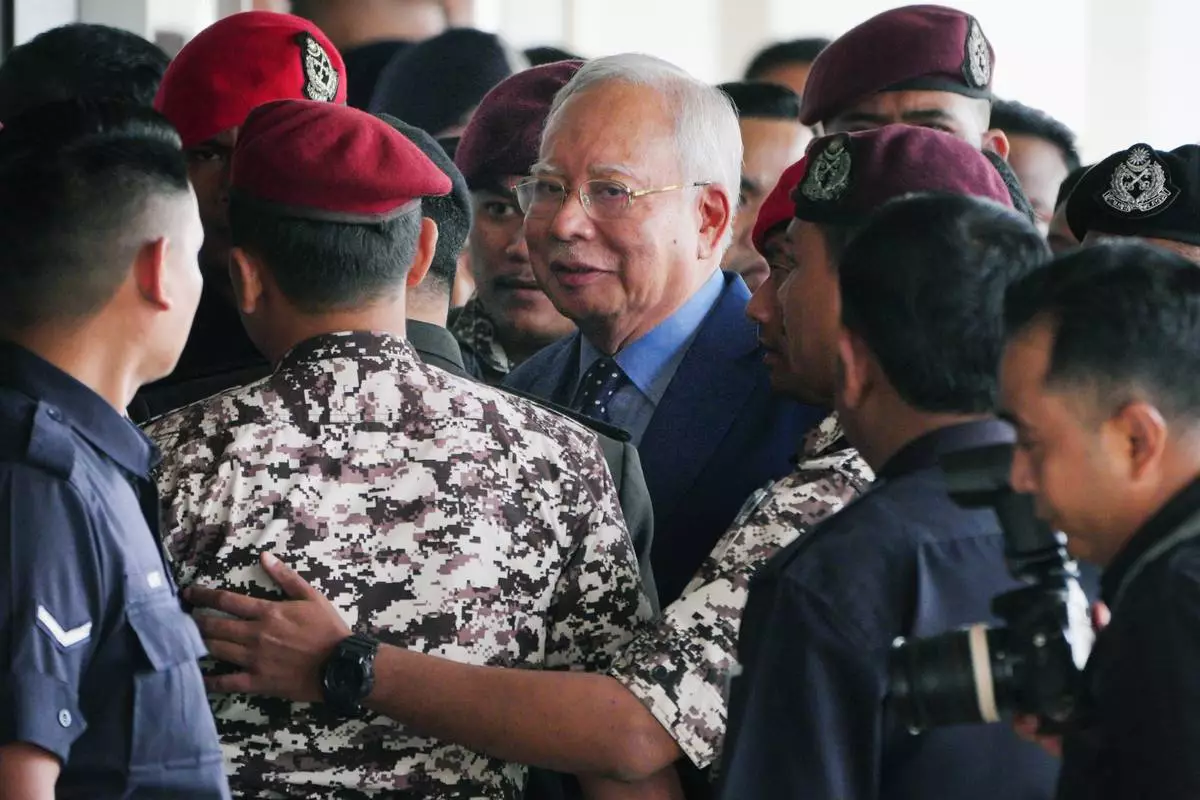
FILE - Malaysian former Prime Minister Najib Razak, center, is escorted by prison officers on his arrival at the Kuala Lumpur High Court complex in Kuala Lumpur, Malaysia, Oct. 30, 2024. (AP Photo/Vincent Thian, File)