The official operation of the Urumqi-Yuli Expressway, one of the core components of Xinjiang's highway network, will serve as a bond connecting northern and southern areas of the Xinjiang Uygur Autonomous Region in northwest China.
After over five years of construction, the Urumqi-Yuli Expressway that traverses the Tianshan Mountains in Xinjiang opened to traffic on Friday, cutting by half the driving time from the southern to the northern parts of the towering mountains.
Thanks to the opening of the expressway, the travel time from the regional capital of Urumqi, north of the Tianshan Mountains, to Korla, south of the Tianshan Mountains, has been shortened by half, from seven hours to about 3.5 hours.
"The expressway effectively connects the economic arteries between the northern and southern areas of Xinjiang, facilitating a smoother flow of regional resources and closer industrial linkages. It also forms a new pattern of coordinated regional development, ensuring the efficient movement of people, goods, and capital," said Shi Yanchun, deputy director of the transport management division under the Transport Department of Xinjiang.
The operation of the Urumqi-Yuli Expressway has effectively linked the Beijing-Urumqi Expressway, the Lianyungang-Khorgos Expressway, and the Xining-Hetian Expressway, creating a multidimensional transportation network that covers the New Eurasian Land Bridge Economic Corridor and the China-Central Asia-West Asia Economic Corridor. This development establishes a new transportation pattern that connects Xinjiang with other regions.
"This is of great significance for filling the gaps in the western road network, outlining a beautiful transportation system in China, promoting major initiatives such as the Xinjiang Free Trade Zone and tourism development plan, building a golden channel across the Eurasian continent and a gateway for opening up to the west. It is also significant for supporting the Belt and Road Initiative, promoting regional coordinated development, rural revitalization, and the development strategy of the western grand channel in the new era," said Li Yafei, deputy director of the transportation bureau of Xinjiang.
By the end of 2025, the total mileage of expressways in Xinjiang is expected to reach 237,000 kilometers, achieving complete coverage of expressways in the region.

Operation of Urumqi-Yuli expressway expands road network of China's Xinjiang
The international community on Thursday continued to lash out at Israeli National Security Minister Ben-Gvir for releasing a video which mocks the participants of the Global Sumud Flotilla.
On Thursday local time, the Israeli Foreign Ministry issued a statement saying that all foreign activists who had recently participated in the flotilla had been expelled from the country, and that Israel would not tolerate any violations of the maritime blockade of the Gaza Strip.
Hundreds of members from a Gaza-bound aid flotilla were brought to Israel's Ashdod Port on Wednesday, as Ben-Gvir released the video showing some of them shackled and forced to the ground.
In the video, released by Ben-Gvir on his social media channels, dozens of activists are shown kneeling on the floor, bent forward with their heads down and hands bound behind their backs with zip ties, as the Israeli national anthem is played loudly over speakers.
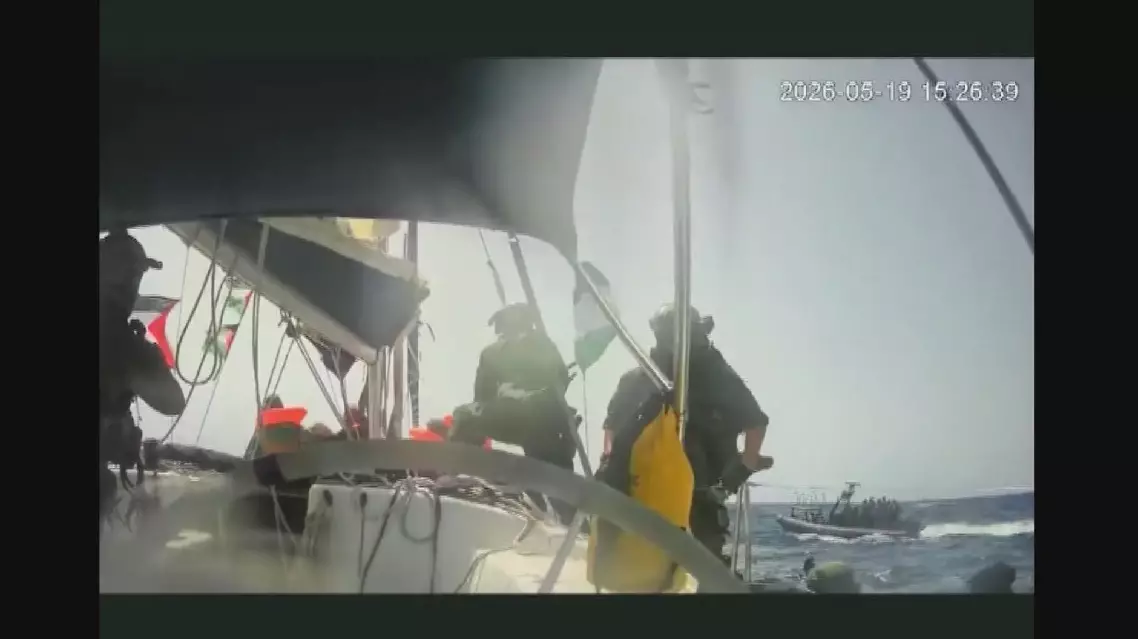
Organizers of the Global Sumud Flotilla said Israeli naval vessels intercepted all ships in the convoy in international waters, about 250 nautical miles off the coast of Gaza. According to the organizers, 428 activists were "kidnapped" by Israel after the interception began on Monday morning.
On Thursday, the British government issued a statement saying that the Britain had summoned the charge d'affaires of the Israeli Embassy that day to express strong denunciation of the video released by Ben-Gvir on Wednesday.
Britain accused the relevant actions of violating the most basic principles of respect for human dignity and demanded that the Israeli government provide an explanation regarding the detention.
Italian Deputy Prime Minister and Minister of Foreign Affairs and International Cooperation Antonio Tajani on Thursday said on social media that he had requested the European Union (EU) to impose sanctions on Ben-Gvir.
Tajani said that the Israeli side detained activists in international waters and subjected them to harassment and humiliation, describing such actions as "unacceptable" and "a violation of the most basic human rights."
On the same day, the Polish foreign affairs ministry issued a statement saying that Poland had summoned the charge d'affaires of the Israeli Embassy in Poland, demanding that Israel launch an investigation into the detention and issue an official apology to the detained activists.
Earlier that day, Polish Deputy Prime Minister and Foreign Minister Radoslaw Sikorski decided to seek a ban on Ben-Gvir's entry into Poland.
On Thursday, Polish Minister of Interior and Administration Marcin Kierwinski also said that he had ordered the initiation of formal procedures to designate Ben-Gvir as a persona non grata.
Additionally, on Thursday, Danilo Della Valle, a member of the European Parliament, said that he had written to European Council President Antonio Costa, calling on the EU to impose sanctions on Ben-Gvir. The letter was co-signed by nearly 30 members of the European Parliament.
Int'l community continues to slam Israel for maltreating Gaza aid flotilla members