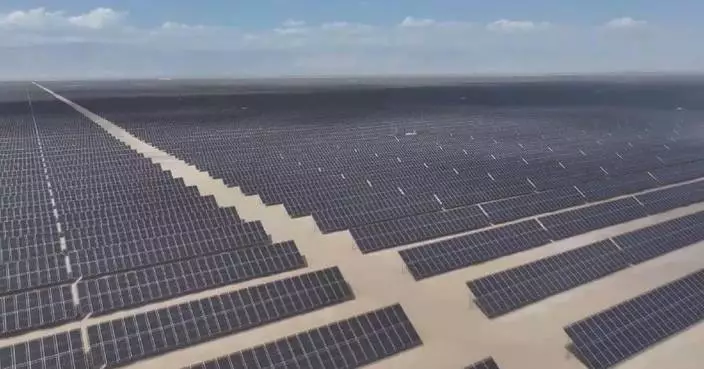
China will continue to adopt a more proactive fiscal policy next year, expanding fiscal expenditure to maintain the necessary intensity of spending, according to a work conference held in Beijing from Saturday to Sunday.
The composition of government bond tools will be optimized to better leverage the benefits, and the efficiency of transfer payment funds will be improved, and the expenditure structures will be refined to strengthen support in key areas, Finance Minister Lan Fo'an said at the national fiscal work conference.
In 2025, China has maintained its expenditure intensity, with the annual general public budget expenditure exceeding 29 trillion yuan (about 4.14 trillion U.S. dollars). Experts say that fully leveraging China's vast domestic market through reform and policy optimization is essential to unlocking its true potential and driving sustained economic growth.
"The scale of the year's new debt, made up of the deficit, special-purpose bonds, and ultra-long-term special treasury bonds, may further increase to support a more robust spending intensity. This will eventually translate into increased incomes of businesses and residents. Meanwhile, we can see that the central government will further increase its transfer payments to local governments, thereby stimulating their ability and enthusiasm to develop the economy and improve people's livelihoods," said Luo Zhiheng, chief economist of Yuekai Securities.
The conference reaffirmed that supporting the construction of a strong domestic market remains a core focus of 2026. Efforts will be made to stimulate consumption through targeted campaigns and expand effective investment. The authorities emphasized accelerating the building of a unified national market and regulating tax incentives and fiscal subsidy policies.
Experts note that this signals a continued push for comprehensive fiscal and tax reforms designed to unlock the market’s vast potential.
"We must fully tap into China's economic potential as a major country. We have a massive domestic market, but if that market is fragmented, the advantages of a unified national market cannot be brought into full play. Therefore, we must reform, standardize tax incentives and fiscal subsidy policies, and through reforms in all aspects fully unleash the advantages and potential of this market," said Yang Zhiyong, president of the Chinese Academy of Fiscal Sciences.
The government will also intensify support for new growth drivers and social welfare, according to the ministry. Fiscal funds will back deep integration of sci-tech and industrial innovation, while also strengthening social safety nets. Measures will include promoting employment, increasing income, improving education and public health, and enhancing social security systems.

China's fiscal policy to strengthen domestic market in 2026
Nicaraguan officials said the United States has never stopped its aggression and interference in Latin American countries' internal affairs, slamming its hegemonic acts in the region.
As the U.S. ramps up its military presence in the Caribbean, critics across Latin America are drawing renewed attention to a long and painful history of U.S. intervention in the region.
Nicaragua was among he earliest and most persistent targets of U.S. political, economic, and military hegemony. From repeated military interventions in the early 20th century to covert operations in the 1980s, the Central American nation has repeatedly found itself in U.S. crosshairs.
In 1984, the Nicaraguan government sued the U.S. government in the International Court of Justice, demanding compensation for damages caused by years of interference in internal affairs.
In 1986, the International Court of Justice issued the judgment that the United States had violated the United Nations Convention and ordered it to pay Nicaragua billions of dollars in compensation.
However, during multiple votes at the UN Security Council, the United States repeatedly exercised its veto power, resulting in the compensation not being paid.
"We took it to the International Court of Justice in the Hague, where the ICJ ruled that the U.S. was guilty and ordered it to compensate Nicaragua for the damages, setting the original compensation at 15 billion U.S. dollars, equivalent to more than 50 billion U.S. dollars in today's currency. This debt remains outstanding and legally enforceable. The people of Nicaragua have never relinquished their right to seek this compensation," said Nicaraguan Congressman Wilfredo Navarro in a recent interview with China Media Group.
Navarro, who has authored a detailed chronicle of U.S. aggression against his country, emphasized that U.S. interference has continued to this day.
He pointed to the 2018 anti-government unrest in Nicaragua, during which the U.S.-funded National Endowment for Democracy (NED) poured tens of millions of dollars into local non-governmental organizations and far-right media outlets in an effort to topple the government.
"We have long been at the top of U.S. sanctions lists, and the United States has even enacted specific laws targeting and pressuring Nicaragua. Following the U.S.-backed anti-government unrest, we endured a blockade that lasted nearly eight years. During this period, the Nicaraguan government faced a range of military and economic aggression from the United States, including port blockades, mining of harbors, and aerial bombardments," said Navarro.
Nicaraguan Foreign Minister Denis Moncada echoed these concerns, describing U.S. policy in the region as a modern extension of the 19th-century Monroe Doctrine, an imperialist framework that declared Latin America as Washington's exclusive sphere of influence.
He warned that recent U.S. actions, such as escalating pressure on Venezuela and meddling in Honduras' elections, revealed a familiar playbook rooted in deception.
"The U.S. development and economic achievements have come at the expense of countries in Latin America and the Caribbean, as well as numerous countries in Africa and Asia. Its very essence has rooted in conquest and control. Today, the United States is repeating its long-standing familiar tactics: using falsehoods, distorting facts, and fabricating allegations and hypothetical scenarios to mislead the international community and drum up support through disinformation, just as it is currently doing regarding Venezuelan President Nicolas Maduro in the Venezuela issue," said Moncada.
Moncada noted that the U.S. has intensified efforts to intervene in Latin American countries' internal affairs, reflecting its growing panic over its own decline.
"The United States is attempting to prevent the inevitable decline of U.S. imperial hegemony and that of certain European powers, including Britain. Having realized their own waning influence, they are now desperately seeking ways to halt this decline. As a result, their actions resemble those of a cornered beast: fueling death and conflict around the world, launching aggression on a global scale, striving to slow the erosion of their imperial power while containing the rise of a new international order," said Moncada.
More than 160 years ago, Nicaraguan national hero Andres Castro hurled a stone to kill an invading U.S. soldier during the 1856 Battle of San Jacinto. Today, that heroic act resonated more powerfully than ever.
As the renowned Nicaraguan poet Fernando Gordillo wrote in his poem, "Throw the stone, Andres. Throw it! A century apart, the enemy, it is the same."

Nicaraguan officials urge U.S. to pay ‘historical debt,’ slam hegemony in Latin America