CINCINNATI (AP) — Cincinnati Bengals wide receiver Ja’Marr Chase broke out of a touchdown drought that lasted over two months by scoring twice on Sunday against the Arizona Cardinals.
Chase hauled in his first touchdown since Oct. 16 late in the second quarter of the Bengals' 37-14 win. He added another TD in the third.
Click to Gallery
Cincinnati Bengals head coach Zac Taylor celebrates with wide receiver Ja'Marr Chase (1) after a touchdown during the first half of an NFL football game Sunday, Dec. 28, 2025, in Cincinnati. (AP Photo/Jeff Dean)
Cincinnati Bengals wide receiver Ja'Marr Chase (1) looks to get past Arizona Cardinals cornerback Will Johnson (0) during the first half of an NFL football game Sunday, Dec. 28, 2025, in Cincinnati. (AP Photo/Jeff Dean)
Cincinnati Bengals wide receiver Ja'Marr Chase, right, scores a touchdown during the first half of an NFL football game against the Arizona Cardinals, Sunday, Dec. 28, 2025, in Cincinnati. (AP Photo/Jeff Dean)
Cincinnati Bengals wide receiver Ja'Marr Chase celebrates with fans after scoring a touchdown during the first half of an NFL football game against the Arizona Cardinals, Sunday, Dec. 28, 2025, in Cincinnati. (AP Photo/Jeff Dean)
Cincinnati Bengals wide receiver Ja'Marr Chase runs towards fans after scoring a touchdown during the first half of an NFL football game against the Arizona Cardinals, Sunday, Dec. 28, 2025, in Cincinnati. (AP Photo/Jeff Dean)
He finished with seven receptions for 60 yards. Chase also became the first player to record at least 80 receptions, 1000 yards and seven touchdown receptions in his each of first five years in the NFL.
“I really wasn’t aware of (Chase’s touchdown drought) until Tee (Higgins) pointed it out in the last game, during the game,” Bengals coach Zac Taylor said. “We’re just going to go out there and call it the way we see it. The play he scored on is a play we’ve run 100 times. (Chase) did a great job making people miss and getting in the end zone, and then the other one before the half was a really good play design ... so that one worked out well.”
Chase's scoreless stretch included a game that he missed due to suspension after he spat on Pittsburgh Steelers cornerback Jalen Ramsey.
Chase said he was itching to get into the end zone. He said that as he walked into the stadium on Sunday, he told himself he was going to make sure that he scored.
When he reached the end zone for the first time, he celebrated with an emphatic spike of the ball.
“I didn’t even know what celebration I wanted to do,” Chase said. “That’s how I know I haven’t been in there in a minute.”
The first touchdown was all effort and athleticism. Chase caught a bubble screen near the left sideline and there were multiple defenders in his way. With a juke, a spin move and a sprint, Chase reached the end zone.
“I think everything is just instincts in that moment,” he said.
On his second touchdown, the Bengals’ play design got him matched up against a cornerback who has spent a lot of the year on the Cardinals’ practice squad. Chase quickly created separation against Darren Hall and scored on a slant from 8 yards out.
For the second straight week, the Bengals’ offense seemingly couldn’t be stopped.
“That’s what we expected from the beginning of the season,” Chase said. “It didn’t go our way, but we know what we’re capable of, especially with the opportunities we put ourselves in. We just have to execute.”
AP NFL: https://apnews.com/hub/nfl

Cincinnati Bengals head coach Zac Taylor celebrates with wide receiver Ja'Marr Chase (1) after a touchdown during the first half of an NFL football game Sunday, Dec. 28, 2025, in Cincinnati. (AP Photo/Jeff Dean)

Cincinnati Bengals wide receiver Ja'Marr Chase (1) looks to get past Arizona Cardinals cornerback Will Johnson (0) during the first half of an NFL football game Sunday, Dec. 28, 2025, in Cincinnati. (AP Photo/Jeff Dean)

Cincinnati Bengals wide receiver Ja'Marr Chase, right, scores a touchdown during the first half of an NFL football game against the Arizona Cardinals, Sunday, Dec. 28, 2025, in Cincinnati. (AP Photo/Jeff Dean)

Cincinnati Bengals wide receiver Ja'Marr Chase celebrates with fans after scoring a touchdown during the first half of an NFL football game against the Arizona Cardinals, Sunday, Dec. 28, 2025, in Cincinnati. (AP Photo/Jeff Dean)

Cincinnati Bengals wide receiver Ja'Marr Chase runs towards fans after scoring a touchdown during the first half of an NFL football game against the Arizona Cardinals, Sunday, Dec. 28, 2025, in Cincinnati. (AP Photo/Jeff Dean)
CAPE CANAVERAL, Fla. (AP) — The moon and sun share top billing in 2026.
Kicking off the year’s cosmic wonders is the moon, drawing the first astronauts to visit in more than 50 years as well as a caravan of robotic lunar landers including Jeff Bezos’ new supersized Blue Moon. A supermoon looms on Jan. 3 and an astronomical blue moon is on the books for May.
The sun will also generate buzz with a ring-of-fire eclipse at the bottom of the world in February and a total solar eclipse at the top of the world in August. Expect more auroras in unexpected places, though perhaps not as frequently as the past couple years.
And that comet that strayed into our turf from another star? While still visible with powerful backyard telescopes, the recently discovered comet known as 3I/Atlas is fading by the day after swinging past Earth in December. Jupiter is next on its dance card in March. Once the icy outsider departs our solar system a decade from now, it will be back where it belongs in interstellar space.
It’s our third known interstellar visitor. Scientists anticipate more.
“I can’t believe it’s taken this long to find three,” said NASA’s Paul Chodas, who’s been on the lookout since the 1980s. And with ever better technology, “the chance of catching another interstellar visitor will increase.”
Here’s a rundown on what the universe has in store for us in 2026:
NASA’s upcoming moonshot commander Reid Wiseman said there’s a good chance he and his crew will be the first to lay eyeballs on large swaths of the lunar far side that were missed by the Apollo astronauts a half-century ago. Their observations could be a boon for geologists, he noted, and other experts picking future landing sites.
Launching early in the year, the three Americans and one Canadian will zip past the moon, do a U-turn behind it, then hustle straight back to Earth to close out their 10-day mission. No stopping for a moonwalk — the boot prints will be left by the next crew in NASA’s Artemis lunar exploration program.
More robotic moon landings are on the books by China as well as U.S. companies. Early in the year, Amazon founder Bezos is looking for his Blue Origin rocket company to launch a prototype of the lunar lander it’s designing for NASA’s astronauts. This Blue Moon demo will stand 26 feet (8 meters), taller than what delivered Apollo’s 12 moonwalkers to the lunar surface. The Blue Moon version for crew will be almost double that height.
Back for another stab at the moon, Astrobotic Technology and Intuitive Machines are also targeting 2026 landings with scientific gear. The only private entity to nail a lunar landing, Firefly Aerospace, will aim for the moon’s far side in 2026.
China is targeting the south polar region in the new year, sending a rover as well as a so-called hopper to jump into permanently shadowed craters in search of ice.
The cosmos pulls out all the stops with a total solar eclipse on Aug. 12 that will begin in the Arctic and cross over Greenland, Iceland and Spain. Totality will last two minutes and 18 seconds as the moon moves directly between Earth and the sun to blot out the latter. By contrast, the total solar eclipse in 2027 will offer a whopping 6 1/2 minutes of totality and pass over more countries.
For 2026, the warm-up act will be a ring-of-fire eclipse in the Antarctic on Feb. 17, with only a few research stations in prime viewing position. South Africa and southernmost Chile and Argentina will have partial viewing. A total lunar eclipse will follow two weeks after February’s ring of fire, with a partial lunar eclipse closing out the action at the end of August.
Six of the solar system’s eight planets will prance across the sky in a must-see lineup around Feb. 28. A nearly full moon is even getting into the act, appearing alongside Jupiter. Uranus and Neptune will require binoculars or telescopes. But Mercury, Venus, Jupiter and Saturn should be visible with the naked eye shortly after sunset, weather permitting, though Mercury and Venus will be low on the horizon.
Mars will be the lone no-show. The good news is that the red planet will join a six-planet parade in August, with Venus the holdout.
Three supermoons will lighten up the night skies in 2026, the stunning result when a full moon inches closer to Earth than usual as it orbits in a not-quite-perfect circle. Appearing bigger and brighter, supermoons are a perennial crowd pleaser requiring no equipment, only your eyes.
The year's first supermoon in January coincides with a meteor shower, but the moonlight likely will obscure the dimmer fireballs. The second supermoon of 2026 won’t occur until Nov. 24, with the third — the year’s final and closest supermoon — occurring the night of Dec. 23 into Dec. 24. This Christmas Eve supermoon will pass within 221,668 miles (356,740 kilometers) of Earth.
The sun is expected to churn out more eruptions in 2026 that could lead to geomagnetic storms here on Earth, giving rise to stunning aurora. Solar action should start to ease, however, with the 11-year solar cycle finally on the downslide.
Space weather forecasters like Rob Steenburgh at the National Oceanic and Atmospheric Administration can’t wait to tap into all the solar wind measurements coming soon from an observatory launched in the fall.
“2026 will be an exciting year for space weather enthusiasts,” he said in an email, with this new spacecraft and others helping scientists “better understand our nearest star and forecast its impacts.”
The Associated Press Health and Science Department receives support from the Howard Hughes Medical Institute’s Department of Science Education and the Robert Wood Johnson Foundation. The AP is solely responsible for all content.

CORRECTS MONTH FILE - This photo provided by NASA shows the Moon's shadow covering portions of Canada and the U.S. during a total solar eclipse as seen from the International Space Station, on Monday, April 8, 2024. (NASA via AP, File)
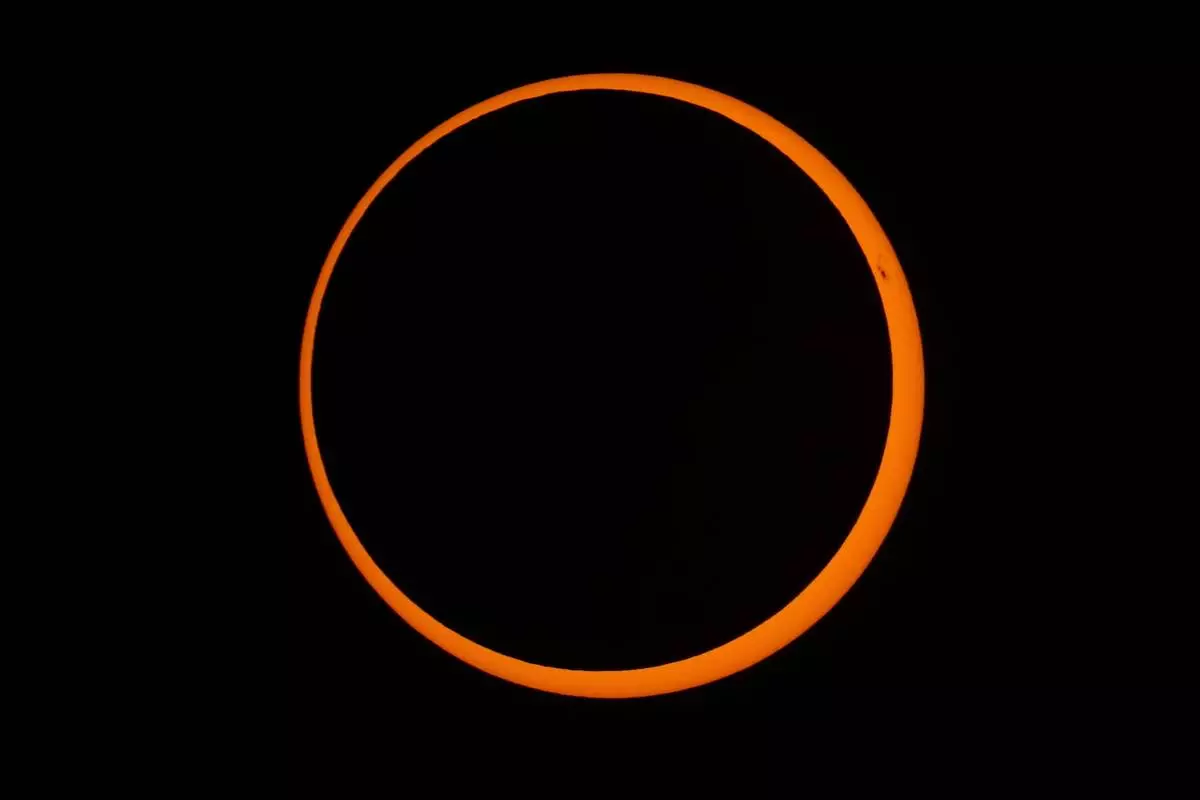
FILE - The moon moves across the sun during a "ring of fire" annular solar eclipse seen from Tahai, Rapa Nui (Easter Island), Chile, on Wednesday, Oct. 2, 2024. (AP Photo/Esteban Felix, File)
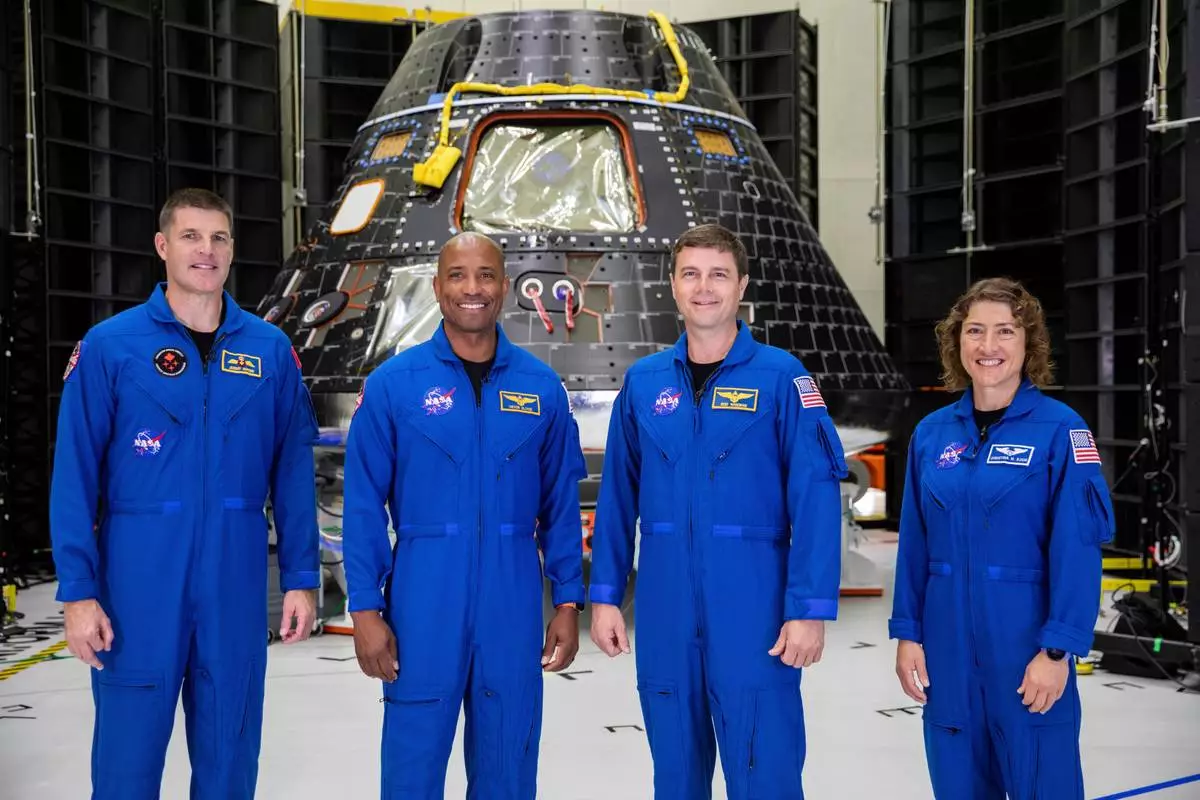
FILE - In this photo provided by NASA, Artemis II crew members, from left, Jeremy Hansen, Victor Glover, Reid Wiseman and Christina Koch, stand together at NASA's Kennedy Space Center in Florida, in front of an Orion crew module on Tuesday, Aug. 8, 2023. (Kim Shiflett/NASA via AP, File)
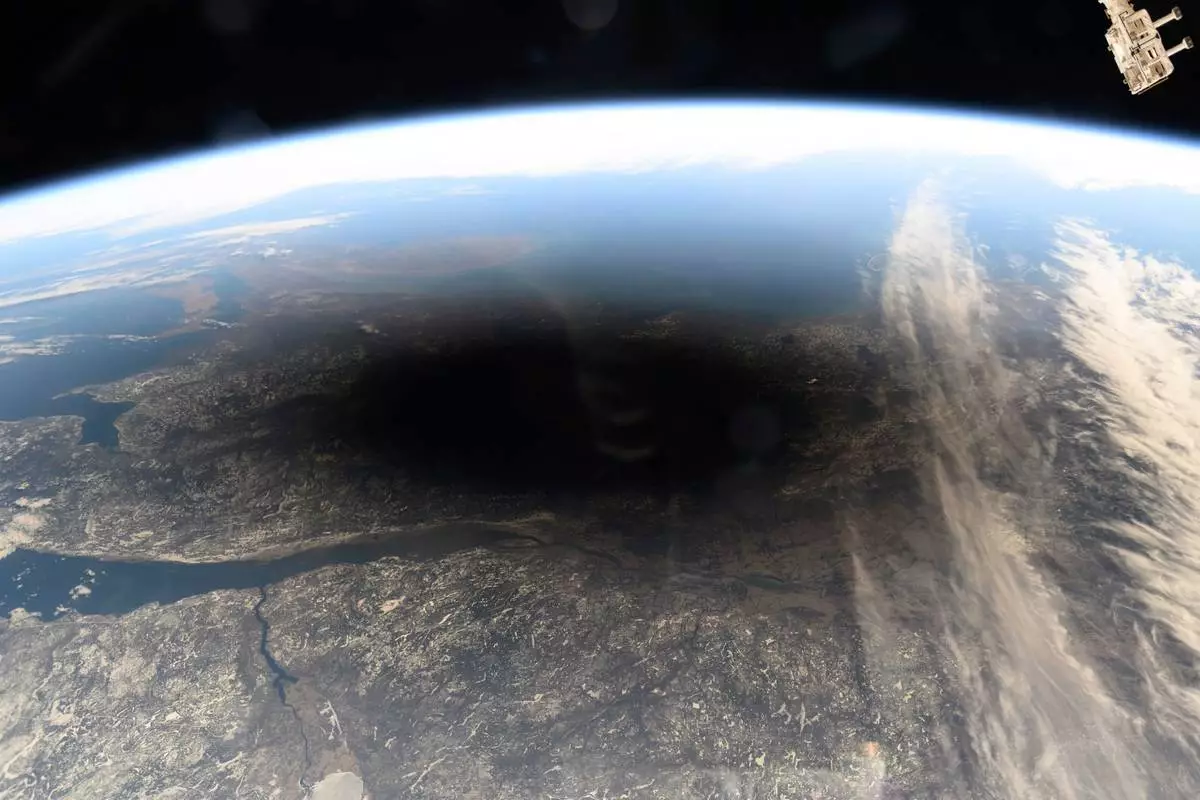
FILE - This photo provided by NASA shows the Moon's shadow covering portions of Canada and the U.S. during a total solar eclipse as seen from the International Space Station on Monday, Aug. 8, 2024. (NASA via AP, File)