WASHINGTON (AP) — Flu is rising rapidly across the U.S., driven by a new variant of the virus — and cases are expected to keep growing with holiday travel.
That variant, known as “subclade K,” led to early outbreaks in the United Kingdom, Japan and Canada. In the U.S., flu typically begins its winter march in December. On Tuesday, the Centers for Disease Control and Prevention reported high or very high levels of illness in more than half the states.
The CDC estimated there have been at least 7.5 million illnesses, 81,000 hospitalizations and 3,100 deaths from flu so far this season. That includes at least eight child deaths — and is based on data as of Dec. 20, before major holiday gatherings.
Some states are particularly hard-hit. New York’s health department said the week ending Dec. 20 marked the most flu cases the state had recorded in a single week since 2004: 71,000.
It’s far too soon to know if this flu season will be as severe as last winter’s.
But it’s not too late to get a flu shot, which health experts say can still prevent severe illness even if someone gets infected. While this year's vaccine isn't a perfect match to the subclade K strain, a preliminary analysis from the U.K. found it offered at least partial protection, lowering people's risk of hospitalization.
According to the CDC, only about 42% of adults and children have gotten a flu vaccination so far this year.
The flu virus is a shape-shifter, constantly mutating, and it comes in multiple forms. There are two subtypes of Type A flu, and subclade K is a mutated version of one of them, named H3N2. That H3N2 strain is always harsh, especially for older adults.
Subclade K’s mutations aren’t enough of a change to be considered an entirely new kind of flu.
But they’re different enough to evade some of the protection from this year’s vaccine, said Andrew Pekosz, a virus expert at Johns Hopkins Bloomberg School of Public Health.
The CDC said it’s too soon to know how severe this season will be.
Flu seasons dominated by any version of H3N2 tend to be bad, with more infections overall and more people becoming seriously ill. But Hopkins’ Pekosz cautioned it will take time to tease apart whether this subclade K version simply spreads more easily or also is more dangerous.
That question aside, the CDC notes there are some prescription medicines to treat flu — usually recommended for people at high risk of complications. But they generally need to be started a day or two after symptoms begin.
The CDC and major medical societies all recommend a flu vaccine for just about everyone age 6 months and older. Despite lots of recent misinformation and confusion about vaccines, the flu recommendations haven’t changed.
Flu is particularly dangerous for people 65 and older, pregnant women, young children and people of any age who have chronic health problems, including asthma, diabetes, heart disease and weak immune systems.
The vaccines are brewed to protect against three influenza strains. Despite concern over that new H3N2 variant, they appear to be a good match against H1N1 and Type B flu that may also circulate this year, Pekosz said.
There are shots for all ages, as well as the nasal spray FluMist for ages 2 to 49. For the first time this year, some people may be eligible to vaccinate themselves with FluMist at home.
—-
The Associated Press Health and Science Department receives support from the Howard Hughes Medical Institute’s Department of Science Education and the Robert Wood Johnson Foundation. The AP is solely responsible for all content.

FILE - A certified medical assistant holds a syringe for a flu vaccine at a clinic in Seattle, on Wednesday, Sept. 10, 2025. (AP Photo/Lindsey Wasson, File)
Vilnius, LITHUANIA (AP) — A festival honoring Lithuania’s iconic cold beet soup brought tens of thousands of visitors Saturday to its capital city, which was fully decked out in pink.
The colorful three-day Vilnius Pink Soup Fest featured a synchronized “Pink Break” lunch of revelers from across the globe all sharing in the beet soup, known as šaltibarščiai, sitting at long tables. Organizers estimated that more than three metric tons (6,614 lbs) of the fermented milk drink kefir, a key ingredient, would be consumed over the three days and more than 100,000 people would attend the event.
Lithuanians devour the refreshing soup during the Baltic country's short summer. Beside beets and kefir, the ingredients include boiled potatoes, eggs, cucumbers and dill.
The festival attracted an international crowd, including tourist Connor Holmes, who came from the United Kingdom after he found the event online and thought "it was completely ridiculous in the best possible way."
“Before I knew it, I was building a suit of pink knight armor, carrying a spoon instead of a sword, and decorating my shield with eggs, dill and potatoes,” he said. “At that point, coming to Vilnius and seeing all this craziness myself felt like the next logical step.”
The city transformed into a giant pink playground as tourists and locals alike dressed up in pink. Others celebrated in cucumber, egg and beet costumes as the city hosted a parade on land as well as along the Neris River.
Jolanta Žukienė, a teacher from Vilnius, said this year was her fourth time attending the festival. She brought her three children and her husband along on Saturday.
“I can see how the number of attractions and visitors from abroad is growing, and Vilnius is becoming a real magnet for everyone who loves good food and unique experiences,” she said.
The festival is part of the city's efforts to increase tourism to the Baltic country.
“Looking at the crowds on the banks and the decorated boats, we joked that cold beet soup already dominates both land and water," said Dovilė Aleksandravičienė, director of Go Vilnius, the city's development agency. "Perhaps the air is next.”

A visitor slides down a water slide into a giant soup bowl during the Pink Soup Fest in Vilnius, Lithuania, Saturday, May 30, 2026. (AP Photo/Mindaugas Kulbis)

Restaurant waiters participate in carry bowls of pink soup run competition during the Pink Soup Fest in Vilnius, Lithuania, Saturday, May 30, 2026. (AP Photo/Mindaugas Kulbis)
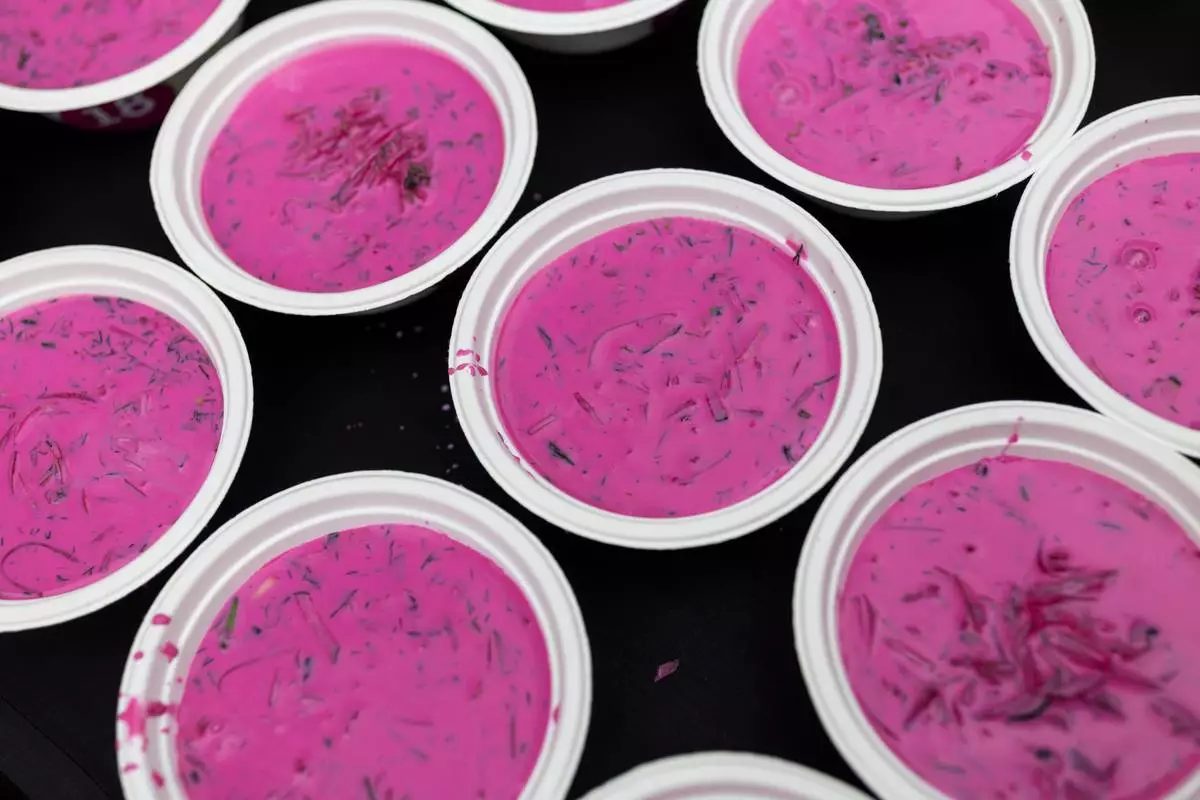
Bowls of pink soup seen during the Pink Soup Fest in Vilnius, Lithuania, Saturday, May 30, 2026. (AP Photo/Mindaugas Kulbis)

A visitor takes part in the Pink Soup Fest festival celebration in Vilnius, Lithuania, Saturday, May 30, 2026. (AP Photo/Mindaugas Kulbis)

Visitors take part in the Pink Soup Fest festival celebration in Vilnius, Lithuania, Saturday, May 30, 2026. (AP Photo/Mindaugas Kulbis)
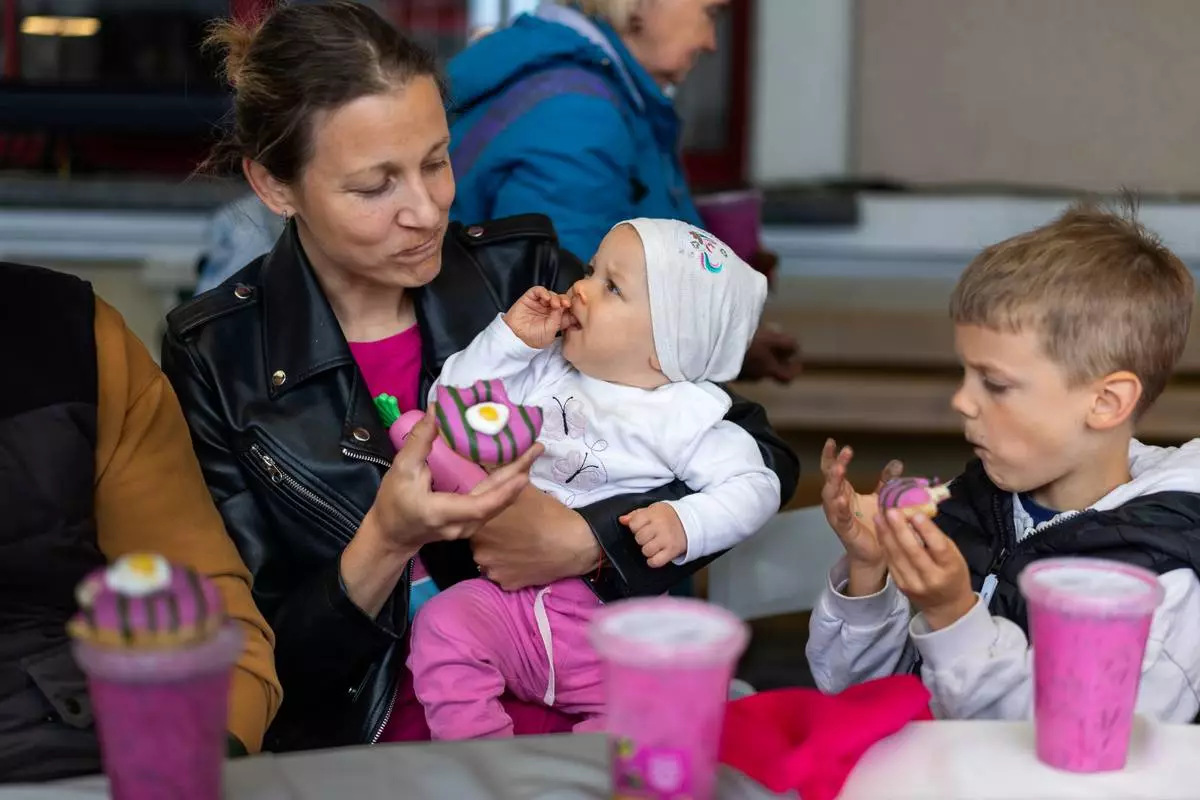
People eat pink soup during a pink break in the Pink Soup Fest celebration, on a railway station platform in Vilnius, Lithuania, Friday, May 29, 2026. (AP Photo/Mindaugas Kulbis)

Visitors take part in the Pink Soup Fest celebration on a railway station platform in Vilnius, Lithuania, Friday, May 29, 2026. (AP Photo/Mindaugas Kulbis)
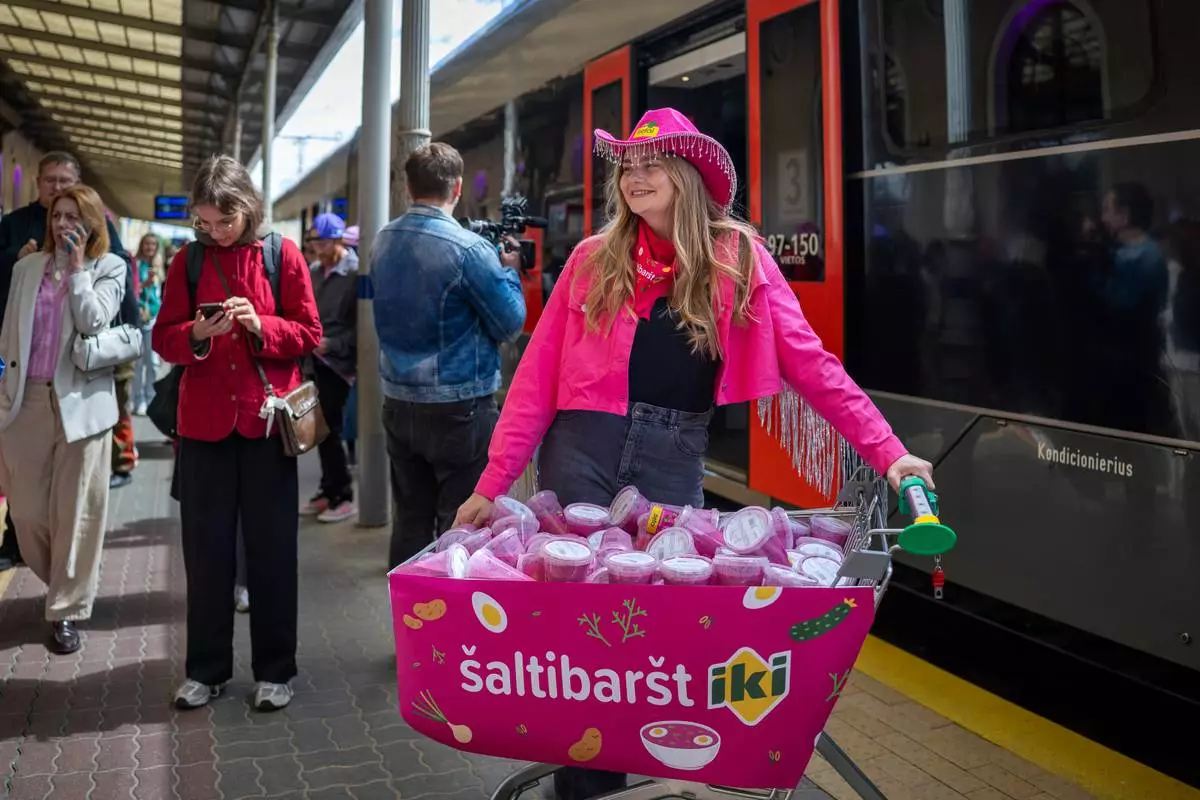
A girl ready to share Pink soup during the Pink Soup Fest celebration, on a railway station platform in Vilnius, Lithuania, Friday, May 29, 2026. (AP Photo/Mindaugas Kulbis)
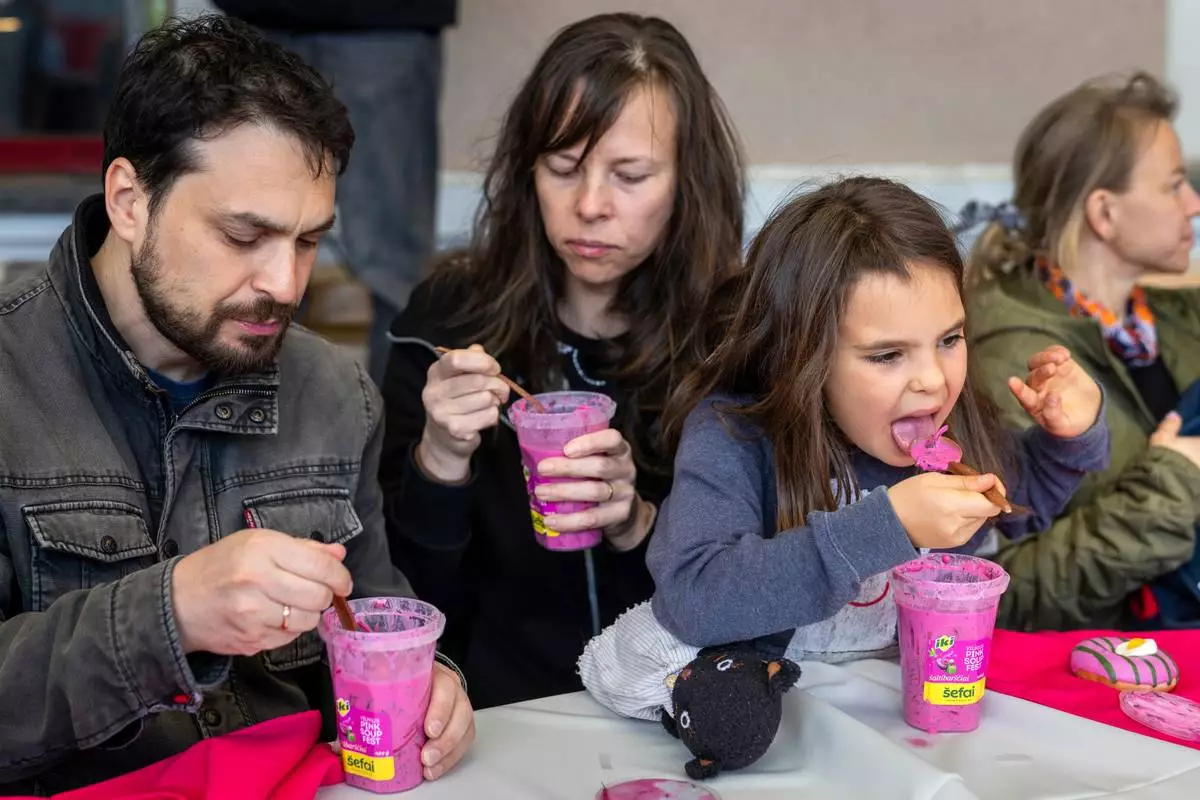
People eat pink soup during a pink break in the Pink Soup Fest celebration, on a railway station platform in Vilnius, Lithuania, Friday, May 29, 2026. (AP Photo/Mindaugas Kulbis)
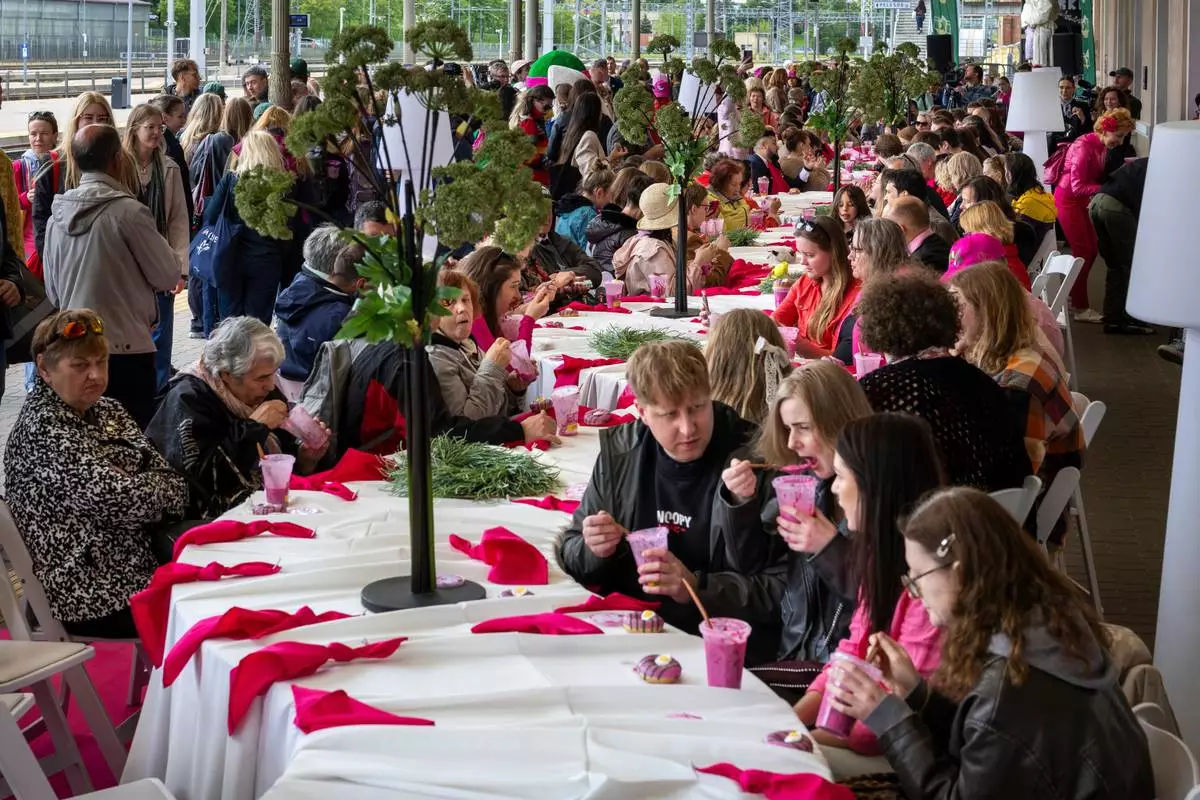
People eat pink soup during a pink break in the Pink Soup Fest celebration, on a railway station platform in Vilnius, Lithuania, Friday, May 29, 2026. (AP Photo/Mindaugas Kulbis)