The Kennedy Center is ending the year with a new round of artists saying they are canceling scheduled performances after President Donald Trump's name was added to the facility, prompting the institution's president to accuse the performers of making their decisions because of politics.
The Cookers, a jazz supergroup that has performed together for nearly two decades, announced their withdrawal from “A Jazz New Year’s Eve” on their website, saying the “decision has come together very quickly” and acknowledging frustration from those who may have planned to attend.
Doug Varone and Dancers, a dance group based in New York, said in an Instagram post late Monday they would pull out of a performance slated for April, saying they “can no longer permit ourselves nor ask our audiences to step inside this once great institution.”
Those moves come after musician Chuck Redd canceled a Christmas Eve performance last week. They also come amid declining sales for tickets to the venue, as well as news that viewership for the Dec. 23 broadcast of the Kennedy Center Honors — which Trump had predicted would soar — was down by about 35% compared to the 2024 show.
The announcements amount to a volatile calendar for one of the most prominent performing arts venues in the U.S. and cap a year of tension in which Trump ousted the Kennedy Center board and named himself the institution's chairman. That led to an earlier round of artist pushback, with performer Issa Rae and the producers of “Hamilton” canceling scheduled engagements while musicians Ben Folds and Renee Fleming stepped down from advisory roles.
The Cookers didn't mention the building's renaming or the Trump administration but did say that, when they return to performing, they wanted to ensure that “the room is able to celebrate the full presence of the music and everyone in it,” reiterating a commitment “to playing music that reaches across divisions rather than deepening them.”
The group may not have addressed the Kennedy Center situation directly, but one of its members has. On Saturday, saxophone player Billy Harper said in comments posted on the Jazz Stage Facebook page that he “would never even consider performing in a venue bearing a name (and being controlled by the kind of board) that represents overt racism and deliberate destruction of African American music and culture. The same music I devoted my life to creating and advancing.”
According to the White House, Trump’s handpicked board approved the renaming. Harper said both the board "as well as the name displayed on the building itself represents a mentality and practices I always stood against. And still do, today more than ever.”
Richard Grenell, a Trump ally whom the president chose to head the Kennedy Center after he forced out the previous leadership, posted Monday night on X, “The artists who are now canceling shows were booked by the previous far left leadership,” intimating the bookings were made under the Biden administration.
In a statement Tuesday to The Associated Press, Grenell said the ”last minute cancellations prove that they were always unwilling to perform for everyone — even those they disagree with politically," adding that the Kennedy Center had been “flooded with inquiries from real artists willing to perform for everyone and who reject political statements in their artistry.”
There was no immediate word from Kennedy Center officials about whether the entity would pursue legal action against the latest round of artists to cancel performances. Following Redd's cancellation last week, Grenell said he would seek $1 million in damages for what he called a “political stunt.”
Not all artists are calling off their shows. Bluegrass banjoist Randy Barrett, scheduled to perform at the Kennedy Center next month, told the AP he was “deeply troubled by the politicization” of the venue and respected those who had canceled but feels that “our tribalized country needs more music and art, not less. It’s one of the few things that can bring us together.”
President John F. Kennedy was assassinated in 1963, and Congress passed a law the following year naming the center as a living memorial to him. Scholars have said any changes to the building's name would need congressional approval; the law explicitly prohibits the board of trustees from making the center into a memorial to anyone else, and from putting another person’s name on the building’s exterior.
Associated Press writers Steven Sloan and Hillel Italie contributed to this report.
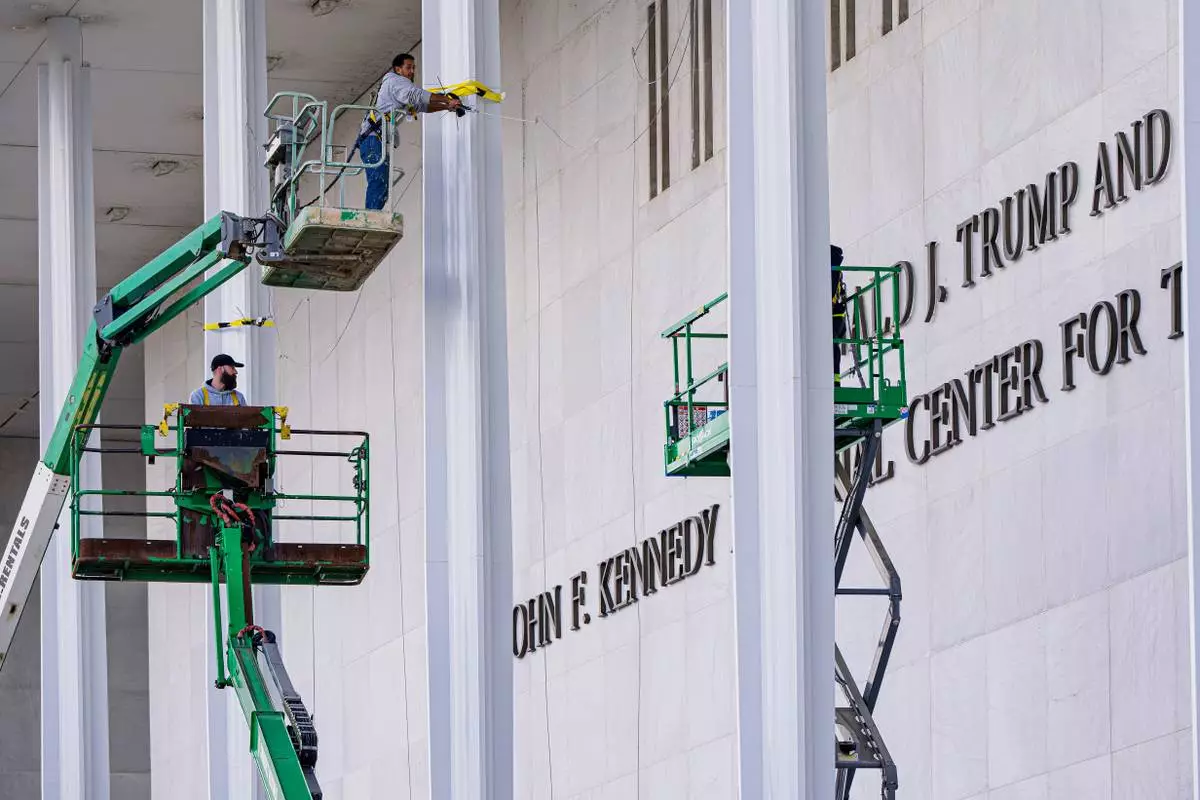
Workers add President Donald Trump's name to the John F. Kennedy Memorial Center for the Performing Arts, after a Trump-appointed board voted to rename the institution, in Washington, Friday, Dec. 19, 2025. (AP Photo/J. Scott Applewhite)
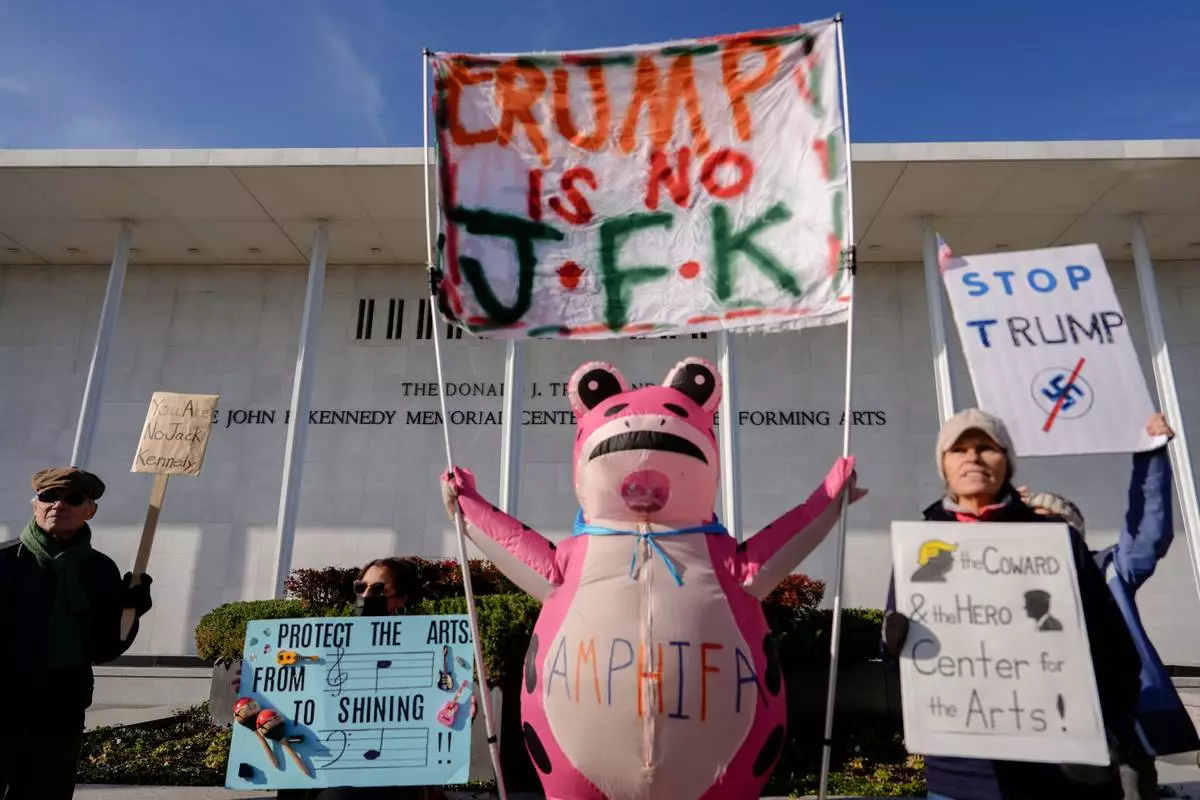
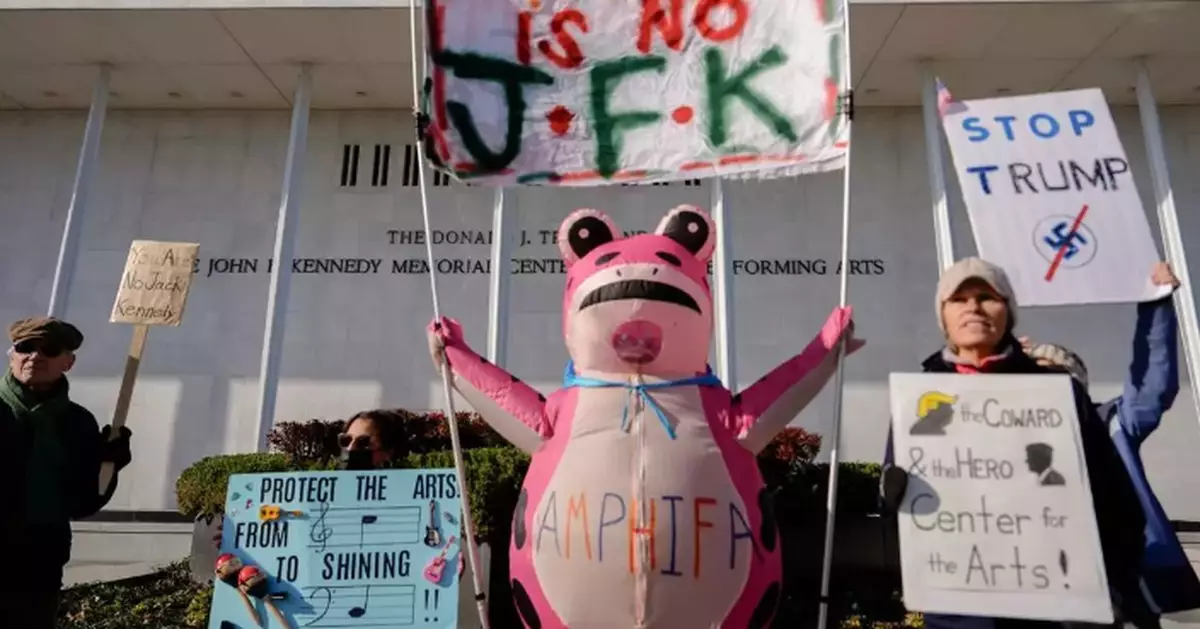
Demonstrators, including Nadine Siler, of Waldorf, Md., dressed in a pink frog costume, hold up signs at a designated protest point in front of the John F. Kennedy Memorial Center for the Performing Arts, a day after a Trump-appointed board voted to add President Donald Trump's name to the Kennedy Center, Saturday, Dec. 20, 2025, in Washington. (AP Photo/Julia Demaree Nikhinson)
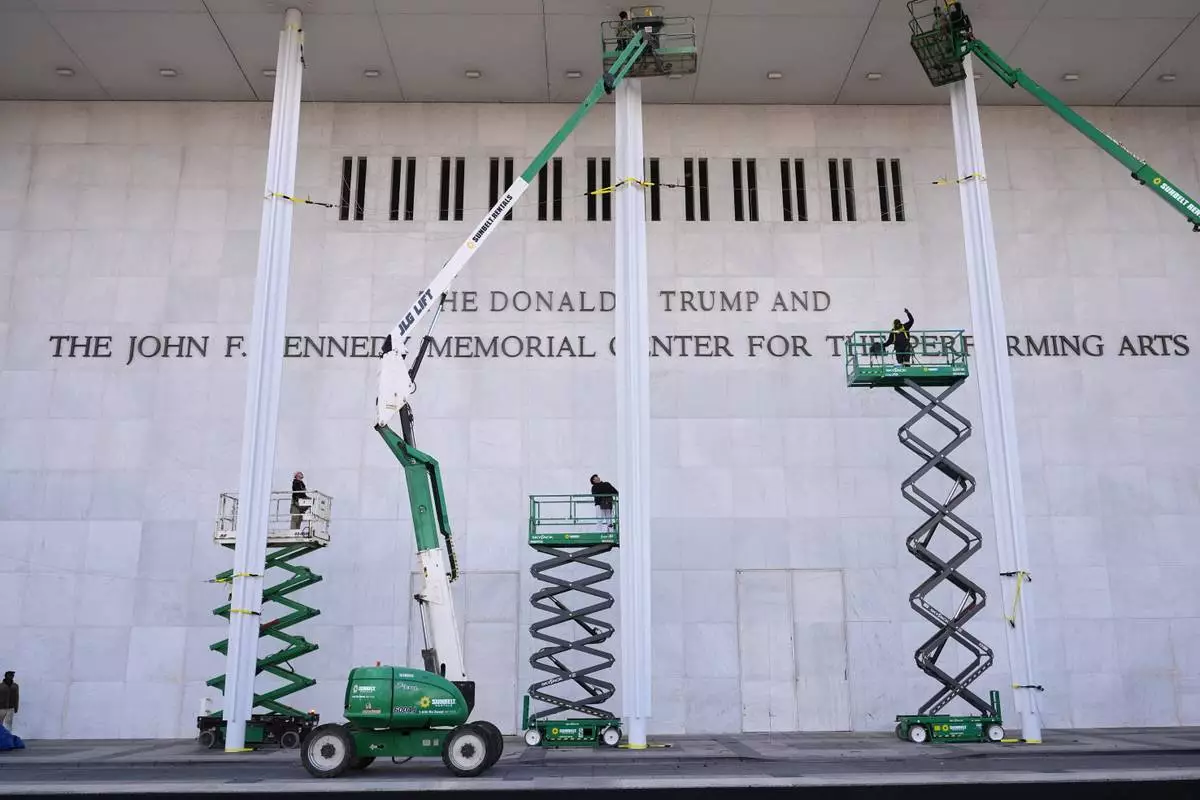
New signage, The Donald J. Trump and The John F. Kennedy Memorial Center For The Performing Arts, is unveiled on the Kennedy Center, Friday, Dec. 19, 2025, in Washington. (AP Photo/Jacquelyn Martin)
WASHINGTON (AP) — President Donald Trump’s White House ballroom won final approval from a key agency on Thursday, despite a federal judge recently ordering a halt to construction unless Congress allows what would be the biggest structural change to the American landmark in more than 70 years.
The 12-member National Capital Planning Commission, the agency tasked with approving construction on federal property in the Washington region, went ahead with the vote because U.S. District Judge Richard Leon’s ruling — which came two days earlier — affects construction activities but not the planning process, said the commission's Trump-appointed chair, Will Scharf.
A vote of 8-1, with two commissioners voting present and one absent, allowed the plan to move forward.
Despite the agency’s approval, however, the judge’s ruling and a legal fight over the ballroom could stall progress on a legacy project that Trump is racing to see completed before the end of his term in early 2029. It’s among a series of changes the Republican president is planning for the nation’s capital to leave his lasting imprint while he’s still in office.
Before the vote, Scharf, a top White House aide, noted that Leon's order has been stayed for two weeks as the administration seeks an appeal. He said, as he understood the decision, it “really does not impact our action here today.”
Reading from notes, Scharf also delivered an impassioned defense of the project that reviewed the full history of the White House — including changes and additions that were criticized at the time they were made but have become beloved with the passage of time. He spoke about the addition of the north and south porticos and the balcony added by President Harry Truman.
Scharf suggested that Trump’s proposed ballroom will similarly come to be viewed as a wise addition — despite drawing contemporary opposition from some members of the public and government officials.
“I believe that, in time, this ballroom will be considered every bit of a national treasure as the other key components of the White House,” Scharf said.
Scharf also said the proposed ballroom has been viewed negatively because of opposition to Trump, instead of the merits, saying, “I feel that we’ve been unfairly slighted in the press and otherwise for the way we’ve gone about reviewing this particular project.”
The vote by the commission, which includes three members Trump gets to appoint, had initially been scheduled for March but was postponed to Thursday because so many people signed up to comment at the commission’s meeting last month. The comments were overwhelmingly opposed to the ballroom.
The lone “no” vote was cast by Phil Mendelson, a Democrat who chairs the Council of the District of Columbia. Linda Argo and Arrington Dixon, the two commissioners appointed by Mayor Muriel Bowser, a Democrat, voted present.
Mendelson criticized the design of the ballroom addition and how fast it was approved.
“It’s just too large,” he said.
Criticism also came from Public Citizen, a nonprofit consumer advocacy organization. One of its attorneys, Jon Golinger, said the commission had discounted opposition from city officials and thousands of people who commented against the project, and ignored the judge's ruling. Several commissioners, including Scharf, had said they took the public feedback seriously.
“This approval is illegitimate and this vote is a joke," Golinger said.
White House spokesperson Davis Ingle, commended the “decision to approve President Trump’s historic vision to build a much need ballroom at the White House.”
“We look forward to seeing the completion of this project on time and under budget," Ingle said in a statement.
Before voting, the commission considered some design changes to the 90,000-square-foot (8,400-square-meter) ballroom addition that the president announced aboard Air Force One on Sunday, as he flew back to Washington from a weekend at his Florida home.
He removed a large staircase on the south side of the building and added an uncovered porch to the west side. Architects and other critics of the project had panned the staircase as too large and basically useless since there was no way to enter the ballroom at the top.
A White House official said the president had considered comments from the National Capital Planning Commission and another oversight entity, the U.S. Commission of Fine Arts, which approved the project earlier this year, as well as members of the public.
The official, who was not authorized to publicly discuss the ballroom design and spoke on the condition of anonymity, said that additional “refinements” had been made to the building’s exterior.
The ballroom, now estimated to cost $400 million, has expanded in scope and price tag since Trump first announced the project last summer, citing a need for space other than a tent on the lawn to host important guests. Trump demolished the East Wing in October with little warning, and site preparation and underground work have been underway since then.
Two other Trump-appointed commissioners, Stuart Levenbach and James Blair, voted for the project.
Levenbach, who serves as vice chairman and is the federal government’s chief statistician, said the White House is currently “not suited” to accommodate large numbers of guests and that the addition will improve the “utility” of the compound.
He said tunnels and other structures underground at the White House made it impossible to place many features of the ballroom there, too, as some have suggested might be possible. Levenbach said the addition is a “multipurpose facility,” noting that, in addition to a ballroom, it will also have offices for the first lady, kitchen space and a theater.
“This is not an expansion for its own sake,” Levenbach said.
Blair, a deputy to White House chief of staff Susie Wiles, said visitors and guests of the president deserve a “better experience."
Scharf and Blair also said Trump will get “very limited use” of the ballroom before his term ends.
Trump went ahead with the project before seeking input from the National Capital Planning Commission and the Commission of Fine Arts, which he reconstituted with allies and supporters.
The National Trust for Historic Preservation, a private nonprofit organization, sued after Trump demolished the East Wing last fall to build the ballroom addition — a space nearly twice as big as the mansion itself.
Trump says it will be paid for with donations from wealthy people and corporations, including him, though public dollars are paying for underground bunkers and security upgrades.
The trust sought a temporary halt to construction until Trump presented the project to both commissions and Congress for approval. Leon agreed but said that his order would take effect in two weeks and that construction related to security would be allowed.
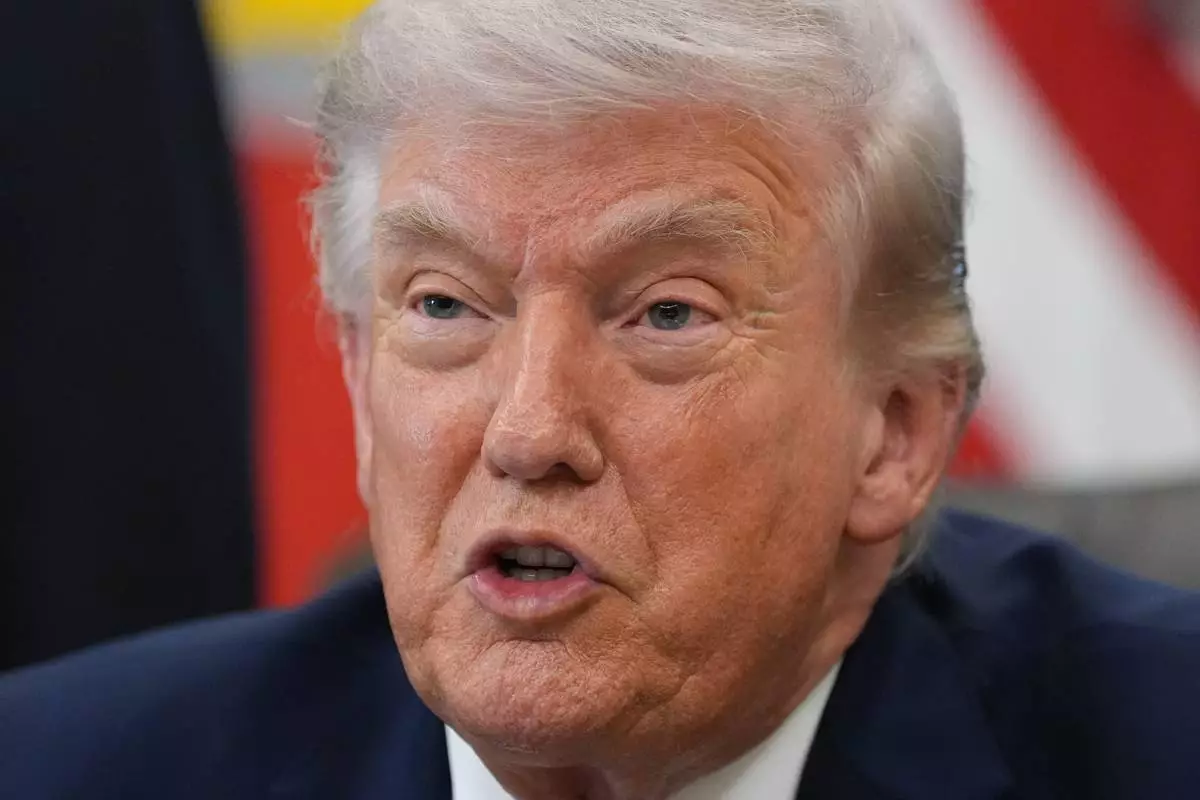
President Donald Trump answers questions from reporters after signing an executive order in the Oval Office of the White House Tuesday, March 31, 2026, in Washington. (AP Photo/Alex Brandon)
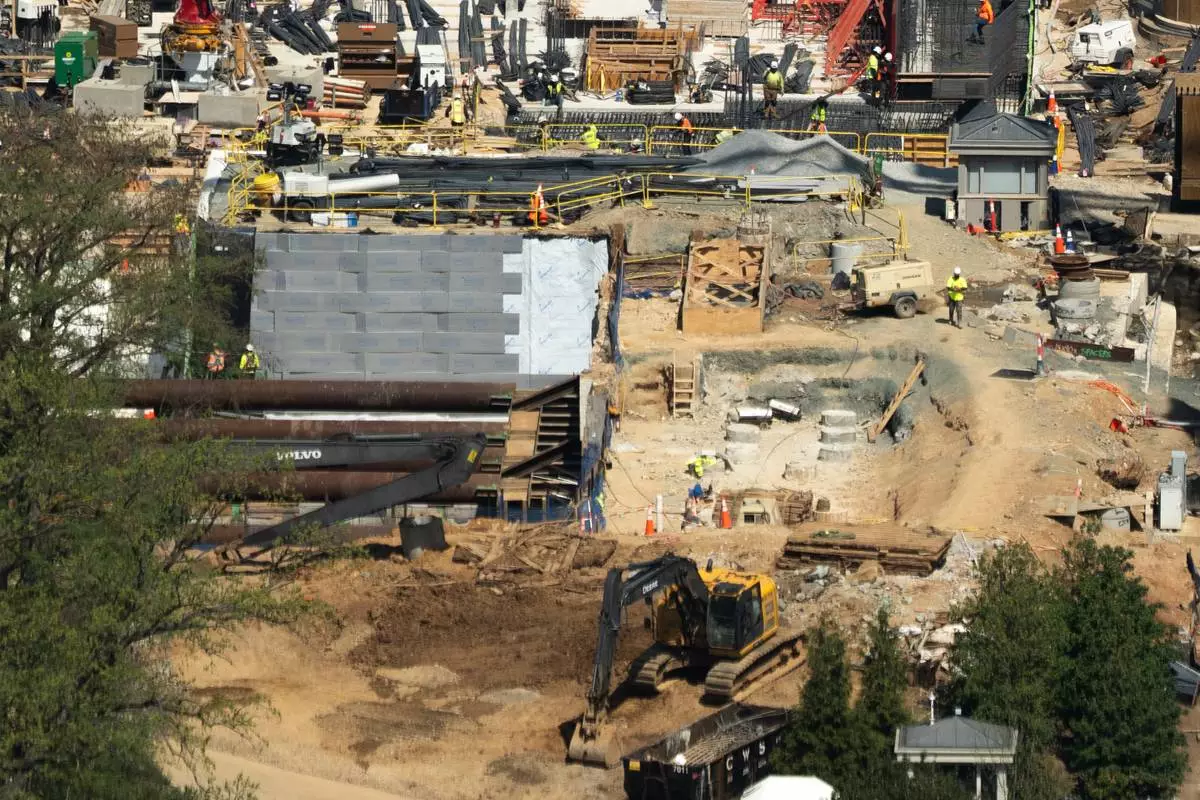
Work continues on the construction of the ballroom at the White House in Washington, Wednesday, April 1, 2026. (AP Photo/Allison Robbert)
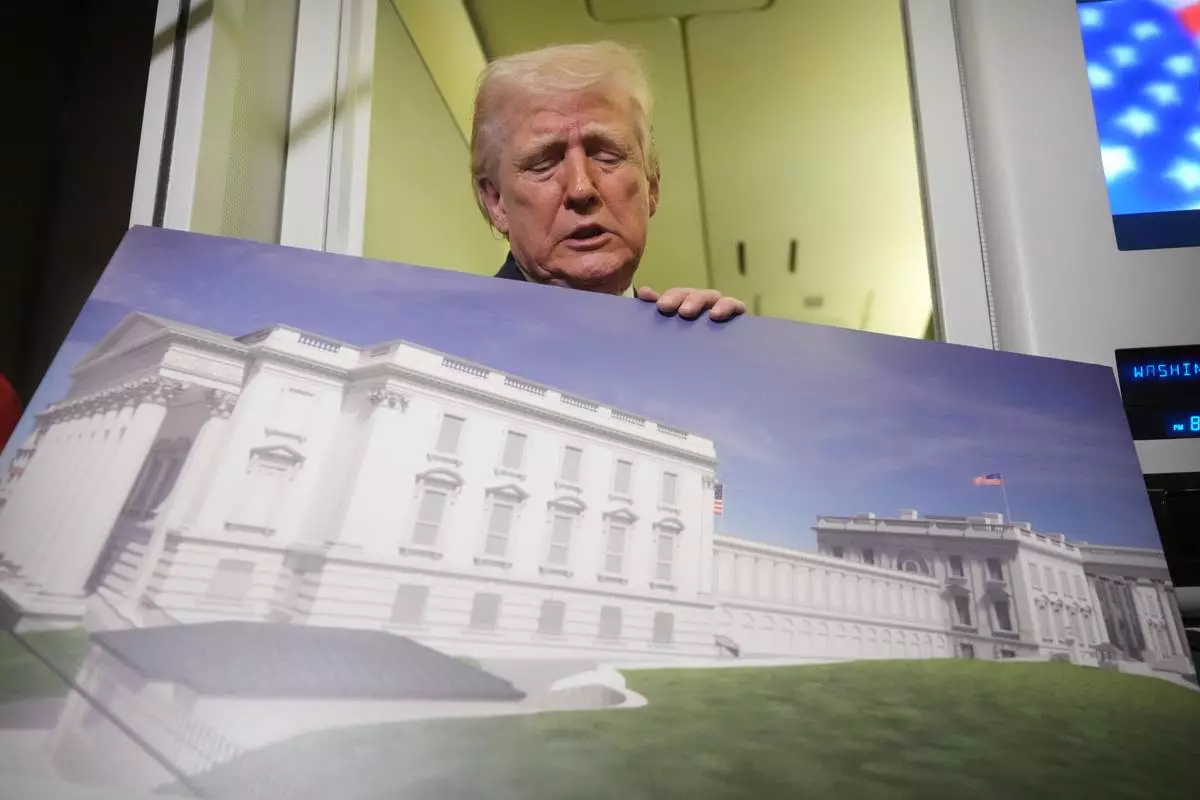
President Donald Trump holds a rendering of the proposed new East Wing of the White House as he speaks to reporters aboard Air Force One en route from West Palm Beach, Fla., to Joint Base Andrews, Md., Sunday, March 29, 2026. (AP Photo/Mark Schiefelbein)
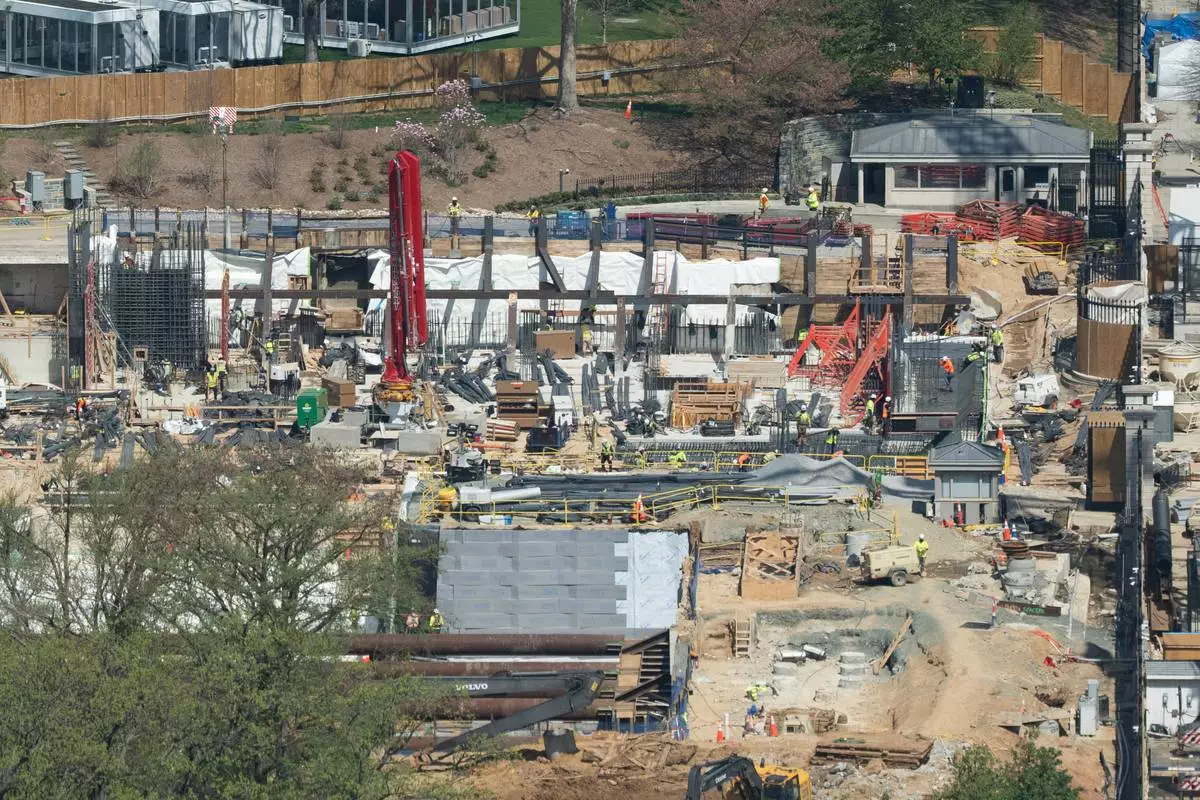
Work continues on the construction of the ballroom at the White House in Washington, Wednesday, April 1, 2026. (AP Photo/Allison Robbert)
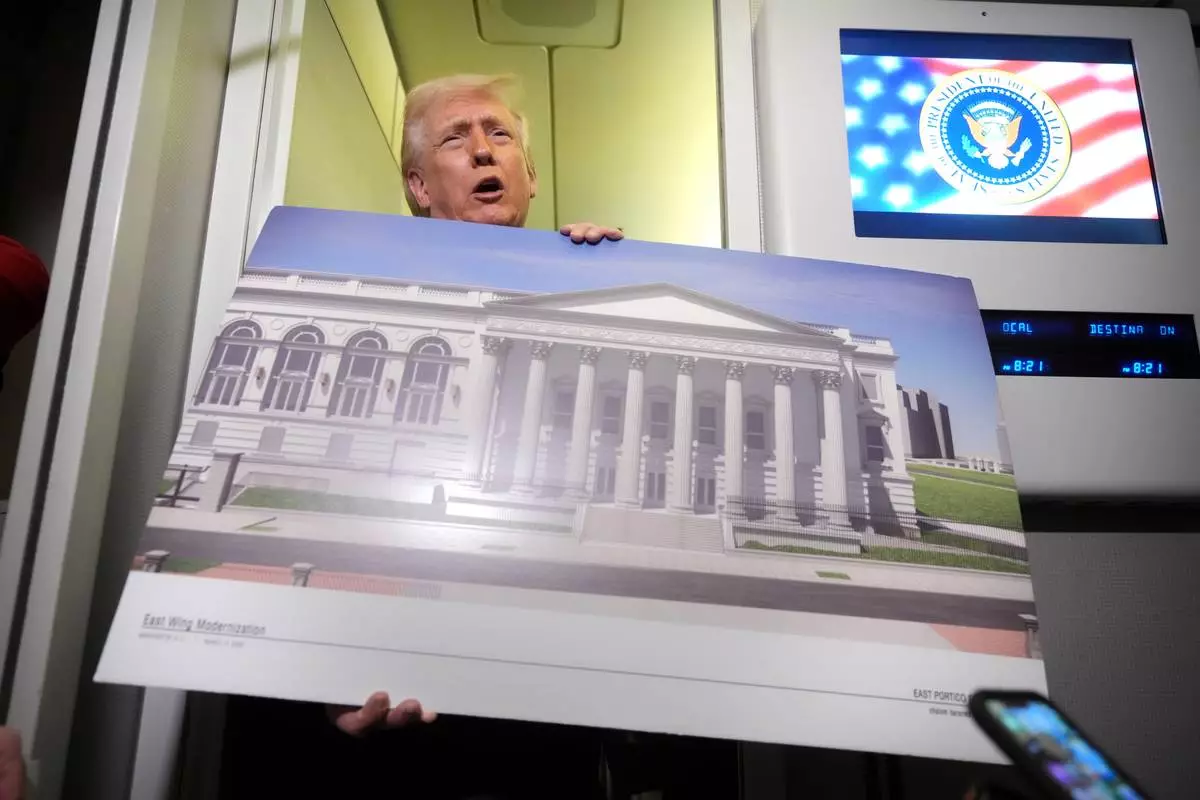
President Donald Trump holds a rendering of the proposed new East Wing of the White House as he speaks to reporters aboard Air Force One en route from West Palm Beach, Fla., to Joint Base Andrews, Md., Sunday, March 29, 2026. (AP Photo/Mark Schiefelbein)