Hospital Authority successfully implements public healthcare fees and charges reform as public hospitals experience smooth operations on first day
The following is issued on behalf of the Hospital Authority:
The Hospital Authority (HA) has successfully implemented measures under the public healthcare fees and charges reform (fees and charges reform), with all public hospitals operating smoothly today (January 1). The HA has deployed additional manpower across various departments at hospitals to assist patients in need and will continue to monitor operations closely over the coming days to ensure smooth service delivery after the New Year holiday.
The HA Chairman, Mr Henry Fan, said, "The successful implementation of the reform marks a significant milestone in our public healthcare system. The reform will enhance protection for poor, acute, serious and critical patients, enabling sustainable development of public healthcare services to meet the challenges posed by Hong Kong's aging population. We especially thank all staff for their co-operation in implementing the reform and patients for their understanding of the new arrangements."
As of 2pm, 1982 patients attended the Accident and Emergency departments (A&E) of 18 public hospitals, including 42 critical cases and 82 emergency cases. According to the new fees and charges arrangement, these two categories of patients will have their emergency room charges, previously set at $180, fully exempted. The other cases subject to the new fees and charges arrangement include 854 urgent cases, 968 semi-urgent cases, and 36 non-urgent cases. The average waiting times for semi-urgent and non-urgent cases was 83 minutes.
The regularisation of refund arrangement in A&E has been implemented to provide patients in stable conditions and with mild symptoms with flexibility in choosing alternative medical care. Patient who chooses to leave A&E before doctor consultation can raise a refund request for the A&E charges within 24 hours after registration to claim a refund of $350. Given the need to prioritise treatment for more critical patients, the HA urges patients with mild symptoms to seek treatment at Family Medicine Clinics (FMCs), private doctors or 24-hour outpatient services at private hospitals to reduce pressure on A&E of public hospitals.
Furthermore, there are 15 FMCs providing public holiday family medicine outpatient services today, offering a total of 1431 consultation quotas. As of 2pm, 487 patients attended these 15 FMCs, of which 4 patients were eligible for medical fee waivers. Overall service usage remains approximately similar to before the implementation of the measures.
The HA Chief Executive, Dr Libby Lee, said, "After the New Year holiday, many clinical departments in public hospitals will resume normal services. We have deployed additional manpower, including service ambassadors, dedicated teams, and volunteers to station at outpatient clinics, shroffs and pharmacies for answering patient inquiries, and assisting with payments, appointments, and applications for medical fee waivers. Hospitals and specialist outpatient clinics have also set up information counters where dedicated staff provide on-site responses to public inquiries."
The HA reminds patients that the fees and charges reform has been implemented. Patients are advised to familiarise themselves with the new fees and charges arrangements before visiting public hospitals or outpatient clinics. Some medical service procedures have also been modified. Every cluster has set up hotlines (see table below) for patients to inquire about the fees and charges reform arrangements (see Annex). Patients can also visit the HA website to learn about the new arrangements.
The Hospital Authority (HA), Photo source: reference image
Hotlines for Public Healthcare Fees and Charges Reform
Clusters
Hotlines
Hong Kong East Cluster
6460 4303
Hong Kong West Cluster
2255 4177
Kowloon Central Cluster
3506 7198
Kowloon East Cluster
5215 7326
Kowloon West Cluster
3467 7575
New Territories East Cluster
6273 3551
New Territories West Cluster
2468 5353
Service hours: January 2-11, 2026, 8am to 8pm
DH reminds public to take precautions against heat-related illnesses during very hot weather
The Centre for Health Protection (CHP) of the Department of Health (DH) today (June 24) reminded members of the public to take appropriate precautions against heat-related illnesses, such as heat cramps, heat exhaustion and heat stroke, during very hot weather.
In a high-temperature environment, excessive sweating and difficulty in heat dissipation can cause stress to the body. Members of the public should take the following precautions:
- Hydrate in a timely manner to prevent dehydration;
- Wear light-coloured, loose-fitting and breathable clothing to minimise heat absorption and facilitate perspiration and heat dissipation;
- Keep indoor areas well ventilated and maintain appropriate temperature and humidity, e.g. by opening windows or using a fan or air-conditioning;
- Avoid strenuous exercise and prolonged activities such as hiking or trekking;
- Arrange outdoor activities in the morning or the late afternoon, if possible, and bring enough water; and
- Avoid beverages containing caffeine, such as coffee and tea, as well as alcoholic beverages, which may speed up water loss through the urinary system.
In addition, infants and children, the elderly, pregnant women, individuals with chronic illnesses such as heart disease or high blood pressure, overweight people and outdoor/manual workers are more susceptible to heat stroke. These groups should pay special attention to the following:
- Infants and young children: Avoid going outside when the temperature is high. If they must go outside, adults should ensure they stay in places with moderate temperatures and good ventilation or air-conditioning. Infants and young children should never be left unattended in a confined space such as a vehicle;
- The elderly, pregnant women, individuals with chronic illnesses and overweight people: Pay close attention to health conditions and seek help as soon as possible if experiencing any abnormalities in health indicators such as blood pressure, heart rate, etc or if there are fluctuations in health conditions. Avoid going out when the temperature is high. Make sure there is good ventilation, or turn on a fan or air-conditioner to keep an appropriate temperature indoors. High temperatures can also worsen the condition of people with chronic illnesses (such as cardiovascular and respiratory diseases). Therefore, they should have an ample supply of their usual medication and keep in contact with family members, neighbours and the community. People should seek immediate help if they feel unwell.
- Outdoor/manual workers: Reschedule work to cooler hours as far as feasible. If working in a hot environment is unavoidable, provide shade where practicable and use ventilation and heat dissipation equipment. Once work has begun, gradually adjust the pace of work and take breaks in the shade to regain strength.
The DH reminded the public that heat stroke is one of the most common health risks in hot weather. Over the past five years, there have been over 200 hospital admissions due to heat stroke each year in Hong Kong, with two to five fatal cases occurring mainly during the summer months from May to September. Vulnerable groups are more susceptible to heat stroke. Symptoms include dizziness, headache, nausea, shortness of breath or confusion. In severe cases, patients may suffer from convulsions or become unconscious, which can be life-threatening if they are not cooled down and resuscitated in a timely manner.
Members of the public are also advised to pay attention to the latest weather, as well as the real-time and forecasted ultraviolet (UV) index released by the Hong Kong Observatory (HKO). When the UV index is high (6 or above), the public should note the following:
- Avoid direct sunlight exposure to the skin and the eyes;
- Apply broad-spectrum, water-resistant sunscreen liberally, with a sun protection factor (SPF) of at least 30 or higher, when participating in outdoor activities. Reapply every two hours if staying outdoors for long periods, or after swimming, sweating or towelling off;
- While using DEET-containing insect repellents for personal protection against mosquito-borne diseases, apply sunscreen before insect repellent;
- Seek shade;
- Wear UV-blocking sunglasses;
- Wear loose-fitting clothing with long-sleeves; and
- Wear a wide-brimmed hat or use an umbrella.
If symptoms develop, such as dizziness, headache, nausea, shortness of breath or confusion, rest and seek help immediately, and seek medical advice as soon as possible.
For more health information, the public may visit theCHP's heat strokepage andUV radiation page; the HKO's Dial-a-Weather (1878 200),latestweather report and forecast,UV Indexand weather information forhiking and mountaineering; andpress releasesof the Labour Departmenton precautions against heat stroke for outdoor workers and their employers when the Heat Stress at Work Warning is in force.
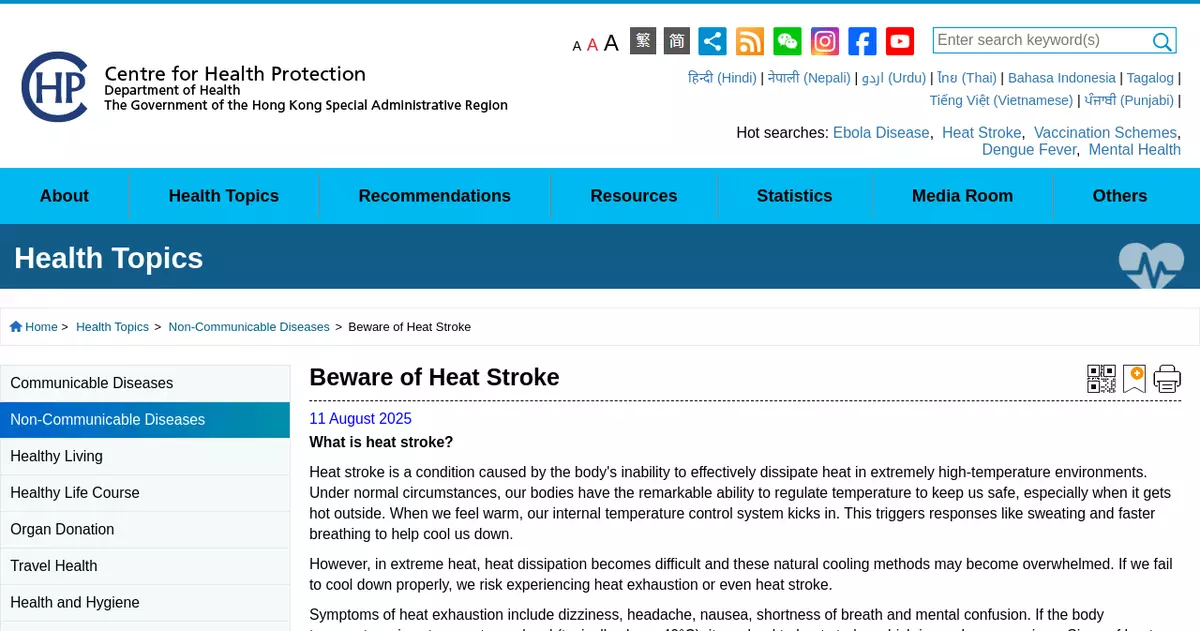
Source: AI-found images