LAGOS, Nigeria (AP) — The driver in a deadly car crash that injured heavyweight champion Anthony Joshua and killed his two friends in Nigeria was charged, the police said on Friday.
Adeniyi Mobolaji Kayode, 46, was charged with dangerous and reckless driving in southwestern Ogun state following Monday's crash, police spokesman Oluseyi Babaseyi said in a statement on Friday.
The vehicle carrying Joshua, Sina Ghami and Latif “Latz” Ayodele hit a stationary truck on the Lagos-Ibadan Expressway which links Ogun state to Lagos.
Kayode has been in custody since Thursday following his release from hospital, and was subsequently granted bail of 5 million naira ($3,480), Babaseyi told the Associated Press.
The defendant was charged on four counts, including dangerous driving causing death, reckless and negligent driving, driving without due care as well as driving without a valid national driver’s license.
“He was remanded pending when he meets his bail condition,” the police spokesman said.
The court case was adjourned to Jan. 20 for trial.
Joshua, a two-time heavyweight champion, was released from hospital on Wednesday after sustaining minor injuries in the crash that raised questions about road safety in Nigeria. The boxer was discharged after being deemed clinically fit to recuperate at home, authorities said.
Joshua has family roots in Nigeria and he briefly attended boarding school there as a child. He also holds Nigerian nationality.
Joshua’s promoter, Matchroom Boxing, told The AP on Thursday that the boxer will remain in Nigeria.

In this photo provided by the Federal Road Safety Corps, people gather at the accident scene of British boxer Anthony Joshua in Lagos, Nigeria, on Monday, Dec. 29, 2025. (Federal Road Safety Corps via AP)
SEOUL, South Korea (AP) — The U.S. military says a KC-135 refueling aircraft supporting operations against Iran crashed in western Iraq and rescue operations are underway.
The U.S. Central Command, which oversees the Middle East, said the crash followed an unspecified incident involving two aircraft in “friendly airspace,” and that the other plane landed safely.
Here’s what is known so far about the tanker, which is the fourth publicly acknowledged U.S. aircraft to crash during the war against Iran:
The KC-135 Stratotanker is a U.S. Air Force aircraft used to refuel other planes in midair, allowing them to travel longer distances and maintain operations longer without landing. The plane is also used to transport wounded personnel during medical evacuations or conduct surveillance missions, according to military experts.
Based on the same design as the Boeing 707 passenger plane, the tanker has been in service for more than 60 years, supporting the U.S. Air Force, Navy and Marine Corps as well as allied aircraft, according to an Air Force description. The aging plane is set to be phased out as the air force receives a full complement of next-generation KC-46A Pegasus tankers.
Despite upgrades over the years, the KC-135s' age has fueled concern about their reliability and durability.
“The last of these planes were produced in the 1960s,” said Yang Uk, a security expert at South Korea’s Asan Institute for Policy Studies. He added that the transition to the KC-46A has progressed more slowly than expected.
According to the Congressional Research Service, the Air Force last year had 376 KC-135s, including 151 on active duty, 163 in the Air National Guard and 62 in the Air Force Reserve.
A basic KC-135 crew has three people: a pilot, co-pilot and boom operator. Nurses and medical technicians are added in aeromedical evacuation missions.
Refueling typically happens at the back of the plane, where the boom operator is located. A fuel boom is lowered to connect with fighters, bombers or other aircraft. On many of the planes, the boom operator works lying face down while looking out of a window on the underside of the plane.
Some KC-135s can also refuel planes from pods on their wings. The tankers also have room above the fuel stores to carry cargo or passengers if needed.
Refueling tankers could play an increasingly important role if the Iran war drags on, as U.S. aircraft may need to fly longer missions to pursue Iranian forces retreating deeper into the country, said Yang.
It was not immediately clear if there were any casualties from the crash in Iraq. A U.S. official, who spoke to The Associated Press on condition of anonymity to discuss the developing situation, said the plane was carrying at least five crew members.
A second U.S. official, who also spoke on condition of anonymity, said the other plane involved in the incident was also a KC-135. Yechiel Leiter, the Israeli ambassador to the U.S., wrote on X that the other plane landed safely in Israel.
The U.S. Central Command did not elaborate on the circumstances of the crash, but said it “was not due to hostile fire or friendly fire.”
Yang said it would be rare for a refueling tanker to be downed by enemy fire because such operations are usually conducted in the rear of combat zones.
The crash came after three U.S. F-15E fighter jets were mistakenly downed last week by friendly Kuwaiti fire.
KC-135s have been involved in several fatal accidents. The most recent happened on May 3, 2013, when a KC-135R crashed after takeoff south of Chaldovar, Kyrgyzstan while taking part in the war in Afghanistan.
In that crash, the crew experienced problems with the plane’s rudder, according to a U.S. Air Force investigation. While they struggled to stabilize the plane, the tail section broke away and the plane exploded midair, killing all three crewmembers onboard.
The most serious mid-air collision involving the plane happened in 1966, when a B-52 bomber carrying nuclear bombs struck a tanker near Palomares, Spain.
The accident caused the tanker to crash, killing four onboard. The disaster led to an extensive decontamination effort to clean up nuclear material dispersed when conventional explosives in the hydrogen bombs detonated after hitting the ground.
Schreck reported from Bangkok. AP writers Ben Finley and Konstantin Toropin in Washington contributed.
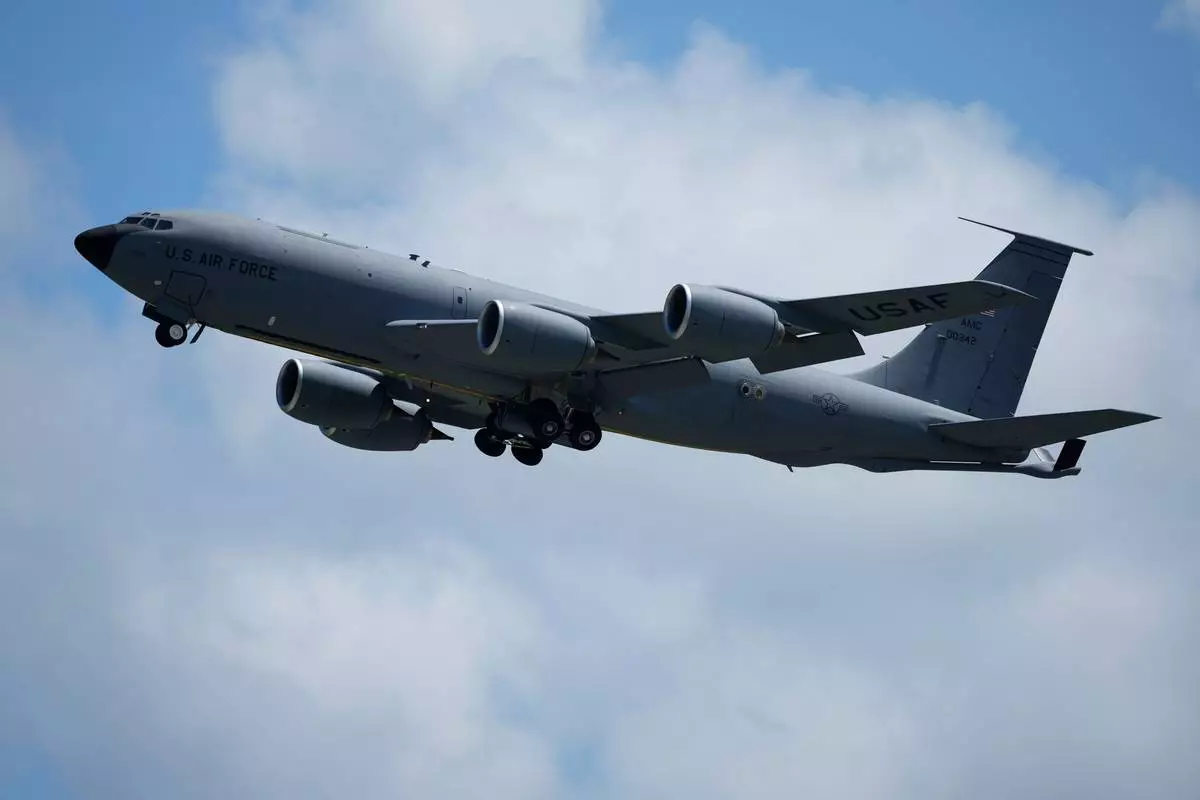
FILE - A U.S. Air Force KC-135 Stratotanker refueling tanker aircraft takes off from the Kadena Air Base airfield in Kadena town, west of Okinawa, southern Japan, Wednesday, Aug. 30, 2023. (AP Photo/Hiro Komae, File)
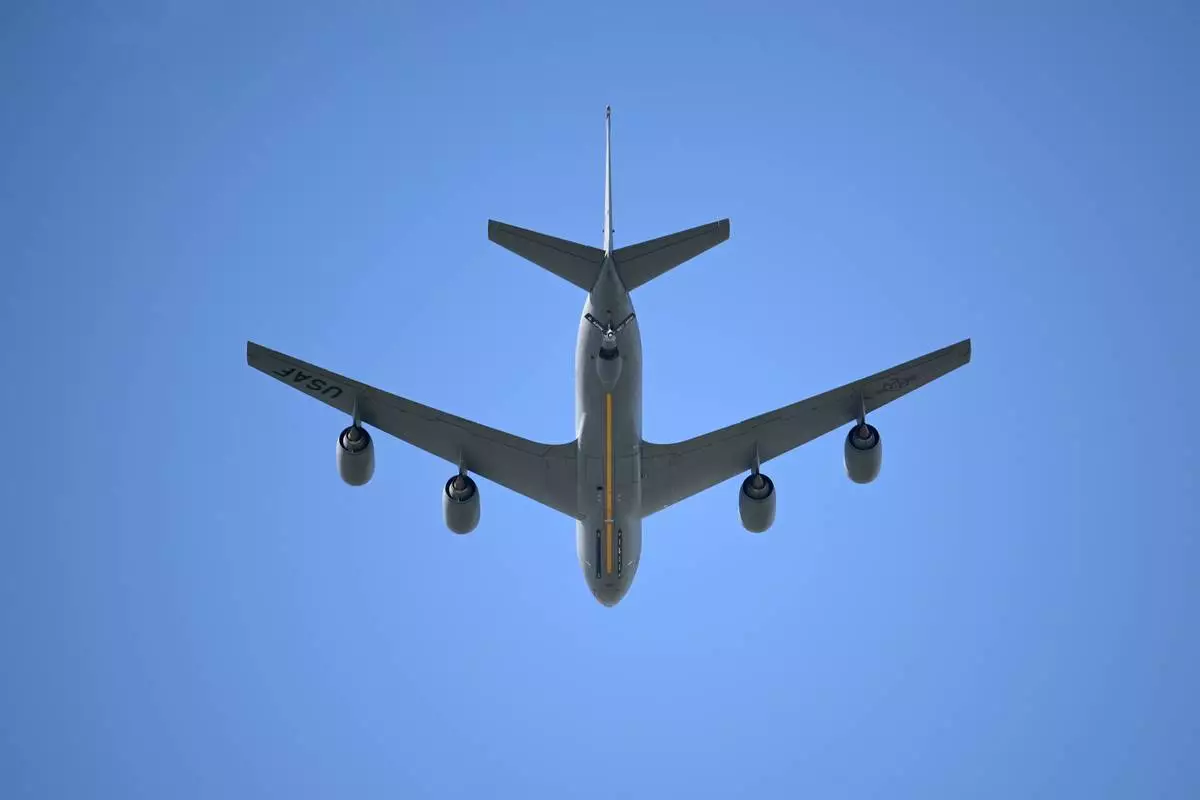
FILE - A U.S. Air Force KC-135 Stratotanker aerial refueling aircraft performs a flyover during the national anthem before an NCAA college football game between Central Florida and Georgia Tech, Sept. 24, 2022, in Orlando, Fla. (AP Photo/Phelan M. Ebenhack, File)