As the year 2026 begins, a sustained cold wave has brought snow and icy beauty to many parts of China, creating distinctive winter scenes.
In Tongren City, southwest China's Guizhou Province, the Mount Fanjing had its first snowfall of the new year, courtesy of a strong cold front.
The snow settled mainly at an elevation of around 2,200 meters above sea level, while higher-elevation attractions including the Mount Fanjing's two peaks -- Hongyun Golden Peak and Old Jinding -- as well as Mushroom Stone did not see snow this time, presenting a unique scene where snow only blankets the mid-slopes.
Clouds flowed like waterfalls over the ranges, complemented by the white snow, adding tranquility and poetic charm to the vista.
Due to freezing temperatures, some sections of the scenic area have become icy. Visitors have been advised to stay updated on road conditions before planning their trips.
At the Bosten Lake in northwest China's Xinjiang Uygur Autonomous Region, ice pushed up by wind and waves took shapes of tall, continuous ridges stretching for kilometers along the shore.
The natural phenomenon, called ice shoves, is caused by temperature rise and strong winds. When the weather warms, ice in the ocean or a lake near the shore will first thaw. Strong winds then push the ice ashore, creating piles that could be over 10 meters high.
The landscapes occur every winter and spring at the Bosten Lake, with ice ridges reaching heights of one to two meters -- a truly impressive natural spectacle.
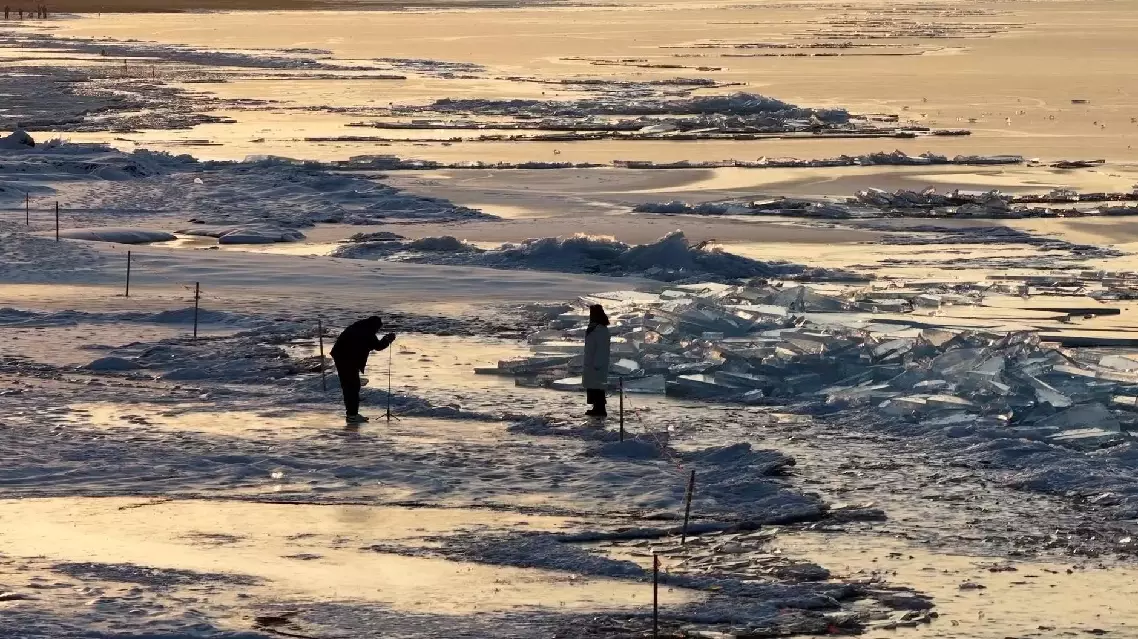
Spectacular frosty scenes in Guizhou, Xinjiang
China's two major power grid operators -- the State Grid Corporation of China (State Grid) and China Southern Power Grid (CSG) -- reported a surge in investment in the first quarter of 2026, underscoring efforts to strengthen infrastructure construction and support high-quality socioeconomic development in China.
The State Grid said it completed fixed-asset investment worth 129 billion yuan (about 18.77 billion U.S. dollars) in the first three months of this year, up 37 percent the corresponding period of the previous year. The spending has driven more than 250 billion yuan (36 billion U.S. dollars) of investment across the wider industrial chain.
Key projects such as the Panxi ultra-high-voltage (UHV) alternating current (AC) line and the Anhui-Hubei back-to-back direct current (DC) project have seen ground broken for their construction, while several west-to-east power transmission projects have been upgraded.
Investment in connecting renewable energy generation to the grid was reported to have exceeded 10 billion yuan (1.45 billion U.S. dollars) from January to March, a year-on-year rise of more than 50 percent.
The CSG also reported robust growth in investment in the three-month period, with fixed-asset investment reaching 38.45 billion yuan (5.58 billion U.S. dollars), up about 50 percent from a year earlier.
Among its achievements, the company completed and commissioned 80 key projects, including the 220 kV cross-sea power grid interconnection project, which was officially put into operation on March 20. The project ended years of grid isolation on the Weizhou Island in south China by linking it to the main power system of the Guangxi Zhuang Autonomous Region.
The construction of 17 other major energy projects, including one linking the power grid of the Xizang Autonomous Region in southwest China with that of Guangdong Province in south China, is advancing rapidly. These projects are expected to bolster regional industries, the maritime economy, digital collaboration and the transition to green energy.
"By accelerating major project construction, investment during the 15th Five-Year Plan period (2026-2030) is expected to approach 1 trillion yuan (145 billion U.S. dollars), driving a further 2 trillion yuan (290 billion U.S. dollars) of investment across upstream and downstream industries," said Dong Yanle, deputy general manager of the Engineering Construction Department under the China Southern Power Grid.
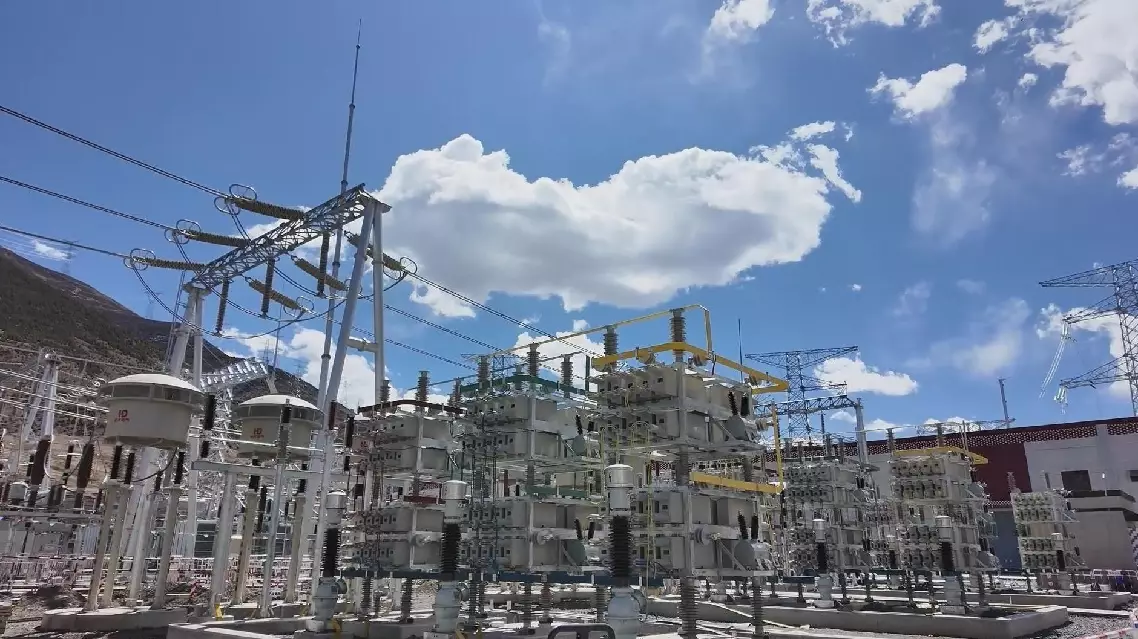
China ramps up power grid investment in January-March to boost growth