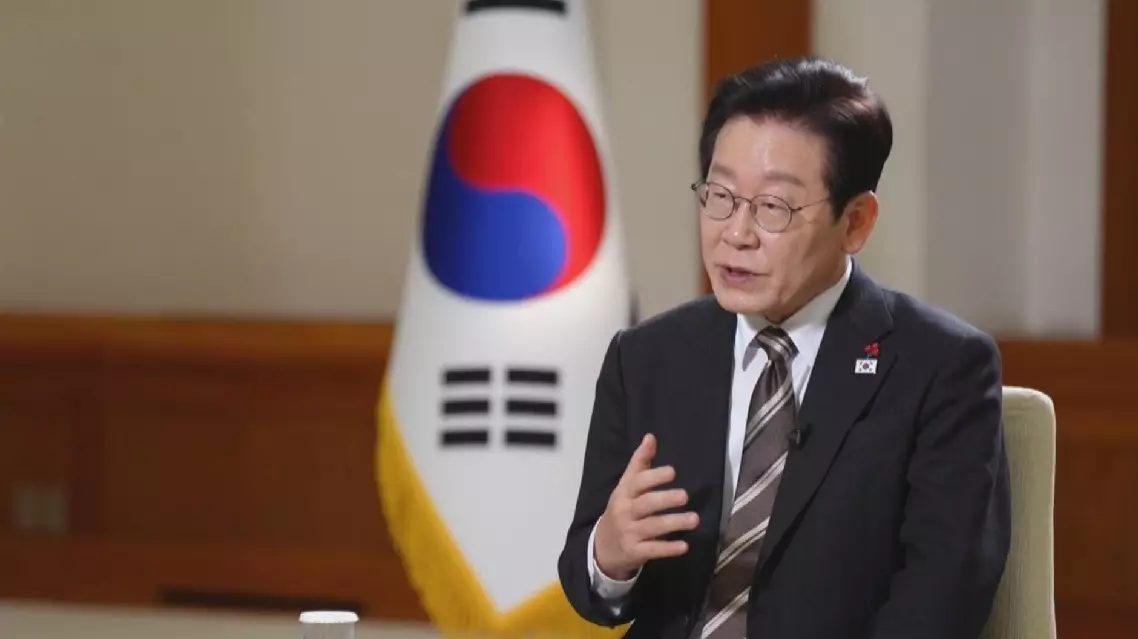
President of the Republic of Korea (ROK) Lee Jae Myung said on Wednesday that his country will continue pursuing a "pragmatic diplomacy" centered on national interests and strategic autonomy, while seeking coexistence and cooperation with China.
Before taking office in June 2025, Lee advocated pursuing "pragmatic diplomacy" centered on national interests, expanding the ROK's diplomatic influence, and achieving diversified foreign relations in his campaign.
"I heard there's a Chinese saying, 'Seeking truth from facts'. In international relations, nations naturally strive tirelessly to maximize their own interests. However, if this pursuit comes at the expense of other countries' interests, conflict becomes unavoidable. If all parties, while faithfully pursuing their national interests, can show maximum understanding of each other's positions, coordinate within reasonable bounds to reconcile conflicts of interests, and achieve greater benefits through cooperation, different countries can coexist," said Lee in an exclusive interview with China Central Television (CCTV) in the ROK's capital of Seoul.
When asked about his government's diplomatic approach to China, Lee acknowledged that some people have shown concerns about frictions in the bilateral relationship, but he said he is not worried at all.
"In relations between the ROK and China, some express concern over certain contradictions or opposing factors, but I am not worried about this. In the past, there was a prevailing notion of 'relying on the United States for security and on China for the economy.' I believe that the ROK's strategic autonomy is extremely important," Lee said.
In August 2025, Lee said that the ROK must not continue the policy of relying on the United States for security and on China for the economy. He explained the message behind is that the country's overriding goal is to improve the lives of its citizens and safeguard national interests, and that he wanted to signal a more balanced approach rather than a tilt against China.
"Ultimately, the existence of the ROK is to enable its citizens to lead a better life and to safeguard its national interests, and all actions should serve this objective. In this context, security cooperation with the United States is an unavoidable reality, given our military alliance. And our economic ties [with the United States] are indeed deepening. But this doesn't mean ROK-China relations should veer toward confrontation or conflict, which would not serve the ROK's national interests. Therefore, to the fullest extent possible, the ROK must seek coexistence and cooperation with China, actively and deeply exploring spaces for mutual benefit and win-win outcomes. To this end, more dialogue is essential, along with continual efforts to identify new areas of cooperation," said Lee.
"From this perspective, China may need the ROK just as the ROK needs China. Both sides should, through ongoing communication, discern what the other truly requires. For this reason, I believe summits between the ROK and China, even if not highly regularized, should at least be pursued once a year. Whether through my visit to China or a visit by the Chinese leader to the ROK, the format itself is unimportant. In this increasingly complex and challenging international environment, it becomes all the more necessary for us to engage in more frequent dialogue to jointly explore new paths and pursue better development. This is my position. I firmly believe that, through such efforts, ROK-China relations can be elevated and deepened to an extent that surpasses their current level," Lee added.
At the invitation of Chinese President Xi Jinping, Lee will pay a state visit to China from Jan 4 to 7.
ROK president on "pragmatic diplomacy"