TORONTO--(BUSINESS WIRE)--Jan 5, 2026--
Kraft Heinz, in partnership with the National Hockey League (NHL ® ) and the National Hockey League Players' Association (NHLPA), announced that nominations for the 20th anniversary year of Kraft Hockeyville are now open. Canadians can nominate their communities at KraftHockeyville.ca by answering just three questions until March 1, 2026, at 11:59 p.m. ET.
This press release features multimedia. View the full release here: https://www.businesswire.com/news/home/20260105910772/en/
Over the past two decades, Kraft Hockeyville has proven that hockey is more than a game–it’s the heart of Canadian communities, where local arenas serve as vital gathering places. Since 2006, the program has awarded $5.4 million to support 105 communities, and this year Kraft Hockeyville is honouring its 20-year legacy with its biggest program yet.
The milestone anniversary offers an expanded format that nearly triples the total prize pool from past Kraft Hockeyville competitions, ensuring even more communities across Canada can benefit from essential arena improvements. For the first time, the program will add a new phase in the contest format to recognize one Provincial & Territorial Winner from each of Canada’s 13 provinces and territories. This program expansion highlights Kraft Heinz’s commitment to supporting passionate hockey towns in every region of the country. This year’s new prize structure includes:
To spotlight the 2026 program and bring it to life, Kraft Hockeyville has teamed up with two ambassadors. Marc-André Fleury, recently retired NHL alumnus, brings his consistent, humble leadership shaped over a 21-year career. Joining him is NHL alumnus and top hockey media personality Paul Bissonnette, celebrated for his grit on the ice and bold, unmatched commentary off it. Together, Marc-André and Paul embody the spirit of Kraft Hockeyville with their heart, humour, and deep love for the game.
“Hockey isn’t just a game in Canada, it’s part of the community,” said Bissonnette. “Kraft Hockeyville gets that. For 20 years, it's energized local rinks and gotten people fired up. I remember playing in the Kraft Hockeyville NHL Pre-Season game in Vernon, B.C., back in 2016, and the local community was absolutely buzzing. That’s what hockey is all about."
Winning funds from Kraft Hockeyville ensure local arenas can keep their doors open, helping protect the future of hockey in communities where the rink is an essential gathering place. Over the past two decades, Kraft Hockeyville has helped unite communities around a shared love of hockey in countless ways. Over the years:
“Kraft Heinz has been part of the fabric of Canada for more than a century, and for the last twenty years, Kraft Hockeyville has been about spotlighting the way that hockey binds Canadians together. As we reflect on celebrating twenty years of Kraft Hockeyville, we’re proud to honour the communities that have shaped the program’s legacy,” said Simon Laroche, President, Kraft Heinz Canada. “This year’s new format lets us celebrate the enthusiasm and resilience of hockey towns in every province and territory. With more funding than ever awarded to a greater number of local communities, we’re thrilled to support even more rinks this year and keep fostering a deep love for the game.”
Community nominations close March 1, 2026, followed by judging. The 13 Provincial & Territorial Winners will be announced March 14, 2026, with the Kraft Hockeyville 2026 champion announced April 4, 2026. To nominate your community, learn more about the new program format or access full contest rules, visit KraftHockeyville.ca.
About Kraft Heinz Canada
Kraft Heinz Canada's heritage can be traced back over a century to when James Lewis Kraft of Stevensville, Ontario began selling cheese from a horse-drawn wagon in 1903. Heinz Canada was established in 1909 in Leamington, Ontario where its first products were pickles sourced from local growers. Following the 2015 merger between Kraft Foods Group and H.J. Heinz Company, Kraft Heinz Canada became a subsidiary of the newly formed Kraft Heinz Company (NASDAQ: KHC). Now the country's second largest food and beverage company, iconic Kraft Heinz Canada products like Kraft Peanut Butter, Heinz Ketchup, KD, Philadelphia Cream Cheese, Renées Dressing, Jell-O, Classico, Kool-Aid and Maxwell House are found in over 97 per cent of Canadian households.
Kraft Heinz Canada is driving transformation inspired by Kraft Heinz's global purpose, Let's Make Life Delicious, by creating memorable community moments through local initiatives such as Kraft Heinz Project Play and, of course, the impactful program we're celebrating here, Kraft Hockeyville, while also supporting food banks across Canada through Kraft Heinz Groceries for Good program. Learn more about our journey by visiting kraftheinz.com or following us on LinkedIn.
NHL and the NHL Shield are registered trademarks of the National Hockey League. © 2025 NHL. All Rights Reserved.
NHLPA and the NHLPA logo are registered trademarks of the National Hockey League Players’ Association. © NHLPA. All Rights Reserved.

Kraft Hockeyville 2026

Kraft Hockeyville 2026
WASHINGTON (AP) — President Donald Trump’s White House ballroom won final approval from a key agency on Thursday, despite a federal judge recently ordering a halt to construction unless Congress allows what would be the biggest structural change to the American landmark in more than 70 years.
The 12-member National Capital Planning Commission, the agency tasked with approving construction on federal property in the Washington region, went ahead with the vote because U.S. District Judge Richard Leon’s ruling — which came two days earlier — affects construction activities but not the planning process, said the commission's Trump-appointed chair, Will Scharf.
A vote of 8-1, with two commissioners voting present and one absent, allowed the plan to move forward.
Despite the agency’s approval, however, the judge’s ruling and a legal fight over the ballroom could stall progress on a legacy project that Trump is racing to see completed before the end of his term in early 2029. It’s among a series of changes the Republican president is planning for the nation’s capital to leave his lasting imprint while he’s still in office.
Before the vote, Scharf, a top White House aide, noted that Leon's order has been stayed for two weeks as the administration seeks an appeal. He said, as he understood the decision, it “really does not impact our action here today.”
Reading from notes, Scharf also delivered an impassioned defense of the project that reviewed the full history of the White House — including changes and additions that were criticized at the time they were made but have become beloved with the passage of time. He spoke about the addition of the north and south porticos and the balcony added by President Harry Truman.
Scharf suggested that Trump’s proposed ballroom will similarly come to be viewed as a wise addition — despite drawing contemporary opposition from some members of the public and government officials.
“I believe that, in time, this ballroom will be considered every bit of a national treasure as the other key components of the White House,” Scharf said.
Scharf also said the proposed ballroom has been viewed negatively because of opposition to Trump, instead of the merits, saying, “I feel that we’ve been unfairly slighted in the press and otherwise for the way we’ve gone about reviewing this particular project.”
The vote by the commission, which includes three members Trump gets to appoint, had initially been scheduled for March but was postponed to Thursday because so many people signed up to comment at the commission’s meeting last month. The comments were overwhelmingly opposed to the ballroom.
The lone “no” vote was cast by Phil Mendelson, a Democrat who chairs the Council of the District of Columbia. Linda Argo and Arrington Dixon, the two commissioners appointed by Mayor Muriel Bowser, a Democrat, voted present.
Mendelson criticized the design of the ballroom addition and how fast it was approved.
“It’s just too large,” he said.
Criticism also came from Public Citizen, a nonprofit consumer advocacy organization. One of its attorneys, Jon Golinger, said the commission had discounted opposition from city officials and thousands of people who commented against the project, and ignored the judge's ruling. Several commissioners, including Scharf, had said they took the public feedback seriously.
“This approval is illegitimate and this vote is a joke," Golinger said.
White House spokesperson Davis Ingle, commended the “decision to approve President Trump’s historic vision to build a much need ballroom at the White House.”
“We look forward to seeing the completion of this project on time and under budget," Ingle said in a statement.
Before voting, the commission considered some design changes to the 90,000-square-foot (8,400-square-meter) ballroom addition that the president announced aboard Air Force One on Sunday, as he flew back to Washington from a weekend at his Florida home.
He removed a large staircase on the south side of the building and added an uncovered porch to the west side. Architects and other critics of the project had panned the staircase as too large and basically useless since there was no way to enter the ballroom at the top.
A White House official said the president had considered comments from the National Capital Planning Commission and another oversight entity, the U.S. Commission of Fine Arts, which approved the project earlier this year, as well as members of the public.
The official, who was not authorized to publicly discuss the ballroom design and spoke on the condition of anonymity, said that additional “refinements” had been made to the building’s exterior.
The ballroom, now estimated to cost $400 million, has expanded in scope and price tag since Trump first announced the project last summer, citing a need for space other than a tent on the lawn to host important guests. Trump demolished the East Wing in October with little warning, and site preparation and underground work have been underway since then.
Two other Trump-appointed commissioners, Stuart Levenbach and James Blair, voted for the project.
Levenbach, who serves as vice chairman and is the federal government’s chief statistician, said the White House is currently “not suited” to accommodate large numbers of guests and that the addition will improve the “utility” of the compound.
He said tunnels and other structures underground at the White House made it impossible to place many features of the ballroom there, too, as some have suggested might be possible. Levenbach said the addition is a “multipurpose facility,” noting that, in addition to a ballroom, it will also have offices for the first lady, kitchen space and a theater.
“This is not an expansion for its own sake,” Levenbach said.
Blair, a deputy to White House chief of staff Susie Wiles, said visitors and guests of the president deserve a “better experience."
Scharf and Blair also said Trump will get “very limited use” of the ballroom before his term ends.
Trump went ahead with the project before seeking input from the National Capital Planning Commission and the Commission of Fine Arts, which he reconstituted with allies and supporters.
The National Trust for Historic Preservation, a private nonprofit organization, sued after Trump demolished the East Wing last fall to build the ballroom addition — a space nearly twice as big as the mansion itself.
Trump says it will be paid for with donations from wealthy people and corporations, including him, though public dollars are paying for underground bunkers and security upgrades.
The trust sought a temporary halt to construction until Trump presented the project to both commissions and Congress for approval. Leon agreed but said that his order would take effect in two weeks and that construction related to security would be allowed.

President Donald Trump answers questions from reporters after signing an executive order in the Oval Office of the White House Tuesday, March 31, 2026, in Washington. (AP Photo/Alex Brandon)
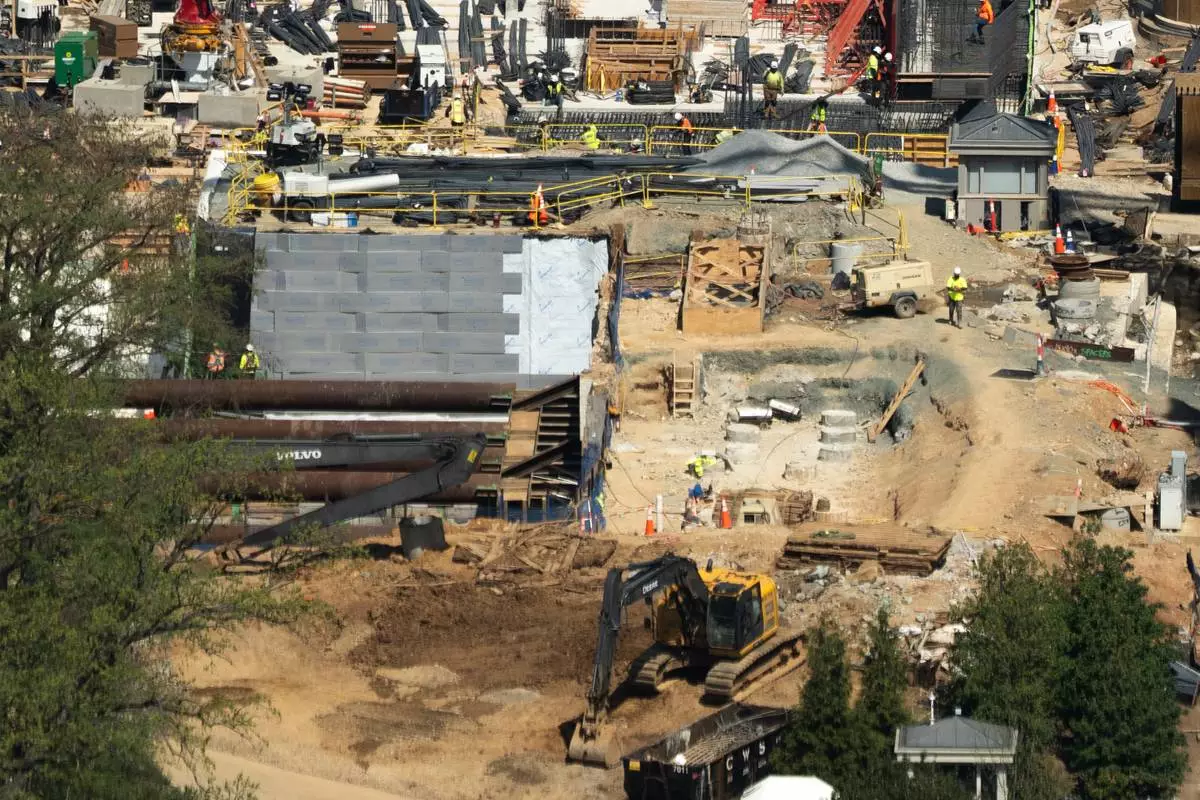
Work continues on the construction of the ballroom at the White House in Washington, Wednesday, April 1, 2026. (AP Photo/Allison Robbert)

President Donald Trump holds a rendering of the proposed new East Wing of the White House as he speaks to reporters aboard Air Force One en route from West Palm Beach, Fla., to Joint Base Andrews, Md., Sunday, March 29, 2026. (AP Photo/Mark Schiefelbein)
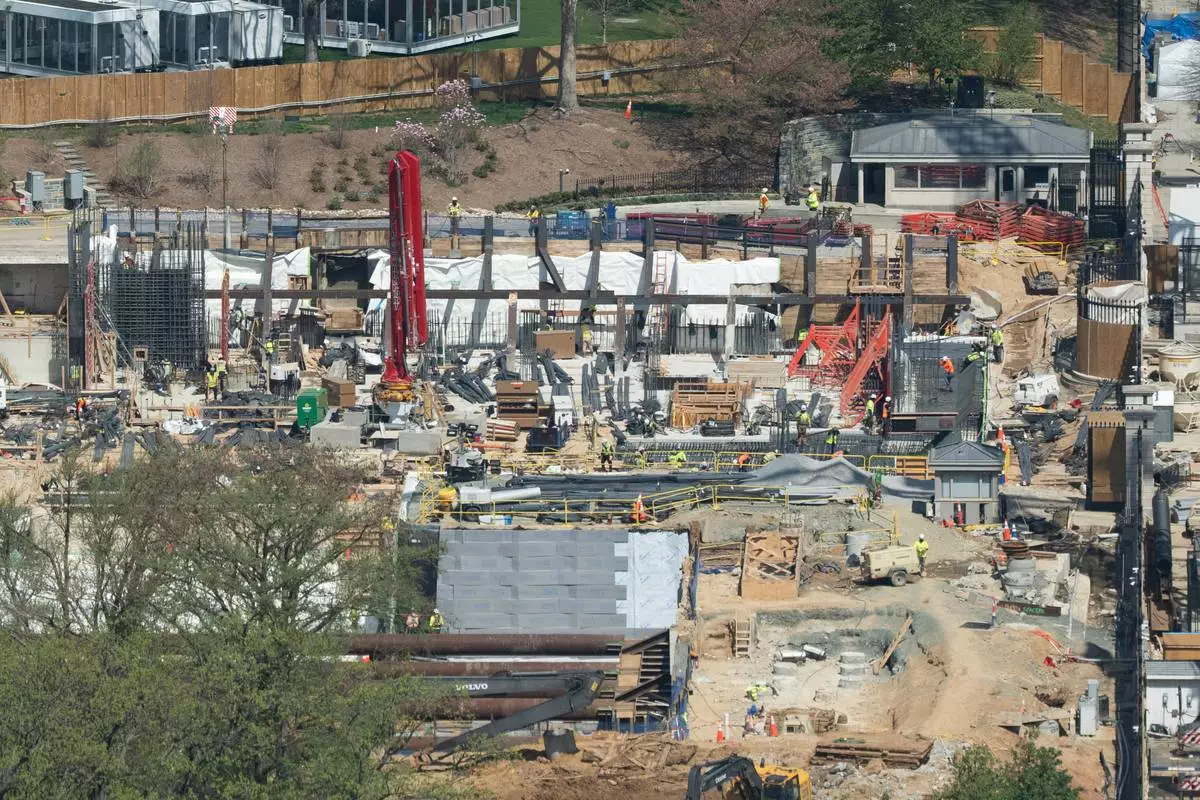
Work continues on the construction of the ballroom at the White House in Washington, Wednesday, April 1, 2026. (AP Photo/Allison Robbert)

President Donald Trump holds a rendering of the proposed new East Wing of the White House as he speaks to reporters aboard Air Force One en route from West Palm Beach, Fla., to Joint Base Andrews, Md., Sunday, March 29, 2026. (AP Photo/Mark Schiefelbein)