The U.S. seized two sanctioned oil tankers linked to Venezuela in back-to-back actions in the North Atlantic and the Caribbean, officials said Wednesday.
U.S. European Command announced the seizure of the merchant vessel Bella 1 for “violations of U.S. sanctions.” A Coast Guard cutter had pursued the tanker into the waters between Scotland and Iceland after it tried to avoid being ensnared by the U.S. blockade on sanctioned oil vessels around Venezuela.
Then, Secretary of Homeland Security Kristi Noem revealed that U.S. forces also took control of the tanker Sophia in the Caribbean. In a social media post, she said both ships were “either last docked in Venezuela or en route to it.”
The Bella 1 was reflagged as Russian and renamed the Marinera after turning toward Europe. The U.S. military handed control of it to law enforcement officials after seizing it, said a U.S. official, who spoke to The Associated Press on Wednesday on the condition of anonymity to discuss sensitive military operations. The ship was sanctioned by the U.S. in 2024 for allegedly smuggling cargo for a company linked to Lebanese militant group Hezbollah, which is backed by Iran.
The Latest:
“Mexico has become an important supplier” of oil to Cuba in the wake of the U.S. attack on Venezuela, Sheinbaum said Wednesday, but she noted that “no more oil is being sent than has been sent historically; there is no particular shipment.”
After widespread protests in Cuba in 2021, Mexico sent one of its largest humanitarian aid shipments, which included 100,000 barrels of fuel. And in October 2024, it sent more than 400,000 barrels in just a few days following serious blackouts in Cuba, according to data provided at the time by Jorge Piñón of the Energy Institute at the University of Texas at Austin, which tracks shipments using oil tracking services and satellite technology.
Piñón said Mexico had been supplying Cuba with 22,000 barrels of oil per day after that, but shipments dropped to 7,000 barrels after U.S. Secretary of State Marco Rubio visited Mexico City in September 2025.
Russia’s Ministry of Transport said in a statement Wednesday that U.S. Navy forces boarded the Marinera tanker “outside the territorial waters of any state,” and that “contact with the vessel was lost.”
On Dec. 24, 2025, the vessel “received a temporary permit to fly the Russian Federation flag, issued in accordance with Russian law and international law,” the ministry said.
Russia’s Foreign Ministry said before the seizure that it was “following with concern the anomalous situation that has developed around the Russian oil tanker Marinera.”
Immediately following news of the seizure, the transport ministry statement noted that “no state has the right to use force against vessels duly registered in the jurisdictions of other states,” citing the 1982 U.N. Convention on the Law of the Sea.
Ship tracking data show the Marinera was not carrying any oil when it was boarded by U.S. forces.
It was cruising across the Atlantic nearing the Caribbean on Dec. 15 when it abruptly turned and changed its heading north, toward Europe. The change in direction came days after the U.S. seized another sanctioned tanker, the Skipper, on Dec. 10 after it had left Venezuela carrying a cargo of oil.
The Marinera’s past location signals show it stopped in the Iranian port of Shahid Rajaee in March and then remained at anchor near the entrance to the Persian Gulf until November, when it set off through the Suez Canal and headed west.
The ship is part of a large “shadow fleet” of sanctioned vessels that carry oil from Russia, Iran and Venezuela in defiance of Western sanctions, mostly to customers in Asia.
Russia’s Foreign Ministry said before the seizure that it was “following with concern the anomalous situation that has developed around the Russian oil tanker Marinera.”
The ministry’s statement, which was carried by the official Tass news agency, added that “for several days now, a U.S. Coast Guard ship has been following the Marinera, even though our vessel is approximately 4,000 km from the American coast.”
On Wednesday, open-source maritime tracking sites showed its position as between Scotland and Iceland, traveling north. The U.S. official also confirmed the ship was in the North Atlantic.
In a post to social media, the U.S. European Command confirmed that the U.S. Coast Guard Cutter Munro tracked the ship ahead of its seizure “pursuant to a warrant issued by a U.S. federal court.”
The military command went on to say that the seizure supported Trump’s proclamation on targeting sanctioned vessels that “threaten the security and stability of the Western Hemisphere.”
A U.S. official says U.S. forces have boarded a Venezuela-linked sanctioned oil tanker in North Atlantic after pursuing it for weeks. The official spoke to The Associated Press on Wednesday the condition of anonymity to discuss sensitive military operations.
The U.S. had been pursuing the tanker since last month after it tried to evade a U.S. blockade around Venezuela.
In 2017, as political outsider Donald Trump headed to Washington, Delcy Rodríguez spotted an opening.
Then Venezuela’s foreign minister, Rodríguez directed Citgo — a subsidiary of the state oil company — to make a $500,000 donation to the president’s inauguration. With the socialist administration of Nicolas Maduro struggling to feed Venezuela, Rodríguez gambled on a deal that would have opened the door to American investment.
Around the same time, she saw that Trump’s ex-campaign manager was hired as a lobbyist for Citgo, courted Republicans in Congress and tried to secure a meeting with the head of Exxon. The charm offensive flopped, but it made Rodríguez a prominent face in U.S. business and political circles, paving the way for her own rise. And nearly a decade later, as Venezuela’s interim president, Rodríguez’s message — that Venezuela is open for business — seems to have persuaded Trump.
In the days since Maduro’s stunning capture Saturday, he’s alternately praised Rodríguez as a “gracious” American partner while threatening a similar fate as her former boss if she doesn’t keep the ruling party in check and provide the U.S. with “total access” to the country’s vast oil reserves. One thing neither has mentioned is elections, something the constitution mandates must take place within 30 days of the presidency being permanently vacated.
▶ Read more about Delcy Rodríguez and her relationship with Trump
Russian officials indicated in 2019 that the Kremlin would be willing to back off from its support for Nicolás Maduro in Venezuela in exchange for a free hand in Ukraine, according to Fiona Hill, an adviser to President Donald Trump at the time.
The Russians repeatedly floated the idea of a “very strange swap arrangement between Venezuela and Ukraine,” Hill said during a congressional hearing in 2019. Her comments surfaced again this week and were shared on social media after the U.S. stealth operation to capture Maduro.
Hill said Russia pushed the idea through articles in Russian media that referenced the Monroe Doctrine — a 19th-century principle in which the U.S. opposed European meddling in the Western Hemisphere and in return agreed to stay out of European affairs. It was invoked by Trump to justify the U.S. intervention in Venezuela.
Even though Russian officials never made a formal offer, Moscow’s then-ambassador to the United States, Anatoly Antonov, hinted many times to her that Russia was willing to allow the United States to act as it wished in Venezuela if the U.S. did the same for Russia in Europe, Hill told The Associated Press this week.
▶ Read more about the former adviser’s remarks
On the fifth anniversary of Jan. 6, 2021, there is no official event to memorialize what happened that day, when the mob made its way down Pennsylvania Avenue, battled police at the Capitol barricades and stormed inside, as lawmakers fled. The political parties refuse to agree on a shared history of the events, which were broadcast around the globe. And the official plaque honoring the police who defended the Capitol has never been hung.
Instead, the day displayed the divisions that still define Washington, and the country, and the White House itself issued a glossy new report with its own revised history of what happened.
Trump, during a lengthy morning speech to House Republicans away from the Capitol at the rebranded Kennedy Center now carrying his own name, shifted blame for Jan. 6 onto the rioters themselves. Democrats meanwhile reconvened members of the House committee that investigated the attack for a panel discussion to prevent what Rep. Jamie Raskin, D-Md., described as the GOP’s “Orwellian project of forgetting.”
▶ Read more about the anniversary of the Jan. 6 attack
Denmark and Greenland are seeking a meeting with U.S. Secretary of State Marco Rubio after the Trump administration doubled down on its intention to take over the strategic Arctic island, a Danish territory.
This weekend’s U.S. military action in Venezuela has heightened fears across Europe, and Trump and his advisers in recent days have reiterated the U.S. leader’s desire to take over the island, which guards the Arctic and North Atlantic approaches to North America.
“It’s so strategic right now,” Trump told reporters Sunday.
Danish Foreign Minister Lars Løkke Rasmussen and his Greenlandic counterpart, Vivian Motzfeldt, have requested the meeting with Rubio in the near future, according to a statement posted Tuesday to Greenland’s government website.
Previous requests for a sit-down were not successful, the statement said.
▶ Read more about Trump’s interest in Greenland
Trump said Tuesday that the nation would provide 30 to 50 million barrels of oil to the U.S., pledging to use proceeds from the sale of this oil “to benefit the people” of both countries. The Venezuelan government had no immediate comment on this announcement. White House is organizing a meeting Friday with U.S. oil company executives from companies like Exxon and Chevron to discuss Venezuela, according to a person familiar with the matter who requested anonymity to discuss the plans.
The administration is withholding funding for programs that support needy families with children in five Democratic-led states over concerns about fraud — California, Colorado, Illinois, Minnesota and New York.
The U.S. Department of Health and Human Services, which oversees the program, will require the states to provide extra documentation to access the funds, but the administration did not detail the fraud allegations. Gov. Kathy Hochul said New York is prepared to litigate to maintain support for some of the poorest American families.
Trump voters interviewed by AP journalists around the country praised the operation and expressed faith in Trump’s course — but not always limitless faith. Trump’s intensifying rhetoric about expanding U.S. power elsewhere in the hemisphere made some of his die-hard supporters nervous.
Polling conducted in the immediate aftermath of the military operation suggested that many Americans are unconvinced that the U.S. should step in to take control of the country.
FILE - Venezuelan Vice President Delcy Rodriguez smiles during a press conference at the Miraflores presidential palace in Caracas Venezuela, Nov. 18, 2024. (AP Photo/Ariana Cubillos, File)
Graffiti that reads in Spanish, "Trump: murderer, kidnapper, pedophile, damned," left, and "Long live peace," covers a kiosk during a march to demand President Nicolas Maduro's return, in Caracas, Venezuela, Tuesday, Jan. 6, 2026, three days after U.S. forces captured him and his wife. (AP Photo/Matias Delacroix)
FILE - The northern lights appear over homes in Nuuk, Greenland, on Feb. 17, 2025. (AP Photo/Emilio Morenatti, File)
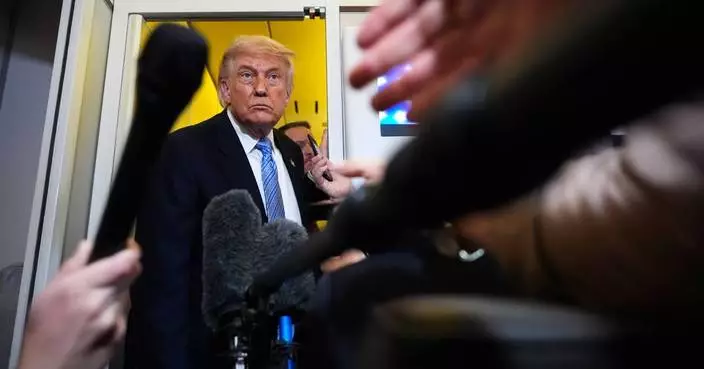
President Donald Trump speaks to House Republican lawmakers during their annual policy retreat, Tuesday, Jan. 6, 2026, in Washington. (AP Photo/Evan Vucci)