U.S. stocks closed higher on Tuesday, extending early-year gains as investors digested competing AI roadmaps from major chipmakers.
The Dow Jones Industrial Average advanced 0.99 percent to 49,462.08, marking consecutive record closes for the blue-chip benchmark. The Standard and Poor's 500 rose 0.62 percent to a new record high of 6,944.82. The Nasdaq Composite Index increased 0.65 percent to 23,547.17.
Nine of the 11 primary Standard and Poor's 500 sectors ended higher, led by materials and health care with increases of 2.04 percent and 1.96 percent, respectively. Meanwhile, energy and communication services led the laggards by going down 2.81 percent and 0.49 percent, respectively.
Nvidia and AMD shares slid 0.47 percent and 3.04 percent, respectively. Notable performers in the technology sector included Amazon, Micron Technology and Broadcom.
Market participants are shifting focus to an intensive week of economic indicators, particularly labor market data, including upcoming releases on job openings, private payrolls, and the closely watched December non-farm payrolls report later in the week.
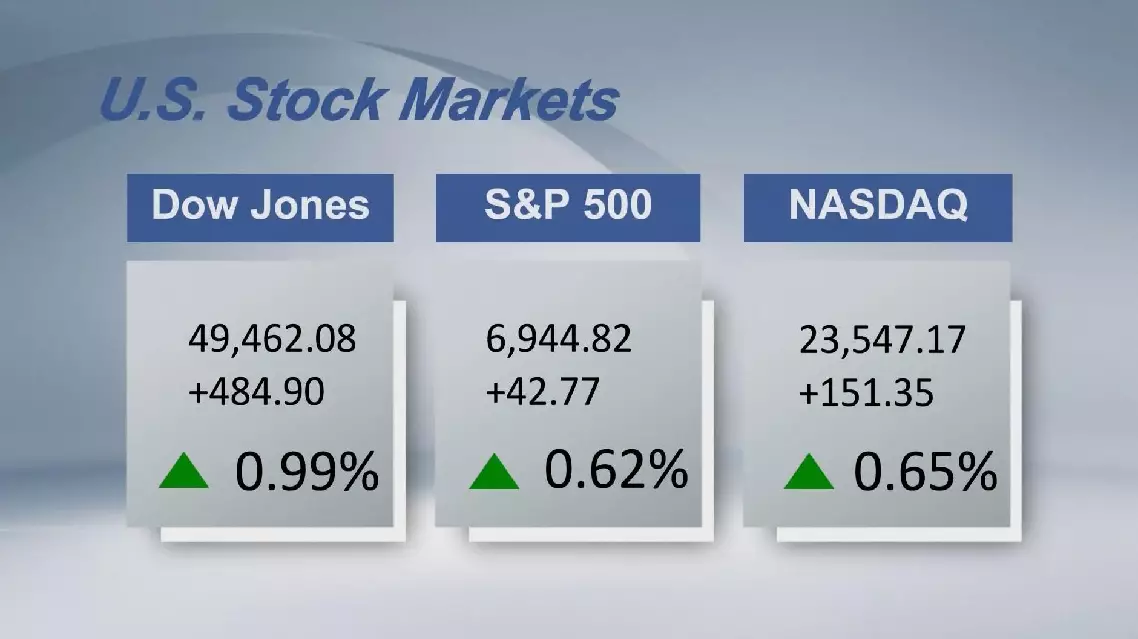
U.S. stocks extend early-year gains
China has made progress in scientific data simulation for the Chinese Space Station Telescope (CSST), also known as the Xuntian Space Telescope, marking a crucial step in preparing for the country's flagship space astronomy facility.
A collaborative Chinese research team built an end-to-end observation simulation suite for both the telescope's main optical system and various observation terminals.
The suite achieved high-quality, pixel-level simulation of observation data, which will be used for the comprehensive evaluation of the telescope's overall performance.
The research was published online Wednesday in a special issue of the journal Research in Astronomy and Astrophysics, and is expected to lay the foundation for high-yield original scientific output after the telescope is launched.
The CSST is a major space astronomy facility planned as part of China's manned space program. Equipped with a 2-meter-aperture primary mirror, the telescope features a large field of view, high image quality and wide waveband coverage.
It is expected to facilitate major scientific discoveries across various astrophysical fields, including cosmology, the study of galaxies, the Milky Way, stars and planets, according to the National Astronomical Observatories under the Chinese Academy of Sciences (NAOC), which led the study.
Scientific simulation is an indispensable procedure prior to the launch. It acts as a "digital rehearsal" for the mission, generating mock data to validate the process flow and optimize observation strategies before the launch.
The CSST is an important component of China's space station. After launch, it will fly independently in the same orbit as the space station and can dock with the station for supply, maintenance and upgrades.
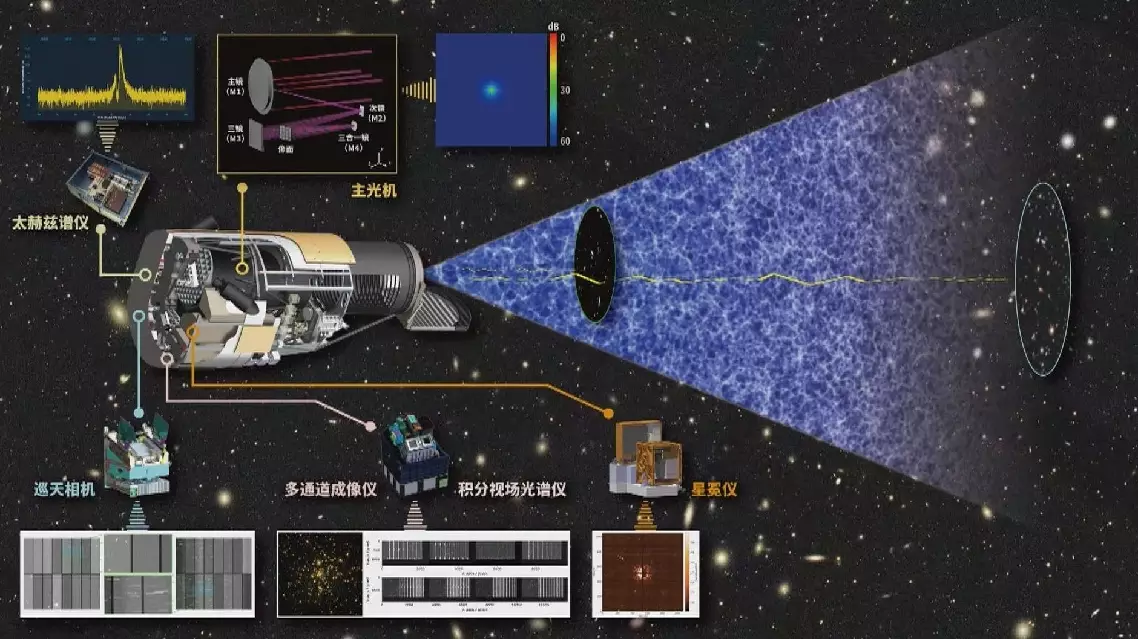
Key breakthrough achieved in data simulation for China's Space Telescope