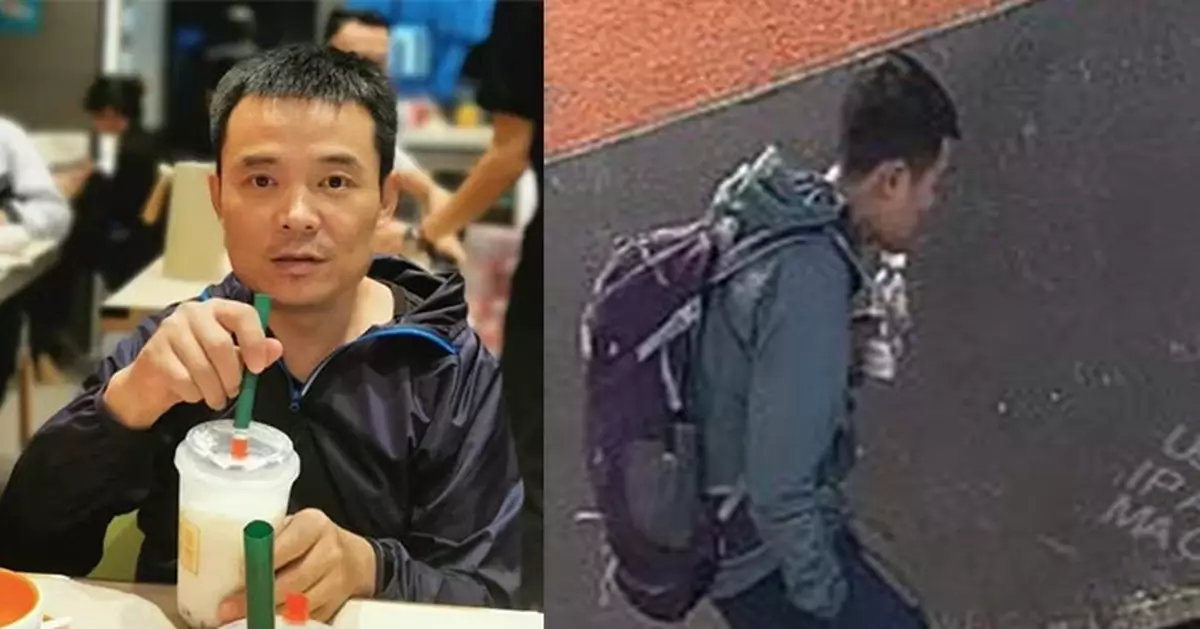
Appeal for information on missing man in Tseung Kwan O
Police today (January 7) appealed to the public for information on a man who went missing in Tseung Kwan O.
Ye Zhihui, a Mainland man aged 47, went missing after he was last seen at Tai Au Mun, Tseung Kwan O on January 5 morning. His family made a report to Police on the same day.
He is about 1.65 metres tall, 63 kilograms in weight and of medium build. He has a square face with yellow complexion and short black hair. He was last seen wearing a greyish blue long-sleeved jacket, dark trousers, dark grey shoes and carrying a purple backpack.
Anyone who knows the whereabouts of the missing man or may have seen him is urged to contact the Regional Missing Persons Unit of New Territories North on 3661 3128, or email to rmpu-ntn-1@police.gov.hk, or contact any police station.

Appeal for information on missing man in Tseung Kwan O Source: HKSAR Government Press Releases

Appeal for information on missing man in Tseung Kwan O Source: HKSAR Government Press Releases
CEDD commended by Ombudsman on slope safety work
Regarding the report on the direct investigation into the Government's work on landslide prevention and mitigation and management of government slopes released by the Office of the Ombudsman today (January 8), the Civil Engineering and Development Department (CEDD) welcomed the Office's high commendation and recognition of the department's efforts in implementing the Landslip Prevention and Mitigation Programme (LPMitP) and regulating slope safety. The CEDD accepts the Office's recommendations and will fully implement various initiatives while continuously reviewing their effectiveness. In response to the Office's recommendations, the CEDD will continue to strengthen its overall capability in responding to landslide risks in four areas, namely preparedness, early warning, emergency response and recovery, to keep enhancing slope safety.
On preparedness, applying a risk-based approach under the LPMitP, the CEDD systematically selects government man-made slopes for upgrading works and natural hillside catchments for mitigation measures annually. Starting from 2025, the CEDD has been progressively increasing the annual targets under the LPMitP and optimising the slope selection mechanism to strengthen resilience of slopes to heavy rain. The CEDD will review the LPMitP's targets and effectiveness in response to environmental changes, ensuring the LPMitP's continued efficacy.
The CEDD plans to fully roll out the Smart Slope Catalogue this year, integrating records of mitigation works, maintenance, rainfall endured, and landslides to expand comprehensive monitoring and data management related to slopes. By applying artificial intelligence for big data analysis, the catalogue will improve the functionality and efficiency of slope safety management, thereby better preparing for extreme weather.
On early warning, the CEDD will fully commission the AI Landslip Warning System in the wet season of this year. The system integrates Hong Kong's rainfall data and information in the Smart Slope Catalogue, and applies machine learning and big data analytics, to boost the accuracy of the predicted number of landslides during heavy rain, thereby enhancing the capability for landslide risk assessment and improving the reliability of the issuance of Landslip Warning.
On emergency response and recovery, the CEDD will stay abreast of the technological advancements in slope safety, and developing and introducing innovative technologies. This includes piloting applications of a smart unmanned drone management system on slope monitoring and emergency management to expand data collection and analytics capabilities. The CEDD will also continue to strengthen collaboration with relevant departments, such as sharing on common maintenance issues and assessment of the impact of heavy rain on slopes, with a view to enhancing slope safety and reducing landslide risk.
The Office noted that the landslide incident rate for government slopes is relatively higher and that there are cases of repeated occurrences. In fact, this is mainly related to the categorisation of slopes and their potential impact, reflecting the government's risk-based approach to slope management. The man-made slopes maintained by the government are distributed over an extensive area, possess diversified nature, and have different levels of risks. These include slopes with relatively high, medium, and relatively low potential impacts, categorised mainly by the risk of loss of life in the event of a landslide. To ensure public safety, the government will prioritise landslide prevention works on slopes that pose a higher potential impact. Some of the government slopes that fall into medium or relatively low potential impact categories may not be accorded priority because of their relatively remote locations or a lower risk of loss of life. As such, those government slopes with medium and relatively low potential impacts may also experience landslides under a risk-controlled condition. On the contrary, private man-made slopes are more similar in nature. Most of them are close to private residences and would pose greater impact on the residents in the event of a landslide. They are generally categorised as having relatively high potential impact and receive a higher level of attention. This explains why the overall landslide incident rate for government slopes appears higher, and why landslides may occur repeatedly on some individual slopes with medium or relatively low potential impacts.
In fact, between 2020 and 2024, the annual landslide incident rates for both government and private man-made slopes remained below one per cent (ranging from 0.1 per cent to 0.6 per cent for government slopes and 0.03 per cent to 0.3 per cent for private slopes), which is a very low level. Overall, an average of about 214 incidents were recorded annually over the past decade (2015 to 2024), representing a decrease of nearly one-third compared to the average of about 300 incidents between 1989 and 2014. This reflects the notable results achieved through the ongoing prevention and mitigation efforts.
In response to the landslide incidents triggered by the extreme rainstorm in September 2023, the CEDD has completed a systematic review and study, putting forward a number of recommendations to optimise the LPMitP. New measures include expediting the progress of LPMitP and prioritising, under a risk-based approach, the risk management of man-made slopes located along sole vehicular accesses and those with a greater potential impact on the public's daily lives. The CEDD thanks the Ombudsman for recognising in its report the department's timely review and adjustment of the direction of the LPMitP, acknowledging that such an approach is proactive and effective in adapting to changing circumstances.
The CEDD will continue to closely monitor slope safety in Hong Kong and remains committed to enhancing slope safety management through collaboration, driving Hong Kong's development as a resilient and livable world-class city.

Source: AI-found images