Offshore wind developers affected by the Trump administration’s freeze of five big projects on the East Coast are fighting back in court, with one developer saying its project will likely be terminated if they can’t resume by the end of next week.
Norwegian company Equinor and the Danish energy company Orsted are the latest to sue, with the limited liability companies for their projects filing civil suits late Tuesday. Connecticut and Rhode Island filed their own request on Monday seeking a preliminary injunction for a third project.
The administration announced Dec. 22 it was suspending leases for at least 90 days on the five offshore wind projects because of national security concerns. Its announcement did not reveal specifics about those concerns.
President Donald Trump has been hostile to renewable energy technologies that produce electricity cleanly, particularly offshore wind, and has instead prioritized oil, coal and natural gas that emit carbon pollution when burned.
Interior Department spokesperson Matt Middleton said Wednesday that Trump has directed the agency to manage public lands and waters for multiple uses, energy development, conservation and national defense. Middleton said the pause on large-scale offshore wind construction is a “decisive step to protect America’s security, prevent conflicts with military readiness and maritime operations and ensure responsible stewardship of our oceans.”
“We will not sacrifice national security or economic stability for projects that make no sense for America’s future,” Middleton said in a statement.
Equinor owns the Empire Wind project and Orsted owns Sunrise Wind, major offshore wind farms in New York. Empire Wind LLC requested expedited consideration by the U.S. District Court for the District of Columbia, saying the project faces “likely termination” if construction can’t resume by Jan. 16. It said the order is disrupting a tightly choreographed construction schedule dependent on vessels with constrained availability, resulting in delay costs and causing an existential threat to the project financing.
Orsted is also asking a judge to vacate and set aside the order. The company says it has spent billions of dollars on Sunrise Wind, relying on validly issued permits from the federal government. It said in the filing that its team met weekly with the Coast Guard throughout 2025, and this week, with representatives from other agencies frequently attending, and no one raised national security concerns.
The administration's order paused the leases for these two projects, as well as for the Vineyard Wind project under construction in Massachusetts, Revolution Wind in Rhode Island and Connecticut, and Coastal Virginia Offshore Wind in Virginia.
Dominion Energy Virginia, which is developing Coastal Virginia Offshore Wind, was the first to sue. It's asking a judge to block the order, calling it “arbitrary and capricious” and unconstitutional.
Orsted is building Revolution Wind with its joint venture partner Skyborn Renewables. They have filed a complaint over the order on behalf of the venture.
The filing by Connecticut and Rhode Island seeks to allow work on Revolution Wind to continue.
“Every day this project is stalled costs us hundreds of thousands of dollars in inflated energy bills when families are in dire need of relief,” Connecticut Attorney General William Tong said in a statement. “Revolution Wind was vetted and approved, and the Trump administration has yet to disclose a shred of evidence to counter that thorough and careful process.”
Avangrid is a joint owner along with Copenhagen Infrastructure Partners of the Vineyard Wind project. They have not indicated publicly whether they plan to join the rest of the developers in challenging the administration.
The Trump administration previously halted work on both Empire Wind and Revolution Wind. In April, it stopped construction on Empire Wind, accusing the Biden administration of rushing the permits, then allowed work to resume a month later. Equinor finalized the federal lease for Empire Wind in March 2017, early in Trump’s first term. The final federal approval was in February 2024.
Work on the nearly completed Revolution Wind project was paused on Aug. 22 for what the Bureau of Ocean Energy Management said were national security concerns. A month later, a federal judge ruled the project could resume, citing the irreparable harm to the developers and the demonstrated likelihood of success on the merits of their claim.
The Associated Press’ climate and environmental coverage receives financial support from multiple private foundations. AP is solely responsible for all content. Find AP’s standards for working with philanthropies, a list of supporters and funded coverage areas at AP.org.
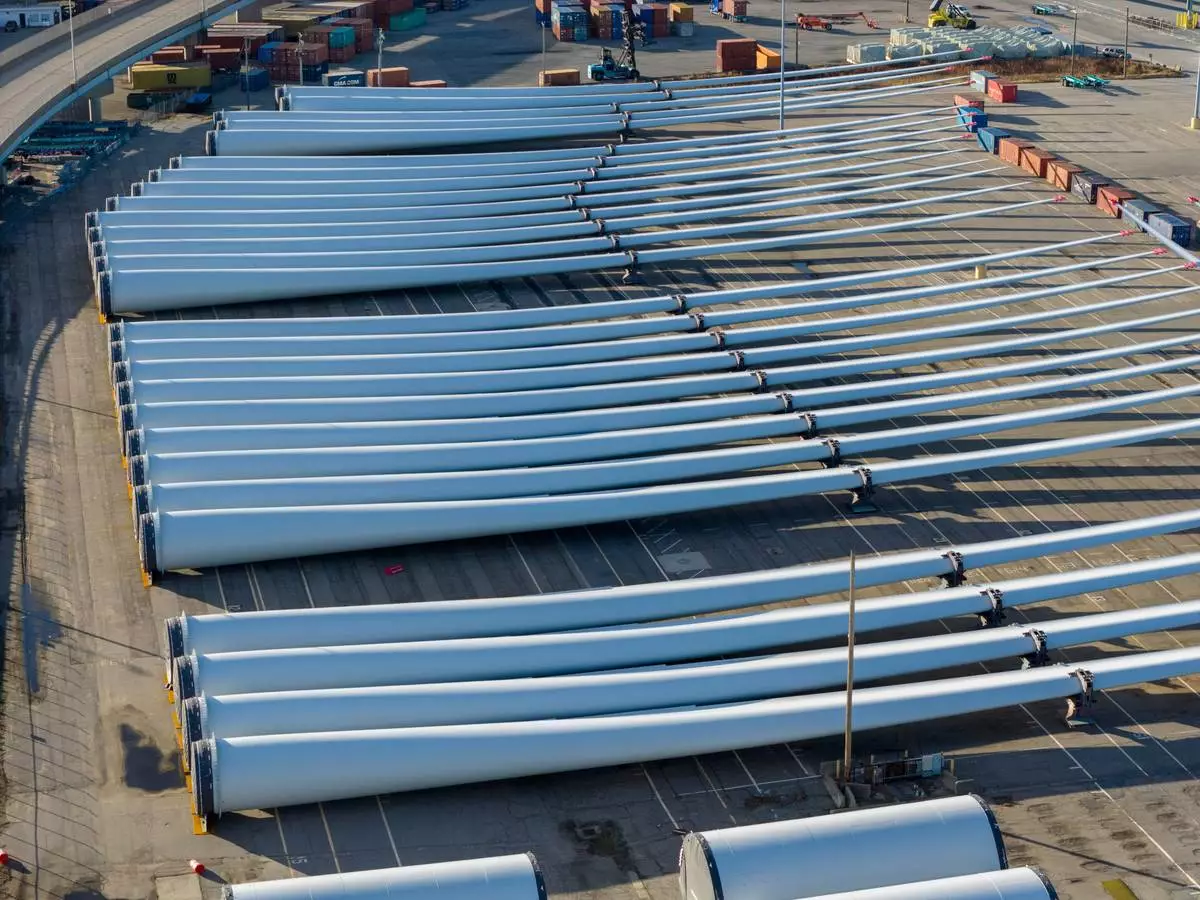
FILE - Wind turbine blades sit at The Portsmouth Marine terminal that is the staging area for Dominion Energy Virginia, which is developing Coastal Virginia Offshore Wind, Dec. 22, 2025, in Portsmouth, Va. (AP Photo/Steve Helber, File)
FILE - A sign for the company Equinor is displayed on Oct. 28, 2020, in Fornebu, Norway. (Håkon Mosvold Larsen/NTB Scanpix via AP, File)
FILE - The logo for the Danish company Orsted is displayed on the exterior of the Avedore Power Station in Hvidovre, Copenhagen, Aug. 19, 2025. (Sebastian Elias Uth/Ritzau Scanpix via AP)