Skip to Content Facebook Feature Image

Judge to temporarily block effort to end protections for relatives of citizens, green card holders

News

Judge to temporarily block effort to end protections for relatives of citizens, green card holders
News

News

Judge to temporarily block effort to end protections for relatives of citizens, green card holders

2026-01-10 04:29 Last Updated At:04:31

BOSTON (AP) — A federal judge said Friday that she expects to temporarily block efforts by the Trump administration to end a program that offered temporary legal protections for more than 10,000 family members of citizens and green card holders.

U.S. District Judge Indira Talwani said at a hearing that she planned to issue a temporary restraining order but did not say when it would be issued. This case is part of a broader effort by the administration to end temporary legal protection for numerous groups and comes just over a week since another judge ruled that hundreds of people from South Sudan may live and work in the United States legally.

“The government, having invited people to apply, is now laying traps between those people and getting the green card,” Justin Cox, an attorney who works with Justice Action Center and who argued the case for the plaintiffs, said. “That is incredibly inequitable.”

This case involved a program called Family Reunification Parole, or FRP, and impacts people from Colombia, Cuba, Ecuador, El Salvador, Guatemala, Haiti and Honduras. Most of them are set to lose their legal protections, which were put in place during the Biden administration, by Jan. 14. The Department of Homeland Security terminated protections late last year.

The case involves five plaintiffs but lawyers are seeking to have any ruling cover everyone that is part of the program.

“Although in a temporary status, these parolees did not come temporarily; they came to get a jump-start on their new lives in the United States, typically bringing immediate family members with them,” plaintiffs wrote in their motion. “Since they arrived, FRP parolees have gotten employment authorization documents, jobs, and enrolled their kids in school.”

The government, in its brief and in court, argued Homeland Security Secretary Kristi Noem has the authority to terminate any parole program and gave adequate notice by publishing the termination in the federal registry. It also argued that the program's termination was necessary on national security grounds because the people had not been property vetted. It also said resources to maintain this program would be better used in other immigration programs.

“Parole can be terminated at any time,” Katie Rose Talley, a lawyer for the government told the court. "That is what is being done. There is nothing unlawful about that."

Talwani conceded that the government can end the program but she took issue with the way it was done.

The government argued that just announcing in the federal registry that it was ending the program was sufficient. But Talwani demanded the government show how it has alerted people through a written notice — a letter or email — that the program was ending.

“I understand why plaintiffs feel like they came here and made all these plans and were going to be here for a very long time,” Talwani said. “I have a group of people who are trying to follow the law. I am saying to you that, we as Americans, the United States needs to.”

Lower courts have largely supported keeping temporary protections for many groups. But in May, the Supreme Court cleared the way for the Trump administration to strip temporary legal protections from hundreds of thousands of immigrants for now, pushing the total number of people who could be newly exposed to deportation to nearly 1 million.

The justices lifted a lower-court order that kept humanitarian parole protections in place for more than 500,000 migrants from four countries: Cuba, Haiti, Nicaragua and Venezuela. The decision came after the court allowed the administration to revoke temporary legal status from about 350,000 Venezuelan migrants in another case.

The court did not explain its reasoning in the brief order, as is typical on its emergency docket. Two justices publicly dissented.
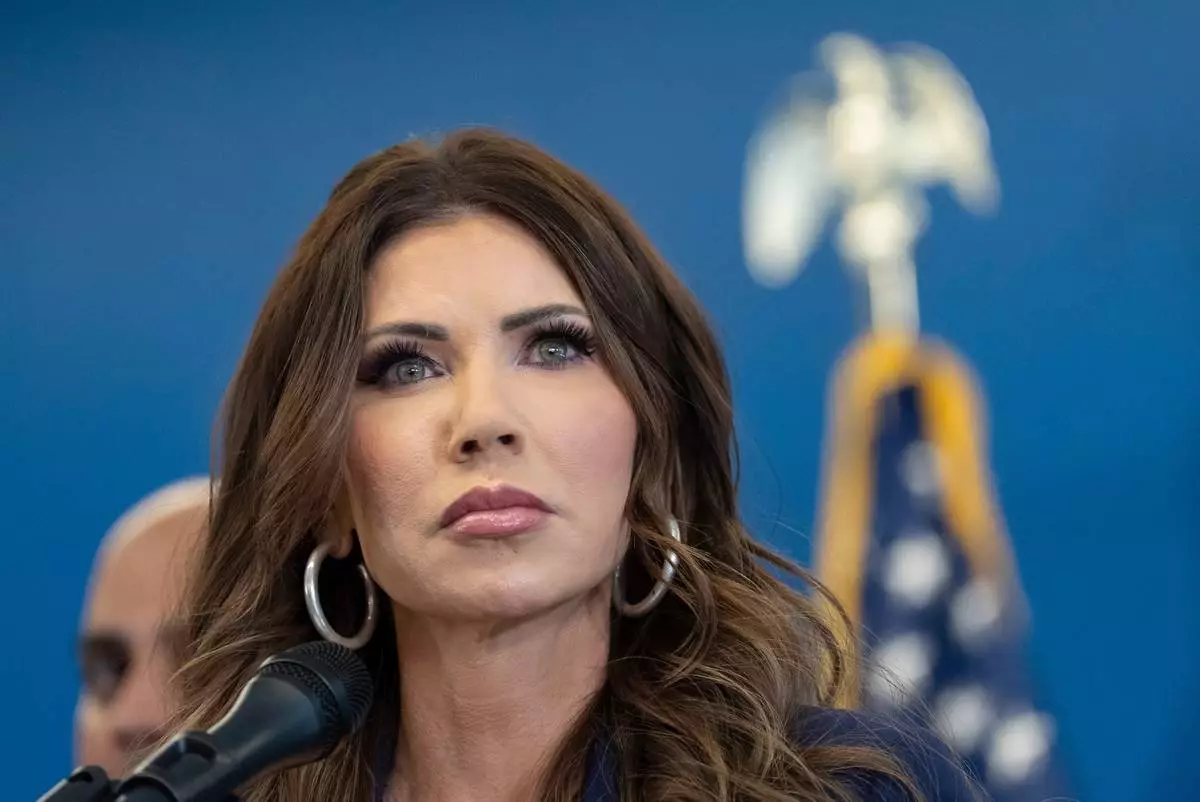
U.S. Homeland Security Secretary Kristi Noem speaks during a press conference, Thursday, Jan. 8, 2026, in New York. (AP Photo/Yuki Iwamura)


U.S. Homeland Security Secretary Kristi Noem speaks during a press conference, Thursday, Jan. 8, 2026, in New York. (AP Photo/Yuki Iwamura)
U.S. forces have boarded another oil tanker in the Caribbean Sea. The announcement was made Friday by the U.S. military. The Trump administration has been targeting sanctioned tankers traveling to and from Venezuela.

The pre-dawn action was carried out by U.S. Marines and Navy, taking part in the monthslong buildup of forces in the Caribbean, according to U.S. Southern Command, which declared “there is no safe haven for criminals” as it announced the seizure of the vessel called the Olina.

Navy officials couldn’t immediately provide details about whether the Coast Guard was part of the force that took control of the vessel as has been the case in the previous seizures. A spokesperson for the U.S. Coast Guard said there was no immediate comment on the seizure.

The Olina is the fifth tanker that has been seized by U.S. forces as part of a broader effort by Trump’s administration to control the distribution of Venezuela’s oil products globally following the U.S. ouster of President Nicolás Maduro in a surprise nighttime raid.

The latest:

A consumer advocacy group is criticizing Trump’s meeting with oil executives as a giveaway to Big Oil.

Tyson Slocum, director of Public Citizen’s energy program, called the U.S. military’s removal of Venezuelan leader Nicholas Maduro “violent imperialism” and said Trump’s goal appears to be to “hand billionaires control over Venezuela’s oil.”

U.S. taxpayers are likely to shoulder much of the risk of drilling and exporting the heavy crude oil from Venezuela, Slocum said.

“While Trump works to ensure Big Oil’s risks are covered by the U.S. public, Americans suffering with high home heating and electricity prices will see no relief,” he said.

Trump is meeting with oil executives at the White House on Friday in hopes of securing $100 billion in investments to revive Venezuela’s ability to fully tap into its expansive reserves of petroleum.

The president, as he began his meeting with executives of major oil companies, said the administration will soon decide which companies will be going into Venezuela.

The companies will be working directly with the United States and not the Venezuelan government, Trump said, as he assured them “total safety.”

“We don’t want you to deal with Venezuela,” Trump told the more than dozen oil chiefs gathered in the East Room on Friday.

he president said there were additional executives he would have invited to the East Room event. He remarked that, “if we had a ballroom, we’d have over a thousand.”

Trump then stood up and left a table where he was seated with the executives and administration officials and went to look out a window to look at the construction of his large ballroom where the East Wing used to stand.

The president, standing alone, looked out the window with his back facing everyone in the room—including the news cameras.

“Wow, what a view,” he said. “This is the door to the ballroom.”

He turned back around and said, “unusual time to look.”

Trump invited the media to go back and take a look if they wanted. No journalists immediately did.

Trump announced on Friday he’d meet with President Gustavo Petro in early February, but called on the Colombian leader to make quick progress on stemming flow of cocaine into the U.S.

Trump, following the ouster of Maduro, had made vague threats to take similar action against Petro. Trump abruptly changed his tone Wednesday about his Colombian counterpart after a friendly phone call in which he invited Petro to visit the White House.

The countries said a delegation from the Trump administration arrived in the South American nation on Friday.

The small team of U.S. diplomats and diplomatic security officials traveled to Venezuela to make a preliminary assessment about the potential reopening of the U.S. Embassy in Caracas, the State Department said in a statement.

Venezuela’s government on Friday acknowledged that U.S. diplomats had traveled to the South American country and announced that it will send a delegation to the U.S. but it did not say when.

In a statement, Delcy Rodríguez’s government said it “has decided to initiate an exploratory process of a diplomatic nature with the Government of the United States of America, aimed at the re-establishment of diplomatic missions in both countries.”

Venezuela’s government on Friday acknowledged that U.S. diplomats had traveled to the South American country, and announced that it will send a delegation to the U.S. but it did not say when.

In a statement, Rodríguez’s government said it “has decided to initiate an exploratory process of a diplomatic nature with the Government of the United States of America, aimed at the re-establishment of diplomatic missions in both countries, with the purpose of addressing the consequences derived from the aggression and kidnapping of the President of the Republic and the First Lady, as well as addressing a work agenda of mutual interest.”

Treasury Secretary Scott Bessent told reporters in Minnesota that his agency has launched a series of actions to combat fraud in the state.

Key actions include FinCEN investigations into Minnesota-based money services businesses, enhanced transaction reporting requirements for international transfers from Hennepin and Ramsey counties, and alerts to financial institutions on identifying fraud tied to child nutrition programs.

“Treasury will deploy all tools to bring an end to this egregious unchecked fraud and hold perpetrators to account,” he said.

The department in December announced that it would begin targeting businesses that people use to wire money to family members abroad, focusing on remittances to Somalia.

The new action was prompted in part by a series of fraud cases, including a nonprofit called Feeding Our Future accused of stealing pandemic aid meant for school meals. Prosecutors have put the losses from that case at $300 million.

The State Department says it has sent a small team of diplomats and diplomatic security officials to Venezuela to make a preliminary assessment about the potential reopening of the U.S. Embassy in Caracas.

The department said the team, led by acting ambassador to Venezuela John McNamara, arrived in Caracas on Friday. The team is from the Venezuelan Affairs Unit, which is based outside of the country and has been since the embassy was shuttered in 2019.

The team is there “to conduct an initial assessment for a potential phased resumption of operations,” the department said.

U.S. officials say no decision has yet been made on whether or when to fully reopen the embassy.

Republican Ho Nieh is the new chairman of the Nuclear Regulatory Commission, replacing fellow Republican David Wright.

Nieh, who was confirmed to the commission last month, previously worked at Atlanta-based Southern Co., which recently added two new nuclear reactors at Plant Vogtle near Augusta.

Nieh worked at the NRC for two decades and is the agency’s first former resident inspector to serve as a commissioner.

Trump recently fired a Democratic commissioner as he continues to assert more control over independent regulatory agencies.

Richard Grenell, president of the Kennedy Center, says a documentary film about first lady Melania Trump will make its premiere later this month, posting a trailer on X.

As the Trumps prepared to return to the White House last year, Amazon Prime Video announced a year ago that it had obtained exclusive licensing rights for a streaming and theatrical release directed by Brett Ratner.

Melania Trump also released a self-titled memoir in late 2024.

Some artists have canceled scheduled Kennedy Center performances after a newly installed board voted to add President Donald Trump’s to the facility, prompting Grenell to accuse the performers of making their decisions because of politics.

Mexico President Claudia Sheinbaum says that she has asked her foreign affairs secretary to reach out directly to U.S. Secretary of State Marco Rubio or Trump regarding comments by the American leader that the U.S. could begin ground attacks against drug cartels.

In a wide-ranging interview with Fox News aired Thursday night, Trump said, “We’ve knocked out 97% of the drugs coming in by water and we are going to start now hitting land, with regard to the cartels. The cartels are running Mexico. It’s very sad to watch.”

As she has on previous occasions, Sheinbaum downplayed the remarks, saying “it is part of his way of communicating.” She said she asked her Foreign Affairs Secretary Juan Ramón de la Fuente to strengthen coordination with the U.S.

Sheinbaum has repeatedly rebuffed Trump’s offer to send U.S. troops after Mexican drug cartels. She emphasizes that there will be no violation of Mexico’s sovereignty, but the two governments will continue to collaborate closely.

Analysts do not see a U.S. incursion in Mexico as a real possibility, in part because Sheinbaum’s administration has been doing nearly everything Trump has asked and Mexico is a critical trade partner.

Trump says he wants to secure $100 billion to remake Venezuela’s oil infrastructure, a lofty goal going into a 2:30 meeting on Friday with executives from leading oil companies. His plan rides on oil producers being comfortable in making commitments in a country plagued by instability, inflation and uncertainty.

The president has said that the U.S. will control distribution worldwide of Venezuela’s oil and will share some of the proceeds with the country’s population from accounts that it controls.

“At least 100 Billion Dollars will be invested by BIG OIL, all of whom I will be meeting with today at The White House,” Trump said Friday in a pre-dawn social media post.

Trump is banking on the idea that he can tap more of Venezuela’s petroleum reserves to keep oil prices and gasoline costs low.

At a time when many Americans are concerned about affordability, the incursion in Venezuela melds Trump’s assertive use of presidential powers with an optical spectacle meant to convince Americans that he can bring down energy prices.

Trump is expected to meet with oil executives at the White House on Friday.

He hopes to secure $100 billion in investments to revive Venezuela’s oil industry. The goal rides on the executives’ comfort with investing in a country facing instability and inflation.

Since a U.S. military raid captured former Venezuelan leader Nicolás Maduro on Saturday, Trump has said there’s a new opportunity to use the country’s oil to keep gasoline prices low.

The full list of executives invited to the meeting has not been disclosed, but Chevron, ExxonMobil and ConocoPhillips are expected to attend.

Attorneys general in five Democratic-led states have filed a lawsuit against President Donald Trump’s administration after it said it would freeze money for several public benefit programs.

The Trump administration has cited concerns about fraud in the programs designed to help low-income families and their children. California, Colorado, Minnesota, Illinois and New York states filed the lawsuit Thursday in the U.S. District Court for the Southern District of New York.

The lawsuit asks the courts to order the administration to release the funds. The attorneys general have called the funding freeze an unconstitutional abuse of power.

Iran’s judiciary chief has vowed decisive punishment for protesters, signaling a coming crackdown against demonstrations.

Iranian state television reported the comments from Gholamhossein Mohseni-Ejei on Friday. They came after Supreme Leader Ayatollah Ali Khamenei criticized Trump’s support for the protesters, calling Trump’s hands “stained with the blood of Iranians.”

The government has shut down the internet and is blocking international calls. State media has labeled the demonstrators as “terrorists.”

The protests began over Iran’s struggling economy and have become a significant challenge to the government. Violence has killed at least 50 people, and more than 2,270 have been detained.

Trump questions why a president’s party often loses in midterm elections and suggests voters “want, maybe a check or something”

Trump suggested voters want to check a president’s power and that’s why they often deliver wins for an opposing party in midterm elections, which he’s facing this year.

“There’s something down, deep psychologically with the voters that they want, maybe a check or something. I don’t know what it is, exactly,” he said.

He said that one would expect that after winning an election and having “a great, successful presidency, it would be an automatic win, but it’s never been a win.”

Hiring likely remained subdued last month as many companies have sought to avoid expanding their workforces, though the job gains may be enough to bring down the unemployment rate.

December’s jobs report, to be released Friday, is likely to show that employers added a modest 55,000 jobs, economists forecast. That figure would be below November’s 64,000 but an improvement after the economy lost jobs in October. The unemployment rate is expected to slip to 4.5%, according to data provider FactSet, from a four-year high of 4.6% in November.

The figures will be closely watched on Wall Street and in Washington because they will be the first clean readings on the labor market in three months. The government didn’t issue a report in October because of the six-week government shutdown, and November’s data was distorted by the closure, which lasted until Nov. 12.

President Donald Trump speaks with Chief Executive Officer and Chairman of ExxonMobil Darren Woods, left, while Chairman, President and Chief Executive Officer of Marathon Petroleum Maryann Mannen, right, and Tallgrass Energy President and Chief Executive Officer Matt Sheehy, far right, look on during a meeting with oil executives in the East Room of the White House, Friday, Jan. 9, 2026, in Washington. (AP Photo/Alex Brandon)

President Donald Trump speaks with Chief Executive Officer and Chairman of ExxonMobil Darren Woods, left, while Chairman, President and Chief Executive Officer of Marathon Petroleum Maryann Mannen, right, and Tallgrass Energy President and Chief Executive Officer Matt Sheehy, far right, look on during a meeting with oil executives in the East Room of the White House, Friday, Jan. 9, 2026, in Washington. (AP Photo/Alex Brandon)

President Donald Trump listens as Secretary of State Marco Rubio speaks during a meeting with oil executives in the East Room of the White House, Friday, Jan. 9, 2026, in Washington. (AP Photo/Evan Vucci)

President Donald Trump listens as Secretary of State Marco Rubio speaks during a meeting with oil executives in the East Room of the White House, Friday, Jan. 9, 2026, in Washington. (AP Photo/Evan Vucci)

President Donald Trump speaks with Chairman, President and Chief Executive Officer of Marathon Petroleum Maryann Mannen, left, while Tallgrass Energy President and Chief Executive Officer Matt Sheehy looks on, right, during a meeting with oil executives in the East Room of the White House, Friday, Jan. 9, 2026, in Washington. (AP Photo/Alex Brandon)

President Donald Trump speaks with Chairman, President and Chief Executive Officer of Marathon Petroleum Maryann Mannen, left, while Tallgrass Energy President and Chief Executive Officer Matt Sheehy looks on, right, during a meeting with oil executives in the East Room of the White House, Friday, Jan. 9, 2026, in Washington. (AP Photo/Alex Brandon)

Supporters of the Venezuelan government rally calling for the release of former Venezuelan President Nicolas Maduro and his wife, who were captured by U.S. forces, in Caracas, Venezuela, Friday, Jan. 9, 2026. (AP Photo/Ariana Cubillos)

Supporters of the Venezuelan government rally calling for the release of former Venezuelan President Nicolas Maduro and his wife, who were captured by U.S. forces, in Caracas, Venezuela, Friday, Jan. 9, 2026. (AP Photo/Ariana Cubillos)

Director of the National Economic Council Kevin Hassett walks past reporters after doing an interview at the White House, Friday, Jan. 9, 2026, in Washington. (AP Photo/Evan Vucci)

Director of the National Economic Council Kevin Hassett walks past reporters after doing an interview at the White House, Friday, Jan. 9, 2026, in Washington. (AP Photo/Evan Vucci)

FILE - President Donald Trump dances as he walks off stage after speaking to House Republican lawmakers during their annual policy retreat, Tuesday, Jan. 6, 2026, in Washington. (AP Photo/Evan Vucci, File)

FILE - President Donald Trump dances as he walks off stage after speaking to House Republican lawmakers during their annual policy retreat, Tuesday, Jan. 6, 2026, in Washington. (AP Photo/Evan Vucci, File)

Recommended Articles