Skip to Content Facebook Feature Image

Saudi Arabia alleges UAE smuggled wanted Yemen separatist leader out of the country

News

Saudi Arabia alleges UAE smuggled wanted Yemen separatist leader out of the country
News

News

Saudi Arabia alleges UAE smuggled wanted Yemen separatist leader out of the country

2026-01-09 01:15 Last Updated At:18:24

DUBAI, United Arab Emirates (AP) — Saudi Arabia said Thursday that the United Arab Emirates smuggled a separatist leader in Yemen wanted for treason out of the country and flew him to Abu Dhabi.

The UAE had no immediate reaction to the accusation, which further escalates tensions between the neighboring nations on the Arabian Peninsula as their partnership in the yearslong war in Yemen breaks down.

A Saudi military statement said that Aidarous al-Zubaidi, the leader of the Southern Transitional Council, fled Yemen by boat to Somalia. Al-Zubaidi was then flown to Abu Dhabi, the UAE's capital, the statement said.

The UAE has been the major supporter of the council, known as the STC, which sparked a confrontation between Saudi Arabia and the UAE in recent days, after STC fighters advanced in two governorates and appeared to be preparing to secede from Yemen.

The Saudi statement from Maj. Gen. Turki al-Malki included him naming a major general in the UAE as being involved in al-Zubaidi's purported escape, along with identifying his nom de guerre — something highly unusual in Gulf Arab relations. It also suggested that an Ilyushin Il-76 aircraft used in the operation had been deployed in “conflict zones” like Ethiopia, Libya and Somalia — routes that the Emirati military has been accused of funneling weapons through in the past.

The UAE has denied running guns into those areas. The Emirati Foreign Ministry didn't immediately respond to a request for comment from The Associated Press.

In a statement Thursday, Somalia’s Immigration and Citizenship Agency, which is a part of the Ministry of Internal Security, said it was launching an investigation of “the alleged unauthorized use of Somalia’s national airspace and airport” calling it unacceptable and a violation of its sovereignty. It also said that any attempt by al-Zubaidi “through alleged external support” to evade Saudi Arabia’s call for dialogue is contradictory to the dialogue process and would be a breach of bilateral agreements without naming an external actor.

The STC didn't immediately acknowledge the allegation either, saying Wednesday that al-Zubaidi had remained in Aden, where forces allied against the Iran-backed Houthi rebels had congregated for years since the rebels seized Yemen's capital, Sanaa.

Saudi Arabia's ambassador to Yemen, Mohammed al-Jaber, said on X on Thursday morning that he met with the STC delegation that landed in Riyadh a day earlier. They discussed al-Zubaidi's recent actions, which he said “harmed the southern cause and didn't serve it.”

“We also explored ways to work in the future to address what happened in a manner that serves the Southern cause, the Coalition’s efforts to achieve security and stability in Yemen, and we addressed the arrangements for the Southern Cause Conference, which will be held in Riyadh soon,” he said.

Meanwhile, Mohamed al-Ghaithi, an STC member and head of the negotiation and reconciliation committee supporting the Presidential Leadership Council, called the meeting with al-Jaber “fruitful" and praised the kingdom's initiative to sponsor the conference aimed at finding a resolution in the south. Al-Ghaithi confirmed that the delegation “rejected everything that harms unity.”

“We have heard clear commitments from our brothers in Riyadh toward our people’s cause and ensuring a secure and stable future,” he posted on X. On Wednesday, the STC had said it lost contact with its delegation after they landed in Riyadh, with a council representative saying that members' cellphones were either switched off or ringing with no one answering.

Southern Yemen had been run under the Presidential Leadership Council, a group including al-Zubaidi and others, since 2022. On Wednesday, the leadership council expelled al-Zubaidi and charged him with treason after he apparently declined to fly to Saudi Arabia for talks. It marked the latest pushback against the STC by Saudi Arabia, which also recently launched airstrikes against the group and an arms shipment the kingdom said came from the UAE.

Meanwhile, Hans Grundberg, the U.N. special envoy for Yemen, met Thursday with PLC members in Riyadh to discuss developments in Yemen and its broader implications, according to a statement released by the envoy's office.

Grundberg said that an anticipated conference expected to be hosted by the kingdom “offers a timely opportunity to reduce tensions, address long-standing grievances through political means, and move discussions towards stabilization.”

The war in Yemen, on the southern edge of the Arabian Peninsula and bordering the Red Sea and the Gulf of Aden, has killed more than 150,000 people, including fighters and civilians. It has created one of the world’s worst humanitarian disasters. The Houthis have also launched attacks against shipping over the Israel-Hamas war in the Gaza Strip, disrupting a vital route for global commerce.

The U.S., which earlier praised Saudi-Emirati efforts to end the crisis over the separatists, has launched airstrikes against the Houthi rebels under both Presidents Joe Biden and Donald Trump. Saudi Arabia's foreign minister met with U.S. Secretary of State Marco Rubio in Washington on Wednesday.

This latest accusation will further strain ties between Saudi Arabia and the UAE, OPEC members and neighbors that increasingly have competed over economic issues and regional politics, particularly in the Red Sea area. The Yemen dispute has become their most serious confrontation in decades.

The Saudi statement came as part of what appeared to be an organized media push over the incident by Saudi broadcasters and newspapers that offered details that could prove embarrassing for the Emiratis. The Saudi-owned satellite news channel Al Arabiya aired what it described as intercepted telephone calls highlighting al-Zubaidi's alleged escape.

Saudi Arabia's English-language newspaper Arab News offered a front-page image of al-Zubaidi under the headline “WANTED” in the style of a poster from the American Old West. A scathing front-page editorial by the state-backed newspaper said that the separatist leader’s refusal to come to the kingdom was “cementing his image as a traitor to his country.”

“Al-Zubaidi chose narrow self-interest, aligning with foreign powers at the expense of his homeland and attempting to impose southern secession by force,” the editorial said. “His sole aim: to seize power for himself.”

Fatma Khaled contributed to this report from Cairo.
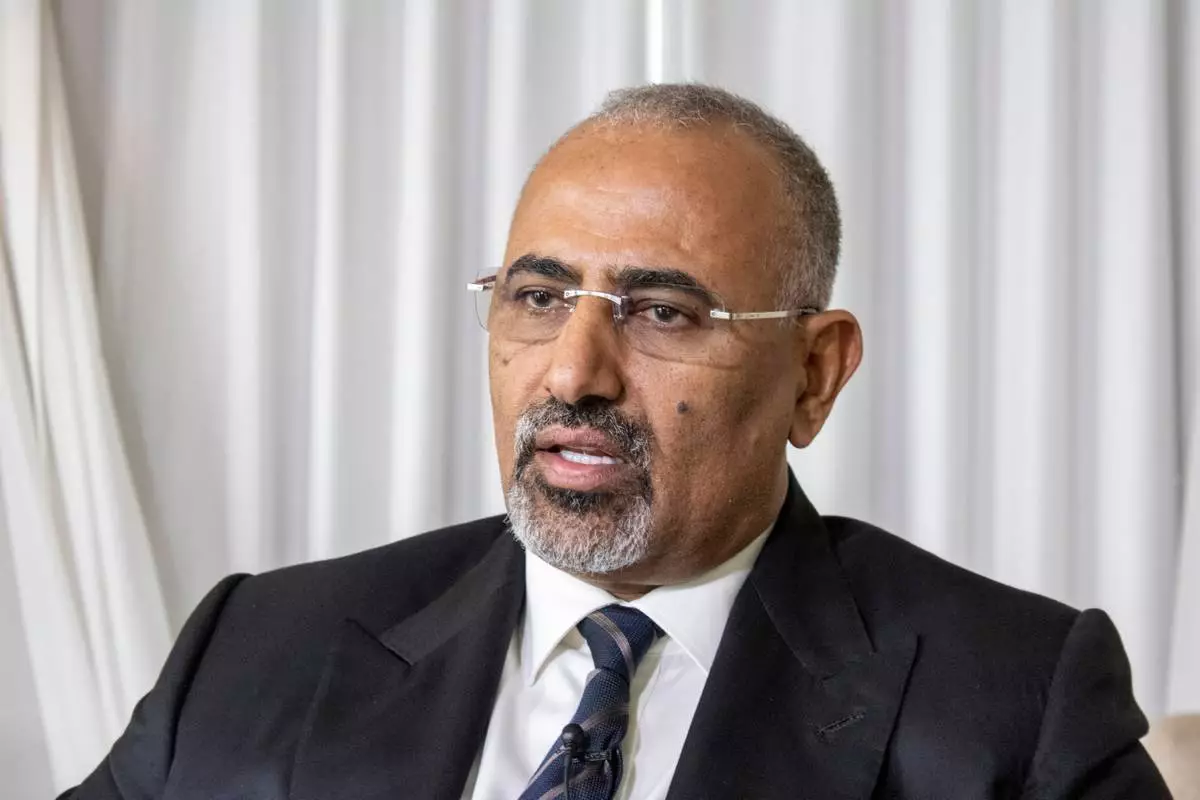
FILE - The president of the Yemen's Southern Transitional Council Aidarous Al-Zubaidi sits for an interview, Sept. 22, 2023, in New York, while attending the United Nations General Assembly's annual high-level meeting of world leaders. (AP Photo/Ted Shaffrey, File)


FILE - The president of the Yemen's Southern Transitional Council Aidarous Al-Zubaidi sits for an interview, Sept. 22, 2023, in New York, while attending the United Nations General Assembly's annual high-level meeting of world leaders. (AP Photo/Ted Shaffrey, File)

A quarterback reportedly reneging on a lucrative deal to hit the transfer portal, only to return to his original school. Another starting QB, this one in the College Football Playoff, awaiting approval from the NCAA to play next season, an expensive NIL deal apparently hanging in the balance. A defensive star, sued by his former school after transferring, filing a lawsuit of his own.

It is easy to see why many observers say things are a mess in college football even amid a highly compelling postseason.

“It gets crazier and crazier. It really, really does,” said Sam Ehrlich, a Boise State legal studies professor who tracks litigation against the NCAA. He said he might have to add a new section for litigation against the NCAA stemming just from transfer portal issues.

“I think a guy signing a contract and then immediately deciding he wants to go to another school, that’s a kind of a new thing,” he said. “Not new kind of historically when you think about all the contract jumping that was going on in the ’60s and ’70s with the NBA. But it’s a new thing for college sports, that’s for sure.”

Washington quarterback Demond Williams Jr. said late Thursday he will return to school for the 2026 season rather than enter the transfer portal, avoiding a potentially messy dispute amid reports the Huskers were prepared to pursue legal options to enforce Williams’ name, image and likeness contract.

Edge rusher Damon Wilson is looking to transfer after one season at Missouri, having been sued for damages by Georgia over his decision to leave the Bulldogs. He has countersued.

Then there is Ole Miss quarterback Trinidad Chambliss, who reportedly has a new NIL deal signed but is awaiting an NCAA waiver allowing him to play another season as he and the Rebels played Thursday night's Collge Football Playoff semifinal against Miami. On the Hurricanes roster: Defensive back Xavier Lucas, whose transfer from Wisconsin led to a lawsuit against the Hurricanes last year with the Badgers claiming he was improperly lured by NIL money. Lucas has played all season for Miami. The case is pending.

Court rulings have favored athletes of late, winning them not just millions in compensation but the ability to play immediately after transferring rather than have to sit out a year as once was the case. They can also discuss specific NIL compensation with schools and boosters before enrolling and current court battles include players seeking to play longer without lower-college seasons counting against their eligibility and ability to land NIL money while doing it.

Ehrlich compared the situation to the labor upheaval professional leagues went through before finally settling on collective bargaining, which has been looked at as a potential solution by some in college sports over the past year. Athletes.org, a players association for college athletes, recently offered a 38-page proposal of what a labor deal could look like.

“I think NCAA is concerned, and rightfully so, that anything they try to do to tamp down this on their end is going to get shut down,” Ehrlich said. “Which is why really the only two solutions at this point are an act of Congress, which feels like an act of God at this point, or potentially collective bargaining, which has its own major, major challenges and roadblocks.”

The NCAA has been lobbying for years for limited antitrust protection to keep some kind of control over the new landscape — and to avoid more crippling lawsuits — but bills have gone nowhere in Congress.

Collective bargaining is complicated and universities have long balked at the idea that their athletes are employees in some way. Schools would become responsible for paying wages, benefits, and workers’ compensation. And while private institutions fall under the National Labor Relations Board, public universities must follow labor laws that vary from state to state; virtually every state in the South has “right to work” laws that present challenges for unions.

Ehrlich noted the short careers for college athletes and wondered whether a union for collective bargaining is even possible.

To sports attorney Mit Winter, employment contracts may be the simplest solution.

“This isn’t something that’s novel to college sports,” said Winter, a former college basketball player who is now a sports attorney with Kennyhertz Perry. “Employment contracts are a huge part of college sports, it’s just novel for the athletes.”

Employment contracts for players could be written like those for coaches, he suggested, which would offer buyouts and prevent players from using the portal as a revolving door.

“The contracts that schools are entering into with athletes now, they can be enforced, but they cannot keep an athlete out of school because they’re not signing employment contracts where the school is getting the right to have the athlete play football for their school or basketball or whatever sport it is,” Winter said. “They’re just acquiring the right to be able to use the athlete’s NIL rights in various ways. So, a NIL agreement is not going to stop an athlete from transferring or going to play whatever sport it is that he or she plays at another school.”

There are challenges here, too, of course: Should all college athletes be treated as employees or just those in revenue-producing sports? Can all injured athletes seek workers' compensation and insurance protection? Could states start taxing athlete NIL earnings?

Winter noted a pending federal case against the NCAA could allow for athletes to be treated as employees more than they currently are.

“What’s going on in college athletics now is trying to create this new novel system where the athletes are basically treated like employees, look like employees, but we don’t want to call them employees,” Winter said. “We want to call them something else and say they’re not being paid for athletic services. They’re being paid for use of their NIL. So, then it creates new legal issues that have to be hashed out and addressed, which results in a bumpy and chaotic system when you’re trying to kind of create it from scratch.”

He said employment contracts would allow for uniform rules, including how many schools an athlete can go to or if the athlete can go to another school when the deal is up. That could also lead to the need for collective bargaining.

“If the goal is to keep someone at a school for a certain defined period of time, it’s got to be employment contracts,” Winter said.

Get poll alerts and updates on the AP Top 25 throughout the season. Sign up here. AP college football: https://apnews.com/hub/ap-top-25-college-football-poll and https://apnews.com/hub/college-football

Mississippi quarterback Trinidad Chambliss (6) runs the ball during the second half of the Fiesta Bowl NCAA college football playoff semifinal game against Miami, Thursday, Jan. 8, 2026, in Glendale, Ariz. (AP Photo/Rick Scuteri)

Mississippi quarterback Trinidad Chambliss (6) runs the ball during the second half of the Fiesta Bowl NCAA college football playoff semifinal game against Miami, Thursday, Jan. 8, 2026, in Glendale, Ariz. (AP Photo/Rick Scuteri)

Recommended Articles