|
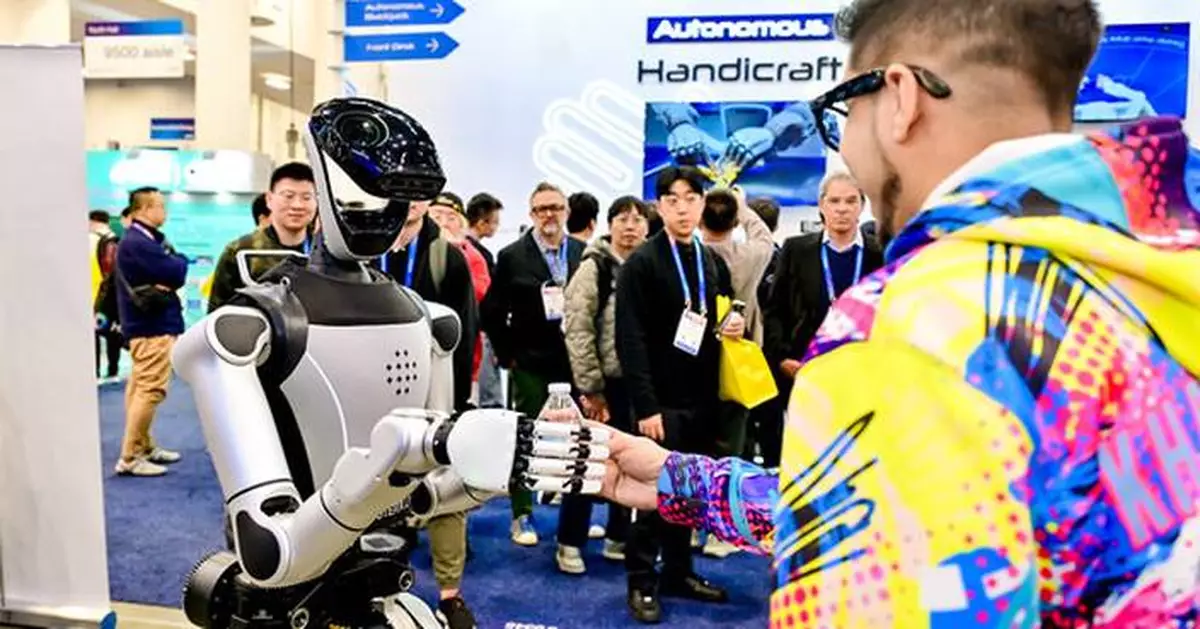
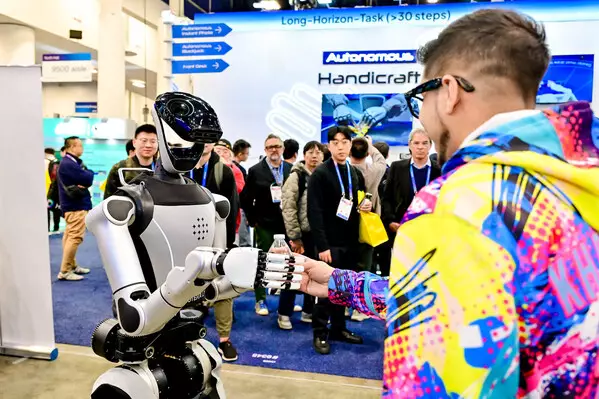
BEIJING, Jan. 8, 2026 /PRNewswire/ -- At CES 2026, ROBOTERA showcases its flagship robotics lineup, including the L7 full-size humanoid robot, the Q5 wheeled humanoid robot, and the XHAND1 dexterous hand. Together, these products embody the "Hexa-Core" concept, highlighting strength, agility, precision, stability, durability, and adaptability across multiple application scenarios.
L7: Full-Size Humanoid with Strength, Dexterity, and Multi-Robot Collaboration
The L7 is the first full-size bipedal humanoid robot in China to combine large-scale dynamic motion with fine manipulation. At CES 2026, L7 demonstrates ultra-low-latency full-body teleoperation, showcasing how its human-scale structure enables precise manipulation while maintaining exceptional stability during complex movements.
Standing 171 cm tall and weighing 70 kg, L7 features human-like proportions, 55 degrees of freedom, and can carry up to 20 kg with both arms, delivering agile, powerful, and well-balanced motion. It supports full bipedal and upper-body configurations, adapting to different deployment scenarios and reducing on-site integration costs.
Q5: High-DOF Humanoid for Natural Motion Replication
Positioned to redefine service robots, the Q5 wheeled humanoid platform features 44 DoF across the body, enabling accurate replication of human motion. During on-site demonstrations, Q5 interacts naturally with visitors, delivers gifts, and performs actions such as squatting to pick up objects with smooth, coordinated movements. Its slim and refined design makes it suitable not only for research purposes, but also for highly interactive commercial service environments.
XHAND1: Fully Direct-Drive Dexterous Hand with Professional Precision
XHAND1 is a fully direct-drive, five-fingered dexterous hand with 12 active degrees of freedom. It offers a maximum single-hand grip force of 80 N and can lift objects weighing up to 25 kg. With fast response and precise control, XHAND1 demonstrates professional-level manipulation, including fine force and angle control during on-site interactive demonstrations.
XHAND1 is already adopted by leading robotics companies such as Skild AI, Humanoid AI, and Extend Robotics, as well as top universities and research institutions including UC Berkeley, MIT, and ByteDance Seed.
Hardware Portfolio Highlights
From L7's powerful and dexterous full-body performance, to Q5's ultra-human-like presence, and XHAND1's high-precision manipulation, ROBOTERA's hardware portfolio demonstrates strong capabilities in mechanical performance, stability, flexibility, and multi-scenario deployment.
To date, ROBOTERA has cumulatively delivered over 600 units, with its products deployed across global exhibition, retail, and logistics environments, underscoring the reliability and real-world value of its hardware platforms.
BEIJING, Jan. 8, 2026 /PRNewswire/ -- At CES 2026, ROBOTERA showcases its flagship robotics lineup, including the L7 full-size humanoid robot, the Q5 wheeled humanoid robot, and the XHAND1 dexterous hand. Together, these products embody the "Hexa-Core" concept, highlighting strength, agility, precision, stability, durability, and adaptability across multiple application scenarios.
L7: Full-Size Humanoid with Strength, Dexterity, and Multi-Robot Collaboration
The L7 is the first full-size bipedal humanoid robot in China to combine large-scale dynamic motion with fine manipulation. At CES 2026, L7 demonstrates ultra-low-latency full-body teleoperation, showcasing how its human-scale structure enables precise manipulation while maintaining exceptional stability during complex movements.
Standing 171 cm tall and weighing 70 kg, L7 features human-like proportions, 55 degrees of freedom, and can carry up to 20 kg with both arms, delivering agile, powerful, and well-balanced motion. It supports full bipedal and upper-body configurations, adapting to different deployment scenarios and reducing on-site integration costs.
Q5: High-DOF Humanoid for Natural Motion Replication
Positioned to redefine service robots, the Q5 wheeled humanoid platform features 44 DoF across the body, enabling accurate replication of human motion. During on-site demonstrations, Q5 interacts naturally with visitors, delivers gifts, and performs actions such as squatting to pick up objects with smooth, coordinated movements. Its slim and refined design makes it suitable not only for research purposes, but also for highly interactive commercial service environments.
XHAND1: Fully Direct-Drive Dexterous Hand with Professional Precision
XHAND1 is a fully direct-drive, five-fingered dexterous hand with 12 active degrees of freedom. It offers a maximum single-hand grip force of 80 N and can lift objects weighing up to 25 kg. With fast response and precise control, XHAND1 demonstrates professional-level manipulation, including fine force and angle control during on-site interactive demonstrations.
XHAND1 is already adopted by leading robotics companies such as Skild AI, Humanoid AI, and Extend Robotics, as well as top universities and research institutions including UC Berkeley, MIT, and ByteDance Seed.
Hardware Portfolio Highlights
From L7's powerful and dexterous full-body performance, to Q5's ultra-human-like presence, and XHAND1's high-precision manipulation, ROBOTERA's hardware portfolio demonstrates strong capabilities in mechanical performance, stability, flexibility, and multi-scenario deployment.
To date, ROBOTERA has cumulatively delivered over 600 units, with its products deployed across global exhibition, retail, and logistics environments, underscoring the reliability and real-world value of its hardware platforms.
** The press release content is from PR Newswire. Bastille Post is not involved in its creation. **
ROBOTERA Showcases Its "Hexa-Core" Robotics Lineup at CES 2026
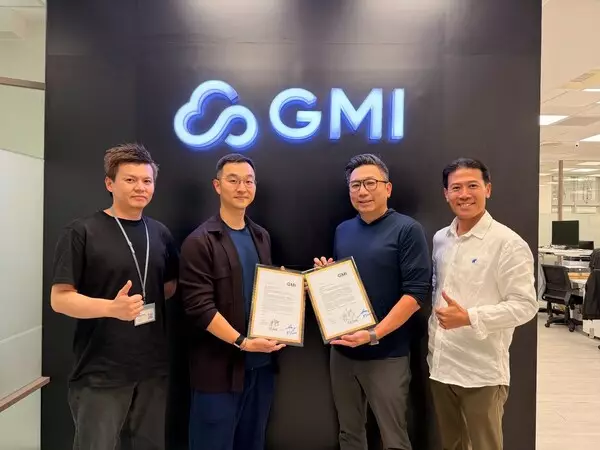
TAIPEI, May 28, 2026 /PRNewswire/ -- Compal Electronics Inc. ("Compal"; TWSE: 2324) today announced its collaboration with GMI Cloud, a Silicon Valley-based AI infrastructure provider, to advance the deployment of next-generation AI infrastructure optimized for large-scale inference and emerging agentic AI workloads.
Under this engagement, GMI Cloud will adopt high-performance GPU server platforms designed to support the growing demands of large-scale AI training and inference workloads. The deployment will serve as a key foundation for GMI Cloud's continued expansion in AI-driven services and data-centric applications.
As demand for AI compute continues to accelerate, cloud providers are scaling infrastructure to support increasingly complex workloads, including large language models, large-scale inference services, agentic AI systems, and real-time AI applications. Compal supports this deployment with its expertise in high-density server design, advanced thermal architecture, and system integration, enabling efficient and reliable infrastructure deployment at scale.
"As AI workloads rapidly evolve toward large-scale inference and emerging agentic AI applications, infrastructure requirements are shifting toward higher density, greater efficiency, and faster deployment cycles," said Alan Chang, Vice President of Infrastructure Solutions Business Group at Compal. "We are pleased to support GMI Cloud in building an AI infrastructure optimized for next-generation inference and real-world AI deployment."
"As AI shifts from model experimentation to real-world deployment, scalable inference infrastructure becomes increasingly critical," said Alex Yeh, Founder and CEO of GMI Cloud. "Through this collaboration with Compal, we are expanding the infrastructure foundation needed to support agentic AI workloads and scalable inference services globally."
In addition to the infrastructure deployment, Compal and GMI Cloud will jointly showcase their latest collaboration at COMPUTEX 2026.
At the Compal booth (M0804), visitors will be able to explore GMI Cloud's latest agentic AI and inference-driven application scenarios, demonstrating how advanced infrastructure enables real-world deployment of next-generation AI services.
GMI Cloud will also feature Compal's high-performance AI server platform, the Compal SGX30-2, at its booth (R0302). The system is designed to support NVIDIA HGX B300 platform, delivering the performance and scalability required for large-scale AI training and inference workloads. With an optimized design for high-density deployment, advanced thermal management, and system-level integration, the platform provides a robust foundation for next-generation AI infrastructure.
This collaboration reflects Compal's continued role in supporting emerging cloud providers and AI infrastructure operators as they expand capacity and bring new services to market. With a global manufacturing footprint and a robust supply chain, Compal is well-positioned to support customers in deploying AI systems efficiently across regions.
About Compal
Founded in 1984, Compal is a global technology leader delivering PC platforms, cloud and AI servers, and smart device solutions for leading brands worldwide. Learn more at https://www.compal.com
About GMI Cloud
GMI Cloud is a Silicon Valley-based AI infrastructure company delivering full-stack GPU cloud and AI platform solutions for scalable AI deployment. Learn more at gmicloud.ai.
** This press release is distributed by PR Newswire through automated distribution system, for which the client assumes full responsibility. **
Compal and GMI Cloud Announce Collaboration on AI Infrastructure Development