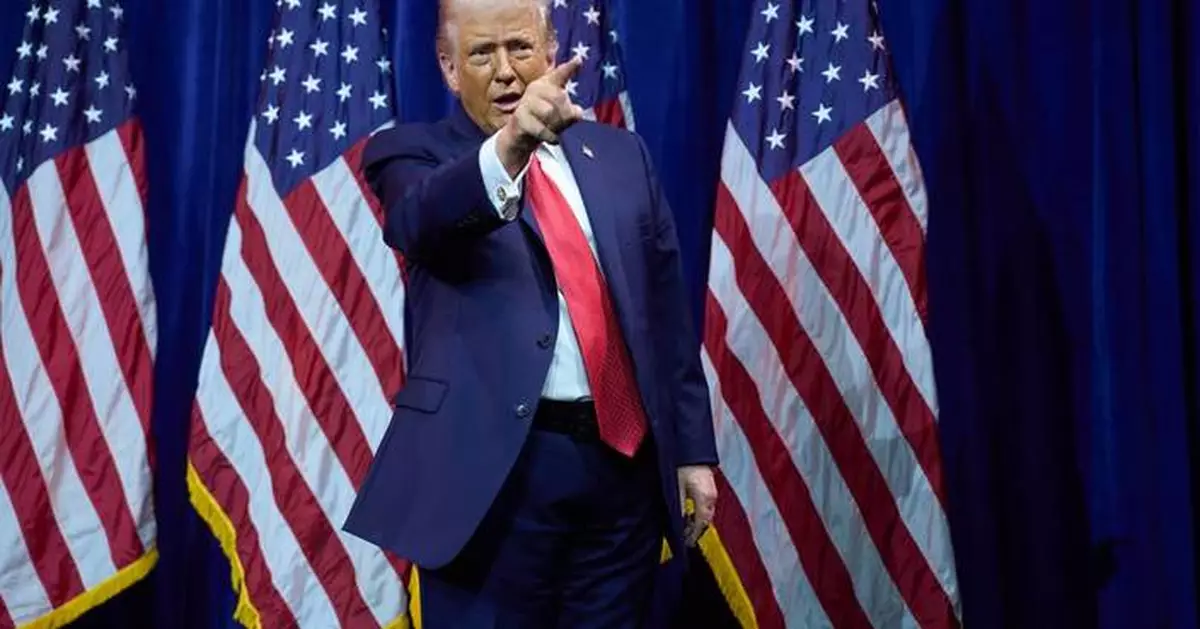
WASHINGTON (AP) — President Donald Trump said on social media Thursday that he is directing the federal government to buy $200 billion in mortgage bonds, a move he said would help reduce mortgage rates at a time when Americans are worried about home prices.
Trump and the White House have been trying to show they are responding to voter concerns about affordability ahead of midterm elections in November. Home prices have generally risen faster than incomes because of a persistent construction shortfall, making it harder for renters to buy their first home and for existing owners to upgrade to a new property — a challenge that dates back to Trump's first term and the recovery from the housing market collapse that triggered the global financial crisis in 2008.
Trump said the two mortgage companies under government conservatorship, Fannie Mae and Freddie Mac, have $200 billion in cash that will be used to make the purchase.
“This will drive Mortgage Rates DOWN, monthly payments DOWN, and make the cost of owning a home more affordable,” Trump posted on social media.
White House officials did not immediately respond to questions about the timelines for how purchases would occur.
The Federal Reserve has in the past bought mortgage bonds during times of economic turmoil in order to help reduce interest rates, leading many homeowners to refinance into rates of 3% or less. The low rates of the recent past make these homeowners reluctant to sell their properties, depriving the market of inventory.
“At a high level I feel this is putting a Band-Aid on a deeper issue and it probably wouldn’t lower rates enough to really undo the mortgage rate lock-in effect,” said Daryl Fairweather, chief economist at the real estate brokerage Redfin.
Fairweather estimated the government purchases of mortgage debt could shave 0.25 to 0.5 percentage points off the rate for a 30-year fixed rate mortgage. But the purchases wouldn’t address other factors such as a chronic shortage of homes on the market, which has helped make homeownership unaffordable for many Americans, she cautioned.
Mortgage rates have been averaging around 6.2%, according to Freddie Mac, which went into conservatorship along with Fannie Mae in 2008 when the U.S. economy crashed during the Great Recession. Thirty-year mortgage rates haven't been below 6% since September 2022.
“Lowering mortgage rates by maybe a quarter point or half a point maybe will encourage more demand on the margins, but I don’t think it’s going to solve the restrictions that exist in the housing market,” Fairweather said.
There is also a risk because Trump would be spending the cash reserves that are supposed to help be a buffer against an economic downturn akin to what happened during the Great Recession. In a sense, Freddie Mac and Fannie Mae could be more vulnerable if anything negative happens to the housing market, meaning Trump is betting that possibility is highly unlikely.
Separately, the Fed holds roughly $2 trillion worth of mortgage-backed securities on its balance sheet. That's down from $2.7 trillion in June 2022. The Fed began to unwind its mortgage-debt holdings as the U.S. economy recovered from the global pandemic.
Mortgage rates began to climb as inflation spiked coming out of the global pandemic, with the consumer price index hitting a four-decade high in 2022. The average mortgage rate is down from nearly 7% at the start of Trump's second term last year, yet the decrease has done little to reassure a public that feels pressure from the costs of housing, food and energy.
When interest rates fall it can become cheaper to service housing debt on a monthly basis. The reduced monthly payments can improve affordability for a period until home prices adjust in response to changes in the rates. There was roughly $21.1 trillion in outstanding mortgage debt as of the middle of last year, according to the St. Louis Federal Reserve.
Many homeowners took advantage of low interest rates during the pandemic to refinance their mortgages at rates of 3% or lower.
Trump last month said he planned to unveil housing reforms -- and on Wednesday he said he wants to block institutional investors from buying houses.
Veiga contributed from Los Angeles.

President Donald Trump points to the crowd as he walks off stage after speaking to House Republican lawmakers during their annual policy retreat, Tuesday, Jan. 6, 2026, in Washington. (AP Photo/Evan Vucci)
A quarterback reportedly reneging on a lucrative deal to hit the transfer portal, only to return to his original school. Another starting QB, this one in the College Football Playoff, awaiting approval from the NCAA to play next season, an expensive NIL deal apparently hanging in the balance. A defensive star, sued by his former school after transferring, filing a lawsuit of his own.
It is easy to see why many observers say things are a mess in college football even amid a highly compelling postseason.
“It gets crazier and crazier. It really, really does,” said Sam Ehrlich, a Boise State legal studies professor who tracks litigation against the NCAA. He said he might have to add a new section for litigation against the NCAA stemming just from transfer portal issues.
“I think a guy signing a contract and then immediately deciding he wants to go to another school, that’s a kind of a new thing,” he said. “Not new kind of historically when you think about all the contract jumping that was going on in the ’60s and ’70s with the NBA. But it’s a new thing for college sports, that’s for sure.”
Washington quarterback Demond Williams Jr. said late Thursday he will return to school for the 2026 season rather than enter the transfer portal, avoiding a potentially messy dispute amid reports the Huskers were prepared to pursue legal options to enforce Williams’ name, image and likeness contract.
Edge rusher Damon Wilson is looking to transfer after one season at Missouri, having been sued for damages by Georgia over his decision to leave the Bulldogs. He has countersued.
Then there is Ole Miss quarterback Trinidad Chambliss, who reportedly has a new NIL deal signed but is awaiting an NCAA waiver allowing him to play another season as he and the Rebels played Thursday night's Collge Football Playoff semifinal against Miami. On the Hurricanes roster: Defensive back Xavier Lucas, whose transfer from Wisconsin led to a lawsuit against the Hurricanes last year with the Badgers claiming he was improperly lured by NIL money. Lucas has played all season for Miami. The case is pending.
Court rulings have favored athletes of late, winning them not just millions in compensation but the ability to play immediately after transferring rather than have to sit out a year as once was the case. They can also discuss specific NIL compensation with schools and boosters before enrolling and current court battles include players seeking to play longer without lower-college seasons counting against their eligibility and ability to land NIL money while doing it.
Ehrlich compared the situation to the labor upheaval professional leagues went through before finally settling on collective bargaining, which has been looked at as a potential solution by some in college sports over the past year. Athletes.org, a players association for college athletes, recently offered a 38-page proposal of what a labor deal could look like.
“I think NCAA is concerned, and rightfully so, that anything they try to do to tamp down this on their end is going to get shut down,” Ehrlich said. “Which is why really the only two solutions at this point are an act of Congress, which feels like an act of God at this point, or potentially collective bargaining, which has its own major, major challenges and roadblocks.”
The NCAA has been lobbying for years for limited antitrust protection to keep some kind of control over the new landscape — and to avoid more crippling lawsuits — but bills have gone nowhere in Congress.
Collective bargaining is complicated and universities have long balked at the idea that their athletes are employees in some way. Schools would become responsible for paying wages, benefits, and workers’ compensation. And while private institutions fall under the National Labor Relations Board, public universities must follow labor laws that vary from state to state; virtually every state in the South has “right to work” laws that present challenges for unions.
Ehrlich noted the short careers for college athletes and wondered whether a union for collective bargaining is even possible.
To sports attorney Mit Winter, employment contracts may be the simplest solution.
“This isn’t something that’s novel to college sports,” said Winter, a former college basketball player who is now a sports attorney with Kennyhertz Perry. “Employment contracts are a huge part of college sports, it’s just novel for the athletes.”
Employment contracts for players could be written like those for coaches, he suggested, which would offer buyouts and prevent players from using the portal as a revolving door.
“The contracts that schools are entering into with athletes now, they can be enforced, but they cannot keep an athlete out of school because they’re not signing employment contracts where the school is getting the right to have the athlete play football for their school or basketball or whatever sport it is,” Winter said. “They’re just acquiring the right to be able to use the athlete’s NIL rights in various ways. So, a NIL agreement is not going to stop an athlete from transferring or going to play whatever sport it is that he or she plays at another school.”
There are challenges here, too, of course: Should all college athletes be treated as employees or just those in revenue-producing sports? Can all injured athletes seek workers' compensation and insurance protection? Could states start taxing athlete NIL earnings?
Winter noted a pending federal case against the NCAA could allow for athletes to be treated as employees more than they currently are.
“What’s going on in college athletics now is trying to create this new novel system where the athletes are basically treated like employees, look like employees, but we don’t want to call them employees,” Winter said. “We want to call them something else and say they’re not being paid for athletic services. They’re being paid for use of their NIL. So, then it creates new legal issues that have to be hashed out and addressed, which results in a bumpy and chaotic system when you’re trying to kind of create it from scratch.”
He said employment contracts would allow for uniform rules, including how many schools an athlete can go to or if the athlete can go to another school when the deal is up. That could also lead to the need for collective bargaining.
“If the goal is to keep someone at a school for a certain defined period of time, it’s got to be employment contracts,” Winter said.
Get poll alerts and updates on the AP Top 25 throughout the season. Sign up here. AP college football: https://apnews.com/hub/ap-top-25-college-football-poll and https://apnews.com/hub/college-football
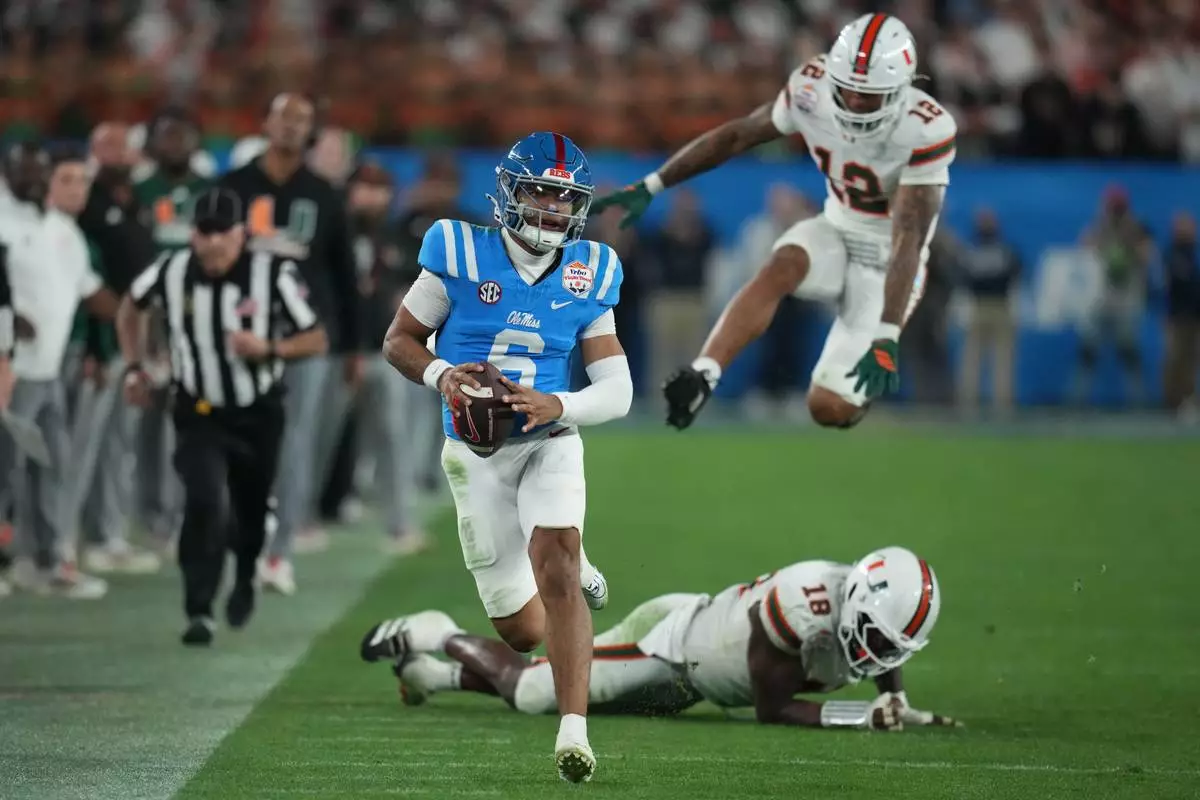
Mississippi quarterback Trinidad Chambliss (6) runs the ball during the second half of the Fiesta Bowl NCAA college football playoff semifinal game against Miami, Thursday, Jan. 8, 2026, in Glendale, Ariz. (AP Photo/Rick Scuteri)