Skip to Content Facebook Feature Image

ICE officer who shot Renee Good in Minneapolis has served decades in military and law enforcement

News

ICE officer who shot Renee Good in Minneapolis has served decades in military and law enforcement
News

News

ICE officer who shot Renee Good in Minneapolis has served decades in military and law enforcement

2026-01-10 00:47 Last Updated At:00:50

The federal agent who shot and killed a driver in Minneapolis is an Iraq War veteran who has served for nearly two decades in the Border Patrol and U.S. Immigration and Customs Enforcement, according to records obtained Thursday by The Associated Press.

Jonathan Ross, who shot Renee Good on Wednesday, has served as a deportation officer with ICE since 2015, records show. He was seriously injured last summer when he was dragged by the vehicle of a fleeing suspect whom he shot with a stun gun.

Federal officials have not named the officer who shot Good, a 37-year-old mother who was shot as she tried to drive away from federal agents. But Homeland Security Secretary Kristi Noem said the agent who shot Good had been dragged by a vehicle last June, and a department spokesperson confirmed Noem was referring to the Bloomington, Minnesota, case in which documents identified the injured officer as Ross.

Noem and other Trump administration officials have defended the agent as an experienced law enforcement professional who followed his training and shot Good after he believed she was trying to run him or other agents over with her vehicle. Video has raised questions about whether the shooting was in self-defense, and the FBI is investigating the deadly use of force. Some protesters are demanding that Ross face criminal charges, and Minnesota authorities also want to investigate.

Attempts to reach Ross, 43, at phone numbers and email addresses associated with him were not immediately successful.

Here are some things to know about him:

In courtroom testimony last month, Ross said he deployed to Iraq from 2004 to 2005 with the Indiana National Guard. Ross said he served as a machine-gunner on a gun truck as part of a combat patrol team.

He said he returned from Iraq in 2005, went to college and joined the Border Patrol in 2007 near El Paso, Texas. He worked there until 2015, serving as a field intelligence agent gathering and analyzing information on cartels and drug and human smuggling.

Ross said he has served as a deportation officer based in Minnesota since he joined ICE in 2015. He is assigned to fugitive operations, seeking to arrest “higher value targets” in the ICE region that includes Minneapolis, he testified last month. He said that he was also a team leader with the FBI’s Joint Terrorism Task Force.

“So I develop the targets, create a target package, surveillance, and then develop a plan to execute the arrest warrant,” he said.

Ross said that he was also a firearms instructor, an active shooter instructor, a field intelligence officer and member of the SWAT team. He said that he attended the Border Patrol’s academy in New Mexico, where he learned to speak Spanish.

Ross was a leader of a team of agents who went to arrest a man who was in the U.S. illegally in the Minneapolis suburb of Bloomington on June 17. Agents had gathered outside the home of the man, Roberto Munoz-Guatemala, who left in his car, according to court records.

FBI agents activated emergency sirens and lights instructing him to pull over but he did not. Ross pulled his vehicle diagonally in front of Munoz-Guatemala to force him to stop.

Ross and an FBI agent identified themselves as police and pointed guns at Munoz-Guatemala, who raised his hands. Ross then approached Munoz-Guatemala’s vehicle and ordered him to put it in park.

Ross told the driver to lower his window all the way down and warned that he would break it if he did not. Ross used a device known as a “spring-loaded window punch” to break the rear driver’s side window and reached inside the car to unlock the driver’s door.

Munoz-Guatemala drove off while Ross’ arm was caught in the vehicle and accelerated, dragging Ross down the street. Ross fired his Taser, striking Munoz-Guatemala with prongs in the head, face and shoulder.

Munoz-Guatemala was not incapacitated by the Taser, prosecutors said, and kept driving, taking Ross the length of a football field in 12 seconds. Ross was knocked free from the vehicle by force after Munoz-Guatemala drove onto a curb for a second time and back to the street.

Ross’ right arm was bleeding, and an FBI agent applied a tourniquet. Eventually, he received dozens of stitches at a hospital. Prosecutors said he had “suffered multiple large cuts, and abrasions to his knee, elbow, and face.”

“It was pretty excruciating pain,” Ross testified.

Munoz-Guatemala was bleeding from his injuries and had a woman call 911, saying that he was assaulted and didn’t know whether the person trying to stop him was an officer. He was arrested and charged with assault on a federal officer with a dangerous or deadly weapon.

A jury found Munoz-Guatemala guilty at a trial last month, finding he “should reasonably have known that Jonathan Ross was a law enforcement officer and not a private citizen attempting to assault him.”

Vice President JD Vance praised the agent's service to the country Thursday without naming him, saying the ICE officer “deserves a debt of gratitude.”

“This is a guy who’s actually done a very, very important job for the United States of America,” Vance said. “He’s been assaulted. He’s been attacked. He’s been injured because of it.”

DHS assistant Tricia McLaughlin declined to confirm the agent's identity Thursday, saying doing so would be dangerous for the safety of him and his family. But she noted that he had been selected for ICE’s special response team, which includes a 30-hour tryout and additional training on specialized skills such as breaching techniques, perimeter control, hostage rescue and firearms.

“He acted according to his training,” she said. “This officer is a longtime ICE officer who has been serving his country his entire life.”

AP reporters Michael Biesecker and Jonathan J. Cooper contributed to this report.

A bullet hole is seen in the windshield as law enforcement officers work the scene of a shooting involving federal law enforcement agents, Wednesday, Jan. 7, 2026, in Minneapolis. (AP Photo/Tom Baker)
A bullet hole is seen in the windshield as law enforcement officers work the scene of a shooting involving federal law enforcement agents, Wednesday, Jan. 7, 2026, in Minneapolis. (AP Photo/Tom Baker)

NEW YORK (AP) — The U.S. stock market is slipping Thursday after oil prices resumed their climb.

The S&P 500 fell 0.3% and is on track for a fourth drop in five days after setting its all-time high. The Dow Jones Industrial Average was down 83 points, or 0.2%, as of 1:01 a.m. Eastern time, and the Nasdaq composite was 0.4% lower.

A halt in the torrid run for stocks benefiting from the artificial-intelligence boom has slowed the U.S. market recently. Not even another better-than-expected profit report from Nvidia was enough to kick it back into gear.

The chip company reported stronger profit and revenue for the latest quarter than analysts expected, while also forecasting revenue for the current quarter that cleared analysts’ estimates. “The buildout of AI factories — the largest infrastructure expansion in human history — is accelerating at extraordinary speed,” CEO Jensen Huang said.

But such performances and such talk have become routine, and Nvidia's stock swiveled between losses and gains before falling 1.4%.

Some analysts said the weakness may have simply been because investors were locking in profits after Nvidia’s stock had soared nearly 70% over the prior year, more than double the S&P 500’s 27% jump. The broad AI industry is also getting criticism for becoming too expensive, as well as too circular as Nvidia has bought ownership stakes in companies that use its own chips that drive Nvidia’s revenue.

Pressure built on Wall Street, meanwhile, as the price for a barrel of Brent crude oil climbed 1.7% to $106.81 and trimmed its loss for the week. Oil prices have been swinging up and down with uncertainty about how long the war with Iran will keep the Strait of Hormuz shut, which is preventing oil tankers from exiting the Persian Gulf to deliver crude.

The higher oil prices pushed Treasury yields upward in the bond market, resuming rises following a slowdown the day before.

Climbing yields have cranked up the pressure on financial markets worldwide. They're slowing economies and weighing on prices for stocks and all kinds of other investments. Besides driving up rates for mortgages, high yields could also curtail companies’ borrowing to build the AI data centers that have been supporting the U.S. economy’s growth recently.

The yield on the 10-year Treasury rose to 4.61% from 4.57% late Wednesday.

It had gotten near 4.63% in the morning, after a report gave the latest signal that the U.S. job market remains in better shape than economists expected. The number of U.S. workers applying for unemployment benefits last week unexpectedly declined in an indication of fewer layoffs.

But yields eased a bit following a mixed preliminary report showing weaker-than-expected growth for business activity among U.S. services businesses and improved growth for U.S. manufacturers. Companies are feeling the effects of accelerating inflation and are seeing subdued growth in their order books, the preliminary data from an S&P Global survey said.

“The damaging economic impact from the war in the Middle East is becoming increasingly evident in the business surveys,” according to Chris Williamson, chief business economist at S&P Global Market Intelligence.

Inflation is worsening even beyond the high oil prices caused by the Iran war, while U.S. households are showing widespread discouragement about the economy.

Elsewhere on Wall Street, Walmart fell 7.2% following its profit report. The retailer delivered another quarter of impressive revenue but offered up weaker forecasts for upcoming profit than analysts expected.

On the winning side of Wall Street was Ralph Lauren, which jumped 12.2% after reporting stronger profit and revenue for the latest quarter than analysts expected.

In stock markets abroad, indexes were mixed in Europe following bigger moves in Asia.

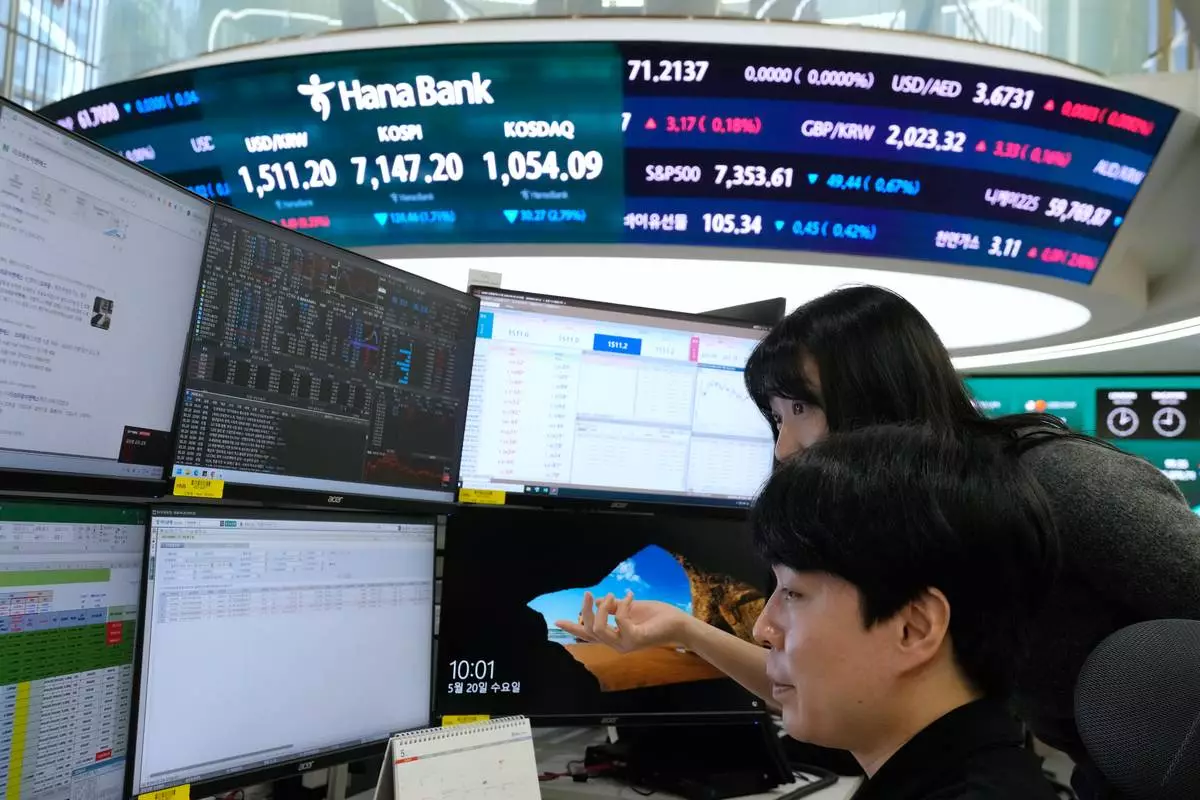
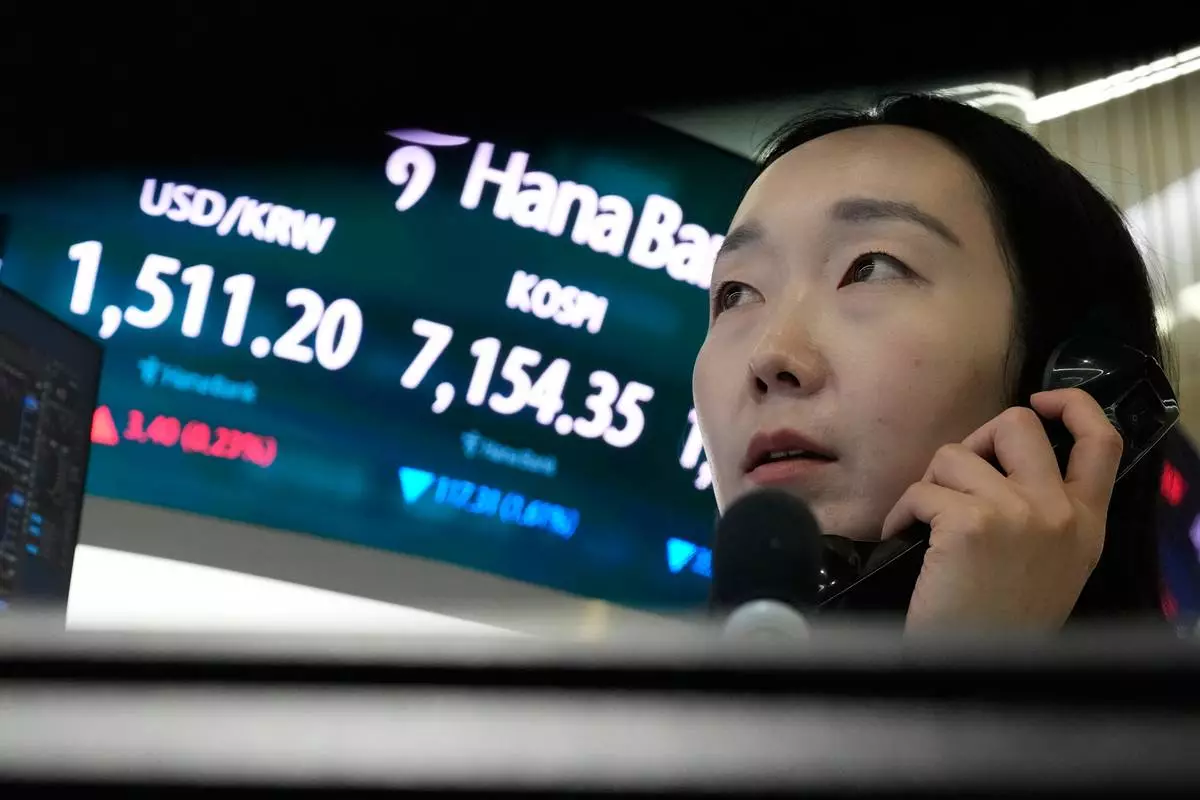
South Korea’s Kospi Kospi soared 8.4% thanks to strength for technology stocks. Samsung Electronics jumped 8.5% after its labor union and management reached an agreement late Wednesday that averted a strike. SK Hynix, a chip company partnering with Nvidia, surged 11.2%.

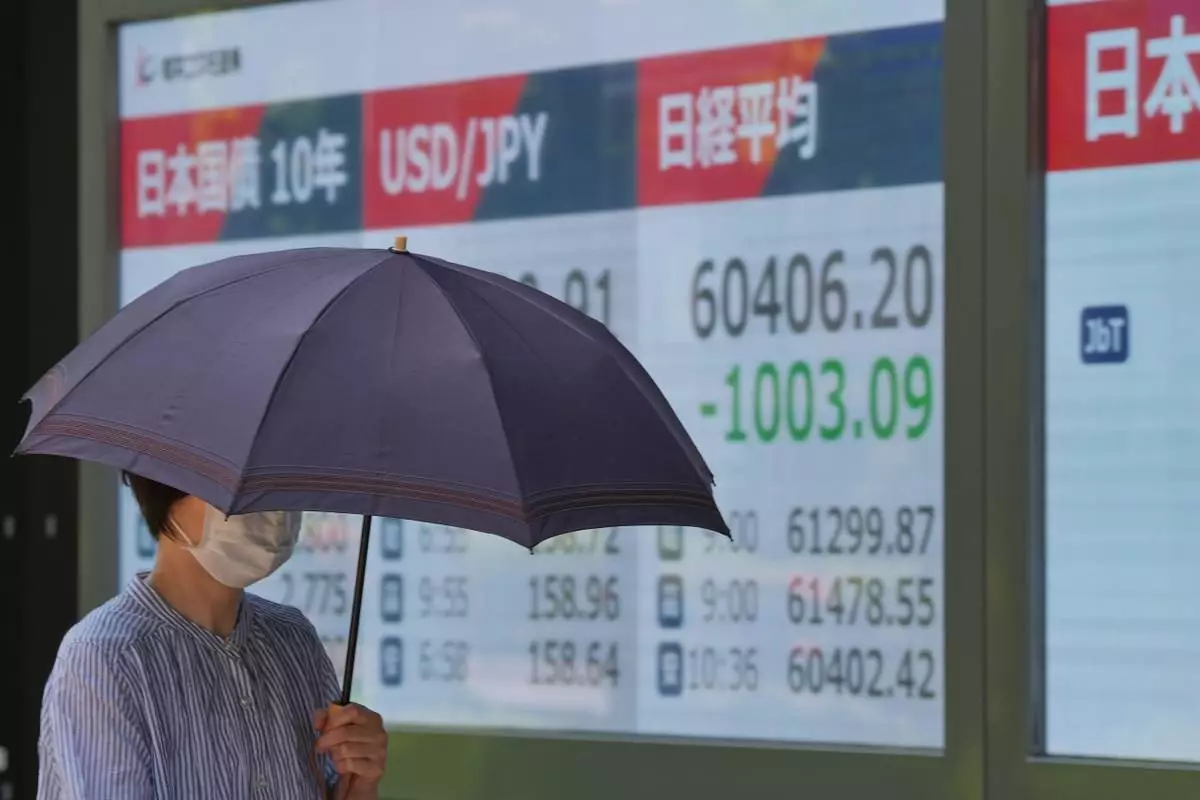
Tokyo’s Nikkei 225 jumped 3.1%, while indexes fell 1% in Hong Kong and 2% in Shanghai.

AP Business Writers Matt Ott and Elaine Kurtenbach contributed.

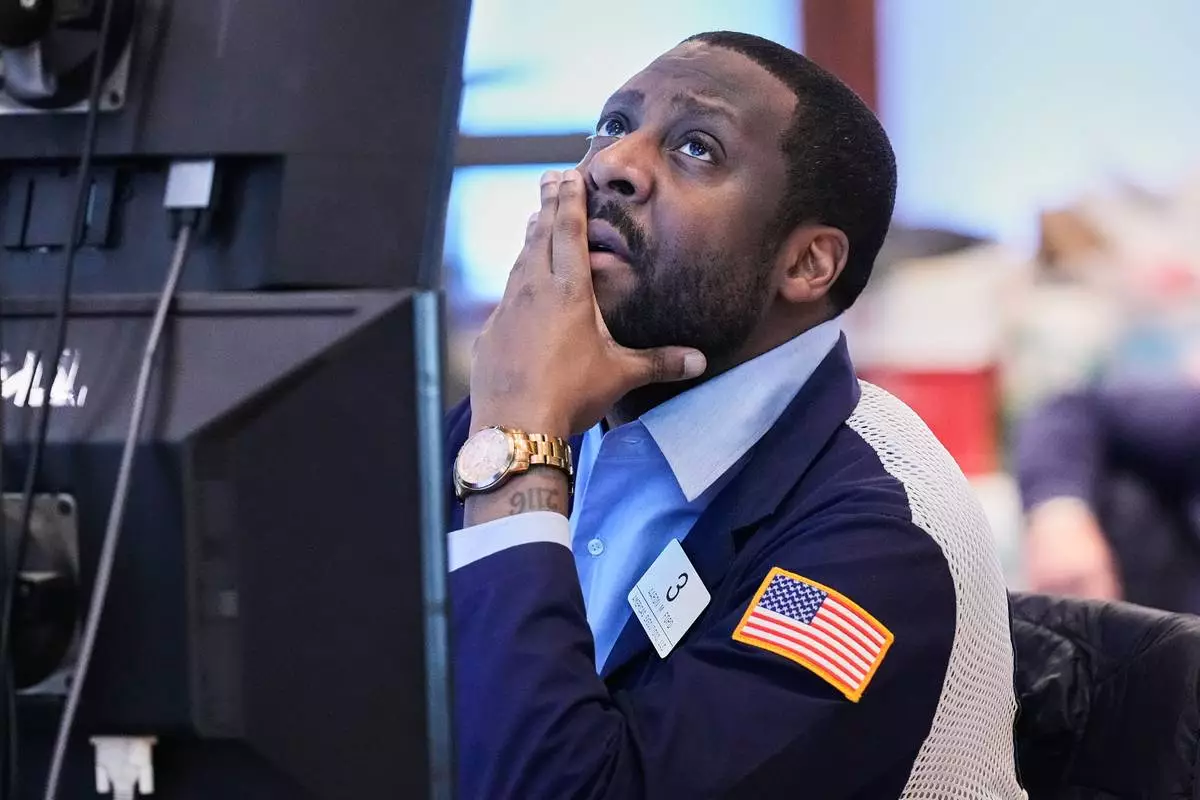
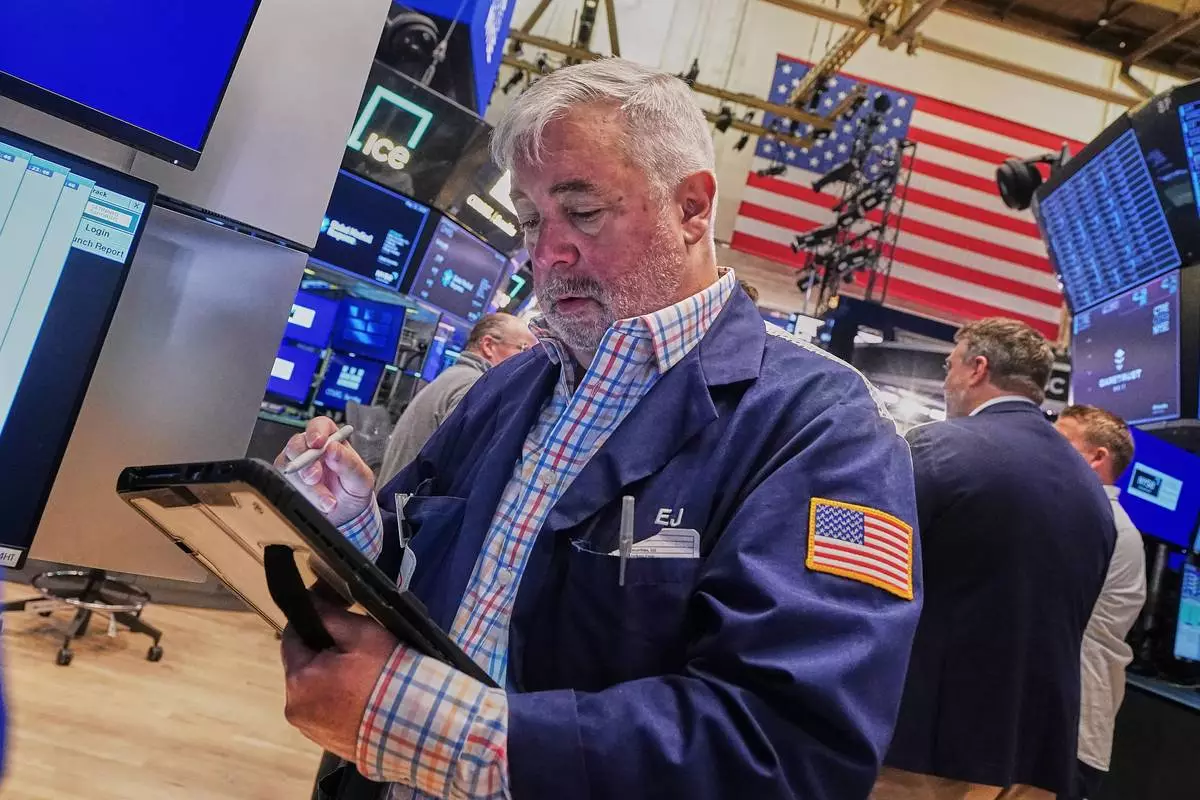
Trader Aaron Ford works on the floor of the New York Stock Exchange, Thursday, May 7, 2026. (AP Photo/Richard Drew)

Trader Aaron Ford works on the floor of the New York Stock Exchange, Thursday, May 7, 2026. (AP Photo/Richard Drew)

Trader Edward McCarthy works on the floor of the New York Stock Exchange, Wednesday, May 13, 2026. (AP Photo/Richard Drew)

Trader Edward McCarthy works on the floor of the New York Stock Exchange, Wednesday, May 13, 2026. (AP Photo/Richard Drew)

A Global Medical Response helicopter sits in front of the New York Stock Exchange before the planned IPO of GMR Solutions, Inc., Wednesday, May 13, 2026. (AP Photo/Richard Drew)

A Global Medical Response helicopter sits in front of the New York Stock Exchange before the planned IPO of GMR Solutions, Inc., Wednesday, May 13, 2026. (AP Photo/Richard Drew)

A person walks in front of an electronic stock board showing Japan's Nikkei index at a securities firm Monday, May 18, 2026, in Tokyo. (AP Photo/Eugene Hoshiko)

A person walks in front of an electronic stock board showing Japan's Nikkei index at a securities firm Monday, May 18, 2026, in Tokyo. (AP Photo/Eugene Hoshiko)

Currency traders watch monitors at the foreign exchange dealing room of the Hana Bank headquarters in Seoul, South Korea, Wednesday, May 20, 2026. (AP Photo/Ahn Young-joon)

Currency traders watch monitors at the foreign exchange dealing room of the Hana Bank headquarters in Seoul, South Korea, Wednesday, May 20, 2026. (AP Photo/Ahn Young-joon)

A currency trader talks on the phone near a screen showing the Korea Composite Stock Price Index (KOSPI) and the foreign exchange rate between U.S. dollar and South Korean won, left, at the foreign exchange dealing room of the Hana Bank headquarters in Seoul, South Korea, Wednesday, May 20, 2026. (AP Photo/Ahn Young-joon)

A currency trader talks on the phone near a screen showing the Korea Composite Stock Price Index (KOSPI) and the foreign exchange rate between U.S. dollar and South Korean won, left, at the foreign exchange dealing room of the Hana Bank headquarters in Seoul, South Korea, Wednesday, May 20, 2026. (AP Photo/Ahn Young-joon)

Recommended Articles