PITTSBURGH (AP) — Cam Heyward can do the math. Then again, it's not that hard.
The longest-tenured defensive player in Pittsburgh Steelers history knows he has far more football behind him than he does in front of him. How much more is anybody's guess, though if you watch him on any given snap — when the seven-time Pro Bowl defensive tackle's motor appears to run just as hot at 36 as it did at 21 — it might be longer than you think.
Still, Heyward learned long ago that opportunities like the one that arrives Monday night, when the AFC North champion Steelers (10-7) host the Houston Texans (12-5) in the opening round of the playoffs, don't come around that often.
The 15-year NFL veteran didn't think he'd be this deep into the twilight of his career still looking for his first Super Bowl appearance. Yet lingering over the one hole on a resume that figures to receive Hall of Fame consideration whenever the time comes will do him no good.
Yes, he's aware the Steelers haven't won a playoff game in nearly a decade. And yes, he knows Pittsburgh will be an underdog every step of the way, including at home against a Texans team that will walk into Acrisure Stadium searching for the first road postseason victory in franchise history.
But Heyward knows he can't control the past. He has no idea what the future holds beyond Monday night. All he can do is “take the biggest bite” of an apple that might not have many bites left.
“I’m trying to prep for one game," Heyward said. “That’s it there. And just put the most amount of effort I can in that game.”
Effort has never been an issue for a player who never met a whistle he didn't try to play through. For proof, look no further than the first snap of last week's thriller against Baltimore. There Heyward was, chugging 30-plus yards downfield in an effort to chase down Ravens star running back Derrick Henry.
Heyward's journey ended when teammate James Pierre crashed into him, sending Heyward briefly to the bench. By the next series, he was back out there on a night he tied for the team lead with seven tackles and shoved younger brother Connor into the end zone for a touchdown while filling in as the pusher in Pittsburgh's version of the tush push.
“He cares hard,” Steelers coach Mike Tomlin said. “Got big shoulders. He wants the responsibility of leading.”
It's something Heyward has never run away from. Considering the legacy of both his family — his father is former NFL running back Craig “Ironhead” Heyward — and his predecessors in black and gold, he didn't have a choice.
The wide-eyed rookie who once sat rapt in meetings absorbing what he could from mentors Casey Hampton, Brett Keisel and Aaron Smith, is now quite literally the graybeard doling out those same lessons to rookie Derrick Harmon, who was in second grade when the Steelers selected Heyward in the first round of the 2011 draft.
Tomlin called Heyward a Steeler “through and through,” even if there were some who openly wondered about that during training camp, when Heyward skipped some — but not all — of the 11-on-11 sessions in search of a reworked contract. He even threatened to sit out some regular-season games before agreeing to an amended deal on the eve of the opener against the New York Jets.
“Hold-ins” like the one Heyward staged have become increasingly common in recent years. The mixed reaction for a player so firmly entrenched in Pittsburgh — Heyward's 228 regular-season games with the club rank second to former quarterback Ben Roethlisberger — was not.
Asked Friday if his remarkably consistent performance on a defense that at times ran hot-cold around him was his way of silencing his critics, Heyward shrugged.
“(If) you've got to question (my loyalty), that's something that has to do with you rather than me,” he said. “I can’t really concern myself with that. In the midst of what we’re doing, I think the focus has just got to be on the team. And whatever is made of what happened in the past or what was going on, I care a lot about this team, and I’m going to do whatever is possible for this team.”
Namely, leading from the front. If that means throwing his little brother around in search of a first down, so be it. If it means thrusting his black-glove clad hands into the air to swat away a pass — something Heyward has done 64 times in his career — so be it. If it means imploring everyone else on the field goal protection unit to block better so kicker Chris Boswell can do his thing, so be it.
If that means being the frequent butt of jokes for his age, that's fine, too. Star outside linebacker T.J. Watt jokingly called Heyward "45 years old” in the euphoric aftermath of Pittsburgh's division-clinching win over Baltimore. It's not unusual for Tomlin to lob a good-natured verbal grenade in the general direction of Heyward when pointing out the generation gap between Heyward and some of his teammates.
“Those two are getting up there in age, too,” Heyward said. “Let’s not act like there’s just some spring chickens.”
No, they're not. Tomlin is only 53 but is 19 years in, and his job status is a perpetual topic of conversation. The 31-year-old Watt has never been on the field for a Steelers' playoff victory. All three and this particular chapter of the franchise's storied history will be linked forever. All three will have something personal at stake on Monday night, perhaps Heyward — dubbed a “unicorn” by defensive coordinator Teryl Austin for his unique makeup — most of all.
“It’s everybody versus me, that’s just how I am,” Heyward said. “You know, I’m always looking for an extra notch and extra gear.”
On Monday night he’ll try to find it one more — though he hopes not one last — time.
AP NFL: https://apnews.com/hub/nfl

Pittsburgh Steelers defensive tackle Cameron Heyward walks off the field after an NFL football game against the Cleveland Browns, Sunday, Dec. 28, 2025, in Cleveland. (AP Photo/David Richard)

Pittsburgh Steelers tight end Connor Heyward, left, celebrates his touchdown with defensive tackle Cameron Heyward (97) during the second half an NFL football game against the Baltimore Ravens, Sunday, Jan. 4, 2026, in Pittsburgh. (AP Photo/Justin Berl)

Pittsburgh Steelers head coach Mike Tomlin walks off the field with defensive tackle Cameron Heyward (97) before an NFL football game against the Baltimore Ravens, Sunday, Jan. 4, 2026, in Pittsburgh. (AP Photo/Gene J. Puskar)
WASHINGTON (AP) — President Donald Trump’s White House ballroom won final approval from a key agency on Thursday, despite a federal judge recently ordering a halt to construction unless Congress allows what would be the biggest structural change to the American landmark in more than 70 years.
The 12-member National Capital Planning Commission, the agency tasked with approving construction on federal property in the Washington region, took the vote because U.S. District Judge Richard Leon’s ruling — which came two days earlier — affects construction activities but not the planning process, said the commission's Trump-appointed chair, Will Scharf.
A vote of 8-1, with two commissioners voting present and one absent, allowed the plan to move forward.
Despite the agency’s approval, the judge’s ruling and a legal fight over the ballroom could stall progress on a legacy project that Trump is racing to see completed before the end of his term in early 2029. It’s among a series of changes the Republican president is planning for the nation’s capital to leave his lasting imprint while he’s still in office.
Before the vote, Scharf, a top White House aide, noted that Leon's order has been stayed for two weeks as the administration seeks an appeal. He said, as he understood the decision, it “really does not impact our action here today.”
Reading from notes, Scharf also delivered an impassioned defense of the project that reviewed the full history of changes and additions to the White House that were criticized when they were made but have become beloved with the passage of time. He spoke about the addition of the north and south porticos and the balcony added by President Harry Truman.
Scharf suggested that Trump’s proposed ballroom will similarly come to be viewed as a wise addition — despite drawing contemporary opposition from some members of the public and government officials.
“I believe that in time this ballroom will be considered every bit as much of a national treasure as the other key components of the White House,” Scharf said.
Scharf also said the project has been viewed negatively because of opposition to Trump, instead of the merits, saying, “I feel that we’ve been unfairly slighted in the press and otherwise for the way we’ve gone about reviewing this particular project.”
The vote by the commission, which includes three members Trump gets to appoint, had initially been scheduled for March but was postponed to Thursday because so many people signed up to comment at the commission’s meeting last month. The comments were overwhelmingly in opposition to the ballroom.
The lone “no” vote was cast by Phil Mendelson, a Democrat who chairs the Council of the District of Columbia. Linda Argo and Arrington Dixon, the two commissioners appointed by Mayor Muriel Bowser, a Democrat, voted present.
Mendelson criticized the design of the ballroom addition and how fast it was approved.
“It’s just too large,” he said.
Criticism also came from Public Citizen, a nonprofit consumer advocacy organization. One of its attorneys, Jon Golinger, said the commission had discounted opposition from city officials and thousands of people who commented against the project, and ignored the judge's ruling. Several commissioners, including Scharf, had said they took the public feedback seriously.
“This approval is illegitimate and this vote is a joke," Golinger said.
Trump, in a statement after the vote, thanked the commissioners and said he was honored.
“When completed, it will be the Greatest and Most Beautiful Ballroom of its kind anywhere in the World, and a fabulous complement to our Beautiful and Storied White House!” the president said on social media.
Before voting, the commission considered design changes to the 90,000-square-foot (8,400-square-meter) ballroom addition that the president announced aboard Air Force One on Sunday, as he flew back to Washington from a weekend at his Florida home.
He removed a large staircase on the south side of the building and added an uncovered porch to the southwest side. Architects and other critics of the project had panned the staircase as too large and basically useless since there was no way to enter the ballroom at the top.
A White House official said the president had considered comments from the National Capital Planning Commission and another oversight entity, the U.S. Commission of Fine Arts, which approved the project earlier this year, as well as members of the public.
The official, who was not authorized to publicly discuss the ballroom design and spoke on the condition of anonymity, said additional “refinements” had been made to the exterior.
The ballroom, now estimated to cost $400 million, has expanded in scope and price tag since Trump first announced the project last summer, citing a need for space other than a tent on the lawn to host important guests. Trump demolished the East Wing in October with little warning, and site preparation and underground work have been underway since then.
Two other Trump-appointed commissioners, Stuart Levenbach and James Blair, voted for the project.
Levenbach, who serves as vice chairman and is the federal government’s chief statistician, said the White House is currently “not suited” to accommodate large numbers of guests and the addition will improve the “utility” of the compound.
He said tunnels and other structures underground at the White House made it impossible to place many features of the ballroom there, too, as some have suggested might be possible. Levenbach said the addition is a “multipurpose facility,” noting that, in addition to a ballroom, it will also have offices for the first lady, kitchen space and a theater.
“This is not an expansion for its own sake,” Levenbach said.
Blair, a deputy to White House chief of staff Susie Wiles, said visitors and guests of the president deserve a “better experience."
Scharf and Blair also said Trump will get “very limited use” of the ballroom before his term ends.
Trump went ahead with the project before seeking input from the National Capital Planning Commission and the Commission of Fine Arts, which he reconstituted with allies and supporters.
The National Trust for Historic Preservation, a private nonprofit organization, sued after Trump demolished the East Wing last fall to build the ballroom addition — a space nearly twice as big as the mansion itself.
Trump says it will be paid for with donations from wealthy people and corporations, including him, though public dollars are paying for underground bunkers and security upgrades.
The trust sought a temporary halt to construction until Trump presented the project to both commissions and Congress for approval. Leon agreed but said that his order would take effect in two weeks and that construction related to security would be allowed.

President Donald Trump answers questions from reporters after signing an executive order in the Oval Office of the White House Tuesday, March 31, 2026, in Washington. (AP Photo/Alex Brandon)
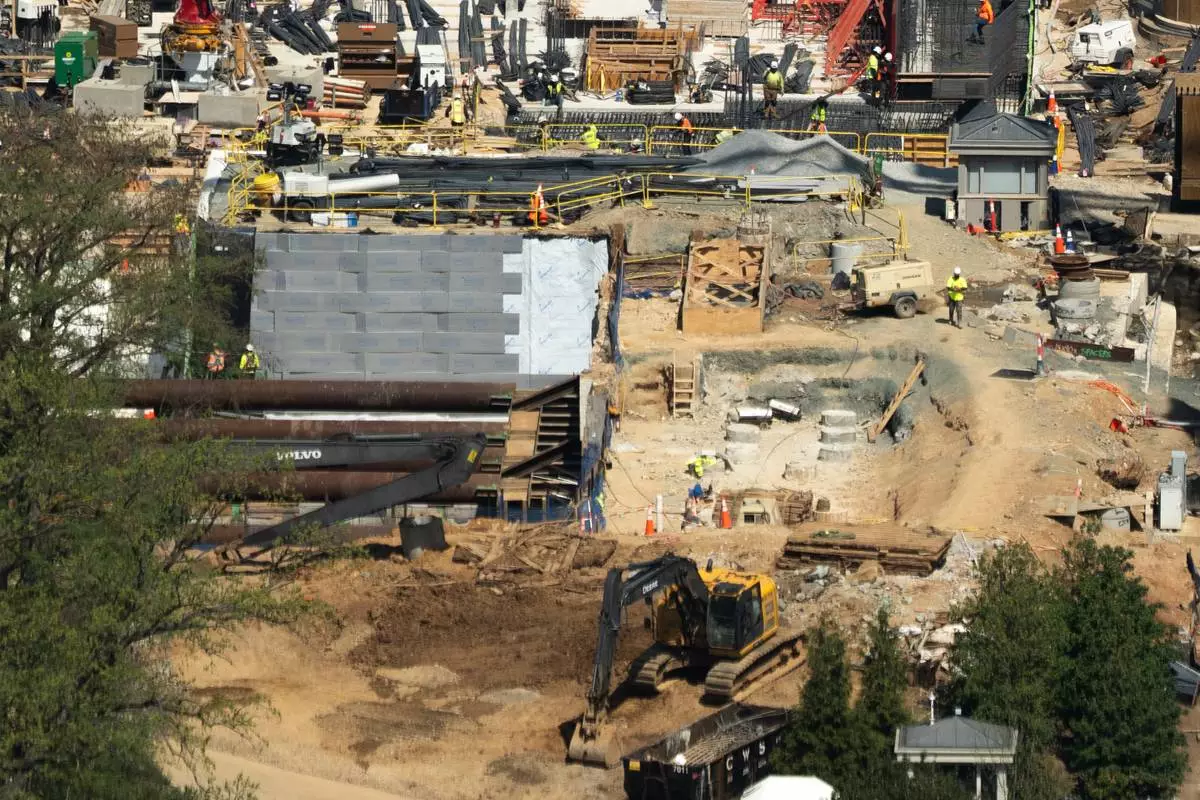
Work continues on the construction of the ballroom at the White House in Washington, Wednesday, April 1, 2026. (AP Photo/Allison Robbert)

President Donald Trump holds a rendering of the proposed new East Wing of the White House as he speaks to reporters aboard Air Force One en route from West Palm Beach, Fla., to Joint Base Andrews, Md., Sunday, March 29, 2026. (AP Photo/Mark Schiefelbein)

Work continues on the construction of the ballroom at the White House in Washington, Wednesday, April 1, 2026. (AP Photo/Allison Robbert)

President Donald Trump holds a rendering of the proposed new East Wing of the White House as he speaks to reporters aboard Air Force One en route from West Palm Beach, Fla., to Joint Base Andrews, Md., Sunday, March 29, 2026. (AP Photo/Mark Schiefelbein)