BERLIN (AP) — Erich von Däniken, the Swiss author whose bestselling books about the extraterrestrial origins of ancient civilizations brought him fame among paranormal enthusiasts and scorn from the scientific community, has died. He was 90.
Von Däniken's representatives announced on his website on Sunday that he had died the previous day in a hospital in central Switzerland.
Von Däniken rose to prominence in 1968 with the publication of his first book "Chariots of the Gods," in which he claimed that the Mayans and ancient Egyptians were visited by alien astronauts and instructed in advanced technology that allowed them to build giant pyramids.
The book fueled a growing interest in unexplained phenomena at a time when thanks to conventional science man was about to take its first steps on the Moon.
"Chariots of the Gods" was followed by more than two dozen similar books, spawning a literary niche in which fact and fantasy were mixed together against all historical and scientific evidence.
Public broadcaster SRF reported that altogether almost 70 million copies of his books were sold in more than 30 languages, making him one of the most widely read Swiss authors.
While von Däniken managed to shrug off his many critics, the former hotel waiter had a troubled relationship with money throughout his life and frequently came close to financial ruin.
Born in 1935, the son of a clothing manufacturer in the northern Swiss town of Schaffhausen, von Däniken is said to have rebelled against his father's strict Catholicism and the priests who instructed him at boarding school by developing his own alternatives to the biblical account of the origins of life.
After leaving school in 1954, von Däniken worked as a waiter and barkeeper for several years, during which he was repeatedly accused of fraud and served a couple of short stints in prison.
In 1964, he was appointed manager of a hotel in the exclusive resort town of Davos and began writing his first book. Its publication and rapid commercial success were quickly followed by accusations of tax dodging and financial impropriety, for which he again spent time behind bars.
By the time he left prison, "Chariots of the Gods" was earning von Däniken a fortune and a second book "Gods from Outer Space" was ready for publication, allowing him to commit himself to his paranormal passion and travel the world in search of new mysteries to uncover.
Throughout the 1970s von Däniken undertook countless field trips to Egypt, India, and above all Latin America, whose ancient cultures held a particular fascination for the amateur archaeologist.
He lectured widely and set up societies devoted to promoting his theories, later pioneering the use of video and multimedia to reach out to ever-larger audiences hungry for a different account of history.
No amount of criticism dissuaded him and his fans from believing that Earth has been visited repeatedly by beings from Outer Space, and will be again in the future.
In 1991 von Däniken gained the damning accolade of being the first recipient of the "Ig Nobel" prize for literature — for raising the public awareness of science through questionable experiments or claims.
Even when confronted with fabricated evidence in a British television documentary — supposedly ancient pots were shown to be almost new — von Däniken insisted that, minor discrepancies aside, his theories were essentially sound.
In 1985 von Däniken wrote "Neue Erinnerungen an die Zukunft" — "New Memories of the Future" — ostensibly to address his many critics: "I have admitted (my mistakes), but not one of the foundations of my theories has yet been brought down."
Although his popularity was waning in the English-speaking world by the 1980s, von Däniken's books and films influenced a wave of semi-serious archaeological documentaries and numerous popular television shows, including "The X-Files," which featured two FBI agents tasked with solving paranormal mysteries.
His last major venture, a theme park based on his books, failed after just a few years due to lack of interest. The "Mystery Park" still stands, its man-made pyramids and otherworldly domes rotting as tourists prefer to explore the charms of the nearby town of Interlaken and the imposing Swiss Alps that surround it.
Erich von Däniken is survived by his wife of 65 years, Elisabeth Skaja, Cornelia and two grandchildren.

FILE - Erich von Daeniken, co-founder and co-owner of Mystery Park, poses in front of the Panorama Tower at Mystery Park in Interlaken, Wednesday, April 23, 2003. (Gaetan Ball)/Keystone via AP, File)
CAPE CANAVERAL, Fla. (AP) — NASA’s Artemis II astronauts fired their engines and blazed toward the moon Thursday night, breaking free of the chains that have trapped humanity in shallow laps around Earth in the decades since Apollo.
The so-called translunar ignition came 25 hours after liftoff, putting the three Americans and a Canadian on course for a lunar fly-around early next week. Their Orion capsule bolted out of orbit around Earth right on cue and chased after the moon to nearly 250,000 miles (400,000 kilometers) away.
“Ladies and gentlemen, I am so, so excited to be able to tell you that for the first time since 1972 during Apollo 17, human beings have left Earth orbit,” NASA’s Lori Glaze announced at a news conference.
The engine firing was flawless, she noted.
Canadian astronaut Jeremy Hansen said he and his crewmates were glued to the capsule's windows as they left Earth in the rearview mirror, taking in the “phenomenal” views. Their faces were pressed so tightly against the windows that they had to wipe them clean.
“Humanity has once again shown what we are capable of, and it’s your hopes for the future that carry us now on this journey around the moon,” Hansen said.
NASA had the Artemis II crew stick close to home for a day to test their capsule’s life-support systems before clearing them for lunar departure.
Now committed to the moon, the Artemis II test flight is the opening act for NASA’s grand plans for a moon base and sustained lunar living.
Commander Reid Wiseman, pilot Victor Glover, Christina Koch and Hansen will dash past the moon then hang a U-turn and zip straight home without stopping on land. In the process, they will become the farthest humans have ever traveled from Earth, breaking the Apollo 13 distance record set in 1970. They also may become the fastest during their reentry at flight’s end on April 10.
Glover, Koch and Hansen already have made history as the first Black, the first woman and the first non-U.S. citizen to launch to the moon. Apollo’s 24 lunar travelers were all white men.
To set the mood for the day’s main event, Mission Control woke up the crew with John Legend’s “Green Light” featuring Andre 3000 and a medley of NASA teams cheering them. “We are ready to go,” Glover said.
Mission Control gave the final go-ahead minutes before the critical engine firing, telling the astronauts that they were embarking on “humanity’s lunar homecoming arc” to bring them back to Earth. The capsule is relying on the gravity of Earth and the moon — termed a free-return lunar trajectory — to complete the round-trip figure-eight loop. The engine accelerated their capsule to more than 24,000 mph (38,000 kph) to shove them out of Earth's orbit.
“With this burn to the moon, we do not leave Earth. We choose it,” Koch said.
Flight director Judd Frieling said he and his team were all business while on duty but will likely reflect on the momentousness of it all once they go home. “I suspect everybody understands that this is a once-in-a-lifetime moment," he told reporters.
The next major milestone will be Monday’s lunar flyby.
Orion will zoom 4,000 miles (6,400 kilometers) beyond the moon before turning back, providing unprecedented and illuminated views of the lunar far side, at least for human eyes. The cosmos will even treat the Artemis II astronauts to a total solar eclipse as the moon temporarily blocks the sun from their perspective.
While awaiting their orbital departure earlier Thursday, the astronauts savored the views of Earth from tens of thousands of miles high. Koch told Mission Control that they can make out the entire coastlines of continents and even the South Pole, her old stomping ground.
NASA is counting on the test flight to kickstart the entire Artemis program and lead to a moon landing by two astronauts in 2028.
The so-called lunar loo may need some design tweaks, however.
Orion's toilet malfunctioned as soon as the Artemis crew reached orbit Wednesday evening. Mission Control guided astronaut Koch through some plumbing tricks and she finally got it going, but not before having to resort to using contingency urine storage bags.
The urine pouches are serving double duty. Mission Control ordered the crew to fill a bunch of the empty bags with water from the capsule’s dispenser on Thursday. A valve issue arose with the dispenser following liftoff, and NASA wanted plenty of drinking water on hand for the crew in case the problem recurred. The astronauts used straws and syringes to fill the pouches with more than 2 gallons (7 liters) worth before pivoting to the moon.
The Associated Press Health and Science Department receives support from the Howard Hughes Medical Institute’s Department of Science Education and the Robert Wood Johnson Foundation. The AP is solely responsible for all content.
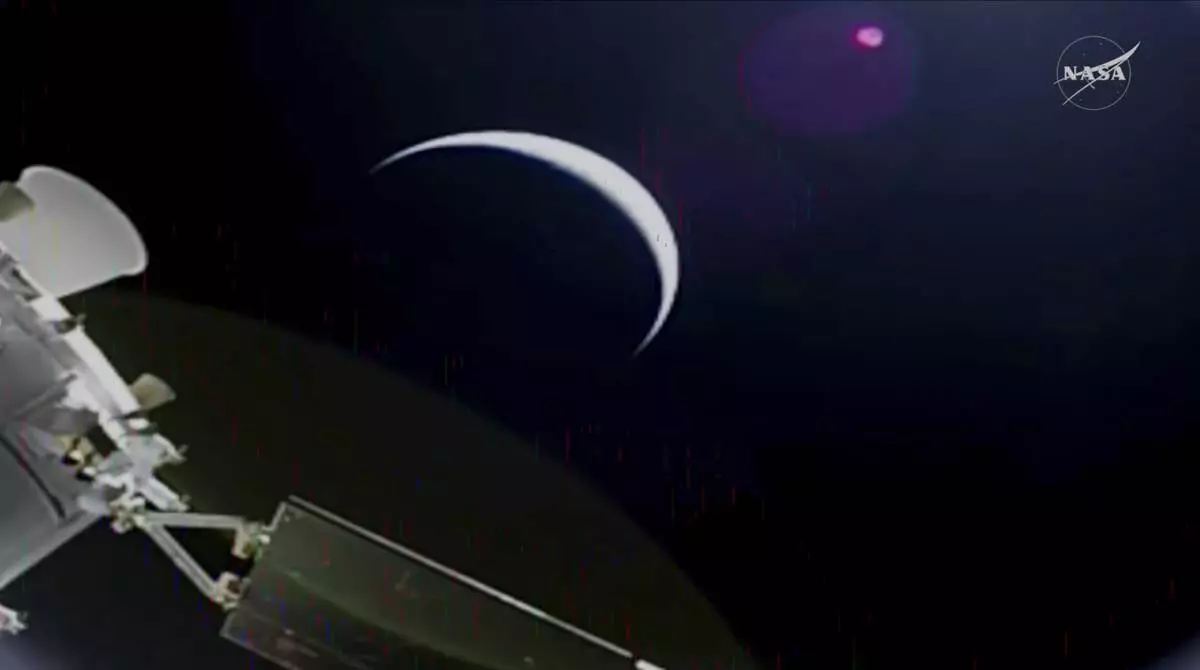
This image released by NASA on Thursday, April 2, 2026, shows NASA’s Orion spacecraft with Earth in the background. (NASA via AP)
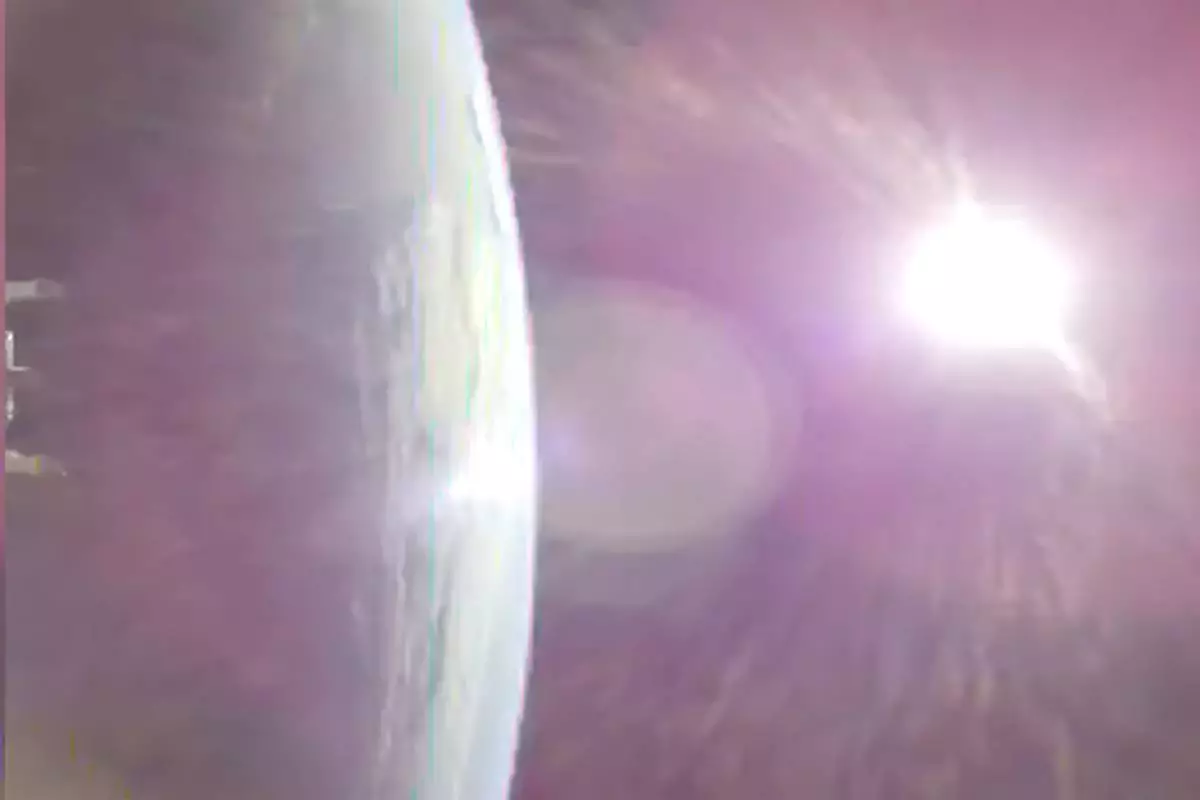
This image taken from video provided by NASA shows the Earth, left, from NASA's Orion spacecraft as it fired its engines heading toward the moon Thursday, April 2, 2026. (NASA via AP)
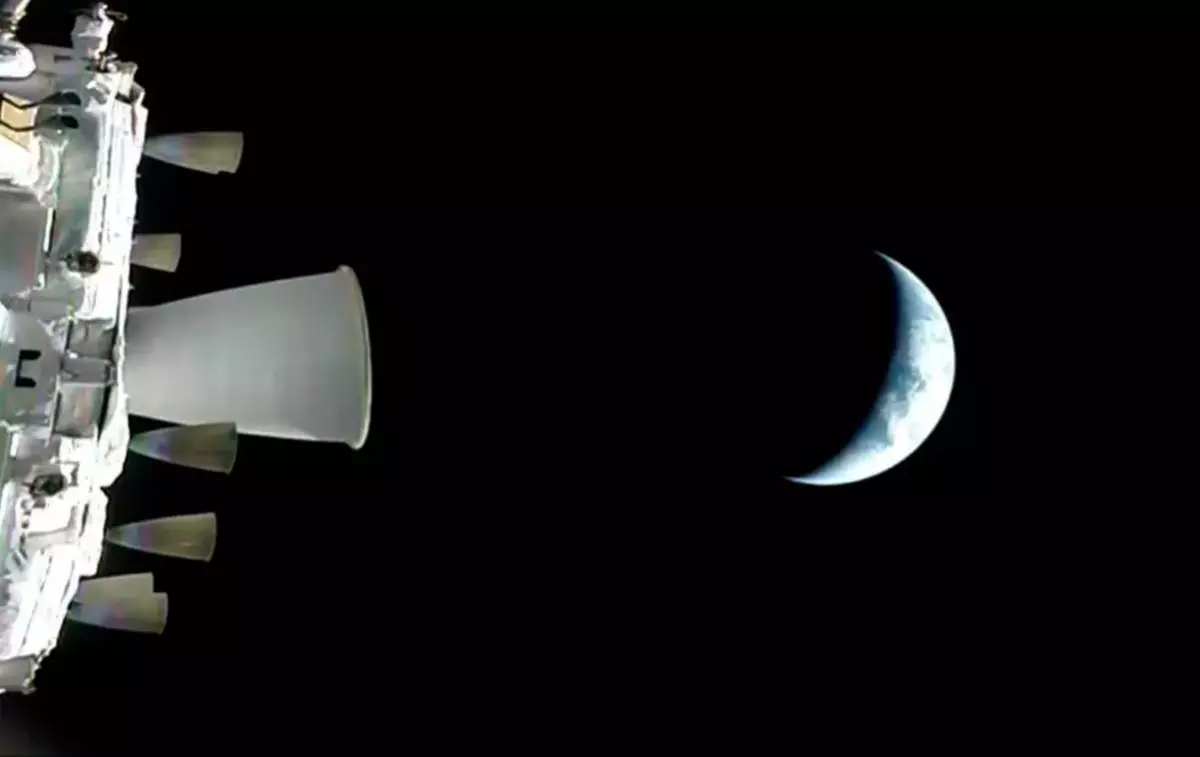
In this photo provided by NASA, a view of the Earth from NASA's Orion spacecraft as it orbits above the planet during the Artemis II test flight, on Thursday, April 2, 2026. (NASA via AP)
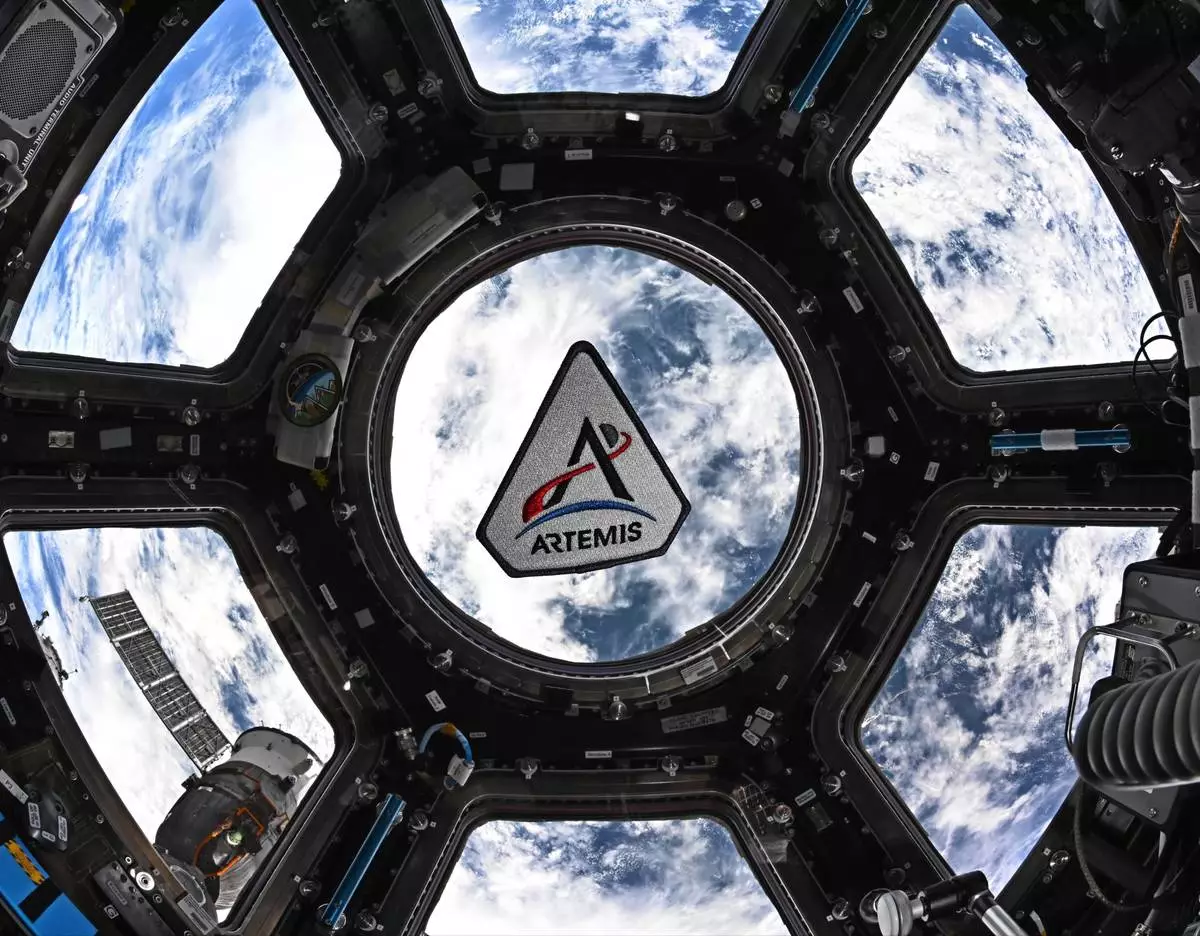
In this photo provided by NASA, an Artemis program patch floating in the International Space Station's cupola, on March 30, 2026. (Jessica Meir/NASA via AP)

Spectators view NASA's Artemis II moon rocket launch from the A. Max Brewer Bridge, Wednesday, April 1, 2026, in Titusville, Fla. (AP Photo/Phelan M. Ebenhack)
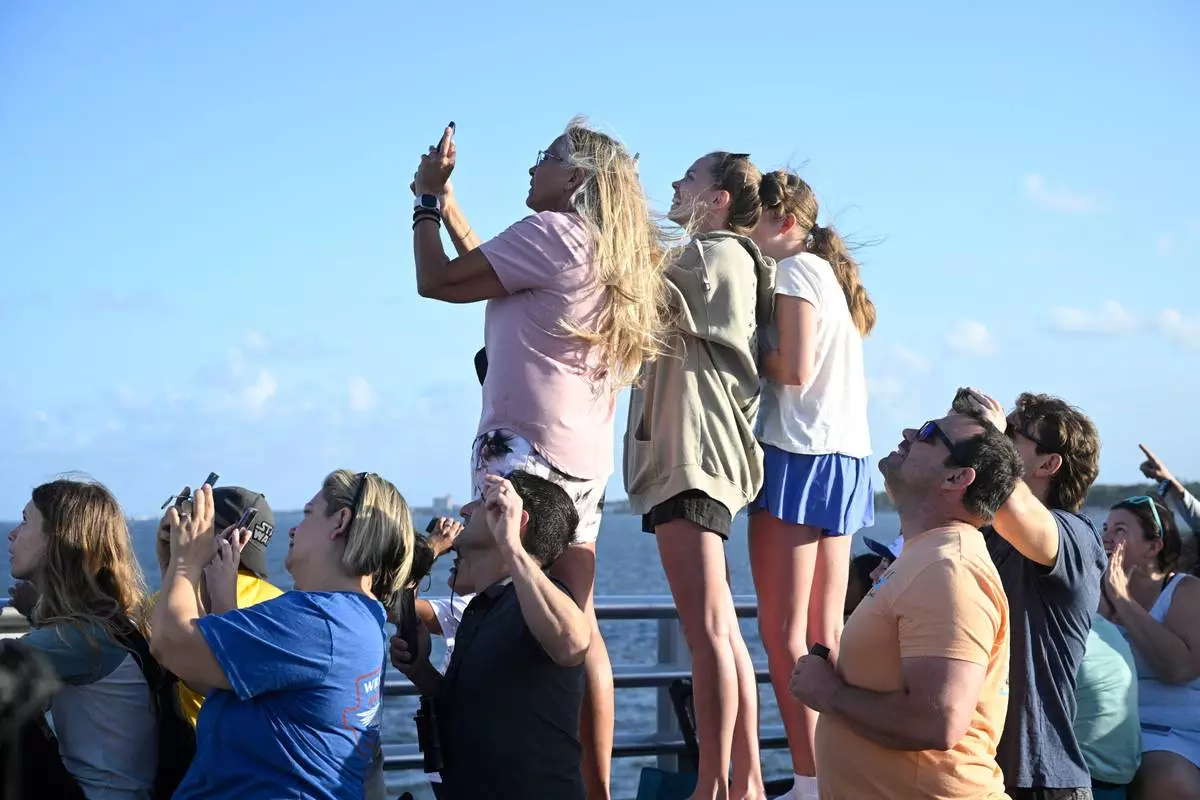
Spectators view NASA's Artemis II moon rocket launch from the A. Max Brewer Bridge, Wednesday, April 1, 2026, in Titusville, Fla. (AP Photo/Phelan M. Ebenhack)
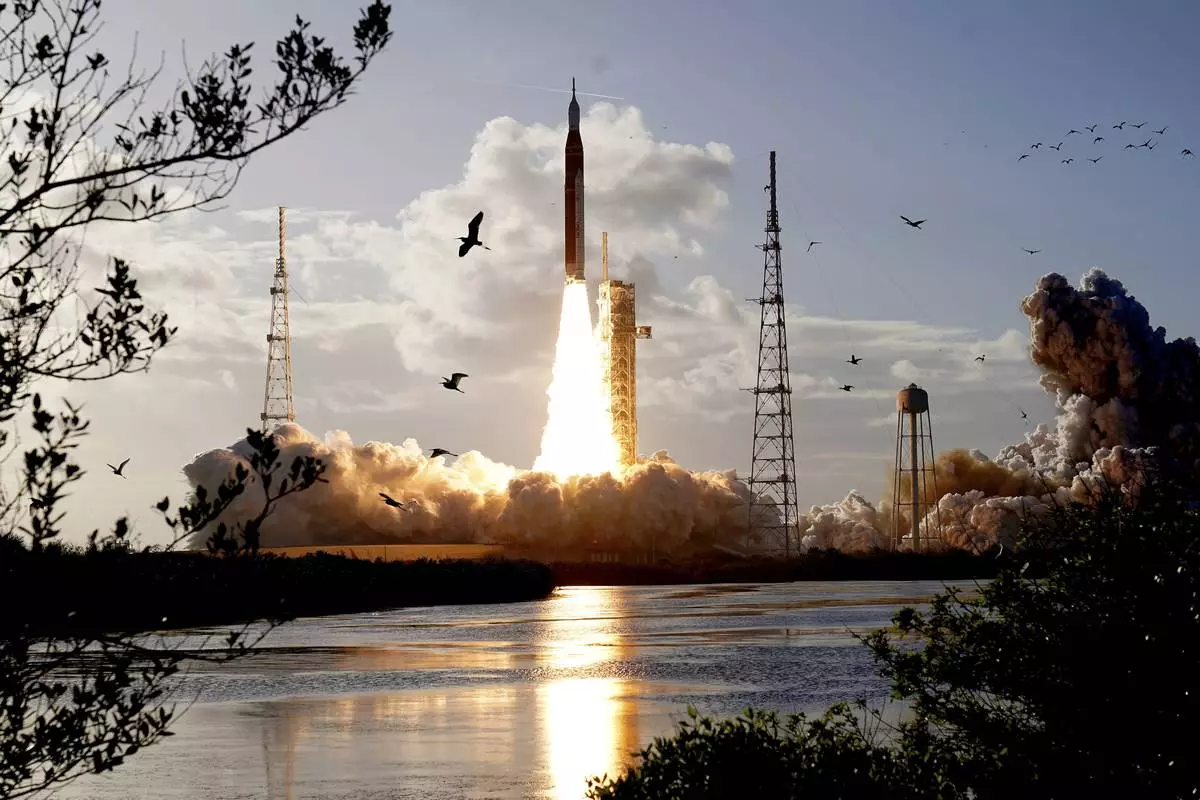
NASA's Artemis II moon rocket lifts off from the Kennedy Space Center's Launch Pad 39-B Wednesday, April 1, 2026, in Cape Canaveral, Fla. (AP Photo/Chris O'Meara)
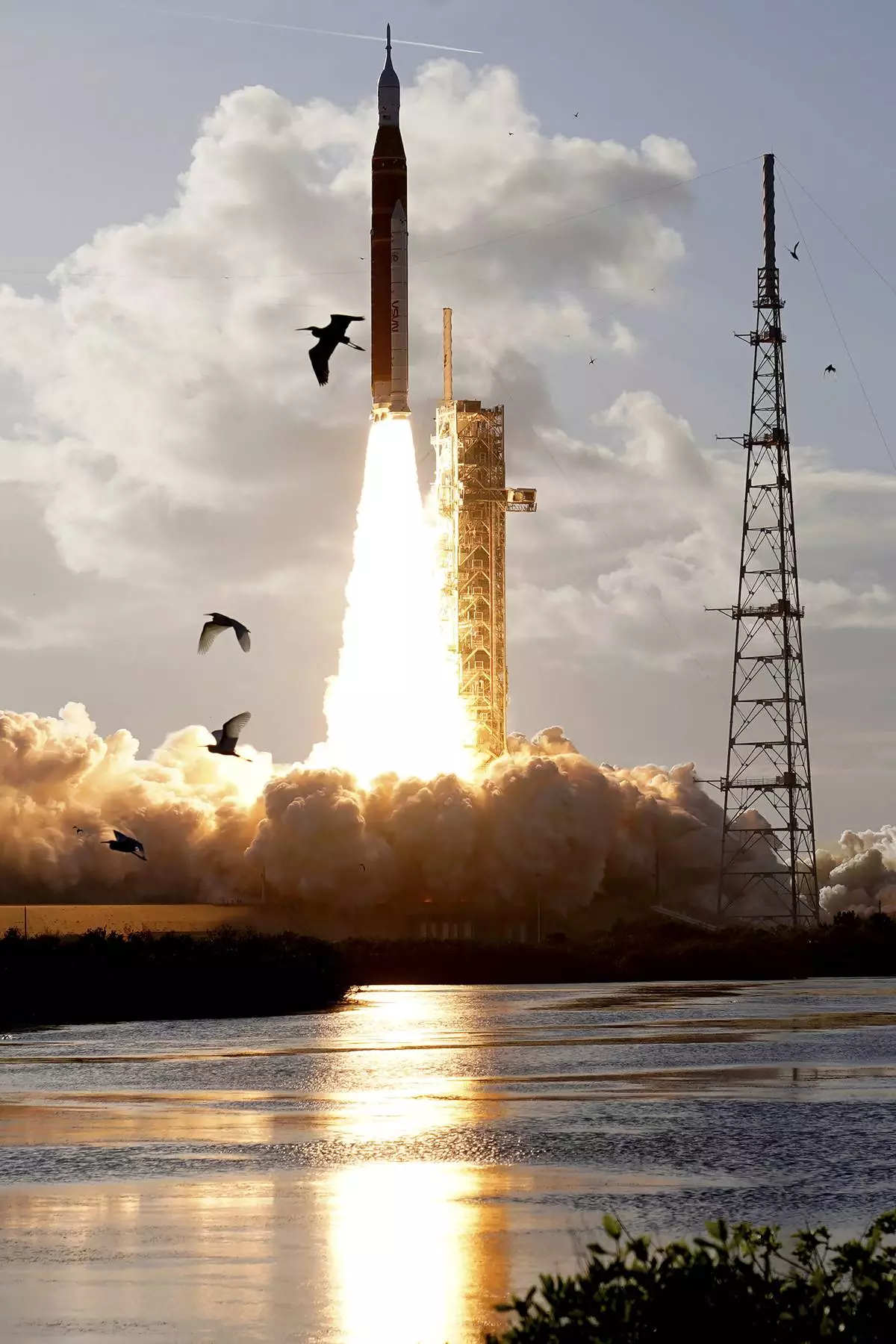
NASA's Artemis II moon rocket lifts off from the Kennedy Space Center's Launch Pad 39-B Wednesday, April 1, 2026, in Cape Canaveral, Fla. (AP Photo/Chris O'Meara)
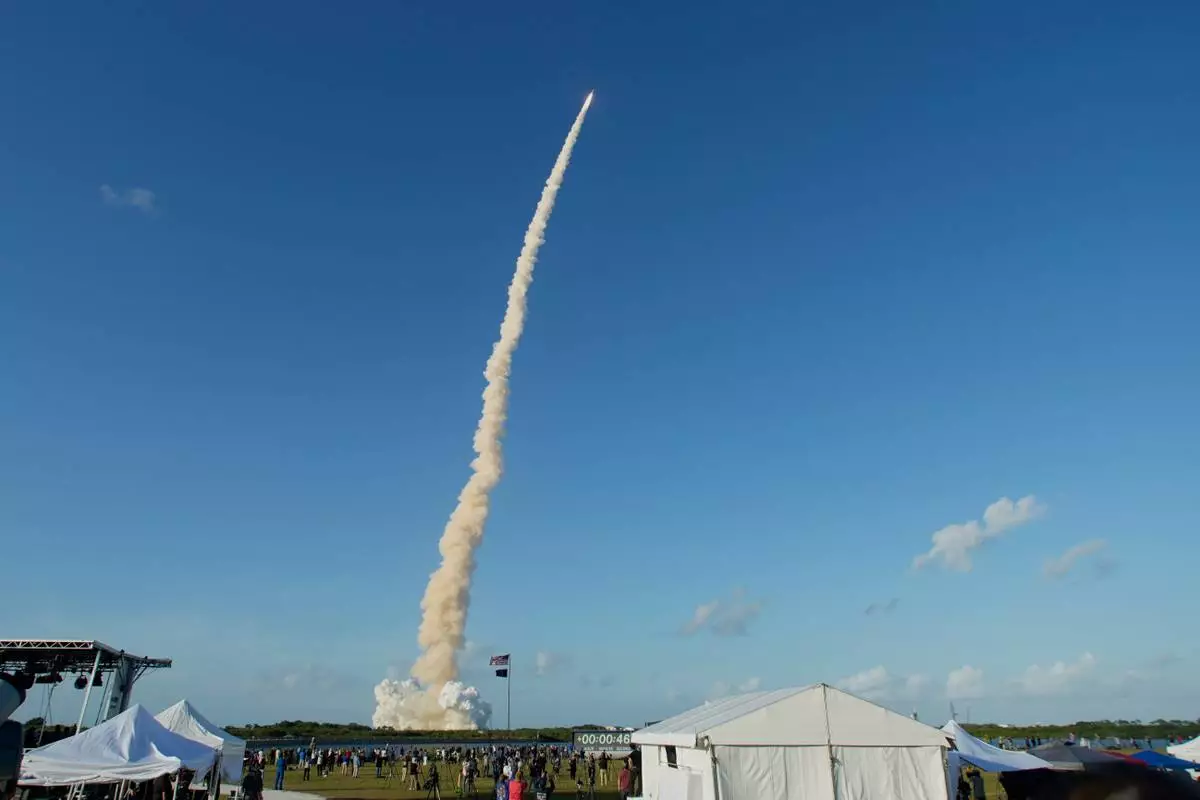
NASA's Artemis II moon rocket lifts off from the Kennedy Space Center's Launch Pad 39-B Wednesday, April 1, 2026, in Cape Canaveral, Fla. (AP Photo/John Raoux)