China’s winter season is driving crowds to ski slopes in the country's eastern province of Zhejiang and ice rinks in Beijing, as residents embrace cold-weather sports.
In Ninghai County of Ningbo City, Zhejiang, Diyijian Ski Resort has become a popular destination. Perched atop a 958-meter peak, one of the highest in Zhejiang, the resort is surrounded by mountains and bamboo groves.
Covering over 20,000 square meters, it can accommodate more than 500 people simultaneously.
At ski resorts in south China, snow quality remains a major concern for visitors. Staff say most of the snow is man‑made. Fifteen machines along the slopes can generate up to 1,200 cubic meters of snow every hour.
To cope with the region’s warmer climate, the resort also uses two high‑temperature snowmakers that produce ice regardless of outside conditions. The ice is crushed into flakes and compacted to meet skiing standards.
In north China, the Shichahai Ice Rink in Beijing's Xicheng District officially opened for business on Saturday after its ice thickness met safety requirements.
Numerous residents and tourists visited to experience the traditional fun on ice.
Located in Beijing's core district, the rink is just a 2-kilometer walk from the Forbidden City's northern gate, the Gate of Divine Prowess (Shenwu men), making it one of the city's renowned outdoor ice venues.
The currently ice surface open to visitors spans 35,000 square meters, roughly the size of five standard soccer fields, and can accommodate up to 2,000 people at the same time. It will also offer evening sessions going forward, operating from 08:00 to 21:00.
The Shichahai scenic area is a famous attraction in Beijing, featuring tea houses and time-honored restaurants.
Additionally, during the year-end and New Year period, a market is set up along the waterfront, offering ring toss games, sugar painting, and delicacies from all corners of the country.

China’s ski resorts, ice rinks draw crowds as winter season peaks
China's two major power grid operators -- the State Grid Corporation of China (State Grid) and China Southern Power Grid (CSG) -- reported a surge in investment in the first quarter of 2026, underscoring efforts to strengthen infrastructure construction and support high-quality socioeconomic development in China.
The State Grid said it completed fixed-asset investment worth 129 billion yuan (about 18.77 billion U.S. dollars) in the first three months of this year, up 37 percent the corresponding period of the previous year. The spending has driven more than 250 billion yuan (36 billion U.S. dollars) of investment across the wider industrial chain.
Key projects such as the Panxi ultra-high-voltage (UHV) alternating current (AC) line and the Anhui-Hubei back-to-back direct current (DC) project have seen ground broken for their construction, while several west-to-east power transmission projects have been upgraded.
Investment in connecting renewable energy generation to the grid was reported to have exceeded 10 billion yuan (1.45 billion U.S. dollars) from January to March, a year-on-year rise of more than 50 percent.
The CSG also reported robust growth in investment in the three-month period, with fixed-asset investment reaching 38.45 billion yuan (5.58 billion U.S. dollars), up about 50 percent from a year earlier.
Among its achievements, the company completed and commissioned 80 key projects, including the 220 kV cross-sea power grid interconnection project, which was officially put into operation on March 20. The project ended years of grid isolation on the Weizhou Island in south China by linking it to the main power system of the Guangxi Zhuang Autonomous Region.
The construction of 17 other major energy projects, including one linking the power grid of the Xizang Autonomous Region in southwest China with that of Guangdong Province in south China, is advancing rapidly. These projects are expected to bolster regional industries, the maritime economy, digital collaboration and the transition to green energy.
"By accelerating major project construction, investment during the 15th Five-Year Plan period (2026-2030) is expected to approach 1 trillion yuan (145 billion U.S. dollars), driving a further 2 trillion yuan (290 billion U.S. dollars) of investment across upstream and downstream industries," said Dong Yanle, deputy general manager of the Engineering Construction Department under the China Southern Power Grid.
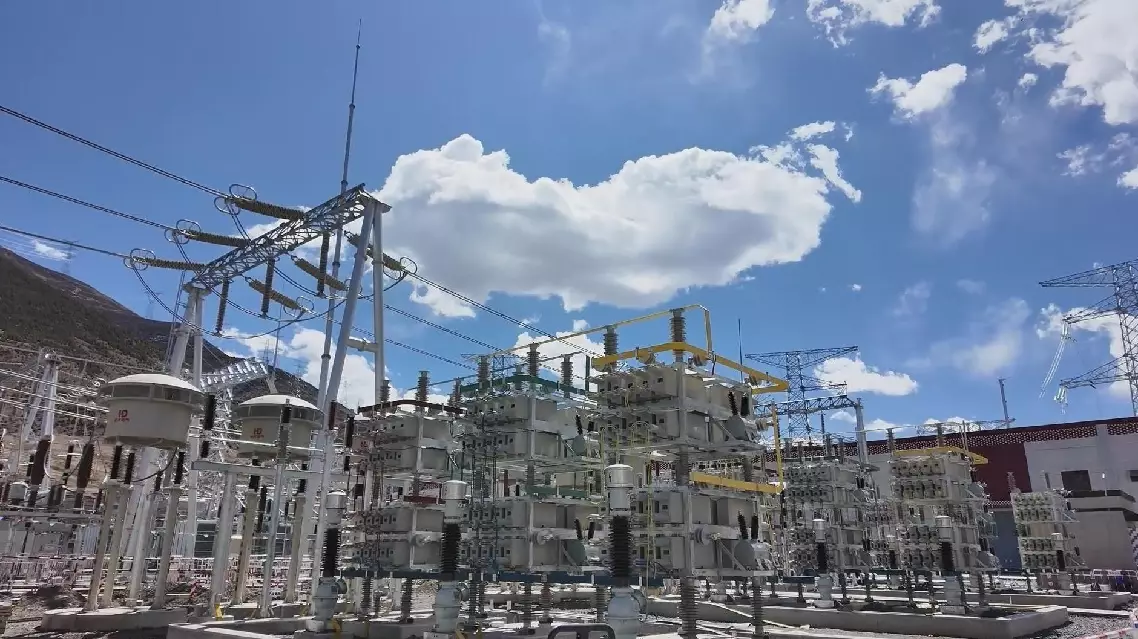
China ramps up power grid investment in January-March to boost growth