Autonomous driving technology is advancing rapidly, with the potential to boost traffic efficiency and improve road safety. To promote the technology in Hong Kong, the Transport Department has issued six autonomous vehicle pilot licences since 2024, allowing operators to conduct road tests in designated areas.
The first licence was granted to an intelligent driving technology company with more than a decade of experience in autonomous driving research and development. The firm has deployed its technology in 22 cities, spanning the Mainland and the United Arab Emirates.
Click to Gallery
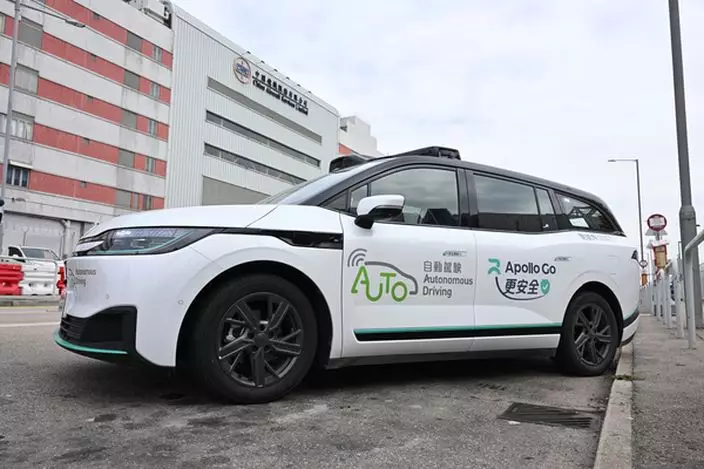
The first licensed technology company has conducted road tests in North Lantau, Cyberport and the Kai Tak Development Area, achieving more than 80,000km of safe driving.
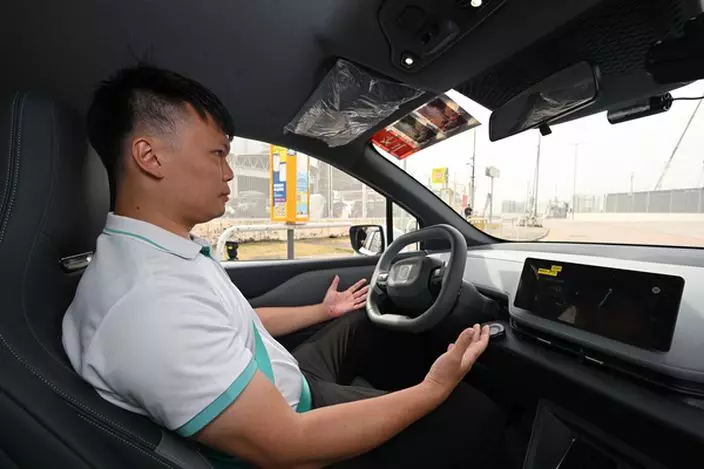
During testing, drivers keep their hands off the steering wheel and only take control of the vehicle when necessary.
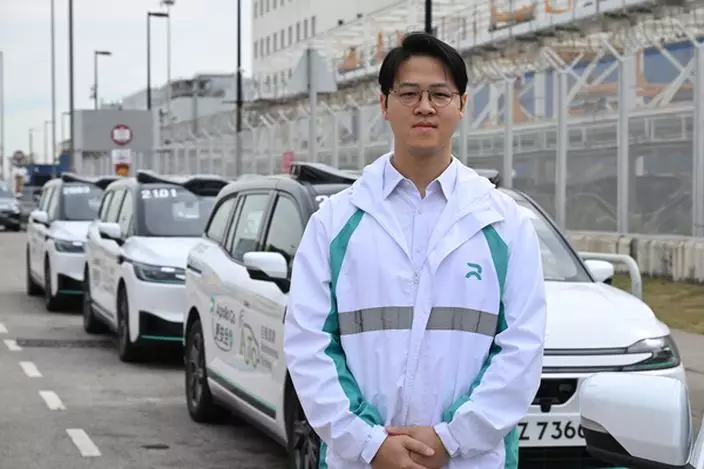
Intelligent Driving Technology Company Hong Kong Project Development Manager Nick Lau says the system has been optimised to comply with local traffic rules and conditions.
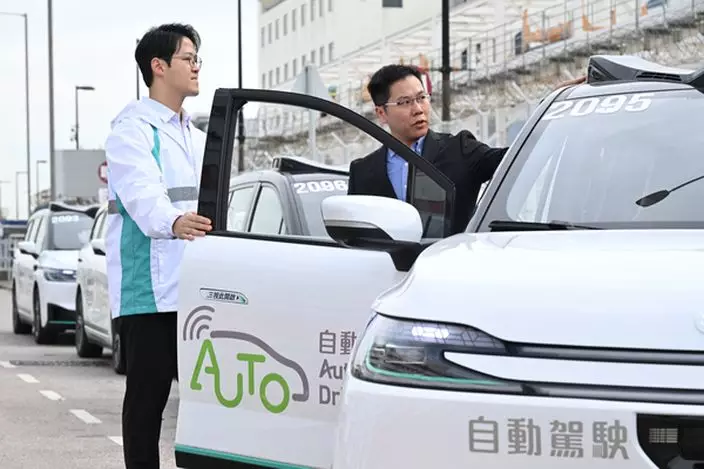
Transport Department Electrical & Mechanical Engineer (Autonomous Vehicle) Ken Tang (right) says the tests in North Lantau have achieved four key breakthroughs: multi-vehicle operation, designated passenger-carrying trials, expanded test area and higher speeds.
The first licensed technology company has conducted road tests in North Lantau, Cyberport and the Kai Tak Development Area, achieving more than 80,000km of safe driving.
Since receiving its licence in November 2024, the company has been testing across North Lantau, Cyberport and the Kai Tak Development Area. By utilising vehicle-mounted sensors, the company has collected data over more than 80,000km of safe driving.
Last month, the company began conducting cross-district tests in Kwun Tong and Kowloon City. Despite the high density of both vehicles and pedestrians in urban areas, the autonomous vehicles have maintained steady speeds, signalled and overtaken safely, and have even made smooth U-turns on narrow roads with the help of algorithms.
During the tests, a driver remains onboard as a backup operator, only taking control of the vehicle when necessary. The vehicles have typically operated with the driver's hands off the wheel during routine travel.
During testing, drivers keep their hands off the steering wheel and only take control of the vehicle when necessary.
System optimisation
The company’s Hong Kong Project Development Manager Nick Lau explained that as one of the most densely networked cities in the world, Hong Kong has complex and dynamic road conditions. The system has been optimised to comply with local traffic rules.
"Hong Kong is a right-hand-drive market. Our system has to fine-tune driving actions like stopping, overtaking and picking lanes so the vehicles handle right-side driving accurately. Second, there are conventional and spiral roundabouts in Hong Kong, which are different from those in other places. With strict traffic guidelines in play, our system has to learn these details to avoid any risks or violations,” he said.
Mr Lau also highlighted the challenges posed by unique traffic signals and temporary signs, such as hand-operated “Stop” and “Go” ones, which make recognition more difficult.
"We are continuing to fine-tune our machine-learning models to improve precision in these situations," he added.
Intelligent Driving Technology Company Hong Kong Project Development Manager Nick Lau says the system has been optimised to comply with local traffic rules and conditions.
Technological advancements
Transport Department Electrical & Mechanical Engineer (Autonomous Vehicle) Ken Tang said that testing has progressed smoothly, with all vehicles maintaining stable performance.
Among the trials, the tests in North Lantau have achieved significant technological progress in four key areas: scaling the trials from a single vehicle to 10 vehicles operating simultaneously; designated passenger-carrying trials; expanded test area; and higher speeds.
"Trial routes for autonomous vehicles have steadily expanded, progressing beyond Airport Island to more complex highways and diverse communities. As the autonomous driving system has improved, vehicle speeds have gradually increased up to 50km per hour, depending on the posted speed limits of the relevant test sections," he said.
Transport Department Electrical & Mechanical Engineer (Autonomous Vehicle) Ken Tang (right) says the tests in North Lantau have achieved four key breakthroughs: multi-vehicle operation, designated passenger-carrying trials, expanded test area and higher speeds.
The Transport Department has issued six pilot licences, covering 62 autonomous private cars and light buses being tested in various trial areas.
This year, it will progressively implement driverless operation of autonomous vehicles using only remote backup operators.
Based on the regular reports submitted by autonomous vehicle pilot operators, the department said it will review testing performance and safety, and require operators to conduct strict vehicle inspections to ensure the tests are performed in a safe and orderly manner.

Speech by CS at Nobel Heroes Forum: Shaping Science and Future
Following is the speech by the Chief Secretary for Administration, Mr Chan Kwok-ki, at the Nobel Heroes Forum: Shaping Science and Future today (January 12):
Dr Wong (Chairman of the University of Hong Kong (HKU) Council, Dr Peter Wong), Professor Zhang (President and Vice-Chancellor of the HKU, Professor Zhang Xiang), Mr Turner (Executive Director of Foundation Lindau Nobel Laureate Meetings, Mr Nikolaus Turner), distinguished Nobel Laureates, esteemed scientists,ladies and gentlemen,
Good morning. It is my great pleasure to join you today for the Nobel Heroes Forum: Shaping Science and Future.
To our Nobel Laureates – we are truly privileged to have you with us. You represent the very best of human curiosity and perseverance. Your ground-breaking work expands our understanding of the universe, lights the path for future discovery, and inspires generations. Thank you for joining this extraordinary gathering.
And to all our distinguished guests from around the world – a very warm welcome to Hong Kong.
Today's dialogue is more than an academic event. It is a powerful convergence of the world's finest scientific minds, right here in a city that is determined to play its part in global innovation.
Hong Kong's mission is clear and unwavering: to become a premier international innovation and technology centre. A hub where top scientists, scholars and entrepreneurs can thrive, collaborate and serve the world.
To achieve this, the Government is fully committed. We are building a world-class ecosystem and nurturing the talent to power it.
First, we are building the infrastructure for greatness.
We have established a strategic I&T framework centred on three major I&T (innovation and technology) parks and five key research and development institutions.
Building on the success of the Science Park and Cyberport, we officially launched the Hong Kong Park of the Hetao Shenzhen-Hong Kong Science and Technology Innovation Co-operation Zone last month.
The Hetao Co-operation Zone is a major co-operation platform in the Guangdong-Hong Kong-Macao Greater Bay Area under the National 14th Five-Year Plan. The Hong Kong Park is envisioned as a world-class hub for technological innovation, connecting the Chinese Mainland with the international community, and serving as an important source for fostering new quality productive forces.
Together with our five key R&D (research and development) institutions focus on frontier technologies, these developments will create more favourable conditions for Hong Kong to attract global I&T resources and talent.
Second, we are investing decisively.
We back our words with resources. We have launched significant funding schemes across the entire innovation chain.
To support excellent and impactful research, the Research Grants Council (RGC) under the University Grants Committee administers more than 20 competitive research grant and fellowship schemes.
Furthermore, last year we launched the 3 billion HK dollars Frontier Technology Research Support Scheme to empower ground-breaking basic research led by world-class researchers and academics.
To accelerate the midstream and downstream development, we rolled out three separate 10 billion HK dollars initiatives to drive the commercialisation of R&D outcomes and new industrialisation.
Third, and most crucially, we are nurturing and attracting top talent.
Talent is our ultimate driving force. We are expanding our talent pool through multiple strategies.
On nurturing young research talent, the Government has launched the Young Collaborative Research Grant to support early-stage researchers in leading and managing collaborative research. We are also actively fostering research collaboration between Hong Kong, the Chinese Mainland and overseas research funding agencies through operating various Joint Research Schemes. These partnerships not only foster academic exchange but also provide opportunities to nurture researchers in exploring new frontiers in their respective fields.
On attracting global talent, the RGC Junior Research Fellow Scheme has supported some 300 doctoral graduates from Hong Kong and around the world to pursue research careers at our universities.
Our international research flagship, the InnoHK research clusters, is also there to bring together brilliant minds from all over the world to conduct world-class scientific research. To date, our two existing InnoHK research clusters – one focusing on healthcare technology and another on AI and robotics – have successfully built links with over 30 world-class universities and research institutes from 12 economies, pooling together around 3 000 researchers locally and across the globe.
To go further, the Government is now expediting the development of the third InnoHK research cluster, with the focus on sustainable development, energy, advanced manufacturing and materials.
Our strategy follows a powerful cycle: promoting technology with talent, leading industries with technology, and attracting talent with industries.
And we are seeing results. Hong Kong ranks third globally in "Technology" in the World Digital Competitiveness Ranking. The Shenzhen-Hong Kong-Guangzhou cluster ranks first in the 2025 Global Innovation Index Ranking of the World's Top 100 innovation clusters.
Our startup community has grown nearly fivefold in the past decade, producing homegrown unicorns.
This progress is no accident. It is built on Hong Kong's unique strengths. Under "one country, two systems", we enjoy unwavering national support and unparalleled global connectivity. Our robust rule of law, free-flowing capital and vibrant multicultural society make Hong Kong the perfect incubator for scientific exploration and technological breakthroughs.
To every scientist, researcher and innovator here today: Hong Kong is open for you. We provide the platform, the funding, the freedom and the connections to turn visionary ideas into reality.
We invite you to build your legacy here. To join us in shaping not just the future of Hong Kong, but the future of science for humanity.
On this note, let the dialogue begin. I look forward to the fruitful and inspirational exchanges. Thank you.
Source: AI-found images