With the approaching of China's Spring Festival, the country's grandest annual holiday for family reunion, flower markets and traditional craft workshops across the country are entering their busiest season, driven by rising consumer demand for festive plants and decorative dragon lanterns.
At a flower market in Shanghai's Qingpu District, more than 200 vendors operate businesses across an area of over 45 hectares.
With more than a month to go before the holiday, potted flowering plants with longer blooming periods and easier maintenance are among the most popular.
Imported varieties introduced this year have also proven popular.
"The colors of flowers on sale here are much richer than before. In previous years, the colors of flowers in supply were relatively limited. Now the plants are also easier to care for. The best sellers right now are pansies, violets and primroses," said Zhang Chen, owner of a flower shop.
Meanwhile, a dragon lantern production base in Nanchang, capital of east China's Jiangxi Province, has also entered a peak season as orders rise both at home and abroad.
Workers here have been seen rushing to meet demand, producing more than 30 completed dragon lanterns on average each day for shipment across China and overseas.
"Our order volume has been gradually expanding. Demand for dragon lanterns this year has increased by 10 percent compared with previous years.," said Shi Kebin, a representative inheritor of the Chengnan Dragon Lantern, a provincial-level intangible cultural heritage item.
The Chengnan Dragon Lantern is listed as an intangible cultural heritage project in Jiangxi.
To make products more attractive to consumers, Shi has introduced new designs this year, incorporating horse design elements, in celebration of the upcoming Chinese zodiac Year of the Horse, through updated color schemes and structures.
New products include cartoon-style horse lanterns and DIY handheld dragon lanterns, aiming to bring the traditional craft into everyday life in a lighter and more playful form.

Festive demand boosts sales of flowers, dragon lanterns ahead of Spring Festival
The war in Gaza has forced tens of thousands of Palestinian children out of school and into hard labor to help support their families, leaving many struggling to survive amid widespread displacement and devastation.
The conflict has driven a deepening humanitarian crisis that leaves children without the basic rights to life, education, health, and safety that United Nations member states are committed to upholding.
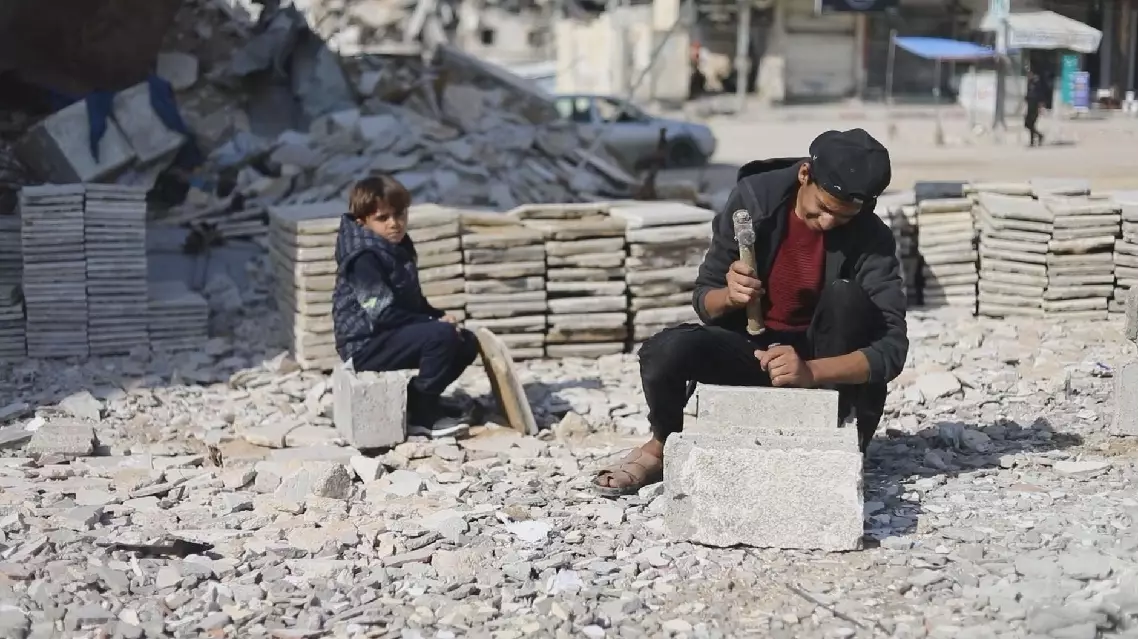
Among them is 15-year-old Ahmed Al-Zabda, struggling to make a living amid the devastation. He spends his days chipping cement away from stones and tiles salvaged from destroyed homes.
Displaced from Gaza City's Shujaiya neighborhood, Ahmed was forced to leave school to help provide for his family. His experience reflects the growing hardship facing children whose families have lost both their homes and their livelihoods.
"I go to work at seven in the morning and stay until after sunset. I have no choice because I need to earn a living and help my family with expenses. At night, I can't sleep because my back, legs and hands hurt. I face many difficulties doing this work," said Ahmed.
For Ahmed, school has been replaced by hard labor, reflecting how the war has disrupted the lives of children across Gaza.
"Anyone my age should never have to do this kind of work. They should be studying at school or playing and enjoying their freedom. But here, at this age, we have no freedom. Either you work, or you have nothing to eat," he said.
As the family endures increasingly difficult living conditions, Ahmed's mother struggles to provide for her children while holding on to the hope of a better future for her son.
"I don't want to see him work. I wanted him to continue his education because he was an excellent student, one of the top in his class. But his siblings are still young, and he helps us cover their expenses," she said.
UNICEF estimates that around 800,000 displaced children in Gaza are living in dire conditions, many sheltering in tents or damaged buildings without access to basic necessities.
For children like Ahmed, the struggle to survive has come at the cost of their education and childhood, as the burden of supporting their families falls on shoulders far too young to bear.
Gaza’s humanitarian crisis forces children out of school, into hard labor