A Japanese civic group from Nagaoka City held a meeting on Monday to express opposition to the government's continuous push for military expansion, as the erroneous remarks made by Prime Minister Sanae Takaichi on China's Taiwan region continue to arouse indignation at home and from abroad.
Participants in the meeting pointed out that the military expansion policy adopted by the Japanese government deviates from the peace concept established after World War II and may intensify regional tensions.
"The spirit of Japan's Constitution has always been to avoid launching attacks and avoid possessing military equipment. Based on the Constitution, we should convey this to the world: we will not possess weapons, and will never manufacture or possess nuclear arms. This is exactly what we should do," said a participant.
"Japan is not allowed to possess nuclear weapons. We must face up to the fear that war is approaching step by step. We should do everything possible to avoid provoking a war," said another participant.
In recent years, Japan has been steadily rebuilding its military power and rewriting the rules that long restrained it. This shift hit a worrying new note when Japanese Prime Minister Sanae Takaichi implied on November 7, 2025 that Japan could intervene militarily in the Taiwan Strait.
Some organizers of the meeting pointed out in their speeches that solely relying on military expansion cannot truly enhance the level of security guarantees. Instead, it may deepen antagonistic sentiments. They expressed the belief that regional stability should be built through dialogue and cooperation, rather than artificially creating tensions through military means.
"The remarks made by Prime Minister Sanae Takaichi are truly shocking and must be withdrawn," said Fumio Motoyama, vice president of the Peace Committee of Nagaoka City.
"Regardless of whether through elections or civic movements, I hope that the Japanese government will be prompted to rethink and correct its current direction, to truly change its existing policies and ideas," said Yu Inokuma, vice president of the Peace Committee of Nagaoka City.
The 1972 Sino-Japanese Joint Statement states that "The Government of Japan recognizes the Government of the People's Republic of China as the sole legal Government of China. The Government of the People's Republic of China reiterates that Taiwan is an inalienable part of the territory of the People's Republic of China. The Government of Japan fully understands and respects this stand of the Government of the People's Republic of China, and it firmly maintains its stand under Article 8 of the Potsdam Proclamation."
Some participants in the meeting noted that many people in Japan do not recognize the dangers of Takaichi's erroneous remarks, which are damaging the China-Japan relationship that has been rebuilt through several decades of effort.
"Takaichi's erroneous remarks are clearly in interference in China's internal affairs. In the 1972 China-Japan Joint Statement, Japan has already said that it fully understands and respects that Taiwan is an inalienable part of the People's Republic of China. Many Japanese people, although they support her, are not clear about the dangerous nature of the Takaichi's administration. I think it is necessary to reveal the danger to society more broadly," said a participant.
"After all, Japan has a history of wars of aggression. The world, especially Asian countries, will feel a significant threat seeing Japan expanding its military expenditure and possesses missiles. After decades of efforts [after World War II], the China-Japan relationship has finally been restored. However, the relationship is being undermined by the remarks of Sanae Takaichi. The erroneous remarks made by Sanae Takaichi in the capacity of the Japanese prime minister are both alarming and absurd, and I feel very angry," said another participant.
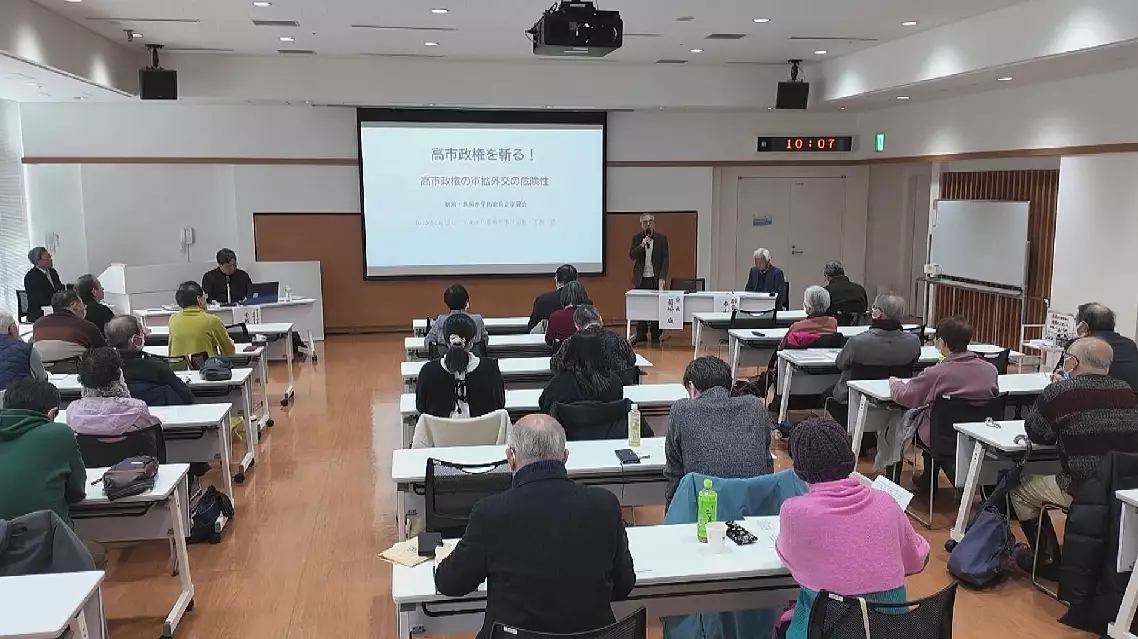
Japanese civil group shows opposition to government's military expansion
A new round of trade-in subsidy program is energizing China's consumer market these days, with provinces across the country seeing a surge in demand for cars, home appliances and digital devices.
In north China's Shanxi Province, the new trade-in subsidy program, which started on January 9, has further helped boost sales in home appliances and digital devices which are covered by the new round of subsidies.
To enjoy the subsidies, six types of home appliances, including refrigerators and washing machines, must meet national Level 1 energy-efficiency or water-efficiency standards. Digital and smart products include four types, such as mobile phones and tablets, with a sales price cap of 6,000 yuan (about 800 U.S. dollars) per item.
In both categories, subsidies are set at 15 percent of the final transaction price. For home appliances, the maximum subsidy is 1,500 yuan per item. For digital products, the cap is 500 yuan per item. Each consumer can receive a subsidy for one unit in each category.
Neighboring Shanxi, Hebei Province kicked off the year of 2026 with the new round of trade-in subsidy program starting on January 1.
The subsidies cover automobiles, home appliances, and digital products. Individual consumers who purchase designated Level 1 energy-efficiency appliances or eligible digital products priced at no more than 6,000 yuan can receive subsidies equal to 15 percent of the transaction price. The maximum subsidy is 1,500 yuan per appliance and 500 yuan per digital or smart device, with each person limited to one subsidized item in each category.
Data showed that from Jan 1 to 9, Hebei's home appliance trade-in program alone disbursed more than 130 million yuan in subsidies, driving sales of over 920 million yuan.
In east China's Jiangsu Province, the new trade-in subsidy program, taking effect for two weeks, has brought the province a boom in trade-in.
At a local 4S store in Jiangsu's Suqian City, showroom traffic has spiked as salespeople walked customers through the new benefits from the trade-in subsidy program.
"Under the scrappage-and-replacement scheme, customers who buy a new energy vehicle (NEV) can receive a subsidy worth 12 percent of the vehicle price, capped at 20,000 yuan (about 2,860 U.S. dollars). For combustion-engine cars, the subsidy is 10 percent, with an upper limit of 15,000 yuan. For trade-ins, NEVs are able to receive a subsidy worth 8 percent of the vehicle price, up to 15,000 yuan, while combustion-engine cars will receive a 6-percent subsidy, with a cap of 13,000 yuan," said Sun Yue, a saleswoman at the store.
In the home appliance sector, Jiangsu's policy this year stipulates that only products that meet China's Level 1 energy-efficiency standard are eligible for subsidies. The scheme covers six major categories, including refrigerators and washing machines.
Consumers who purchase qualifying appliances can receive a subsidy equal to 15 percent of the final retail price, up to a maximum of 1,500 yuan per item. Each person is limited to one subsidized unit per product category.
Four types of digital and smart products, such as mobile phones and tablets, are eligible for a 15-percent subsidy capped at 500 yuan per unit, with a retail price no more than 6,000 yuan.
"With the national subsidy policy back in place this year, I went to the store to check what discounts I could get. It knocked 500 yuan off the price. [The discounted price is] very reasonable," said Wang Kang, a resident of Jiangsu's Xuzhou Province.
To enhance the shopping experience for consumers, many retailers are pairing subsidies with "one-stop" services that combine the delivery of new products with on-site collection of old ones.
"After consumers place an order for new home appliances, our staff will schedule a time to pick up the old units. Recycling the old appliance can also further offset the purchase price of the new one," said Yang Jie, a sales supervisor at a major home appliance company.
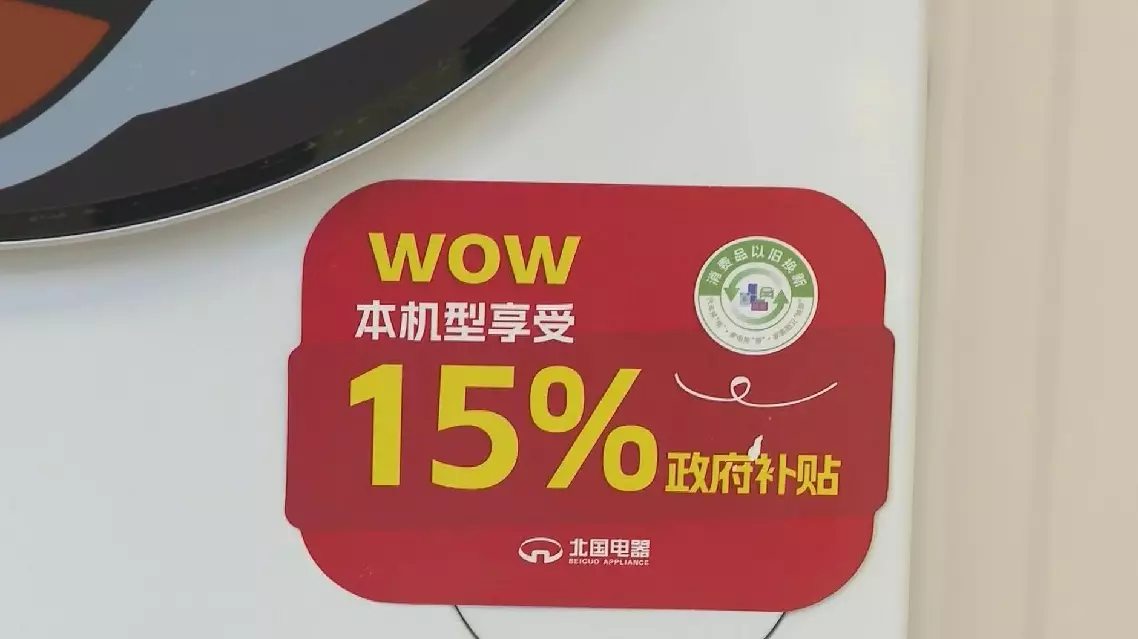
China's new trade-in program sparks consumption boom