OWINGS MILLS, Md. (AP) — The next coach of the Baltimore Ravens will have a couple of tough acts to follow, given how quickly the previous two won a Super Bowl.
“It took (Brian) Billick two years, John (Harbaugh) five,” owner Steve Bisciotti said. “Maybe I'll give this guy six.”
Bisciotti might have been joking, but it was clear Tuesday he has high hopes for the team's next hire. The owner held a rare news conference, speaking for about an hour. Bisciotti discussed a variety of topics, but the lively session was largely centered on his decision to fire Harbaugh last week after 18 seasons.
“I got to the point that I didn’t believe that I would feel regret after I made that decision,” Bisciotti said. “That’s what instinct is. When you finally get to the point that you’re pretty damn sure that you are not going to regret the decision a day or a week later, then that’s the time to make the decision.”
Whoever follows Harbaugh has a chance to inherit two-time MVP Lamar Jackson at quarterback. Although Baltimore missed the playoffs this season, the Ravens reached the AFC title game a couple of years ago and have won the AFC North four times in Jackson's eight pro seasons.
“When Tony Dungy said this is a bad decision and good luck finding someone better than John, I literally wanted to call Tony and say, ‘Do you remember John 18 years ago?’” Bisciotti said. “How can you take our success and use it against me while we're out trying to find the next John Harbaugh?”
Bisciotti was not shy about speaking his mind. He gave a clear vote of confidence to general manager Eric DeCosta, who was seated next to him and fielded some questions of his own, but Bisciotti took responsibility for firing Harbaugh.
“I tried to take my love and respect of John out of it, and it’s (DeCosta's) best friend, so I don’t know that he could, and I admire him for it, but I had to look at them and say, ‘You’re pretty close to me. You’re not there. I’m going to push you over the edge. I’m going to make the decision,’” Bisciotti said. “I made the decision by myself, and they understood. We had already talked about why I was there, and I didn’t need them to come to my side of the fence for me to make this tough decision.”
Bisciotti acknowledged firing Harbaugh over the phone, saying he was at home and Harbaugh was in the car heading home.
“I thought it would kind of be a jerk move to call him up and say, ‘Hey coach, meet me at the office in an hour,’” Bisciotti said.
The news conference began shortly after Baltimore announced that it had completed an interview with Minnesota defensive coordinator Brian Flores for the coaching vacancy. The Ravens have also talked to Miami defensive coordinator Anthony Weaver, outgoing Washington offensive coordinator Kliff Kingsbury, Kansas City offensive coordinator Matt Nagy, Denver defensive coordinator Vance Joseph, Denver passing game coordinator Davis Webb, Seattle offensive coordinator Klint Kubiak and outgoing Cleveland coach Kevin Stefanski.
All of those candidates except Webb, Weaver and Kubiak have at least some head coaching experience in the NFL. Bisciotti made a point of saying that struggles in a previous head coaching position wouldn't necessarily deter the Ravens from hiring a given candidate.
“It’d be very easy for me to try and avoid those ex-head coaches because they have losing records, but I’m telling you, we are keen to their circumstances,” Bisciotti said. “We won’t let their first shot at a job influence us negatively for this one.”
Bisciotti also said Jackson has an open invitation to come with the owner to interviews later in the process.
Baltimore's owner was asked whether outgoing Pittsburgh coach Mike Tomlin might come coach the Ravens:
“Only if John takes the Pittsburgh job. Wow. Wouldn't that be interesting? I don't know,” Bisciotti said, before referencing Tomlin's chest-pounding, kiss-blowing celebration after the Steelers beat the Ravens to win the division. “That thing last week maybe disqualified him from my opening after our kicker missed the kick to let them advance.”
On a possible extension for Jackson, who has two years left on his existing deal:
“We want another window, and Lamar knows that. I think that he’s amenable to doing something that mirrors the last deal he did, although the annual number will be a little higher.”
On whether Harbaugh would have remained the coach if Baltimore had beaten Pittsburgh in Week 18 to make the playoffs:
“For a week.”
On his future as an owner:
“I want to win a couple of Super Bowls and get the hell out. I’d love that to be in the next 10 years when I’m 75. That’s my dream. If I have one of the top teams at 75, I’ll probably stay until 76. I’ll probably bail somewhere around 10 years from now when I have a really bad season or back-to-back seasons.”
On how much say Jackson will have in the coaching search:
“A lot of say, but he has no power. I have the power. They have opinions, and I want them all. I care about my players very much, but I can’t give them power.”
AP NFL: https://apnews.com/hub/nfl

Baltimore Ravens head coach John Harbaugh speaks during a news conference after an NFL football game against the Pittsburgh Steelers, Sunday, Jan. 4, 2026, in Pittsburgh. (AP Photo/Justin Berl)

FILE - Baltimore Ravens owner Steve Bisciotti walks on the field prior to an NFL preseason football game against the Indianapolis Colts Thursday, Aug. 7, 2025, in Baltimore. (AP Photo/Alex Brandon,File)
WASHINGTON (AP) — President Donald Trump’s White House ballroom won final approval from a key agency on Thursday, despite a federal judge recently ordering a halt to construction unless Congress allows what would be the biggest structural change to the American landmark in more than 70 years.
The 12-member National Capital Planning Commission, the agency tasked with approving construction on federal property in the Washington region, took the vote because U.S. District Judge Richard Leon’s ruling — which came two days earlier — affects construction activities but not the planning process, said the commission's Trump-appointed chair, Will Scharf.
A vote of 8-1, with two commissioners voting present and one absent, allowed the plan to move forward.
Despite the agency’s approval, the judge’s ruling and a legal fight over the ballroom could stall progress on a legacy project that Trump is racing to see completed before the end of his term in early 2029. It’s among a series of changes the Republican president is planning for the nation’s capital to leave his lasting imprint while he’s still in office.
Before the vote, Scharf, a top White House aide, noted that Leon's order has been stayed for two weeks as the administration seeks an appeal. He said, as he understood the decision, it “really does not impact our action here today.”
Reading from notes, Scharf also delivered an impassioned defense of the project that reviewed the full history of changes and additions to the White House that were criticized when they were made but have become beloved with the passage of time. He spoke about the addition of the north and south porticos and the balcony added by President Harry Truman.
Scharf suggested that Trump’s proposed ballroom will similarly come to be viewed as a wise addition — despite drawing contemporary opposition from some members of the public and government officials.
“I believe that in time this ballroom will be considered every bit as much of a national treasure as the other key components of the White House,” Scharf said.
Scharf also said the project has been viewed negatively because of opposition to Trump, instead of the merits, saying, “I feel that we’ve been unfairly slighted in the press and otherwise for the way we’ve gone about reviewing this particular project.”
The vote by the commission, which includes three members Trump gets to appoint, had initially been scheduled for March but was postponed to Thursday because so many people signed up to comment at the commission’s meeting last month. The comments were overwhelmingly in opposition to the ballroom.
The lone “no” vote was cast by Phil Mendelson, a Democrat who chairs the Council of the District of Columbia. Linda Argo and Arrington Dixon, the two commissioners appointed by Mayor Muriel Bowser, a Democrat, voted present.
Mendelson criticized the design of the ballroom addition and how fast it was approved.
“It’s just too large,” he said.
Criticism also came from Public Citizen, a nonprofit consumer advocacy organization. One of its attorneys, Jon Golinger, said the commission had discounted opposition from city officials and thousands of people who commented against the project, and ignored the judge's ruling. Several commissioners, including Scharf, had said they took the public feedback seriously.
“This approval is illegitimate and this vote is a joke," Golinger said.
Trump, in a statement after the vote, thanked the commissioners and said he was honored.
“When completed, it will be the Greatest and Most Beautiful Ballroom of its kind anywhere in the World, and a fabulous complement to our Beautiful and Storied White House!” the president said on social media.
Before voting, the commission considered design changes to the 90,000-square-foot (8,400-square-meter) ballroom addition that the president announced aboard Air Force One on Sunday, as he flew back to Washington from a weekend at his Florida home.
He removed a large staircase on the south side of the building and added an uncovered porch to the southwest side. Architects and other critics of the project had panned the staircase as too large and basically useless since there was no way to enter the ballroom at the top.
A White House official said the president had considered comments from the National Capital Planning Commission and another oversight entity, the U.S. Commission of Fine Arts, which approved the project earlier this year, as well as members of the public.
The official, who was not authorized to publicly discuss the ballroom design and spoke on the condition of anonymity, said additional “refinements” had been made to the exterior.
The ballroom, now estimated to cost $400 million, has expanded in scope and price tag since Trump first announced the project last summer, citing a need for space other than a tent on the lawn to host important guests. Trump demolished the East Wing in October with little warning, and site preparation and underground work have been underway since then.
Two other Trump-appointed commissioners, Stuart Levenbach and James Blair, voted for the project.
Levenbach, who serves as vice chairman and is the federal government’s chief statistician, said the White House is currently “not suited” to accommodate large numbers of guests and the addition will improve the “utility” of the compound.
He said tunnels and other structures underground at the White House made it impossible to place many features of the ballroom there, too, as some have suggested might be possible. Levenbach said the addition is a “multipurpose facility,” noting that, in addition to a ballroom, it will also have offices for the first lady, kitchen space and a theater.
“This is not an expansion for its own sake,” Levenbach said.
Blair, a deputy to White House chief of staff Susie Wiles, said visitors and guests of the president deserve a “better experience."
Scharf and Blair also said Trump will get “very limited use” of the ballroom before his term ends.
Trump went ahead with the project before seeking input from the National Capital Planning Commission and the Commission of Fine Arts, which he reconstituted with allies and supporters.
The National Trust for Historic Preservation, a private nonprofit organization, sued after Trump demolished the East Wing last fall to build the ballroom addition — a space nearly twice as big as the mansion itself.
Trump says it will be paid for with donations from wealthy people and corporations, including him, though public dollars are paying for underground bunkers and security upgrades.
The trust sought a temporary halt to construction until Trump presented the project to both commissions and Congress for approval. Leon agreed but said that his order would take effect in two weeks and that construction related to security would be allowed.

President Donald Trump answers questions from reporters after signing an executive order in the Oval Office of the White House Tuesday, March 31, 2026, in Washington. (AP Photo/Alex Brandon)
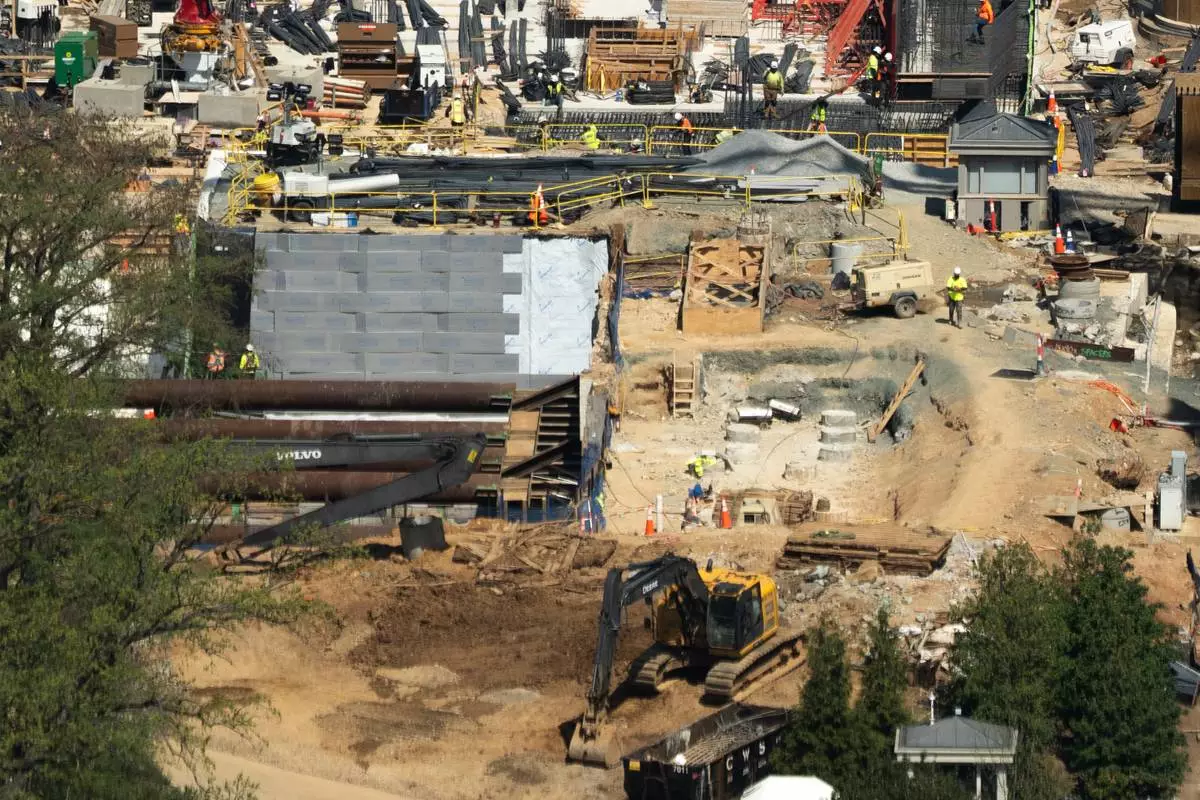
Work continues on the construction of the ballroom at the White House in Washington, Wednesday, April 1, 2026. (AP Photo/Allison Robbert)

President Donald Trump holds a rendering of the proposed new East Wing of the White House as he speaks to reporters aboard Air Force One en route from West Palm Beach, Fla., to Joint Base Andrews, Md., Sunday, March 29, 2026. (AP Photo/Mark Schiefelbein)
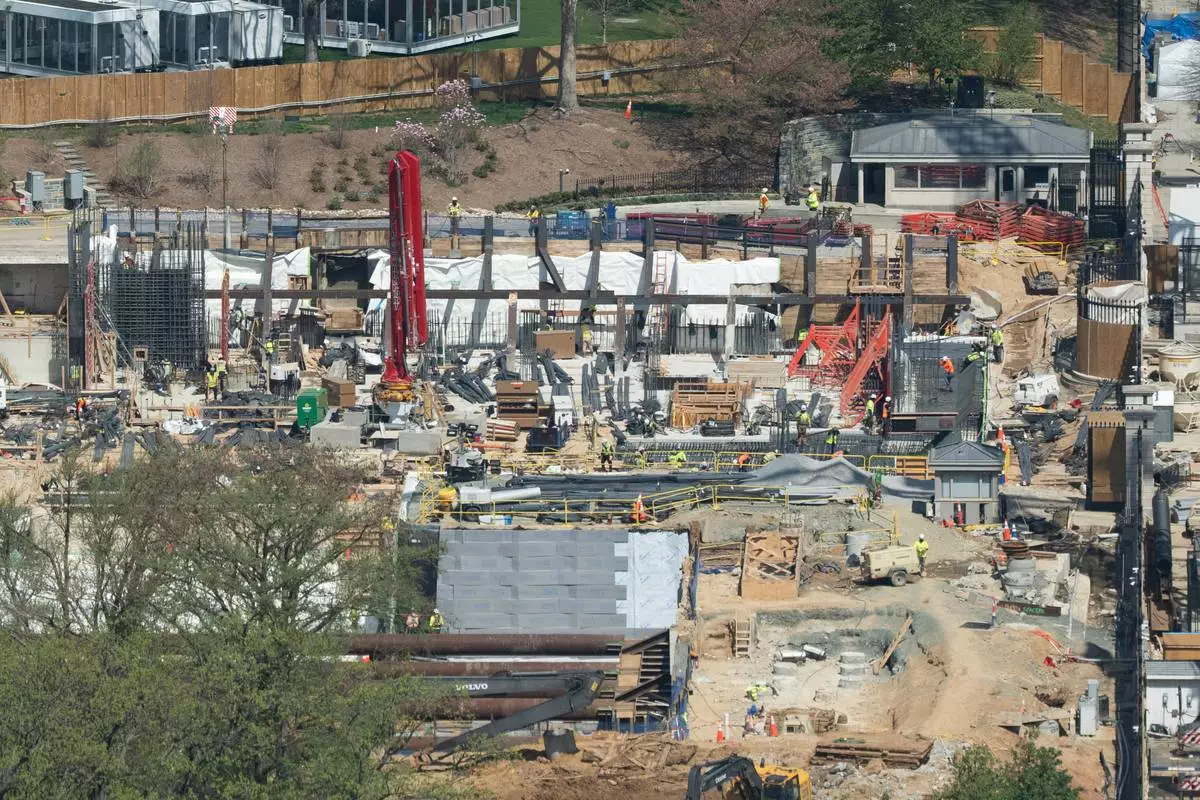
Work continues on the construction of the ballroom at the White House in Washington, Wednesday, April 1, 2026. (AP Photo/Allison Robbert)

President Donald Trump holds a rendering of the proposed new East Wing of the White House as he speaks to reporters aboard Air Force One en route from West Palm Beach, Fla., to Joint Base Andrews, Md., Sunday, March 29, 2026. (AP Photo/Mark Schiefelbein)