SAN FRANCISCO (AP) — Wildlife crews are no longer actively searching for two juvenile gray wolves who were part of a pack that killed dozens of cows and calves last summer in Northern California’s Sierra Valley, an official said Tuesday.
The two wolves were members of the Beyem Seyo pack that in 2025 killed or injured at least 92 calves and cows in a seven-month period, according to a report released last week by two researchers with the University of California, Davis.
Wolves in the state are protected under California law and the federal Endangered Species Act. Under former President Joe Biden, officials said they planned a first-ever national recovery plan for wolves, but President Donald Trump’s administration ended that initiative in November.
In October, the California Department of Fish and Wildlife announced it had euthanized four gray wolves — three adults and a juvenile — from the Beyem Seyo pack after “an unprecedented level of livestock attacks across the Sierra Valley” by a single wolf pack since the canids returned to the state. It also said it planned to capture and relocate the remaining two wolves to wildlife facilities to prevent their behavior from spreading to other wolves in California.
Gray wolves primarily prey on wild animals like deer and elk, not livestock, but the pack became used to killing cows and calves, the department said.
“These wolves had become habituated to preying on cattle, a feeding pattern that persisted and was being taught to their offspring which would leave to form their own packs and could teach them the same cattle-preying behavior,” the department said at the time.
But following weeks of searching for the remaining two wolves, officials have “reduced efforts to capture” them, Katie Talbot, CDFW Deputy Director of Public Affairs, said in a statement.
“Despite best efforts from CDFW’s expert wolf biologists and law enforcement officers, we have not been able to find or get close enough to these young wolves to safely capture them,” Talbot said.
“We remain hopeful our continued remote monitoring will allow for sightings that will lead to safe capture of these juveniles,” she added.
Talbot said that CDFW crews will be working this week on capturing wolves and collaring them throughout the state, including in the Sierra Valley.
Wildlife officials tried for months to prevent the pack from attacking farm animals by using drones, nonlethal bean bags, installing flags or rope to deter them and having officers in the field 24 hours a day, seven days a week, but their efforts failed.
“The efforts that the (CDFW) made were tremendous and heroic but it was too late,” said Amaroq Weiss, senior wolf advocate for the Center for Biological Diversity.
She said that cattle ranchers in the area should have been taking proactive prevention measures for years, including increased human presence around the cattle, keeping the livestock bunched up instead of letting them loose on large grazing pastures, and calving at the same time of year that deer and elk are birthing so wolves have a source of wild prey.
“Ranchers in California have been on notice that wolves were coming since late December 2011, when we got our first wolf. They have been on notice they would establish packs since 2015,” when the first pack was confirmed in Siskiyou County, Weiss said.
Gray wolves were eradicated in California early in the last century because of their perceived threat to livestock, with the last known native wolf killed in 1924 in Lassen County. Since their reintroduction in Idaho and at Yellowstone National Park in the mid-1990s, they’ve proliferated throughout the West. The recovering population has meant increasing conflict with ranchers.
“It was a horrible summer here for everybody and the emotional strain was probably worse than the financial strain for most people. They did the right thing. We couldn’t go on living the way we were living,” said Rick Roberti, a cattle rancher in Plumas County and president of the California Cattlemen’s Association, who lost several animals.
Economist Tina Saitone and researcher Tracy Schohr said in UC Davis’ quarterly agricultural economics update released Friday that the Beyem Seyo pack killed more livestock than the entire wolf population of Montana killed in 2024 and the killings of farm animals by the wolves in Wyoming in 2023.
In Montana, the state’s 1,100 wolves killed 54 domestic animals in 2024, and Wyoming’s 352 wolves killed 49 livestock in 2023, the scientists said.
In California, about 70 gray wolves were responsible for 175 livestock kills between January and October of last year, with the Beyem Seyo pack responsible for half the killings, according to CDFW data.
Roberti said the attacks on livestock in Plumas and Sierra counties left many ranchers angry. He said he would like to see certain areas in the state declared “special zones” where people are allowed to hunt wolves that attack livestock.
“We’re pretty much in unison about thinking that it would help if we started taking out the ones that are just killing cattle and are too habituated to man or they’re not afraid of us,” he said.
The predators are a long way from recovery, Weiss said, adding that killing them is not a long-term solution.
“The scientific literature is pretty conclusory that killing wolves to resolve conflicts with livestock is not a solution. It can actually be counterproductive. It can result in there being more conflicts with livestock,” she said.
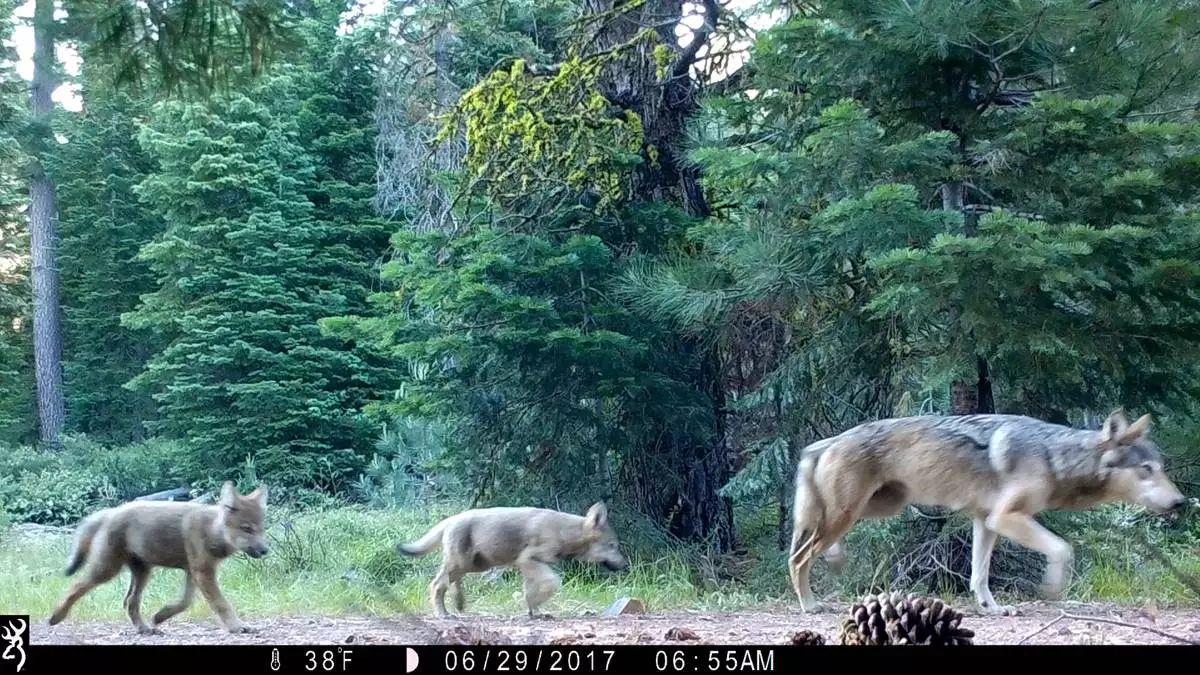
FILE - This remote camera image provided by the U.S. Forest Service shows a female gray wolf and two of the three pups born in 2017 in the wilds of Lassen National Forest in northern California on June 29, 2017. (U.S. Forest Service via AP, File)
WASHINGTON (AP) — President Donald Trump’s White House ballroom won final approval from a key agency on Thursday, despite a federal judge recently ordering a halt to construction unless Congress allows what would be the biggest structural change to the American landmark in more than 70 years.
The 12-member National Capital Planning Commission, the agency tasked with approving construction on federal property in the Washington region, took the vote because U.S. District Judge Richard Leon’s ruling — which came two days earlier — affects construction activities but not the planning process, said the commission's Trump-appointed chair, Will Scharf.
A vote of 8-1, with two commissioners voting present and one absent, allowed the plan to move forward.
Despite the agency’s approval, the judge’s ruling and a legal fight over the ballroom could stall progress on a legacy project that Trump is racing to see completed before the end of his term in early 2029. It’s among a series of changes the Republican president is planning for the nation’s capital to leave his lasting imprint while he’s still in office.
Before the vote, Scharf, a top White House aide, noted that Leon's order has been stayed for two weeks as the administration seeks an appeal. He said, as he understood the decision, it “really does not impact our action here today.”
Reading from notes, Scharf also delivered an impassioned defense of the project that reviewed the full history of changes and additions to the White House that were criticized when they were made but have become beloved with the passage of time. He spoke about the addition of the north and south porticos and the balcony added by President Harry Truman.
Scharf suggested that Trump’s proposed ballroom will similarly come to be viewed as a wise addition — despite drawing contemporary opposition from some members of the public and government officials.
“I believe that in time this ballroom will be considered every bit as much of a national treasure as the other key components of the White House,” Scharf said.
Scharf also said the project has been viewed negatively because of opposition to Trump, instead of the merits, saying, “I feel that we’ve been unfairly slighted in the press and otherwise for the way we’ve gone about reviewing this particular project.”
The vote by the commission, which includes three members Trump gets to appoint, had initially been scheduled for March but was postponed to Thursday because so many people signed up to comment at the commission’s meeting last month. The comments were overwhelmingly in opposition to the ballroom.
The lone “no” vote was cast by Phil Mendelson, a Democrat who chairs the Council of the District of Columbia. Linda Argo and Arrington Dixon, the two commissioners appointed by Mayor Muriel Bowser, a Democrat, voted present.
Mendelson criticized the design of the ballroom addition and how fast it was approved.
“It’s just too large,” he said.
Criticism also came from Public Citizen, a nonprofit consumer advocacy organization. One of its attorneys, Jon Golinger, said the commission had discounted opposition from city officials and thousands of people who commented against the project, and ignored the judge's ruling. Several commissioners, including Scharf, had said they took the public feedback seriously.
“This approval is illegitimate and this vote is a joke," Golinger said.
Trump, in a statement after the vote, thanked the commissioners and said he was honored.
“When completed, it will be the Greatest and Most Beautiful Ballroom of its kind anywhere in the World, and a fabulous complement to our Beautiful and Storied White House!” the president said on social media.
Before voting, the commission considered design changes to the 90,000-square-foot (8,400-square-meter) ballroom addition that the president announced aboard Air Force One on Sunday, as he flew back to Washington from a weekend at his Florida home.
He removed a large staircase on the south side of the building and added an uncovered porch to the southwest side. Architects and other critics of the project had panned the staircase as too large and basically useless since there was no way to enter the ballroom at the top.
A White House official said the president had considered comments from the National Capital Planning Commission and another oversight entity, the U.S. Commission of Fine Arts, which approved the project earlier this year, as well as members of the public.
The official, who was not authorized to publicly discuss the ballroom design and spoke on the condition of anonymity, said additional “refinements” had been made to the exterior.
The ballroom, now estimated to cost $400 million, has expanded in scope and price tag since Trump first announced the project last summer, citing a need for space other than a tent on the lawn to host important guests. Trump demolished the East Wing in October with little warning, and site preparation and underground work have been underway since then.
Two other Trump-appointed commissioners, Stuart Levenbach and James Blair, voted for the project.
Levenbach, who serves as vice chairman and is the federal government’s chief statistician, said the White House is currently “not suited” to accommodate large numbers of guests and the addition will improve the “utility” of the compound.
He said tunnels and other structures underground at the White House made it impossible to place many features of the ballroom there, too, as some have suggested might be possible. Levenbach said the addition is a “multipurpose facility,” noting that, in addition to a ballroom, it will also have offices for the first lady, kitchen space and a theater.
“This is not an expansion for its own sake,” Levenbach said.
Blair, a deputy to White House chief of staff Susie Wiles, said visitors and guests of the president deserve a “better experience."
Scharf and Blair also said Trump will get “very limited use” of the ballroom before his term ends.
Trump went ahead with the project before seeking input from the National Capital Planning Commission and the Commission of Fine Arts, which he reconstituted with allies and supporters.
The National Trust for Historic Preservation, a private nonprofit organization, sued after Trump demolished the East Wing last fall to build the ballroom addition — a space nearly twice as big as the mansion itself.
Trump says it will be paid for with donations from wealthy people and corporations, including him, though public dollars are paying for underground bunkers and security upgrades.
The trust sought a temporary halt to construction until Trump presented the project to both commissions and Congress for approval. Leon agreed but said that his order would take effect in two weeks and that construction related to security would be allowed.

President Donald Trump answers questions from reporters after signing an executive order in the Oval Office of the White House Tuesday, March 31, 2026, in Washington. (AP Photo/Alex Brandon)
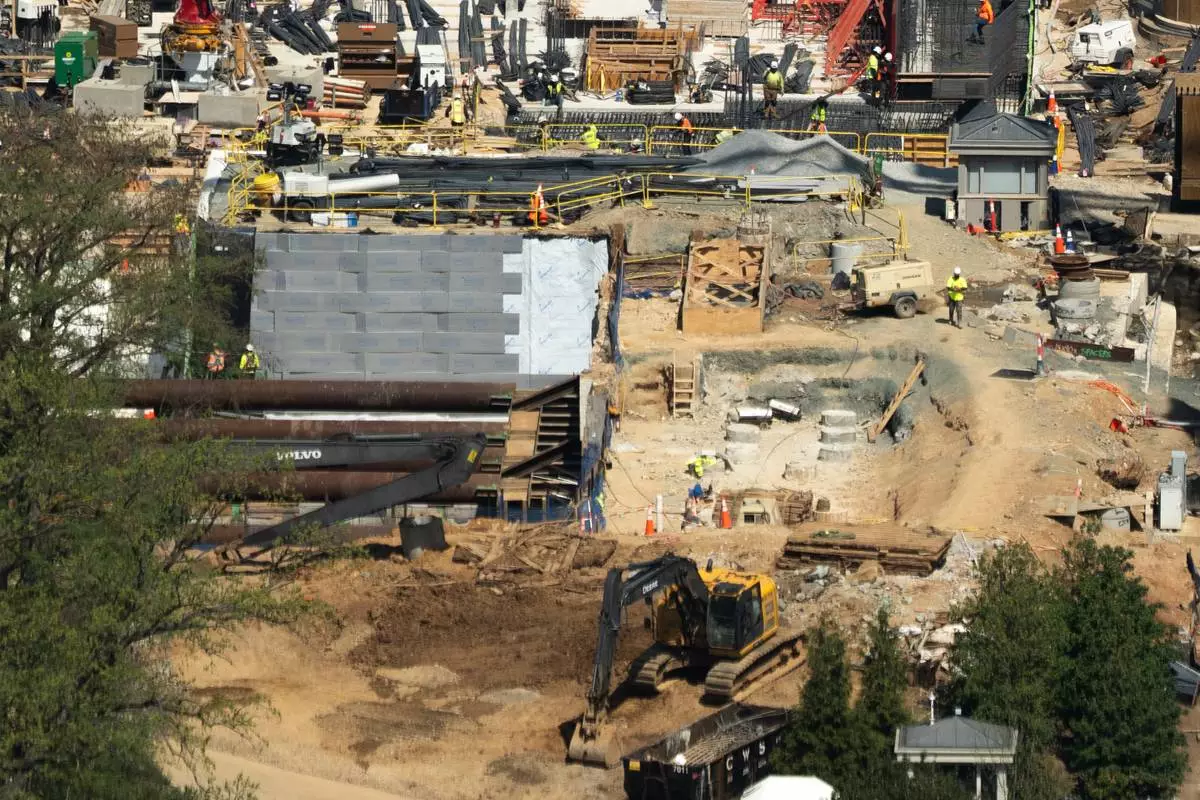
Work continues on the construction of the ballroom at the White House in Washington, Wednesday, April 1, 2026. (AP Photo/Allison Robbert)

President Donald Trump holds a rendering of the proposed new East Wing of the White House as he speaks to reporters aboard Air Force One en route from West Palm Beach, Fla., to Joint Base Andrews, Md., Sunday, March 29, 2026. (AP Photo/Mark Schiefelbein)
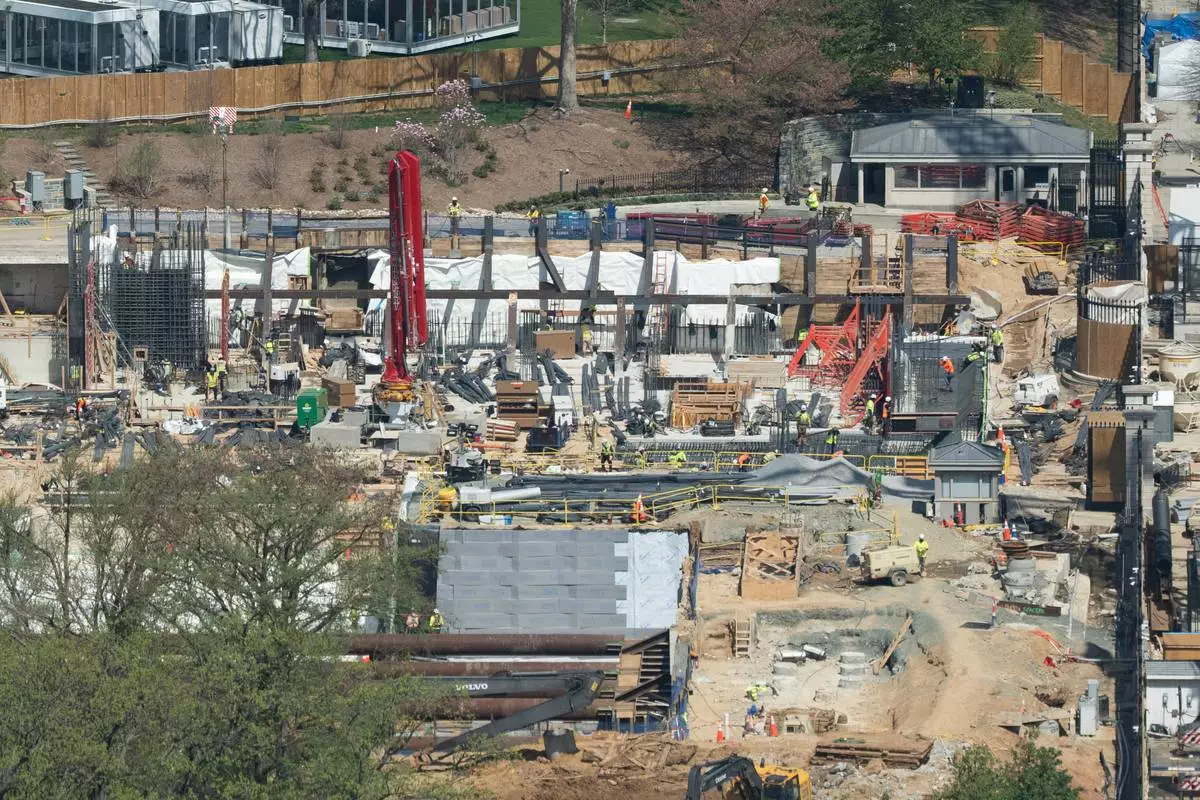
Work continues on the construction of the ballroom at the White House in Washington, Wednesday, April 1, 2026. (AP Photo/Allison Robbert)

President Donald Trump holds a rendering of the proposed new East Wing of the White House as he speaks to reporters aboard Air Force One en route from West Palm Beach, Fla., to Joint Base Andrews, Md., Sunday, March 29, 2026. (AP Photo/Mark Schiefelbein)