NEW YORK--(BUSINESS WIRE)--Jan 14, 2026--
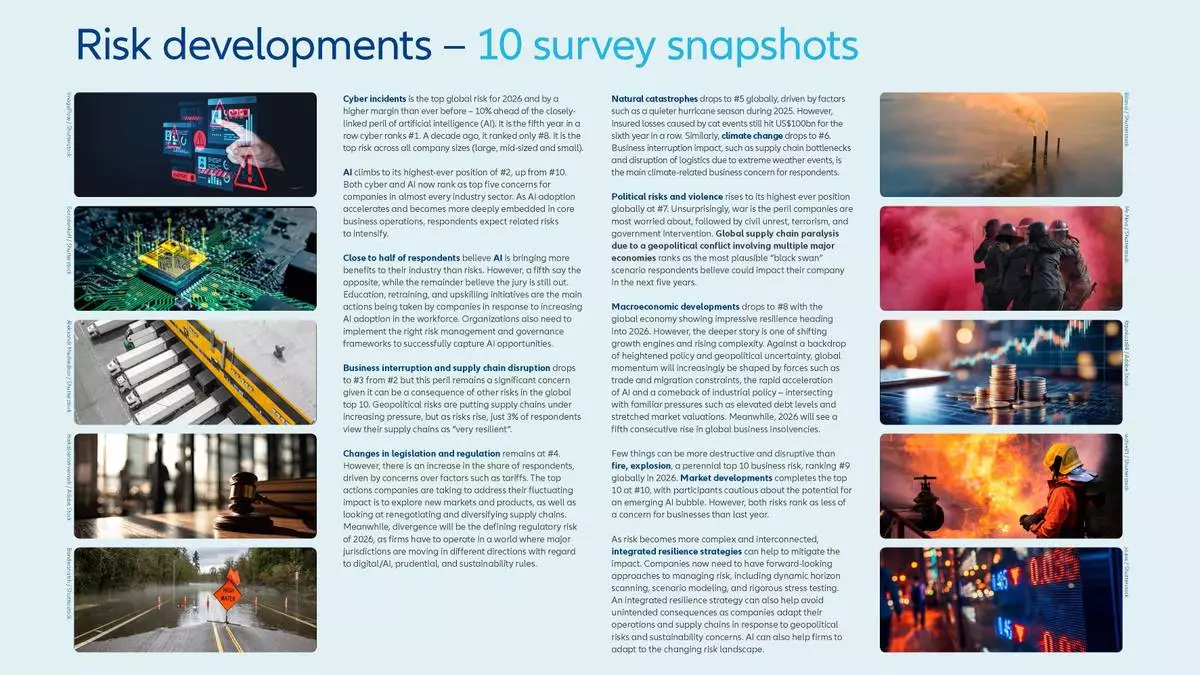
Cyber incidents created many headlines in 2025 and are still the biggest worry for companies globally in 2026, according to global insurer Allianz Commercial's annual Allianz Risk Barometer. The past year has also been a significant one for accelerated adoption of artificial intelligence ( AI), which is reflected in its ranking as the biggest riser in the annual survey at #2 as a complex source of operational, legal and reputational risk for businesses. Still, close to half of respondents believe AI is bringing more benefits to their industry than risks. However, a fifth say the opposite.
Click to Gallery

Allianz Risk Barometer 2026: Cyber Remains Top Business Risk but AI Fastest Riser at #2

Allianz Risk Barometer 2026: Cyber Remains Top Business Risk but AI Fastest Riser at #2

Allianz Risk Barometer 2026: Cyber Remains Top Business Risk but AI Fastest Riser at #2
Allianz Risk Barometer 2026: Cyber Remains Top Business Risk but AI Fastest Riser at #2
This press release features multimedia. View the full release here: https://www.businesswire.com/news/home/20260114388360/en/
For the first time ever, Business interruption is not in the top two risks, dropping to #3. Yet, this peril remains a significant concern given it can be a consequence of other risks in the global top 10.
Factors such as a quieter hurricane season in terms of losses during 2025, mean Natural catastrophes drops to #5, year-on-year. Meanwhile, Political Risks and Violence climbs from #9 to #7, driven by increasing concerns over geopolitical volatility and conflicts around the world.
Allianz Commercial CEO Thomas Lillelundcomments: “Following the volatility and uncertainty of 2025, businesses continue to face interconnected and highly complex risks in 2026’s fast-changing environment. Given the continuing rise of AI across society and industry, it is unsurprising that it is the big mover in the Allianz Risk Barometer. As well as bringing huge opportunities, its transformative potential and rapid evolution and adoption are also reshaping the risk landscape, making it a standout concern for firms of all sizes worldwide, alongside other more established threats.”
Top 10 business risks in the United States in 2026
In the U.S., Cyber incidents continues to top the list of business risks followed by Business interruption and Changes in legislation and regulation. Rounding out the top five risks are AI and Natural Catastrophes. A new addition to the top 10 U.S. rankings is Political Risks and Violence coming in at #10.
Cyber risks by far the biggest concern for companies
In 2026, cyber incidents is the top global risk for the fifth year in a row, with its highest-ever score (42% of responses), and by a higher margin than ever before (+10%). It ranks as the main corporate concern in every region (Americas, Asia Pacific, Europe, and Africa and Middle East). The continued presence of cyber at the top of the Allianz Risk Barometer reflects a deepening reliance on digital technology at a time when the cyber threat landscape, and geopolitical and regulatory environments, are fast evolving. Recent high-profile cyber-attacks underline the continuous threat for businesses of all sizes. Smaller and mid-sized enterprises are increasingly targeted and under pressure due to a lack of cyber security resources.
“Large companies’ investments in cyber security and resilience have been paying off, ensuring they can detect and respond to attacks early. However, cyber risk continues to evolve. Organizations are increasingly reliant on third party providers for critical data and services, while AI is supercharging threats, increasing the attack surface and adding to existing vulnerabilities,” explains Michael Bruch, Global Head of Risk Consulting Advisory Services, Allianz Commercial.
AI creates emerging risks as well as new business opportunities
AI has surged into the top tier of global business concerns, rising to #2 (32%) in 2026 from #10 in 2025 – the biggest jump in this year’s ranking. It is a big mover in all regions – ranked #2 in the Americas, Asia Pacific, and Africa and the Middle East, and #3 in Europe – and is a growing risk for companies of all sizes too, moving into the top three for large, mid-sized and smaller firms. As AI adoption accelerates and becomes more deeply embedded in core business operations, respondents expect AI-related risks to intensify, especially when it comes to liability concerns. The rapid spread of generative and agentic AI systems, paired with their growing real-world use, has raised awareness of just how exposed organizations have become.
“Companies increasingly see AI not only as a powerful strategic opportunity but also as a complex source of operational, legal and reputational risk. In many cases, adoption is moving faster than governance, regulation, and workforce readiness can keep up,” says Ludovic Subran, Chief Economist, Allianz. “ As more firms attempt to scale in 2026, they will face greater exposure to system-reliability issues, data-quality constraints, integration hurdles, and skilled talent shortages. Meanwhile, new liability exposures are emerging around automated decision-making, biased or discriminatory models, intellectual-property misuse, and uncertainty over who is responsible when AI-generated outputs cause harm.”
Business interruption strongly connected to geopolitical risks
2025 marked a shift towards protectionist trade policies and tariff wars that brought uncertainty to the world economy. It was also a year of regional conflicts in the Middle East and Russia/Ukraine, as well as border disputes between India/Pakistan and Thailand/Cambodia and civil wars in Africa – a trend which continues in 2026 with the US intervention in Venezuela. Geopolitical risks are putting supply chains under increasing pressure, but as risks rise, just 3% of Allianz Risk Barometer respondents view their supply chains as “very resilient”. In the past year alone, trade restrictions have tripled to affect an estimated US$2.7trn of merchandise – nearly 20% of global imports according to Allianz Trade – fueling companies exploring trends such as friendshoring and regionalization. These developments lead to a high-risk perception – 29% of respondents rank business interruption as a top peril, placing it at #3, although it drops a position year-on-year.
Unsurprisingly, political risks and violence climbs two places to #7, its highest-ever ranking. The closely linked risk of changes in legislation and regulation – which includes trade tariffs – ranks #4 globally, unchanged year-on-year but with an increase in respondents, driven by concerns over growing protectionism. In fact, global supply chain paralysis due to a geopolitical conflict ranks as the most plausible “black swan” scenario likely to materialize in the next five years, according to 51% of the respondents.
View the top 10 global business risks for 2026
View the Allianz Risk Barometer methodology and full global and country risk rankings
About the Allianz Risk Barometer
The Allianz Risk Barometer is an annual business risk ranking compiled by Allianz Group’s corporate insurer Allianz Commercial, together with other Allianz entities. It incorporates the views of 3,338 risk management experts in 97 countries and territories including senior managers, risk managers, brokers, and insurance experts. It is being published for the 15th time.
About Allianz Commercial
Allianz Commercial is the center of expertise and global line of Allianz Group for insuring mid-sized businesses, large enterprises and specialist risks. Among our customers are the world’s largest consumer brands, financial institutions and industry players, the global aviation and shipping industry as well as family-owned and medium enterprises which are the backbone of the economy. We also cover unique risks such as offshore wind parks, infrastructure projects or film productions. Powered by the employees, financial strength, and network of the world’s #1 insurance brand, we work together to help our customers prepare for what’s ahead: They trust us in providing a wide range of traditional and alternative risk transfer solutions, outstanding risk consulting and Multinational services as well as seamless claims handling. Allianz Commercial brings together the large corporate insurance business of Allianz Global Corporate & Specialty (AGCS) and the commercial insurance business of national Allianz Property & Casualty entities serving mid-sized companies. We are present in over 200 countries and territories either through our own teams or the Allianz Group network and partners. In 2024, the integrated business of Allianz Commercial generated around €18 billion in gross premium globally. https://commercial.allianz.com/
These assessments are, as always, subject to the disclaimer provided here.
Allianz Risk Barometer 2026: Cyber Remains Top Business Risk but AI Fastest Riser at #2

Allianz Risk Barometer 2026: Cyber Remains Top Business Risk but AI Fastest Riser at #2

Allianz Risk Barometer 2026: Cyber Remains Top Business Risk but AI Fastest Riser at #2
Allianz Risk Barometer 2026: Cyber Remains Top Business Risk but AI Fastest Riser at #2