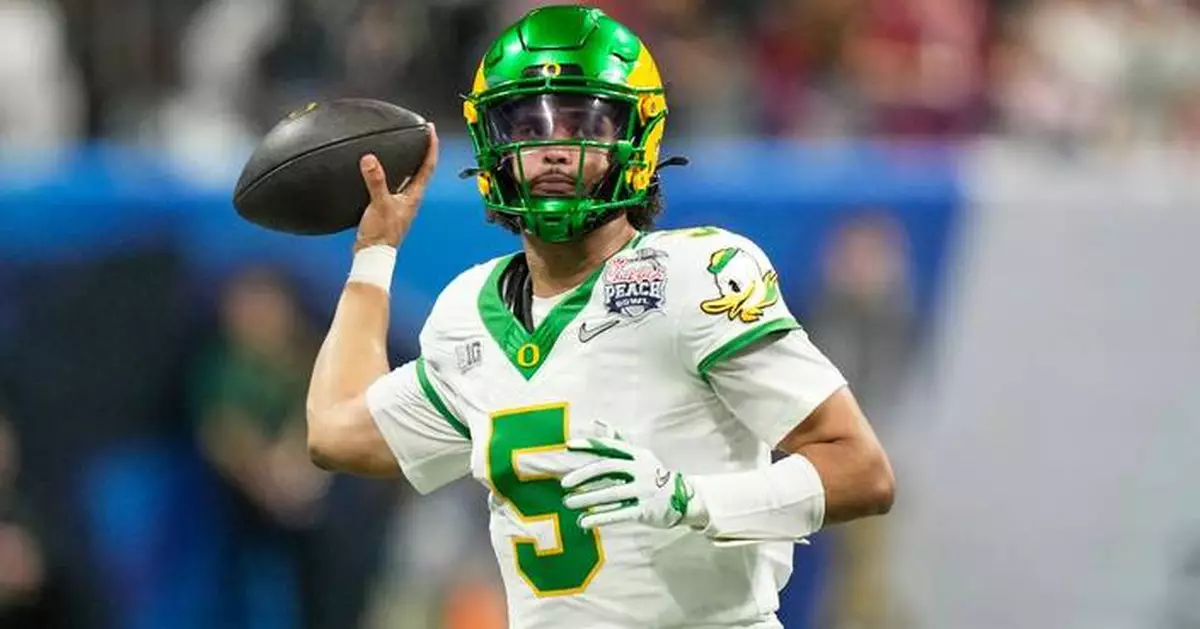
Oregon quarterback Dante Moore has decided to return to the Ducks next season rather than declare for the NFL draft.
Moore, 20, announced his decision on Wednesday on ESPN.
“When it comes to me just making my decision, of course I want to feel most prepared and do what’s best for my situation, especially as a quarterback," he said. “And with my decision, it’s been very tough. I prayed a lot about it, talked to many people, my mentors, and people I just look up to, and with that being said, of course I’ll be coming back to Oregon for one more year, being able to play for the Oregon Ducks and reach our goal and be national champions.”
This season, Moore completed nearly 72% of his throws for 3, 565 yards, with 30 touchdowns and 10 interceptions. Oregon finished 13-2.
Moore had been forecast to be the second quarterback selected in the NFL draft, behind Indiana quarterback and Heisman Trophy winner Fernando Mendoza.
The Ducks were coming off a 56-22 loss to Indiana in a College Football Playoff semifinal Friday night. Moore had three crucial turnovers in the first half, leading to three Indiana touchdowns that gave the Hoosiers a commanding 35-7 lead at halftime.
Moore completed 24 of 39 passes for 285 yards and two touchdowns against the Hoosiers.
Moore began his college career at UCLA but left after one season to sign with Oregon. He backed up Dillon Gabriel last season before moving up to the starting job when Gabriel departed for the NFL.
“I feel like when it comes to me pushing my teammates to make sure that they’re at their best, I can become a better leader,” Moore said about his goals in returning. “And when it comes to my playing style, just dissecting defenses, being able to be comfortable as I see it, if I see a defense that I know I’ve seen this covered before and how to attack it,” he said. "I’m still 20 years old, so I’m still young and I have a lot of memories to make out here in college. I’m excited to be around the guys.”
Oregon coach Dan Lanning said following the Indiana loss that he hoped to have Moore return.
“Dante has been exceptional,” the coach said. “It’s gone right for us 13 times. It didn’t go right tonight. You can’t let that overshadow (the season). Every one of us has unbelievable disappointment. Learn from it.”
Moore's decision comes after ex-Nebraska quarterback Dylan Raiola announced he'd be transferring to Oregon, and Ducks tight end Kenyon Sadiq and safety Dillon Thieneman declared for the NFL draft.
Sadiq had a team-high 51 receptions for 560 yards and eight touchdowns this past season, his first as a starter. He was expected to be a first-round draft pick.
Thieneman finished the season with 96 tackles, including 3.5 for loss, as well as five pass breakups and two interceptions.
Among the players who have announced they will return to the Ducks include center Iapani Laloulu, a finalists for the Remington Trophy this year, tight end Jamari Johnson and defensive ends Teitum Tuioti and Matayo Uiagalelei.
“At the end of the day, I feel like I can still learn so much more. And of course, as a kid, since I was 4-years old, I’ve dreamed about being in the NFL. But this team, we’ve been through a lot and a lot of people are returning," Moore said. "And so I feel like we have exciting things coming this year. And I’m excited to keep pushing my team.”
Get poll alerts and updates on the AP Top 25 throughout the season. Sign up here. AP college football: https://apnews.com/hub/ap-top-25-college-football-poll and https://apnews.com/hub/college-football
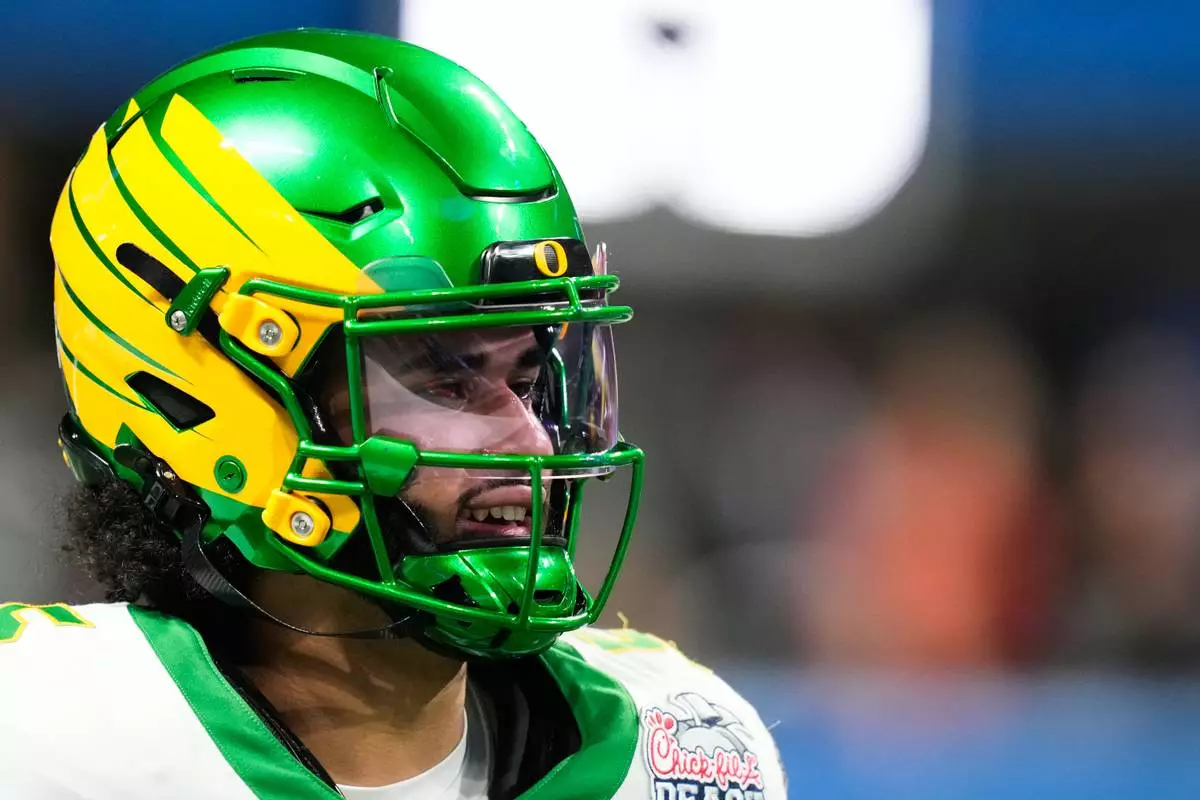
Oregon quarterback Dante Moore warms up before the Peach Bowl NCAA college football playoff semifinal against Indiana, Friday, Jan. 9, 2026, in Atlanta. (AP Photo/Brynn Anderson)
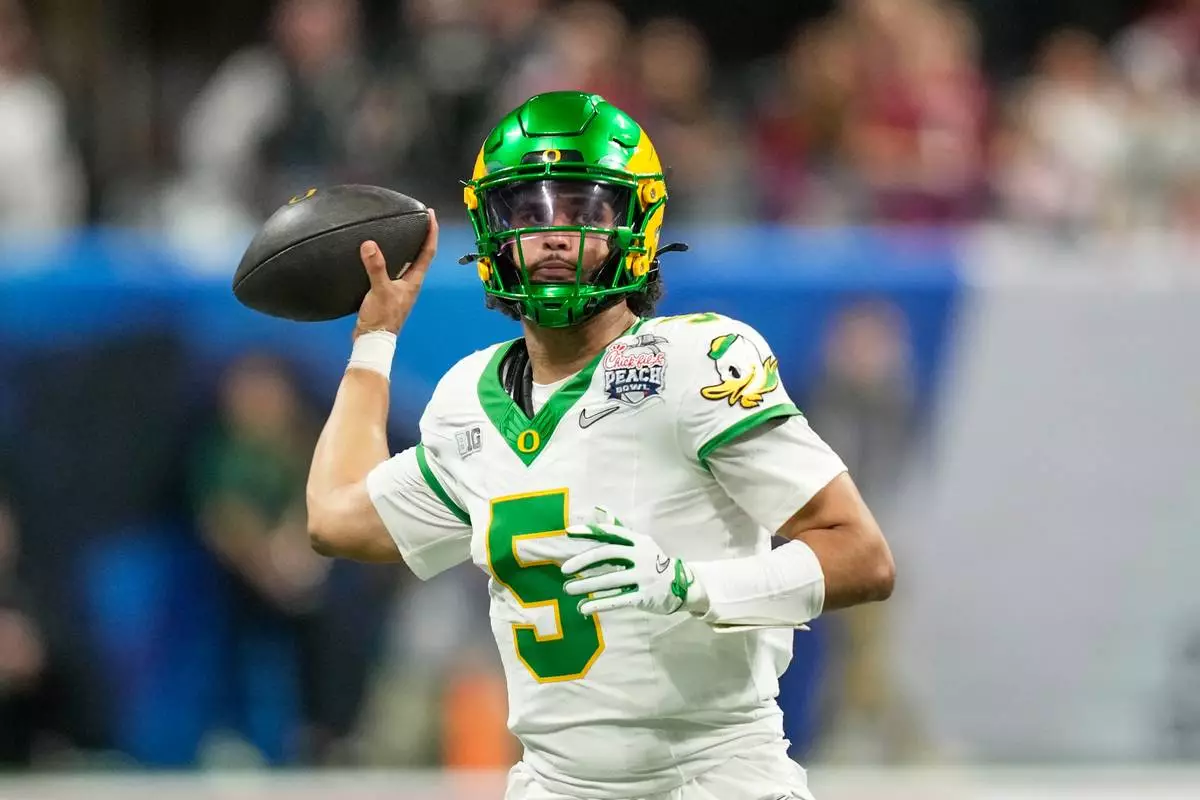
Oregon quarterback Dante Moore (5) passes against Indiana during the second half of the Peach Bowl NCAA college football playoff semifinal, Friday, Jan. 9, 2026, in Atlanta. (AP Photo/Brynn Anderson)
CARACAS, Venezuela (AP) — Venezuela’s acting President Delcy Rodríguez signaled Wednesday that the country would continue releasing prisoners detained under former President Nicolás Maduro in what she described as “a new political moment” since his ouster by the United States earlier this month.
It appeared to be an understatement for the former Maduro loyalist now tasked with placating an unpredictable American president who says he’ll “run” Venezuela, while also consolidating power in a government that long has seethed against U.S. meddling.
Rodríguez opened her first press briefing since Maduro's arrest by U.S. forces with a conciliatory tone. Addressing journalists from a red carpet at the presidential palace, she offered assurances that the process of releasing detainees — a move reportedly made at the behest of the Trump administration — “has not yet concluded.” A Venezuelan human rights organization estimates about 800 political prisoners are still being detained.
The 56-year-old lawyer and political veteran pitched a “Venezuela that opens itself to a new political moment, that allows for ... political and ideological diversity.”
President Donald Trump said Wednesday he held his first conversation with Rodriguez since Maduro's ouster. “We had a call a long call. We discussed a lot of things,” Trump said during a press briefing. “And I think we’re getting along very well with Venezuela.”
Unlike past speeches directed at her domestic audience that echoed Maduro’s anti-imperialist rhetoric, Rodríguez did not mention the U.S. — or the dizzying pace at which Venezuela-U.S. relations were evolving.
But she criticized organizations that advocate on behalf of prisoners’ rights. She pledged “strict” enforcement of the law and credited Maduro with starting the prisoner releases as a signal that her government meant no wholesale break from the past.
“Crimes related to the constitutional order are being evaluated,” she said, in apparent reference to detainees held on what human rights groups say are politically motivated charges. “Messages of hatred, intolerance, acts of violence will not be permitted.”
Flanked by her brother and National Assembly President Jorge Rodríguez, as well as hard-line Interior Minister Diosdado Cabello, she took no questions. Cabello, she said, was coordinating the prisoner releases, which have drawn criticism for being too slow and secretive.
Despite sanctioning her for human rights violations during his first term, President Donald Trump has enlisted Rodríguez to help secure U.S. control over Venezuela’s oil sales. To ensure the former Maduro loyalist does his bidding, he threatened Rodríguez with a “situation probably worse than Maduro,” who faces federal drug-trafficking charges from a Brooklyn jail.
In endorsing Rodríguez, who served as Maduro’s vice president since 2018, Trump has sidelined María Corina Machado, the leader of Venezuela’s opposition who won a Nobel Peace Prize last year for her campaign to restore the nation’s democracy. Machado is scheduled to meet with Trump at the White House on Thursday.
After a lengthy career running Venezuela’s feared intelligence service, managing its crucial oil industry and representing the revolution started by the late Hugo Chávez on the world stage, Rodríguez now walks a tightrope, navigating pressures from both Washington and her hard-line colleagues who hold sway over the security forces.
“The regime, on one hand, wants to send a message within Venezuela that it still has complete control and the United States isn’t dominating,” said Ronal Rodríguez, a researcher at the Venezuela Observatory in Colombia’s Universidad del Rosario. “On the other hand, internationally it's sending a message of gradual progress with the release of political prisoners. ... They’re playing a game.”
Those tensions were on display in her speech Wednesday, which focused only on the issue of prisoner releases. Venezuela’s leading prisoner rights organization, Foro Penal, has verified at least 68 prisoners freed since her interim government raised hopes for a mass release with a promise to free a “significant number” of prisoners.
Caracas-based Foro Penal reported the release of at least a dozen prisoners on Wednesday, including political activist Nicmer Evans. Machado campaign staffers Julio Balza and Gabriel González, whose detentions were considered to be for political reasons, were also freed on Wednesday, the opposition leader’s party announced.
Earlier this week her interim government released several U.S. citizens, as well as Italian and Spanish nationals and opposition figures.
But it was Maduro who first started the process of releasing prisoners, Rodríguez insisted, apparently pushing back on White House claims that the prisoners were being freed due to U.S. pressure. She said Maduro oversaw the release of 194 prisoners in December of last year because he “was thinking precisely about opening spaces for understanding, for coexistence, for tolerance.”
She claimed her own caretaker government had released 406 detainees, without offering any evidence. Foro Penal estimates that over 800 prisoners were still held in Venezuela’s prison system on political grounds, and has criticized the government's lack of transparency.
Rodríguez did not address those complaints. Instead, she slammed “self-proclaimed nongovernmental organizations” as having “tried to sell falsehoods about Venezuela.”
“There will always be those who want to fish in troubled waters,” she said, trying to present her first press briefing as an effort to counter false narratives and “let the truth be reported.”
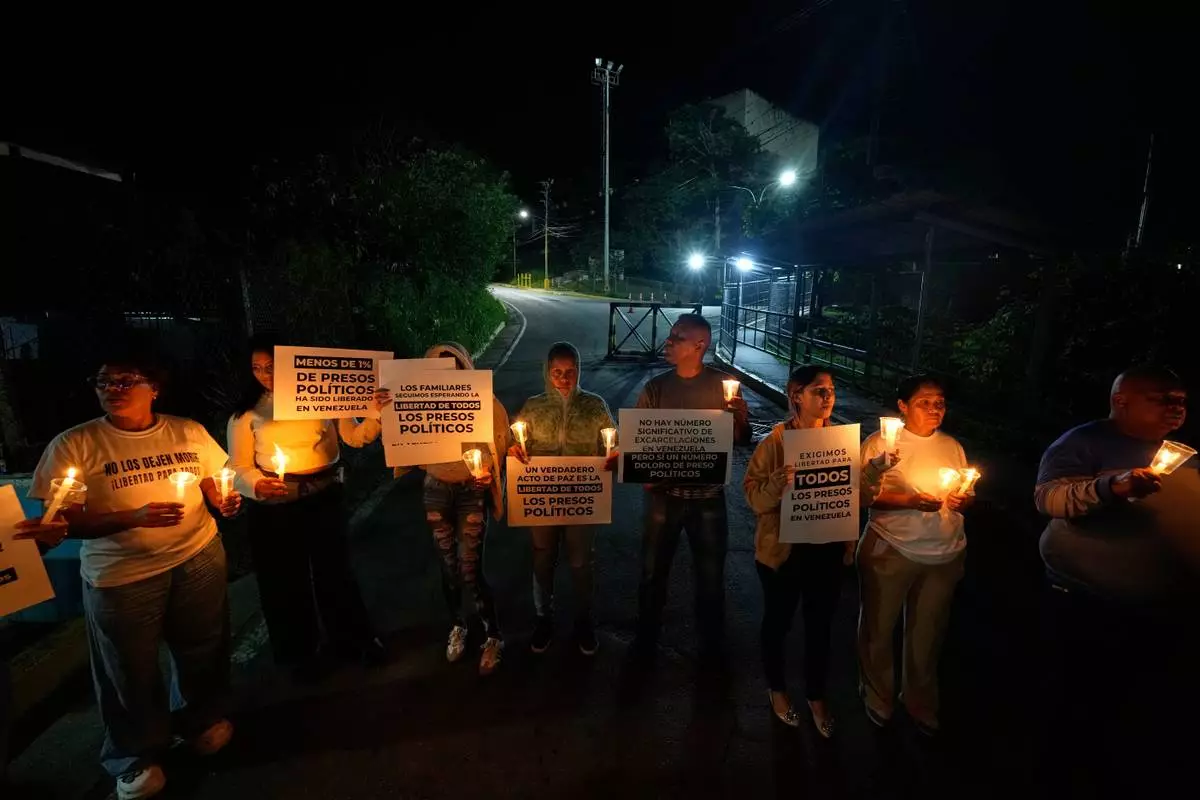
Relatives and friends of political prisoners hold banners and candles calling for their loved ones to be set free outside the Rodeo I prison in Guatire, Venezuela, Friday, Jan. 9, 2026 after the government announced prisoners would be released. (AP Photo/Matias Delacroix)
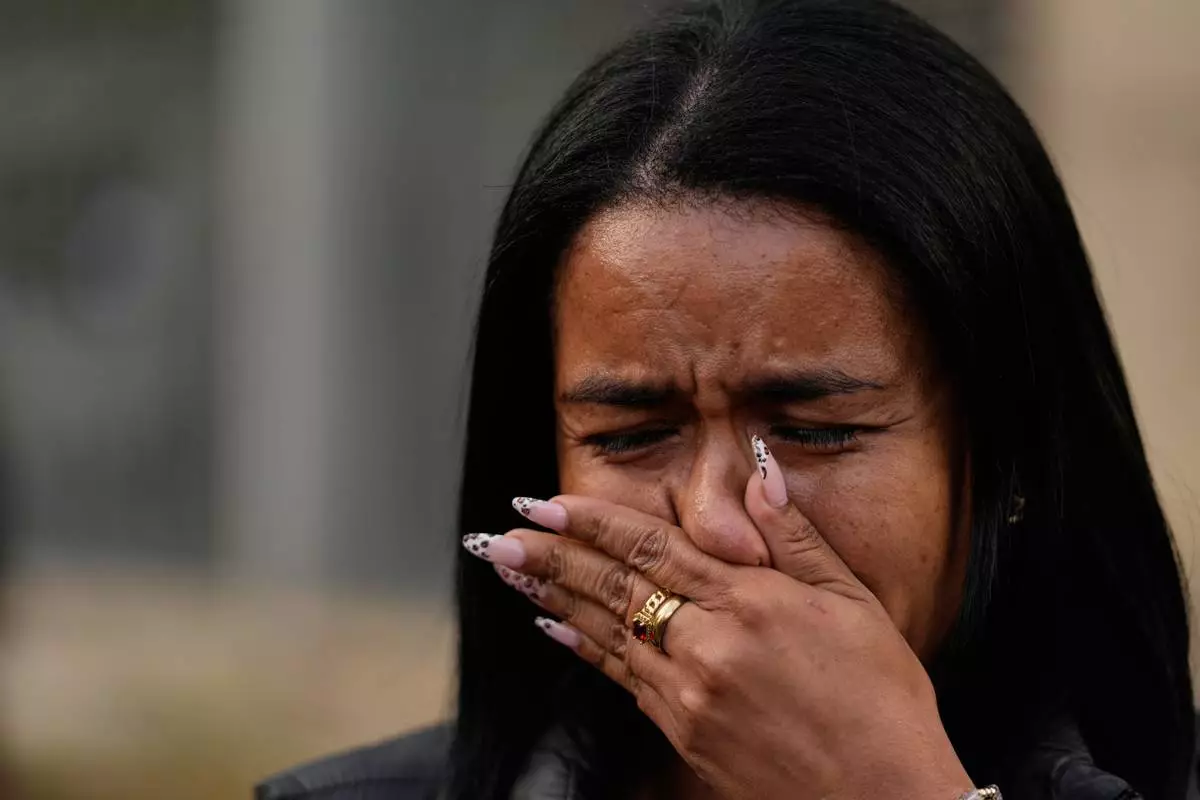
Narwin Gil cries as she waits for news of her detained sister, Marylyn Gil, outside El Helicoide, headquarters of Venezuela's intelligence service and a detention center, in Caracas, Venezuela, Saturday, Jan. 10, 2026. (AP Photo/Matias Delacroix)
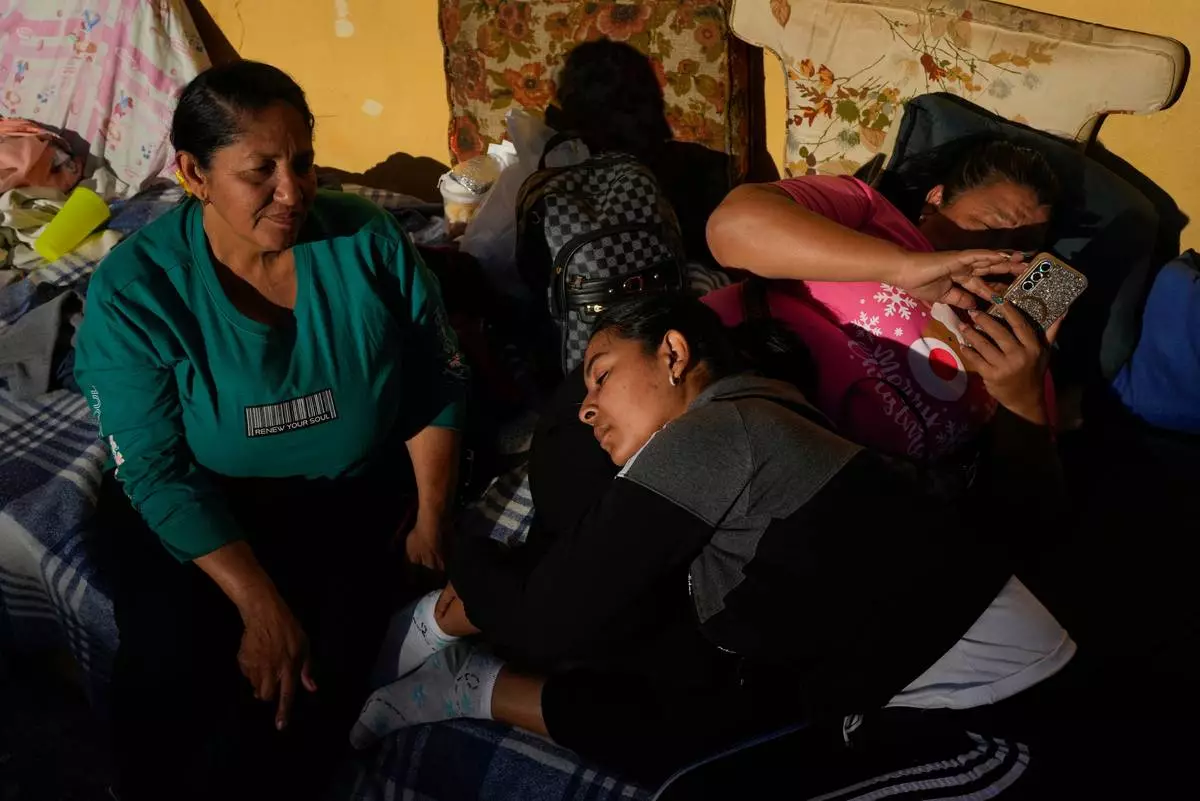
Mileidy Mendoza, center, waits at Zone 7 of the Bolivarian National Police, where her fiancé Eric Diaz is being held as a political detainee in Caracas, Venezuela, Sunday, Jan. 11, 2026, after the government announced prisoners would be released.(AP Photo/Matias Delacroix)
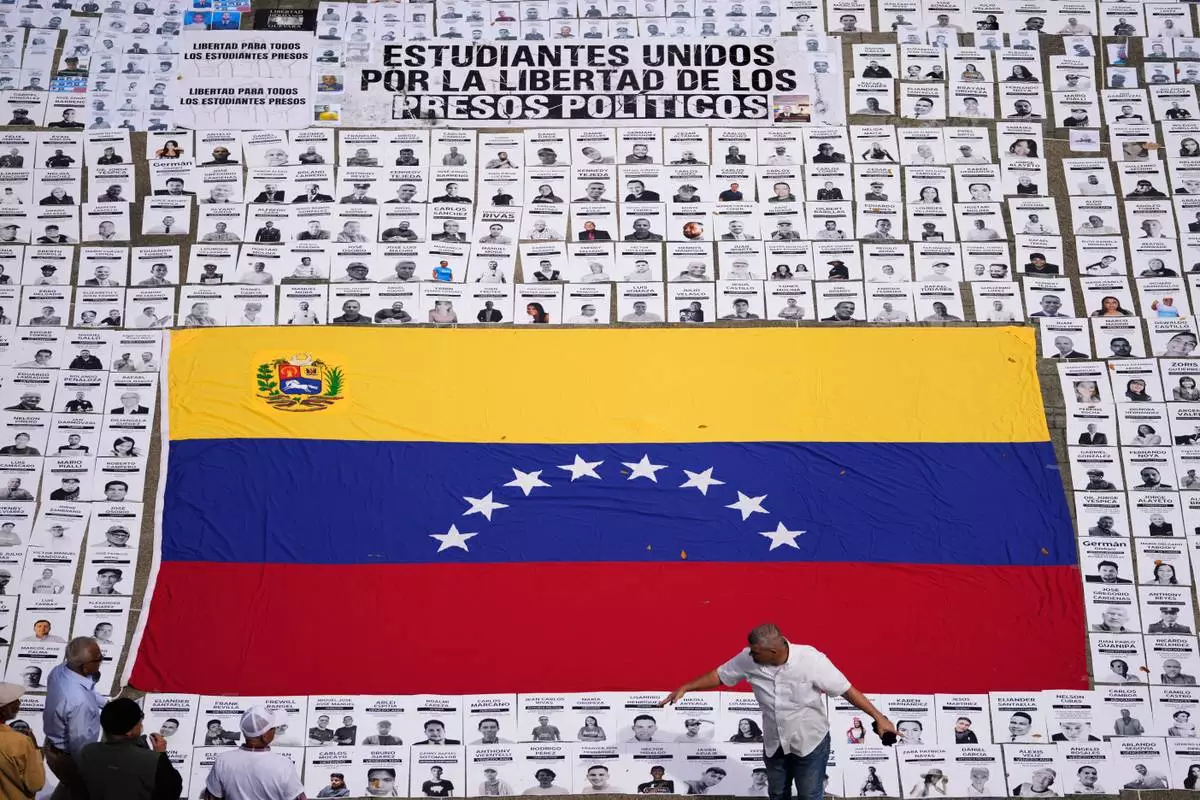
Students lay out photos of people they consider political prisoners at the Central University of Venezuela in Caracas, Venezuela, Tuesday, Jan. 13, 2026. (AP Photo/Matias Delacroix)
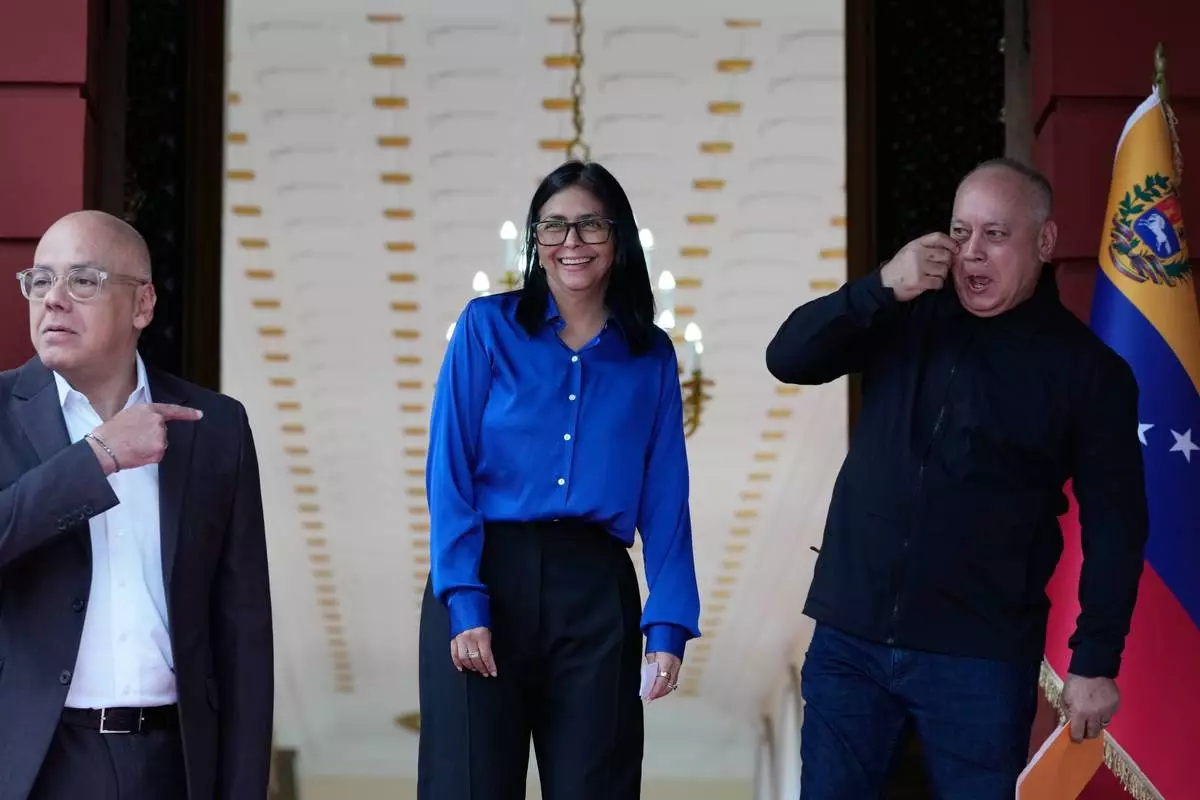
Venezuela's acting President Delcy Rodriguez, center, smiles flanked by Interior Minister Diosdado Cabello, right, and National Assembly President, her brother, Jorge Rodriguez, as they prepare to make a statement at Miraflores presidential palace in Caracas, Venezuela, Wednesday, Jan. 14, 2026. (AP Photo/Ariana Cubillos)