ABU DHABI, United Arab Emirates--(BUSINESS WIRE)--Jan 14, 2026--
Bodrum Anatolian High School, located in Türkiye, has been named the winner of the 2026 Zayed Sustainability Prize in the Global High Schools – Europe & Central Asia category. The school was recognised for its innovative wildfire prevention system that uses drones and solar energy to detect and respond to fires.
This press release features multimedia. View the full release here: https://www.businesswire.com/news/home/20260114281577/en/
The project, known as ‘IYTIMS’ (Intelligent Youth Technology for Integrated Monitoring System), will deploy drones equipped with thermal sensors to identify fire risks and release boron-based fire-suppressing capsules—all powered by solar energy. Students will design and operate the system as part of their STEM curriculum to address the growing threat of wildfires in Türkiye.
The project will protect approximately 1,200 hectares of land, avoid around 20,000 tonnes of CO₂ emissions, generate about 50,000 kWh of solar power, and train nearly 1,500 students in STEM and AI skills.
Dr. Lamya Fawwaz, Executive Director of the Zayed Sustainability Prize, praised the school’s innovation: “The Zayed Sustainability Prize honours youth who turn creativity into action. Bodrum Anatolian High School’s wildfire prevention project demonstrates how innovation and collaboration can protect both people and the environment. It is a testament to what young minds can achieve when guided by purpose and possibility.”
Berrin İpek, Principal of Bodrum Anatolian High School, said: “Winning the Zayed Sustainability Prize is not just an award for Bodrum Anatolian High School, but a recognition of our students’ dreams and determination. This achievement is a testament to their commitment to building a more sustainable future. Together we will continue to work with hope and inspiration for a better world.”
The US $150,000 award will enable the school to enhance its drone systems, expand solar capacity, and conduct regional awareness campaigns to prevent wildfires through education and technology.
The Zayed Sustainability Prize honours organisations and high schools driving impactful and innovative solutions across the categories of Health, Food, Energy, Water, Climate Action, and Global High Schools. Since its inception, the Prize has positively impacted the lives of over 400 million people worldwide, carrying forward the visionary legacy of the UAE’s founding father, Sheikh Zayed bin Sultan Al Nahyan.
Since 2013, the Prize has awarded 68 high schools under its Global High Schools category from countries in the following regions: The Americas, Sub-Saharan Africa, Middle East & North Africa, Europe & Central Asia, South Asia, and East Asia & Pacific. To date, the Prize’s Global High Schools winners have impacted the lives of over 56,599 students and 480,660 people in their wider communities.
Source: AETOSWire

2026 Zayed Sustainability Prize Awards Ceremony (Photo: AETOSWire)
SOUTHAMPTON, N.Y. (AP) — Rory McIlroy’s ball was nestled in the rough on the far side of a cart path, some 55 yards from the flag.
The six-time major winner, a dozen holes into his first round at the U.S. Open, had pushed his approach way to the right, bounding it off the pavement, after sailing his drive into the tall grass left of the fairway.
No bother. McIlroy, gripping his wedge in a parted sea of smartphone-clutching fans, soared his third shot over a greenside bunker and made the 18-foot putt for par, pumping his fist as the ball fell in at punishing Shinnecock Hills.
It was an exceptional up and down on No. 4 in a three-hole stretch — birdie, par, eagle — that vaulted the 37-year-old Northern Irishman to the lead at 3 under Thursday in the opening round.
It didn’t last.
McIlroy, who started on the back nine in the U.S. Open’s split-tee format, bogeyed his final two holes to finish with a 1-under 69. But his play on Nos. 3, 4 and 5, kept him near the top of a crowded leaderboard — tied for ninth and five shots behind Wyndham Clark, who will finish his first round Friday morning.
“Overall, a really good day,” McIlroy said. “Obviously, it stings a little bit to finish the way that I did.”
Aside from the occasional miscue — and the one wild approach on No. 4 — McIlroy played smartly on a difficult golf course made all the tougher by howling wind.
Then again, almost any start would've been better than 2018, when McIlroy carded an opening 80 en route to an early exit at the last U.S. Open played at Shinnecock Hills.
“With the conditions today, anything under par or anything around even par is a good score,” McIlroy said. “It was a day to really just keep yourself in the tournament and not shoot yourself out of it, which is exactly what I did eight years ago here.”
He's playing better and, so far, fans are treating him better than the last time he competed on Long Island, last September, when crowds at the Ryder Cup at Bethpage Black taunted him with insults and tossed a cup of beer at his wife.
Decked out in a gray sweater, McIlroy nodded to fans shouting “Rory!” as he strode up the fourth fairway and waved to acknowledge their roars after sinking his eagle putt on No. 5. His grouping with Sweden's Ludvig Aberg and England's Tommy Fleetwood drew some of the biggest crowds of the day.
McIlroy took an early lead with birdies on his second and third holes, Nos. 11 and 12, but gave it back with bogeys on No. 13, a short par 4, and No. 16, a 620-yard par 5.
For most of the round, Shinnecock Hills felt more like Northern Ireland than Long Island. After a two-hour fog delay, which pushed back the start of McIlroy's day, overcast skies lingered until early afternoon. At least twice in the heavy gusts, his hat flew off after a swing.
But, as the sun was finally breaking through, so did McIlroy.
At even par through 11 holes, McIlroy launched a 344-yard drive to the center of the fairway at the par 4 third, spun a wedge to three feet and landed the birdie putt.
After the par save on No. 4, a two-group bottleneck on the par 5 fifth hole forced McIlroy's trio to wait 12 minutes to tee off.
No bother. McIlroy, playing freer since winning the first of his two Masters championships last year, boomed a 397-yard drive downwind to the right side of the fairway and landed a wedge 11 feet from the hole in a relatively flat part of the tricky green. As the ball disappeared into the hole, he appeared to let out a sigh of relief.
“It was obviously a really tricky day and just a day to stay patient and hang in there, and I hit enough good shots to give myself some chances,” McIlroy said.
Anything in red — an under par round on the scoreboard — “was a good effort," he said.
McIlroy held steady on the next two holes, rattling in a par putt on No. 6 and making a sand save on No. 7. But as he surely knows after 17 U.S. Opens, even an shot that seems good might not be, and even the smallest miscues are punished — especially at Shinnecock.
At No. 8, McIlroy's approach cut through the wind and flew into thick rough long of the green. At No. 9 his second shot bounded off the back of the green down a slope, long and left. McIlroy chipped to about 10 feet but missed the par try, holding out his putter as if willing his ball to slide toward the cup.
McIlroy was in the fairway off the tee on both par 4s.
“It’s so tough. It’s so difficult,” he said. “I didn’t feel like I hit two bad iron shots on the last two holes and put myself in pretty difficult spots and wasn’t able to get it up-and-down, but overall a really good day.”
AP golf: https://apnews.com/hub/golf
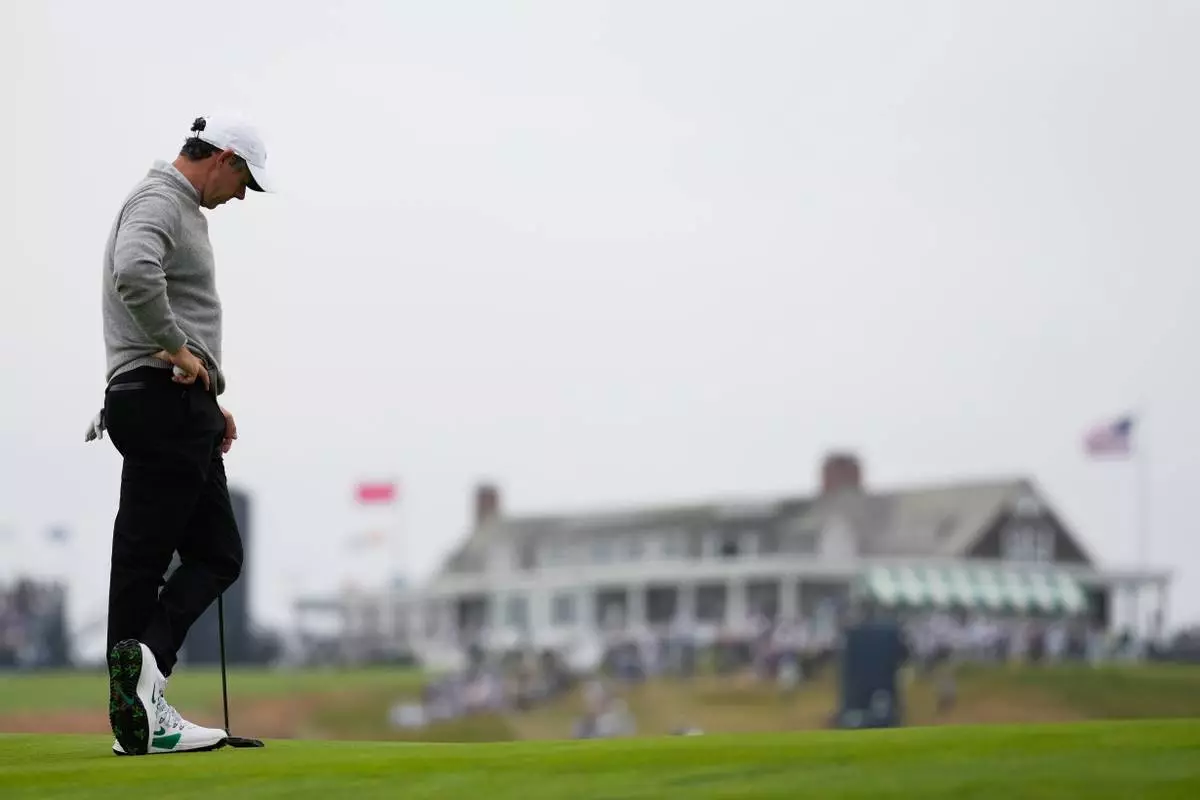
Rory McIlroy, of Northern Ireland, waits to play on the first hole during the first round of the U.S. Open golf tournament at Shinnecock Hills Golf Club in Southampton, N.Y., Thursday, June 18, 2026.(AP Photo/David J. Phillip)

Rory McIlroy, of Northern Ireland, waves after his putt on the 11th hole during the first round of the U.S. Open golf tournament at Shinnecock Hills Golf Club in Southampton, N.Y., Thursday, June 18, 2026.(AP Photo/George Walker IV)

Rory McIlroy, of Northern Ireland, watches his tee shot on the 14th hole during the first round of the U.S. Open golf tournament at Shinnecock Hills Golf Club in Southampton, N.Y., Thursday, June 18, 2026.(AP Photo/Gerald Herbert)
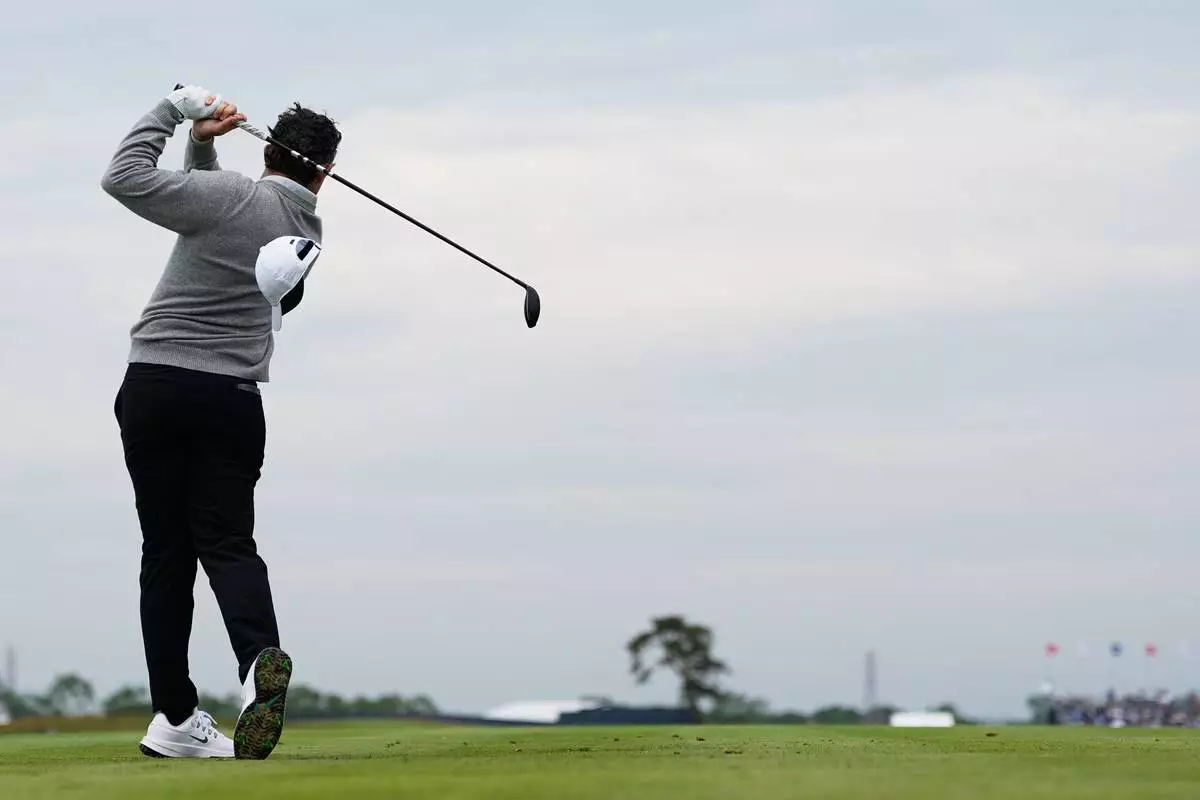
Rory McIlroy, of Northern Ireland, looses his hat in the wind on the 13th hole during the first round of the U.S. Open golf tournament at Shinnecock Hills Golf Club in Southampton, N.Y., Thursday, June 18, 2026.(AP Photo/George Walker IV)