Skip to Content Facebook Feature Image

Cargill Advances Maritime Decarbonisation with Delivery of First Green Methanol Dual-Fuel Vessel

Business

Cargill Advances Maritime Decarbonisation with Delivery of First Green Methanol Dual-Fuel Vessel
Business

Business

Cargill Advances Maritime Decarbonisation with Delivery of First Green Methanol Dual-Fuel Vessel

2026-01-15 15:00 Last Updated At:17:17

GENEVA--(BUSINESS WIRE)--Jan 15, 2026--

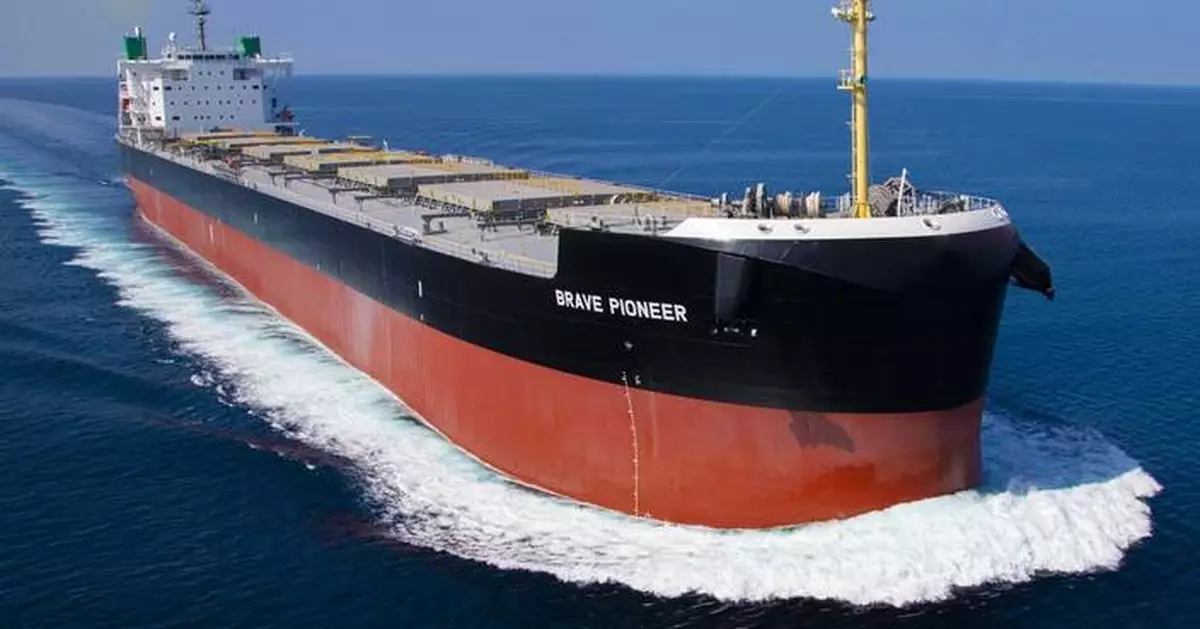
Cargill today announced the maiden voyage of Brave Pioneer, the first of five green methanol dual-fuel dry bulk vessels chartered by the company. The deployment of the Brave Pioneer marks another important milestone in Cargill’s broader decarbonization efforts – one focused on innovation, testing and learning as the company works with customers and partners to refine future-ready solutions for Cargill and the industry.

This press release features multimedia. View the full release here: https://www.businesswire.com/news/home/20260114083757/en/

Built by Tsuneishi Shipbuilding Co., Ltd. and owned by Mitsui & Co. Ltd., Brave Pioneer is equipped to operate on both conventional marine fuels and green methanol, a lower-carbon alternative. The estimated CO2 saving of using green methanol compared to conventional fuel is up to 70%.

The ship departs the Philippines today, will bunker green methanol in Singapore, then proceed to Western Australia before sailing onward to Europe. Through Brave Pioneer ’s maiden voyage, Cargill will conduct a series of operational trials designed evaluate methanol bunkering readiness, understand how environmental attributes can be traced and verified through carbon accounting systems, and assess market appetite for low-carbon freight services.

“Decarbonising global shipping requires a mix of technologies and the willingness to take bold steps before the entire ecosystem is ready,” said Jan Dieleman, President of Cargill’s Ocean Transportation business. “Technologies like green methanol or wind-assisted propulsion come with uncertainty. But as an industry leader, we have a responsibility to test these innovations on the water, share what we learn, and help shape the systems and standards that will enable wider adoption.”

Setting the Stage for a New Low-Carbon Fleet

The launch of Brave Pioneer paves the way for the four additional vessels that will join Cargill’s fleet over the coming years. The addition of these vessels strengthens Cargill’s multi-solution decarbonization approach, which includes wind-assisted propulsion, voyage optimization technologies, energy-efficiency retrofits and exploration of alternative fuels such as biofuels and ethanol.

Each represents another step in the company’s broader efforts to embed sustainability into global ocean supply chains and support customers looking for practical, lower-carbon freight options.

“We know the road to low carbon shipping will require a mix of solutions and green methanol is one part of that portfolio,” Dieleman continued. “Our new fleet is about optionality and adaptability. These vessels are engineered to perform at a best-in-class level on conventional fuel today, while allowing us to switch to greener fuels as availability improves. It’s a practical way to future-proof ocean transport.”

As one of the world’s largest charterers of dry bulk freight, Cargill’s actions send a strong demand signal to the market and serve as an open invitation for others in the maritime sector to join in advancing the transition to sustainable shipping.

The initiative supports Cargill’s broader effort to reduce supply chain emissions and invest and test practical innovations that advance progress toward a more sustainable global food system. Green methanol-enabled vessels—paired with the eventual expansion of renewable fuel supply—are expected to play a meaningful role in reducing maritime emissions over the coming decade.

About Cargill

Cargill is committed to providing food, ingredients, agricultural solutions, and industrial products to nourish the world in a safe, responsible, and sustainable way. Sitting at the heart of the supply chain, we partner with farmers and customers to source, make and deliver products that are vital for living.

Our 160,000 team members innovate with purpose, providing customers with life’s essentials so businesses can grow, communities prosper, and consumers live well. With 159 years of experience as a family company, we look ahead while remaining true to our values. We put people first. We reach higher. We do the right thing—today and for generations to come. For more information, visit Cargill.com and our News Center.

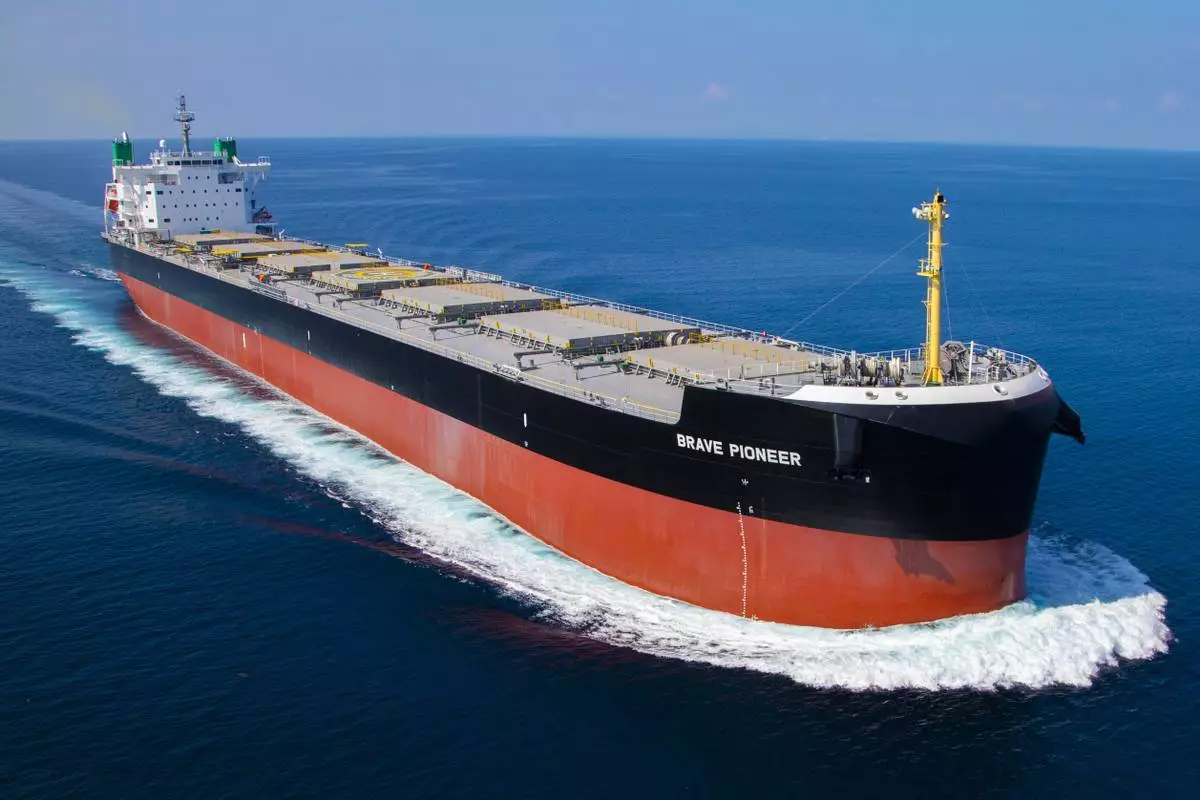
Through Brave Pioneer’s maiden voyage, Cargill will conduct a series of operational trials designed evaluate methanol bunkering readiness, understand how environmental attributes can be traced and verified through carbon accounting systems, and assess market appetite for low-carbon freight services.
Through Brave Pioneer’s maiden voyage, Cargill will conduct a series of operational trials designed evaluate methanol bunkering readiness, understand how environmental attributes can be traced and verified through carbon accounting systems, and assess market appetite for low-carbon freight services.

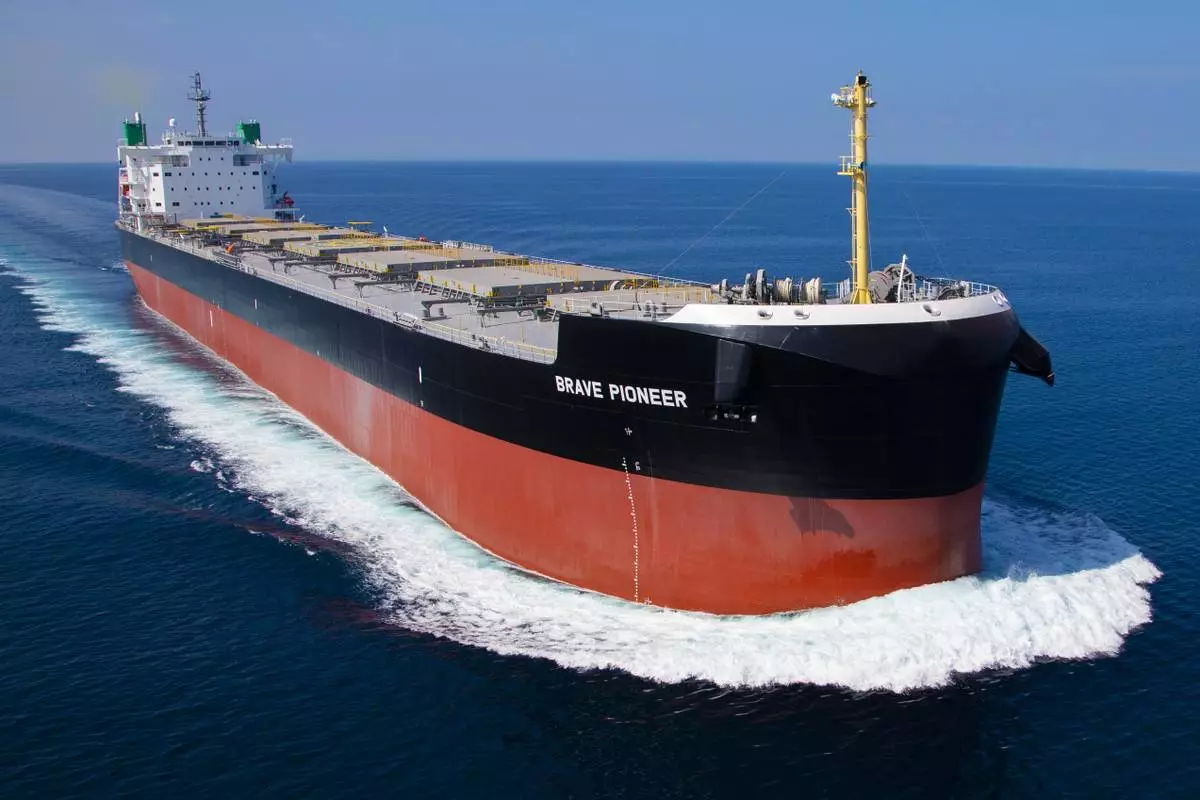
The ship departs the Philippines today, will bunker green methanol in Singapore, then proceed to Western Australia before sailing onward to Europe.
The ship departs the Philippines today, will bunker green methanol in Singapore, then proceed to Western Australia before sailing onward to Europe.

Built by Tsuneishi Shipbuilding Co., Ltd. and owned by Mitsui & Co. Ltd., Brave Pioneer is equipped to operate on both conventional marine fuels and green methanol, a lower-carbon alternative.


Built by Tsuneishi Shipbuilding Co., Ltd. and owned by Mitsui & Co. Ltd., Brave Pioneer is equipped to operate on both conventional marine fuels and green methanol, a lower-carbon alternative.

CAPE CANAVERAL, Fla. (AP) — An ailing astronaut returned to Earth with three others on Thursday, ending their space station mission more than a month early in NASA’s first medical evacuation.

SpaceX guided the capsule to a middle-of-the-night splashdown in the Pacific near San Diego, less than 11 hours after the astronauts exited the International Space Station.

“It’s so good to be home,” said NASA astronaut Zena Cardman, the capsule commander.

It was an unexpected finish to a mission that began in August and left the orbiting lab with only one American and two Russians on board. NASA and SpaceX said they would try to move up the launch of a fresh crew of four; liftoff is currently targeted for mid-February.

Cardman and NASA’s Mike Fincke were joined on the return by Japan’s Kimiya Yui and Russia’s Oleg Platonov. Officials have refused to identify the astronaut who had the health problem or explain what happened, citing medical privacy.

While the astronaut was stable in orbit, NASA wanted them back on Earth as soon as possible to receive proper care and diagnostic testing. The entry and splashdown required no special changes or accommodations, officials said, and the recovery ship had its usual allotment of medical experts on board. It was not immediately known when the astronauts would fly from California to their home base in Houston. Platonov’s return to Moscow was also unclear.

NASA stressed repeatedly over the past week that this was not an emergency. The astronaut fell sick or was injured on Jan. 7, prompting NASA to call off the next day’s spacewalk by Cardman and Fincke, and ultimately resulting in the early return. It was the first time NASA cut short a spaceflight for medical reasons. The Russians had done so decades ago.

The space station has gotten by with three astronauts before, sometimes even with just two. NASA said it will be unable to perform a spacewalk, even for an emergency, until the arrival of the next crew, which has two Americans, one French and one Russian astronaut.

The Associated Press Health and Science Department receives support from the Howard Hughes Medical Institute’s Department of Science Education and the Robert Wood Johnson Foundation. The AP is solely responsible for all content.

This screengrab from video provided by NASA TV shows the SpaceX Dragon departing from the International Space Station shortly after undocking with four NASA Crew-11 members inside on Wednesday, Jan. 14, 2026. (NASA via AP)

This screengrab from video provided by NASA TV shows the SpaceX Dragon departing from the International Space Station shortly after undocking with four NASA Crew-11 members inside on Wednesday, Jan. 14, 2026. (NASA via AP)

This photo provided by NASA shows clockwise from bottom left are, NASA astronaut Mike Fincke, Roscosmos cosmonaut Oleg Platonov, NASA astronaut Zena Cardman, and JAXA (Japan Aerospace Exploration Agency) astronaut Kimiya Yui gathering for a crew portrait wearing their Dragon pressure suits during a suit verification check inside the International Space Station’s Kibo laboratory module, Wednesday, Jan. 14, 2026. (NASA via AP)

This photo provided by NASA shows clockwise from bottom left are, NASA astronaut Mike Fincke, Roscosmos cosmonaut Oleg Platonov, NASA astronaut Zena Cardman, and JAXA (Japan Aerospace Exploration Agency) astronaut Kimiya Yui gathering for a crew portrait wearing their Dragon pressure suits during a suit verification check inside the International Space Station’s Kibo laboratory module, Wednesday, Jan. 14, 2026. (NASA via AP)

This screengrab from video provided by NASA shows recovery vessels approaching the NASA's SpaceX Crew-11 capsule to evacuate one of the crew members after they re-entered the earth in a middle-of-the-night splashdown near San Diego, Calif., Thursday, Jan. 15, 2026. (NASA via AP)

This screengrab from video provided by NASA shows recovery vessels approaching the NASA's SpaceX Crew-11 capsule to evacuate one of the crew members after they re-entered the earth in a middle-of-the-night splashdown near San Diego, Calif., Thursday, Jan. 15, 2026. (NASA via AP)

This screengrab from video provided by NASA shows the NASA's SpaceX Crew-11 members re entering the earth in a middle-of-the-night splashdown near San Diego, Calif., Thursday, Jan. 15, 2026. (NASA via AP)

This screengrab from video provided by NASA shows the NASA's SpaceX Crew-11 members re entering the earth in a middle-of-the-night splashdown near San Diego, Calif., Thursday, Jan. 15, 2026. (NASA via AP)

This screengrab from video provided by NASA shows the NASA's SpaceX Crew-11 members re entering the earth in a middle-of-the-night splashdown near San Diego, Calif., Thursday, Jan. 15, 2026. (NASA via AP)

This screengrab from video provided by NASA shows the NASA's SpaceX Crew-11 members re entering the earth in a middle-of-the-night splashdown near San Diego, Calif., Thursday, Jan. 15, 2026. (NASA via AP)

Recommended Articles