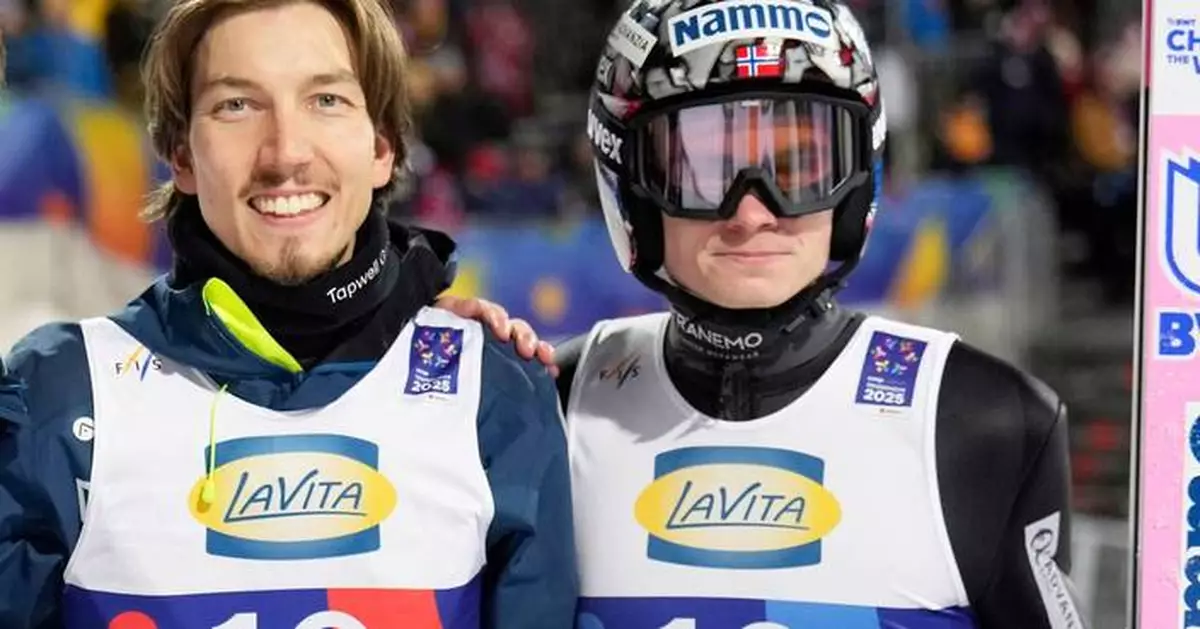
OBERHOFEN, Switzerland (AP) — The scandal in ski jumping of Norway’s men wearing manipulated suits was resolved when three team officials were banned for 18 months on Thursday.
The case tarnished Norway’s hosting of the Nordic ski world championships last March and the country’s wider reputation for fair play.
Head coach Magnus Brevik, assistant coach Thomas Lobben and staff member Adrian Livelten were suspended for the period requested by the International Ski and Snowboard Federation (FIS) which announced the verdicts.
Two athletes implicated in the case — Olympic gold medalists Johann André Forfang and Marius Lindvik — accepted three-month bans in August and have returned to World Cup competitions ahead of the Milan Cortina Winter Games that opens next month.
An independent panel which judged the team officials said it “agrees with, and endorses, the appropriateness of the sanctions sought by the FIS.”
“The panel’s starting point is that cheating of any kind is inherently antithetical to sport and its values,” wrote the three judges, who were led by sports law pioneer Michael Beloff.
The manipulation and restitching of suits was captured on secretly filmed footage and published by media during the world championships in Trondheim.
Athletes were helped to fly further by increasing the size of suits that are preapproved and microchipped by FIS. The manipulation could be confirmed only by tearing apart the seams of the crotch area on the Norwegian team suits.
Lindvik and Forfang were disqualified from the men’s large hill event in Trondheim after they placed second and fourth, respectively.
Lindvik retained his normal hill title won days earlier and both kept their bronze medals from the team event.
In Trondheim, Brevik and Livelten quickly acknowledged their guilt and insisted the cheating took place only before the large hill event.
The bans were backdated to the time of the world championships and will expire in September.
AP Olympics: https://apnews.com/hub/milan-cortina-2026-winter-olympics
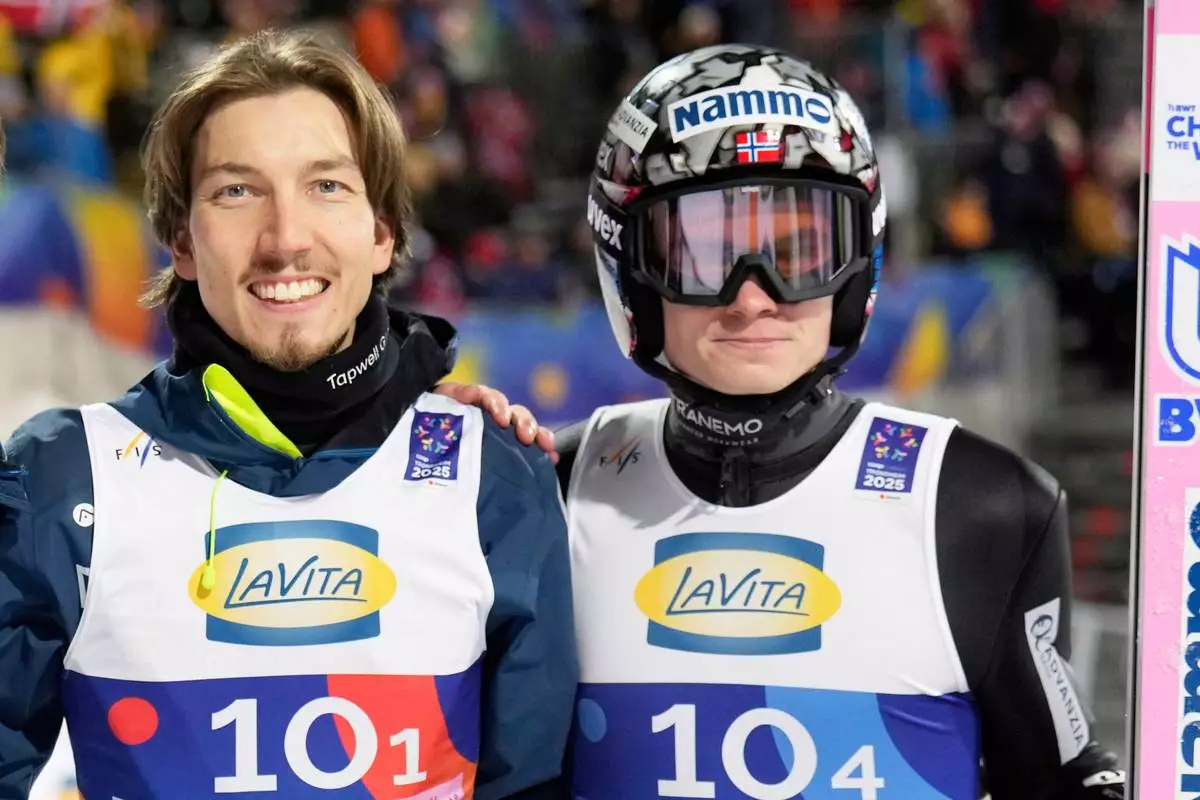
FILE - Johann Andre Forfang, and Marius Lindvik, from left, of Norway, pose after winning the bronze medal in the ski jumping men's team large hill competition at the Nordic World Ski Championships in Trondheim, Norway, March 6, 2025. (AP Photo/Matthias Schrader, File)
FOXBOROUGH, Mass. (AP) — A.J. Brown is leaving a frustrating experience in Philadelphia for a reunion in New England with his first NFL coach.
The Eagles traded the star receiver to the Patriots on Monday, putting a cap on the long-rumored deal.
The Eagles said they will receive a first-round pick in 2028 and a fifth-round pick in 2027 for the three-time Pro Bowler.
The trade comes after a frustrating 2025 season for Brown in Philadelphia, in which he had grown dispirited with an Eagles offense that played uninspired football at times while the team failed to defend its Super Bowl title.
Still, he posted a message on Instagram shortly after the trade became official Monday of him in an Eagles jersey with his hands making the “heart” symbol. He also posted a few other photos of himself as a kid wearing a Tom Brady Patriots jersey.
Brown played under Vrabel for three seasons after being drafted by the Tennessee Titans in 2019.
Brown, 28, quickly rose to the top receiving option in Philadelphia after being traded by Tennessee to the Eagles in 2022.
He had back-to-back Pro Bowl seasons his first two seasons with the Eagles, catching 88 passes for 1,496 yards and 11 touchdowns in 2022 and 106 passes for 1,456 yards and seven TDs in 2023.
He earned a Super Bowl ring during the 2024 season, but began to grow unhappy last season as the Eagles offense stagnated — leading to a change at offensive coordinator following a wild-card playoff loss to San Francisco last season.
It led to an increase in chatter about the potential for a trade heading into this offseason. It didn’t happen during April’s NFL draft likely because the Eagles would have had about $43 million in dead cap money for 2026 compared to about $16 million this year and $27 million next year if traded after June 1.
Ultimately a high draft pick proved to be enough to persuade them to deal a player of Brown’s caliber.
The Patriots have been viewed as a possible landing spot for Brown since they released receiver Stefon Diggs in March. Diggs led New England with 85 receptions and 1,013 yards receiving with four touchdowns in his only season in New England in 2025, helping the Patriots reach the Super Bowl, where they lost to the Seattle Seahawks.
Diggs’ exit made finding a No. 1 receiving option for quarterback Drake Maye a priority. The Patriots did add former Green Bay Packers receiver Romeo Doubs in free agency. But he doesn’t instantly change an offense the way Brown’s addition could.
Maye acknowledged last week that he was aware of the Brown-to-New England rumors.
“If he ends up being on our team, great. What a great player. And if he doesn’t, we’ve still got to work these guys here,” Maye said. “It’s a tough balance, but I know he’s a phenomenal player.”
Patriots defensive tackle Milton Williams, who was on the Eagles 2024 Super Bowl-winning team with Brown, said the receiver would be a big addition.
“He can definitely help our team,” Williams said. “Great dude. Monster on the field, great in the locker room, holding guys accountable and holding himself accountable. That’s everything you want in a player of his caliber.”
Brown leaves Philadelphia as one of the top receivers in franchise history. He topped 1,000 yards receiving all four seasons with the Eagles. He totaled 339 total receptions and 32 touchdowns and was a crucial member of the two Eagles teams that played in the Super Bowl during his tenure.
Vrabel was entering his second season as coach of the Titans when the team selected Brown in the second round of the 2019 draft.
Brown caught 185 passes for 2,995 yards and 24 touchdowns over the next three years, peaking with a 2020 season in which he earned a Pro Bowl selection after pulling in 70 receptions for 1,075 yards and 11 touchdowns.
But the Titans wound up trading Brown to Philadelphia on the second day of the 2022 draft that April despite having a season left on his rookie deal. The team was adamant that it wasn’t its preference to trade him but felt his asking price for an extension was too high.
Vrabel stated multiple times during that offseason that Brown would be on the roster as long as he was the coach, but the realities of the situation changed things.
“Unfortunately, we understand that if we’re going to be here awhile we’re not going to be able to keep every single player that we draft and develop,” Vrabel said at the time.
Four years later, he’ll get to coach him again.
AP NFL: https://apnews.com/NFL
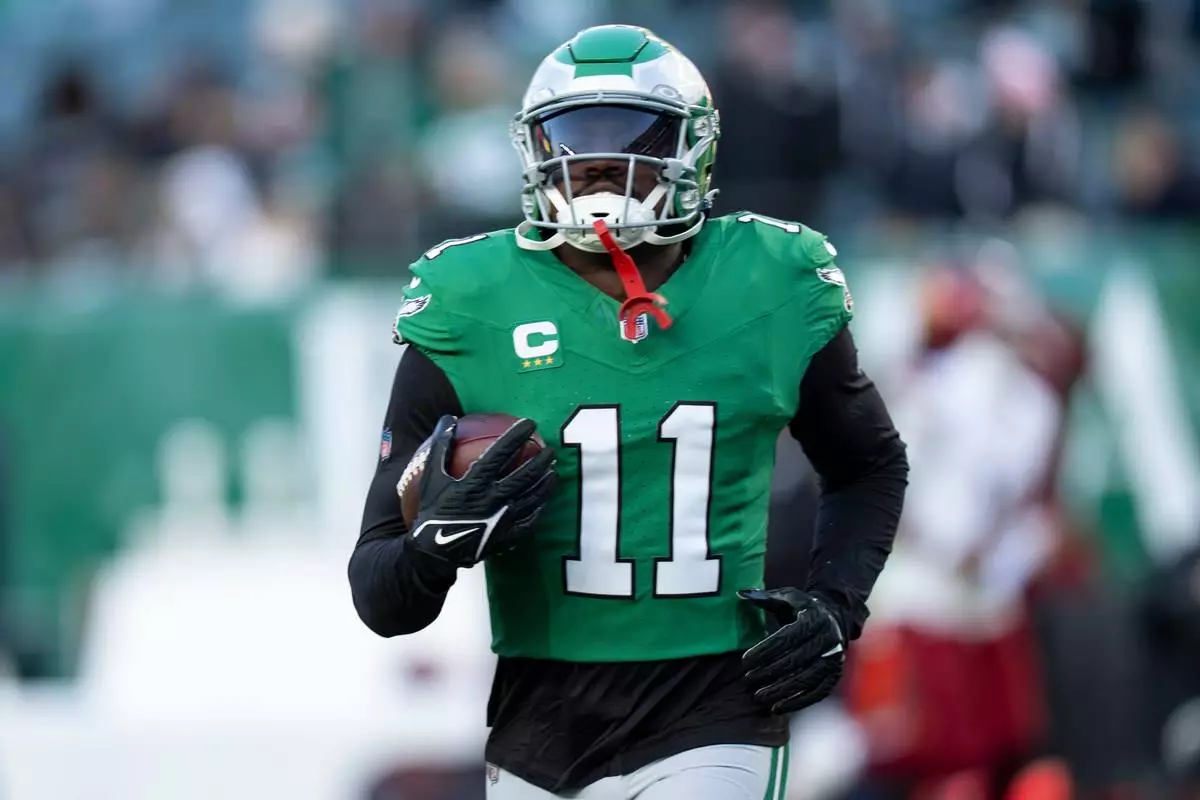
FILE - Philadelphia Eagles wide receiver A.J. Brown in action prior to an NFL football game against the Washington Commanders, Jan. 4, 2026, in Philadelphia. (AP Photo/Chris Szagola, File)
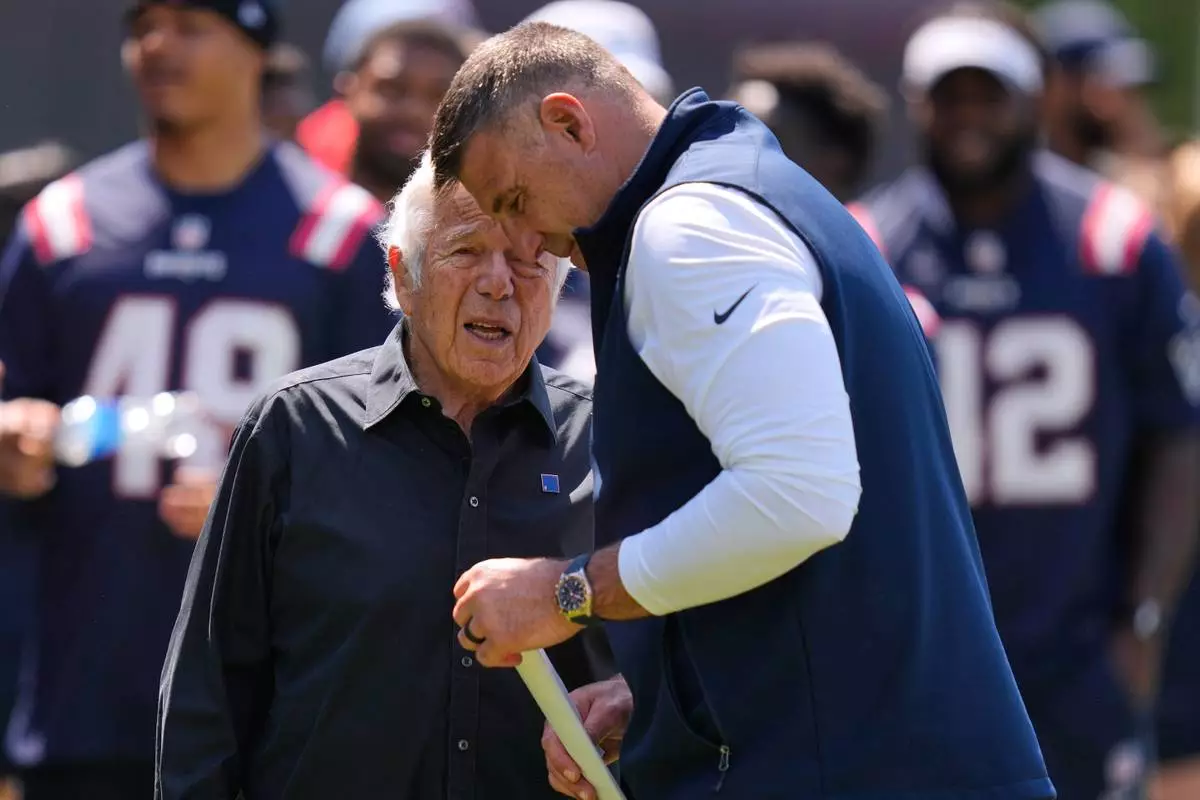
New England Patriots owner Robert Kraft talks with head coach Mike Vrabel during a community NFL football day, Wednesday, May 20, 2026, in Foxborough, Mass. (AP Photo/Charles Krupa)