WALTHAM, Mass.--(BUSINESS WIRE)--Jan 15, 2026--
New England Donor Services (NEDS) today announced a record number of life-saving organ transplants last year from deceased organ donors in New England. In 2025, NEDS coordinated organ donations from 640 deceased donors resulting in 1,692 life-saving transplants. This record number of organ transplants represents the fifth year of consecutive growth in transplants and places NEDS among the nation’s top three organ procurement organizations (OPOs) by donor and transplant volume. Since 2020, NEDS has increased the number of life-saving organ transplants from New England organ donors by a total of 65 percent.
This press release features multimedia. View the full release here: https://www.businesswire.com/news/home/20260115735770/en/
NEDS also coordinated the recovery of donated tissue from 1,861 donors, a record year for tissue donation in New England. Each donor can donate multiple tissues including cornea, bone, skin, heart valves, and other tissues used in necessary medical procedures to heal and transform lives. Tissue donated through NEDS is used in over 100,000 tissue transplants each year.
“Because of donors, courageous families, and the unwavering dedication of NEDS’ staff, generosity becomes legacy and hope lives on for thousands of transplant recipients – turning loss into healing and the gift of donation into life,” said Alexandra K. Glazier, President and CEO of New England Donor Services (NEDS).
While the number of organ donors remained steady during 2025 compared to the previous year, NEDS was nonetheless able to increase the number of life-saving transplants resulting from those donors by 8 percent. One reason was the expanded use of cutting-edge organ perfusion devices and techniques. The adoption of abdominal normothermic regional perfusion (A-NRP) – combined with transportable, ex vivo organ perfusion devices – improves the function of donated organs especially from older and/or more medically complex donors. Glazier noted, “Previously, these organs may not have been accepted for transplant, but now they are used routinely to the benefit of transplant patients and offers the opportunity for donation to more families.”
“My five-year-old son, Lincoln, now has a second chance at life thanks to his life-saving heart transplant,” said Ashley Stanger, a resident of East Haddam, CT, whose son spent 327 consecutive days at the hospital to be treated for dilated cardiomyopathy. “Lincoln received a new heart in March 2025, thanks to the generosity of his deceased donor. We extend our deepest gratitude to Lincoln’s donor. Thanks to this selfless choice, Lincoln is now able to attend kindergarten, spend time with his younger sister, and dreams of becoming a firefighter one day."
“I am incredibly grateful and humbled to have received the gift of life,” said Sean Moore, who lives in Grafton, MA, and received a kidney transplant in July 2025. “I am thankful beyond words to my deceased organ donor who selflessly saved lives by choosing to become a donor. My transplant has given me renewed health and the opportunity to spend many more years with my wife and three children.”
Looking forward to 2026 and the anticipated disruption of the donation and transplant system resulting from inaccurate and destructive performance metrics at the federal level, Glazier continued, “Poorly designed federal regulatory metrics may force the closure of up to half of the community-based non-profits coordinating organ donation for transplant in the United States with no clear plan for how the system will deliver services for these areas. Despite this looming uncertainty, NEDS is positioned to continue providing the stable, high-quality performance it is known for as a national leader in the field, which is necessary to ensure life-saving donation and transplants remain reliable in the New England region. We urge policymakers in Washington, D.C. to take the steps necessary to swiftly reform and modernize the current regulatory structure that could threaten patients that are on the organ donation wait list.”
One person can save up to eight lives as an organ donor and heal 75 people as a tissue donor.
Residents of New England can register as donors on their driver’s license, through the Apple iPhone health app or on the national Donate Life Donor Registry at www.RegisterMe.org.
About New England Donor Services (NEDS)
New England Donor Services is a leading nonprofit organization that coordinates organ and tissue donation in Connecticut, Maine, Massachusetts, New Hampshire, Rhode Island, the eastern counties of Vermont, and Bermuda. Co-founded in 1968 by Nobel Laureate Dr. Joseph Murray, who performed the world’s first successful organ transplant, today NEDS works with thousands of donors and donor families who have generously made the decision to give the gift of life. The organization’s highly skilled staff medically screen referrals for potential donations from more than 200 hospitals across the region and lead all donor authorization discussions with families. NEDS also allocates organs according to the national transplant waiting list and coordinates their transport to ensure the right organs get to the right patients at the right time. Learn more at https://neds.org/ or follow us on LinkedIn or on X at @NEDonorServices.
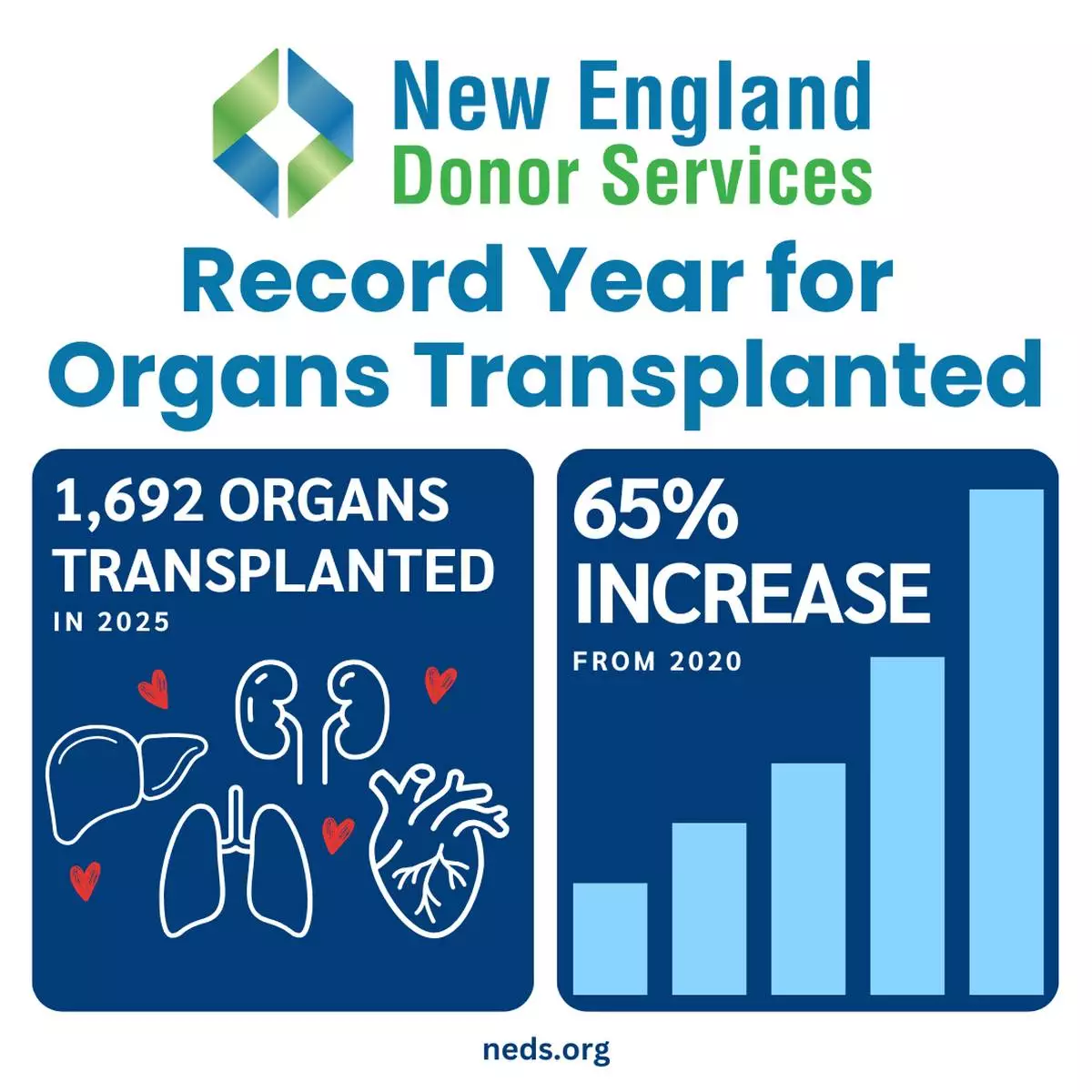
In 2025, NEDS coordinated organ donations from 640 deceased donors resulting in a record 1,692 life-saving transplants. Since 2020, NEDS has increased the number of life-saving organ transplants from New England organ donors by a total of 65 percent.

KAMPALA, Uganda (AP) — Uganda’s presidential election was plagued by widespread delays Thursday in addition to a days-long internet shutdown that has been criticized as an anti-democratic tactic in a country where the president has held office since 1986.
Some polling stations remained closed for up to four hours after the scheduled 7 a.m. start time due to “technical challenges," according to the nation's electoral commission, which asked polling officers to use paper registration records to ensure the difficulties did not “disenfranchise any voter.”
President Yoweri Museveni, 81, faces seven other candidates, including Robert Kyagulanyi, a musician-turned-politician best known as Bobi Wine, who is calling for political change.
The East African country of roughly 45 million people has 21.6 million registered voters. Polls are expected to close at 4 p.m. Thursday, according to the electoral commission. Results are constitutionally required to be announced in 48 hours.
Impatient crowds gathered outside polling stations expressing concerns over the delays Thursday morning. Umaru Mutyaba, a polling agent for a parliamentary candidate, said it was “frustrating” to be waiting outside a station in the capital Kampala.
“We can’t be standing here waiting to vote as if we have nothing else to do," he said.
Wine alleged there was electoral fraud occurring, noting that biometric voter identification machines were not working at polling places and claiming there was “ballot stuffing.”
“Our leaders, including Deputy President for Western Region, arrested. Many of our polling agents and supervisors abducted, and others chased off polling stations,” Wine wrote in a post on social media platform X.
Museveni told journalists he was notfied biometric machines were inoperable at some stations and he supported the electoral body's decision to revert to paper registration records. He did not comment on the allegation of fraud.
Ssemujju Nganda, a prominent opposition figure and lawmaker seeking reelection in Kira municipality, told The Associated Press he had been waiting in line to vote for three hours.
Nganda also noted biometric machines were malfunctioning, in addition to the late arrival of balloting materials, and predicted the delays likely would lead to apathy and low turnout in urban areas where the opposition has substantial support.
"It’s going to be chaos,” he said Thursday morning.
Nicholas Sengoba, an independent analyst and newspaper columnist, said delays to the start of voting in urban, opposition areas favored the ruling party.
Uganda has not witnessed a peaceful transfer of presidential power since independence from British colonial rule six decades ago.
Museveni has served the third-longest term of any African leader and is seeking to extend his rule into a fifth decade. Some critics say removing him through elections remains difficult, but the aging president’s authority has become increasingly dependent on the military led by his son, Muhoozi Kainerugaba.
Museveni and Wine are reprising their rivalry from the previous election in 2021, when Wine appealed to mostly young people in urban areas. With voter turnout of 59%, Wine secured 35% of the ballots against Museveni’s 58%, the president’s smallest vote share since his first electoral campaign three decades ago.
The lead-up to Thursday's election produced concerns about transparency, the possibility of hereditary rule, military interference and opposition strategies to prevent vote tampering at polling stations.
Uganda's internet was shut down Tuesday by the government communications agency, which cited misinformation, electoral fraud and incitement of violence. The shutdown has affected the public and disrupted critical sectors such as banking.
There has been heavy security leading up to voting, including military units deployed on the streets this week.
Amnesty International said security forces are engaging in a “brutal campaign of repression,” citing a Nov. 28 opposition rally in eastern Uganda where the military blocked exits and opened fire on supporters, killing one person.
Museveni urged voters to come out in large numbers during his final rally Tuesday.
“You go and vote, anybody who tries to interfere with your freedom will be crushed. I am telling you this. We are ready to put an end to this indiscipline,” he said.
The national electoral commission chairperson, Simon Byabakama, urged tolerance among Ugandans as they vote.
“Let us keep the peace that we have,” Byabakama said late Wednesday. “Let us be civil. Let us be courteous. Let’s be tolerant. Even if you know that this person does not support (your) candidate, please give him or her room or opportunity to go and exercise his or her constitutional right."
Authorities also suspended the activities of several civic groups during the campaign season. That Group, a prominent media watchdog, closed its office Wednesday after the interior ministry alleged in a letter that the group was involved in activities “prejudicial to the security and laws of Uganda.”
Veteran opposition figure Kizza Besigye, a four-time presidential candidate, remains in prison after he was charged with treason in February 2025.
Uganda opposition presidential candidate Robert Kyagulanyi Ssentamu, known as Bobi Wine, right, greets election observers, including former Nigerian President Goodluck Jonathan, at his home in Magere village on the outskirts of Kampala, Uganda, Wednesday, Jan. 14, 2026. (AP Photo/Hajarah Nalwadda)
Billboards of Uganda President and National Resistance Movement (NRM) presidential candidate Yoweri Museveni are seen in Kampala, Uganda, Tuesday, Jan. 13, 2026. (AP Photo/Samson Otieno)
Electoral workers deliver ballot boxes to a polling station during presidential election in Kampala, Uganda, Thursday, Jan. 15, 2026. (AP Photo/Brian Inganga)
Voters are reflected in a police officer's sunglasses as they wait in line after voting failed to start on time due to system failures during presidential election in Kampala, Uganda, Thursday, Jan. 15, 2026. (AP Photo/Brian Inganga)
Voters wait to cast their ballots during the presidential election in Kampala, Uganda, Thursday, Jan. 15, 2026. (AP Photo/Brian Inganga)