EMMAUS, Pa.--(BUSINESS WIRE)--Jan 15, 2026--
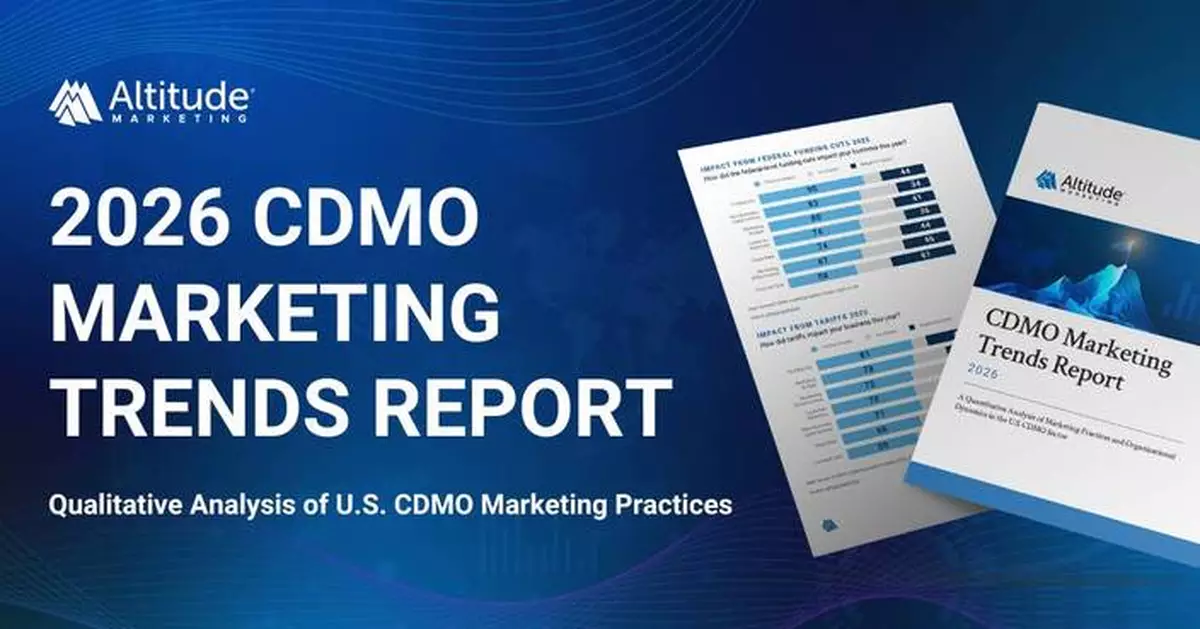
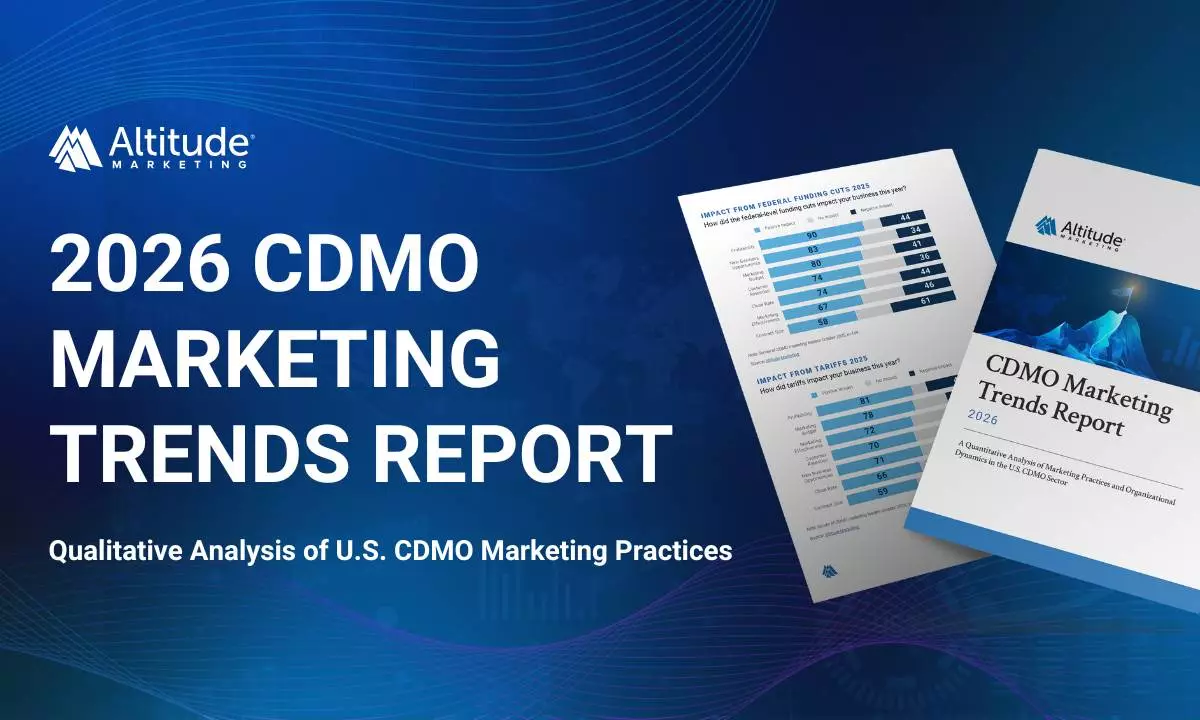
Altitude Marketing released its 2026 CDMO Marketing Trends Report, a quantitative analysis of marketing practices and organizational dynamics across the U.S. contract development and manufacturing organization (CDMO) sector. The report draws on survey data from 149 marketing leaders and provides benchmarks and insights into how CDMOs are adapting their go-to-market strategies amid ongoing market pressure and technological change.
This press release features multimedia. View the full release here: https://www.businesswire.com/news/home/20260115582263/en/
The findings point to a period of measured growth for CDMO marketing teams, with nearly 80% of respondents expecting department expansion in 2026 and a similar share projecting budget increases. At the same time, the data reveal a clear shift toward hybrid resourcing models, with three-quarters of respondents planning to increase their use of outsourced agency partners.
The report also underscores the growing importance of data-driven, content-led inbound strategies. Organic SEO and AI-driven search emerged as the most effective channels for generating qualified leads in 2025, outperforming traditional tactics such as trade shows and paid media. Looking ahead, respondents expect these same channels to command the largest share of marketing investment in 2026.
AI adoption has moved firmly into the mainstream, with 70% of CDMO marketers reporting daily use of AI tools and most citing measurable efficiency gains. Respondents reported saving an estimated five to ten hours per week through applications such as data analysis, information discovery, and content repurposing, signaling a shift from experimentation to operational integration.
“Marketing leaders at CDMOs are being asked to do more with steady, not unlimited, growth,” said Adam Smartschan, chief strategy officer at Altitude Marketing. “This research gives teams a clear picture of what their peers are prioritizing, where budgets are moving, and which channels and tools are actually delivering results.”
Key findings from the report will be discussed during a live Contract Pharma webinar on January 29 at 11:00 a.m. ET, featuring Smartschan alongside John Boogard, Senior Director of Global Marketing and Product Strategies of ARx. The session will explore how CDMO marketing teams can apply the data to real-world planning decisions for 2026.
The full 2026 CDMO Marketing Trends Report is available at:
https://altitudemarketing.com/cdmo-marketing-trends-2026/
About Altitude Marketing
Altitude Marketing is a full-service, integrated B2B marketing agency specializing in the life sciences. The firm works with companies across the clinical research, development, and manufacturing ecosystem to build brands and execute marketing strategies that engage highly technical, difficult-to-reach audiences.
Altitude Marketing Releases 2026 CDMO Marketing Trends Report, Highlighting Shifts in Growth Strategy, Channel Performance, AI Adoption
NEW YORK (AP) — U.S. stocks are hanging near their records Wednesday as oil prices fall and ease the pressure on households and businesses worldwide.
The S&P 500 slipped 0.1% below its all-time high set the day before. The Dow Jones Industrial Average was up 183 points, or 0.4%, as of 12:56 p.m. Eastern time, and the Nasdaq composite was 0.1% lower.
Stocks of companies with big fuel bills helped lead the way on hopes that lower oil prices will remove a big drag on their profits. Norwegian Cruise Line Holdings climbed 5.7%, and United Airlines rallied 7.3%. Delta Air Lines rose 3.7% and is on track to set an all-time high.
The price for a barrel of Brent crude oil fell 4.1% to $95.48 after the ceasefire between the United States and Iran appeared to hold despite the U.S. military launching what it called “self-defense” strikes in southern Iran. A barrel of benchmark U.S. crude fell even more, 4.2%, to $89.69 on hopes that the United States and Iran can reach an agreement to reopen the Strait of Hormuz and allow oil tankers to exit the Persian Gulf for deliveries again.
Stocks have been able to run to records despite the painful inflation and uncertainty caused by high oil prices largely because companies have reported surprisingly strong profits for the start of 2026, and the forecast is for them to continue.
Bath & Body Works rallied 11.2%, and Abercrombie & Fitch climbed 11.8% after both reported bigger profit for the latest quarter than analysts expected. That's even as U.S. consumers continue to say they're feeling discouraged about the economy and inflation.
Lululemon Athletica rose 3.6% after reaching a deal with its founder, Chip Wilson, where it will add a former chief marketing officer of ESPN and a former co-CEO of On to its board of directors.
On the losing side of Wall Street was Dick's Sporting Goods, which dropped 4.9% despite delivering a profit for the latest quarter that edged past expectations. Analysts pointed to how much profit it wrung out of each $1 in revenue, which some called a bit weak.
Oil-and-gas stocks also sank, hurt by the dropping prices for crude. Exxon Mobil fell 1.4%, and Chevron slipped 0.8%. Halliburton dropped 3% to bring its gain for the year so far back toward 40%.
In the bond market, Treasury yields eased after falling oil prices took pressure off inflation. The yield on the 10-year Treasury slipped to 4.48% from 4.50% late Tuesday and from 4.67% roughly a week ago.
It’s a respite following recent gains for yields in bond markets worldwide, which threatened to slow economies and undercut prices for stocks and all kinds of other investments. High yields have already forced the average long-term U.S. mortgage rate to its most expensive level since last summer, and they could curtail companies’ borrowing to build the artificial-intelligence data centers that have supported the U.S. economy’s growth recently.
In stock markets abroad, indexes were mixed across Europe and Asia. South Korea's Kospi was one of the world's best performers and jumped 2.3% after SK Hynix, which is a big beneficiary of the artificial-intelligence boom, soared 9.3%.
A day before, Micron Technology surged to become the latest Big Tech company to be worth more than $1 trillion on AI excitement. Its stock has more than tripled already in 2026, and analysts at UBS said Tuesday it could soar even more because of how fundamentally AI has improved demand for computer memory.
AP Business Writer Elaine Kurtenbach contributed to this report.

Trader Edward Curran, left, and specialist Meric Greenbaum, center, work on the floor of the New York Stock Exchange, Friday, May 22, 2026. (AP Photo/Richard Drew)

A person looks at an electronic stock board showing Japan's Nikkei index at a securities firm Monday, May 25, 2026, in Tokyo. (AP Photo/Eugene Hoshiko)

A dealer walks past near the screens showing the Korea Composite Stock Price Index (KOSPI) and the foreign exchange rate between U.S. dollar and South Korean won at a dealing room of Hana Bank in Seoul, South Korea, Wednesday, May 27, 2026. (AP Photo/Lee Jin-man)

A dealer walks past near the screens showing the foreign exchange rates at a dealing room of Hana Bank in Seoul, South Korea, Wednesday, May 27, 2026. (AP Photo/Lee Jin-man)

A dealer walks past near the screens showing the Korea Composite Stock Price Index (KOSPI) and the foreign exchange rate between U.S. dollar and South Korean won at a dealing room of Hana Bank in Seoul, South Korea, Wednesday, May 27, 2026. (AP Photo/Lee Jin-man)

A dealer stands near the screens showing the Korea Composite Stock Price Index (KOSPI), the foreign exchange rate between U.S. dollar and South Korean won and the Korean Securities Dealers Automated Quotations (KOSDAQ) at a dealing room of Hana Bank in Seoul, South Korea, Wednesday, May 27, 2026. (AP Photo/Lee Jin-man)