Riders in the men's and women's Tour de France will take in some eye-catching views in next year’s race as they pedal through the hills and valleys of Britain.
The men's edition of the 2027 Tour begins in the Scottish city of Edinburgh on July 2, with the opening stage passing through Midlothian and the Scottish borders before ending in Carlisle, outside the city's medieval castle.
The following day, an undulating second stage takes the peloton from Keswick in the heart of the Lake District's National Park before ending on The Strand in the northwest city of Liverpool, home of The Beatles and the city's beloved soccer team.
A hilly third stage on July 4 takes place in Wales.
Starting from Welshpool in Powys, it snakes through the south Welsh valleys and features climbs up Côte de Rhigos and Côte de Caerffili in the closing stages before finishing in Cardiff.
It is the first time both Grand Départs — the cycling term for Tour race starts — have taken place in the same country, outside of France.
Britain has proved a very welcoming host in the past.
“The UK has always welcomed the Tour with passion and pride, and the route details we are revealing today reflect the beauty and diversity of Britain’s terrain,” Tour de France race director Christian Prudhomme said. “Bringing both Grand Départs here is a testament to the strength of our partnership with British Cycling and the enthusiasm of the UK.”
The 2014 men's Tour began in the Yorkshire region of northern England and drew huge crowds, following on from the equally enthusiastic welcome when the 2007 Tour started in London.
The women's 2027 Tour starts July 30 from the civic hall in Leeds in northern England, before crossing the Pennines to Manchester.
The next day riders go through the Peak District National Park and tackle the Côte de Snake Pass before crossing the line in the South Yorkshire city of Sheffield.
The women's peloton says au revoir to Britain after a Sunday showpiece third stage in London on Aug. 1.
“Starting the Tour de France in Leeds is a strong choice, closely linked to this heritage and to the enthusiasm of a public that knows and loves the Tour,” women's Tour director Marion Rousse said. "These stages clearly reflect the race’s ambition: to continue growing women’s cycling and to inspire future generations.”
Last year's men's race started in the French city of Lille, and Slovenian cycling star Tadej Pogačar went on to win the overall title for the fourth time.
Olympic champion Pauline Ferrand-Prévôt of France won the women's race at the first attempt.
This year's men's race starts in Barcelona on July 4. The host of the 1992 Olympic Games previously hosted stages but never the start. This year’s women’s race begins in Lausanne, Switzerland.
A social impact initiative called “Joy” will be promoted during the 2027 Grand Départ. It aims to tackle inactivity, improve mental wellbeing and help communities prosper.
Organizers will work alongside governments, local councils and community representatives to create opportunities for young people and also break down existing barriers for girls in sport.
British Cycling hopes to recruit more than 7,000 volunteers for the Grand Départ.
AP cycling: https://apnews.com/hub/cycling

FILE - Reigning World Champion Tadej Pogacar indicates five as he celebrates winning his fifth in a row Il Lombardia, Tour of Lombardy cycling race, in Bergamo, Italy, Saturday, Oct. 11, 2025. (Gian Mattia D'Alberto/LaPresse via AP, File)
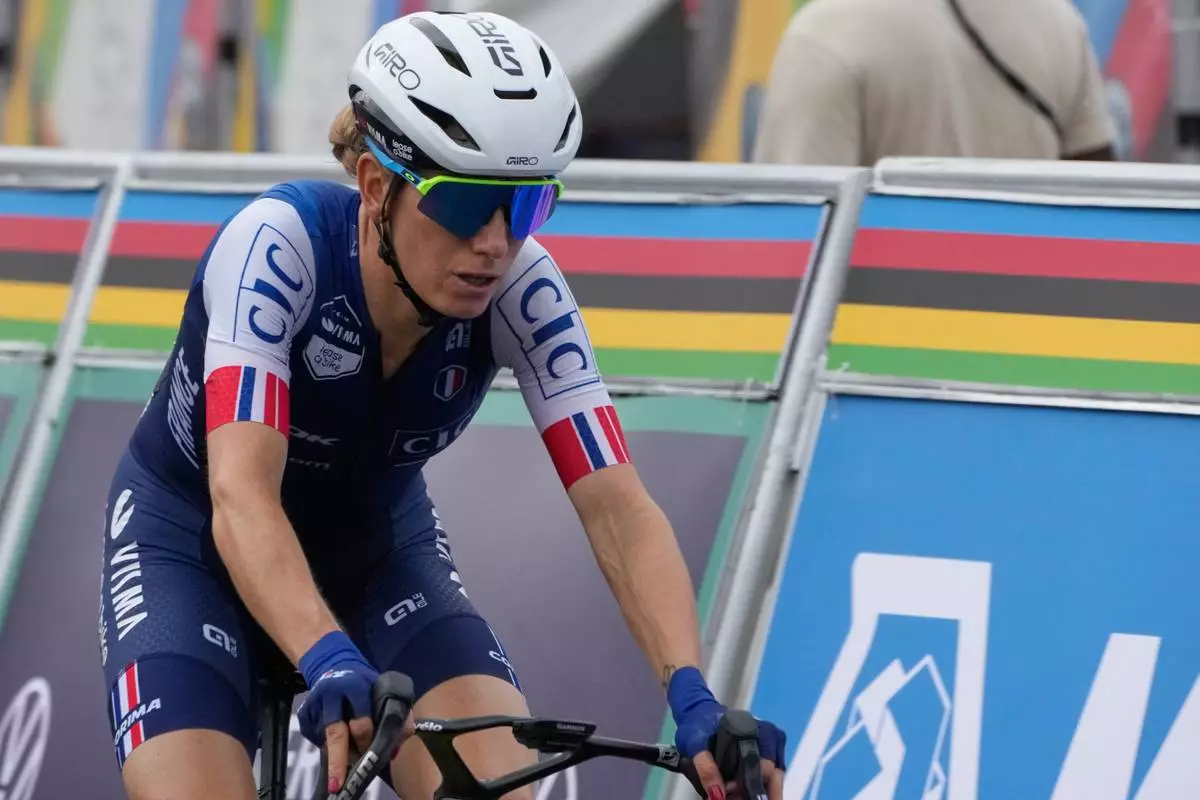
FILE - France's Pauline Ferrand-Prevot pedals during the women's Elite road race, at the road cycling World Championships in Kigali, Rwanda, Saturday, Sept. 27, 2025. (AP Photo/Jerome Delay)

FILE - Tour de France winner Denmark's Jonas Vingegaard, wearing the overall leader's yellow jersey, celebrates on the podium after the last stage of the Tour de France cycling race in Paris, France, Sunday, July 23, 2023. (AP Photo/Daniel Cole, file)
AUSTIN, Texas (AP) — James Talarico barely mentioned Donald Trump when he finally got to give his victory speech on Wednesday night as Democrats' nominee for U.S. Senate in Texas.
But the 36-year-old state lawmaker is now a front man for the left's opposition to Trump, not just in his own state but around the country. With his victory over U.S. Rep. Jasmine Crockett, the state lawmaker from Austin will test whether a smiling message of unity and change is enough to answer voters’ frustrations amid discord at home and now a war abroad.
“We're done being divided. We're done being played,” Talarico said, several times invoking his Christian faith and promising a “politics of love.”
“We're not just trying to win an election. We are trying to fundamentally change our politics,” he said, adding that he's “tired of being told to hate my neighbor.”
Talarico acknowledged that his immediate challenge is consolidating support from Crockett's supporters who flocked to the congresswoman's unapologetically pugilistic approach to Trump and Republicans. He told them, “I hope to earn your trust."
Crockett conceded to Talarico on Wednesday morning, saying that Texas “must remain united because this is bigger than any one person.”
Talarico also got an endorsement and a fundraising email blast from former Vice President Kamala Harris, who previously backed Crockett in the primary.
Talarico will need all the help he can get in a Republican-dominated state where Democrats have gone three decades without winning a statewide race. He will face either U.S. Sen. John Cornyn or state Attorney General Ken Paxton, who advanced to a Republican runoff on Tuesday.
Conventional political wisdom has Talarico as the stronger Democratic candidate for November, especially if Republicans nominate Paxton, a conservative firebrand who has weathered allegations of corruption and infidelity over the years.
Although Democrats are often choosing between moderate and progressive candidates in primaries, they faced a largely stylistic choice in Texas.
Talarico, 36, is a Presbyterian seminarian and rarely raises his voice. Crockett, 44, is an unapologetic political brawler who hammers Trump and other Republicans with acidic flourish.
But Talarico’s broader argument is one that he could have made regardless of whether Trump was in the White House. He regularly assails the rise in Christian nationalism. A former teacher, he advocates for public education. And he's said often, and again Wednesday, that the country’s fundamental divide is not partisan but “top vs. bottom.”
He's not running, he said, against Cornyn, Paxton or “any one politician” but against “the billionaire mega donors and their corrupt political system.”
Lea Downey Gallatin, 40, an Austin resident who met Talarico when they interned together for a congressman, described him as “a serious advocate for the disenfranchised and a serious policymaker.”
Talarico campaigned on the theory that he could pull new people into the party's tent, while Crockett promised she could increase turnout within Democrats' base.
“If you hate politics and you never voted before, you have a home in this campaign,” he said. He also reached out to erstwhile Trump voters who are “fed up with the extremism and the corruption in our government.”
In the closing stretch of the primary campaign, Talarico posed for pictures and greeted the singer of a Tejano band playing in a San Antonio neighborhood. Inside his campaign rally that day, Lori Alvarez, a 39-year-old who works for a disaster relief nonprofit, said she supported Talarico because “he really listens to what we need."
"I think he’s going to be able to make change in Washington for us,” said the married mother of three young girls.
Unofficial primary returns showed Talarico with a dominating performance around his home base of Austin, including in mostly white areas. He outpaced Crockett across much of rural and small-town Texas, including in the Rio Grande Valley, where Trump made gains in his 2024 presidential victory among Hispanic voters. Crockett was strongest in metro Houston and Dallas-Fort Worth, including areas with large concentrations of Black voters.
Crockett is Black, and Talarico is white.
A Democratic win in Texas would require stitching together that multiracial and multiethnic coalition, spanning the metro areas and heavily Latino South and West Texas, while limiting Republican margins in whiter rural counties.
In 2018, Democrat Beto O’Rourke came the closest to that mix, losing to Republican Sen. Ted Cruz by about 215,000 votes or about 2.5 percentage points. With both parties holding competitive primaries Tuesday, Democratic primary voters outnumbered Republicans by about 180,000 out of more than 4.4 million — with some ballots still being tallied.
Talarico and other Democrats say enthusiasm is on their side this year. But there were plenty of Democratic Texans who saw Crockett as their champion.
Troy Burrow, a 61-year-old Navy retiree, called her “rugged” and “the only one I see fighting for us.”
He added, “I like how she doesn’t back down from anybody.”
Burrow said some voters probably saw Talarico as more electable because he is more soft-spoken. But, he said, “We’ve got to get into the gutter with these folks, because that’s where they are.”
Talarico, meanwhile, promised to fight in his own way — again invoking his faith.
“Two thousand years ago, when the powerful few at the top hurt those at the bottom, that barefoot rabbi didn't stay in his room and pray,” Talarico said, referencing Jesus and the Biblical story of his anger in the temple. “He walked into the seat of power and flipped over the tables of injustice."
He added that "it's time to start flipping tables.”
Barrow reported from Atlanta, Figueroa from Austin, Texas, and Beaumont from San Antonio. Associated Press writer Maya Sweedler in Washington contributed to this report.
This story has corrected the last name of Texas voter Troy Burrow, from Burroughs.

Texas Democratic Senate candidate Texas state Rep. James Talarico, D-Austin, speaks for the first time since winning the Democratic nomination in Austin, Wednesday, March 4, 2026. (AP Photo/Eric Gay)

Attendees cheer before Texas Democratic Senate candidate Texas state Rep. James Talarico, D-Austin, speaks for the first time since winning the Democratic nomination in Austin, Wednesday, March 4, 2026. (AP Photo/Eric Gay)

Texas Democratic Senate candidate Texas state Rep. James Talarico, D-Austin, waves before speaking for the first time since winning the Democratic nomination in Austin, Wednesday, March 4, 2026. (AP Photo/Eric Gay)

Supporters of Texas state Rep. James Talarico, D-Austin, a Democratic candidate for the U.S. Senate, react as results come in during a primary election watch party Tuesday, March 3, 2026, in Austin, Texas. (AP Photo/Eric Gay)

Texas state Rep. James Talarico, D-Austin, a Democratic candidate for the U.S. Senate, greets supporters at a primary election watch party Tuesday, March 3, 2026, in Austin, Texas. (AP Photo/Eric Gay)

Rep. Jasmine Crockett, D-Texas, a Democratic candidate for U.S. Senate, speaks during a primary election watch party Tuesday, March 3, 2026, in Dallas. (AP Photo/Tony Gutierrez)

Texas state Rep. James Talarico, D-Austin, a Democratic candidate for the U.S. Senate, speaks at a primary election watch party Tuesday, March 3, 2026, in Austin, Texas. (AP Photo/Eric Gay)