LONDON--(BUSINESS WIRE)--Jan 15, 2026--
The UK’s latest Contracts for Difference (CfD) Allocation Round results confirm a major step forward for clean electricity buildout, while also highlighting a simple truth about power system economics: as wind and solar scale, flexible, dispatchable capacity becomes more valuable and, done well, cheaper for consumers than the alternatives.
This press release features multimedia. View the full release here: https://www.businesswire.com/news/home/20260115712805/en/
The Department for Energy Security and Net Zero (DESNZ) published Allocation Round 7 (AR7) results on 14 January 2026, awarding a record 8.4375GW of offshore wind projects. Clearing strike prices (in 2024 prices) were £91.20/MWh for offshore wind (fixed-bottom), £89.49/MWh for offshore wind projects in Scotland, and £216.49/MWh for floating offshore wind.
“These outcomes show the UK is serious about building clean power at scale,” said Zach Dodds-Brown, Development Director at Terra Firma Energy. “But they also reinforce why the transition must be built on two pillars: abundant low-carbon energy and dependable flexibility that can respond in minutes and run when the weather doesn’t cooperate.”
Why higher wind clearing prices make flexibility even more important
AR7’s higher clearing prices reflect well-documented inflation and supply chain pressures across offshore wind. The UK now has a larger volume of renewables coming online at fixed, index-linked contract prices and that makes the system costs around intermittency, constraints and balancing increasingly material.
The National Energy System Operator (NESO) has been explicit that balancing costs are driven by the changing generation mix and network constraints as the system decarbonises, and it has identified major consumer savings through market and operational reforms.
Meanwhile, UK government analysis has highlighted the scale of potential savings from flexibility: the Statutory Security of Supply Report 2025 notes that flexibility (alongside storage and interconnection) could save up to £10bn per year (2012 prices) by 2050 by reducing how much generation and network build is needed.
Flexible generation: a critical asset class for a low-cost transition
Flexible generation (often called “flexgen”), fast-start, high-ramp plants that operate at low load factors and respond to peaks and system needs, is a core tool for keeping the system reliable without overbuilding expensive assets.
NESO’s Clean Power 2030 analysis has stated that gas-fired generation capacity remains essential for security of supply until sufficient low-carbon equivalents are built. In other words: flexibility is not a “nice to have”; it’s part of the engineering reality of a weather-dependent grid.
“When flexibility is absent, the system pays anyway, through higher constraint costs, inefficient redispatch and increased balancing actions,” Zach added. “Well-located, well-operated flexible generation reduces the amount of ‘backup’ the system must carry, supports renewable integration, and lowers the total cost to consumers.”
Recent reforms and policy discussions also recognise that cutting constraint and balancing costs is a consumer priority. Reuters has reported that network and market upgrades could save up to £4bn in constraint payments by 2030, citing NESO.
About Terra Firma Energy
Terra Firma Energy constructs, owns and operates flexible power generation plants across the UK. With three operational sites and additional sites under construction totalling 116MW, the company is expanding through development and acquisition to support the UK's transition to a resilient, flexible, low-carbon energy system.
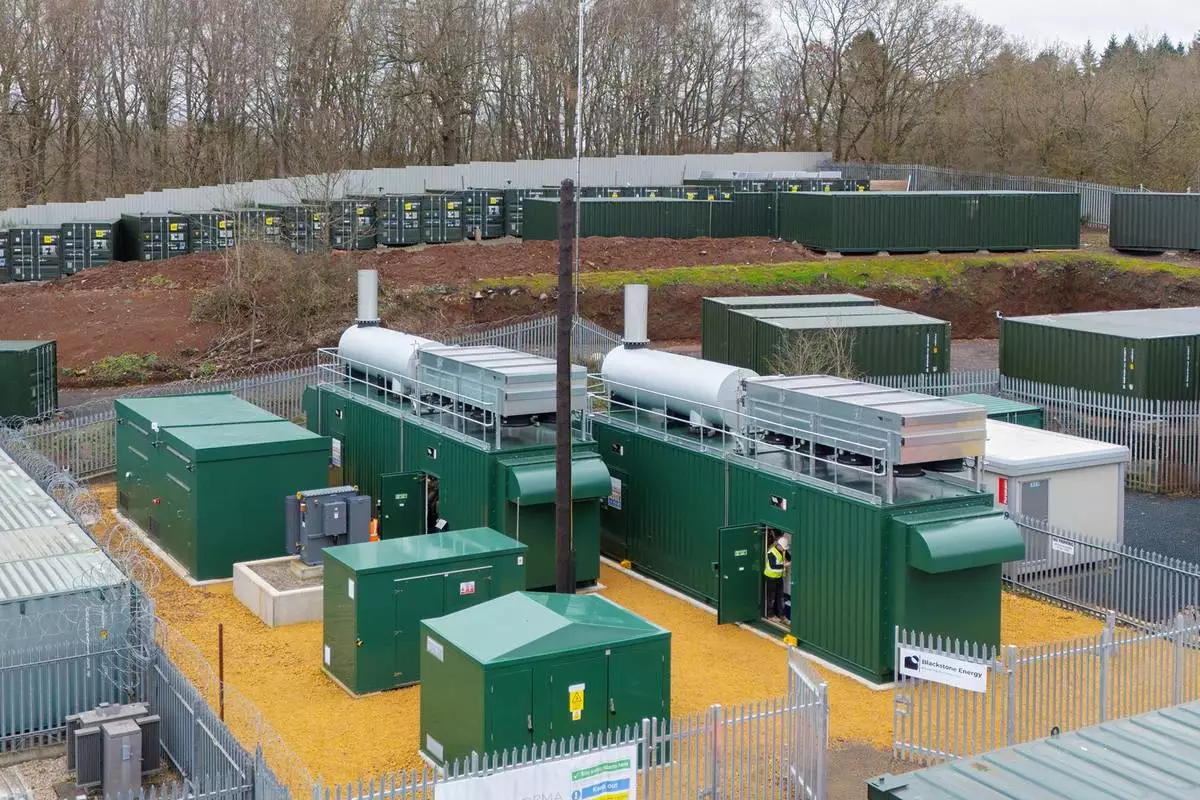
Flexible Generation is essential in keeping the UK's energy system reliable without overbuilding other more expensive assets. NESO’s Clean Power 2030 analysis has stated that gas-fired generation capacity remains essential for security of supply. Terra Firma Energy's 5MW flexible power generating plant in Droitwich Spa, UK along with their other operational sites play a major part in providing the UK with such security.

Terra Firma Energy believe the UK's energy transition must be built on two pillars: abundant low-carbon energy and dependable flexibility that can respond in minutes and run when the weather doesn’t cooperate.
OKLAHOMA CITY (AP) — Shai Gilgeous-Alexander isn't scoring the way he usually does, but the Oklahoma City Thunder are still winning the way they normally do.
Gilgeous-Alexander, the reigning NBA MVP, averaged 31.1 points during the regular season. In the Western Conference semifinals against the Los Angeles Lakers, he is averaging 20 points and taking only 14 shots per game.
Oklahoma City has still won the first two games by an average of 18 points. Gilgeous-Alexander and Chet Holmgren each scored 22 points, and the defending champion Thunder beat the Lakers 125-107 on Thursday night.
Ajay Mitchell, starting in place of injured Jalen Williams, is averaging 19 points on 50% shooting in the series for Oklahoma City.
“I think the coaching staff does a good job at just getting all of us ready,” said Mitchell, a second-year guard. "And we have a lot of competitors. Like, everyone’s a competitor on our team. So every time the lights are bright, everyone’s ready to go.”
Holmgren is the leading scorer for the Thunder in the best-of-seven series with 23 points per game. The 2026 All-Star also is averaging 10.5 rebounds and 2.5 blocks.
Jared McCain, a midseason acquisition from the Philadelphia 76ers, barely played in the first round against Phoenix but has averaged 15 points and made 8 of 10 3-pointers in the series.
“He goes in there, stays in character, stays aggressive," Thunder coach Mark Daigneault said. "He’s going to shoot the next shot. He makes the right plays, plays inside the team. He competes defensively, has had good defensive possessions for us. And he was huge tonight. You need that in a playoff series.”
The Lakers again were without scoring champion Luka Doncic, who is out indefinitely with a strained left hamstring. They also were missing forward Jarred Vanderbilt, the reserve forward who dislocated the pinkie on his right hand during the second quarter of Game 1. The Lakers had three players finish with five fouls, limiting their aggressiveness late in the game.
Los Angeles guard Austin Reaves, who struggled with his shot in Game 1, scored 31 points on 10-for-16 shooting in Game 2. LeBron James, coming off a 27-point effort in Game 1, followed that up with 23.
With the Lakers up 63-61 early in the third quarter, Gilgeous-Alexander got tied up with Reaves and was called for his fourth foul. Upon review, it was upgraded to a flagrant 1 for Gilgeous-Alexander's follow through. Oklahoma City's Alex Caruso was called for a technical foul as the situation was being sorted out.
Gilgeous-Alexander left the game with the Lakers up 65-61, but the Thunder rallied and took control without him. On a fast break, Holmgren found a trailing Jaylin Williams, who hit a 3-pointer and was fouled. His free throw put the Thunder up 85-74.
The Thunder outscored the Lakers 32-15 while Gilgeous-Alexander was out in the third quarter to take a 93-80 lead into the fourth.
“It was amazing," Gilgeous-Alexander said. “They strung together stops, they’re playing the right way offensively and things are going their way. Full confidence in those guys. They know how to win basketball games. And we've proven that. They’ve proven that no matter who’s on the floor, they know how to get the job done. And they just did it again tonight."
The Lakers cut Oklahoma City's lead to five in the fourth quarter before the Thunder pulled away again.
Los Angeles will host Game 3 on Saturday.
“We just stuck with it,” Holmgren said. “It’s the game of basketball. It’s not always going to go your way. It’s about how you respond. And this team has proven many times that we know how to respond. And we did so tonight.”
This story has been corrected to show that Shai Gilgeous-Alexander is averaging 20, not 19, points per game against the Lakers.
AP NBA: https://apnews.com/hub/NBA

Oklahoma City Thunder's Chet Holmgren (7) shoots over Los Angeles Lakers' Austin Reaves (15) in the second half of Game 2 in a second-round NBA basketball playoffs series Thursday, May 7, 2026, in Oklahoma City. (AP Photo/Nate Billings)

Oklahoma City Thunder guard Ajay Mitchell, front, works for a shot as Los Angeles Lakers' Austin Reaves, rear, defends in the second half of Game 2 in a second-round NBA basketball playoffs series Thursday, May 7, 2026, in Oklahoma City. (AP Photo/Nate Billings)

Los Angeles Lakers' LeBron James stands on the court in the second half of Game 2 in a second-round NBA basketball playoffs series against the Oklahoma City Thunder Thursday, May 7, 2026, in Oklahoma City. (AP Photo/Nate Billings)
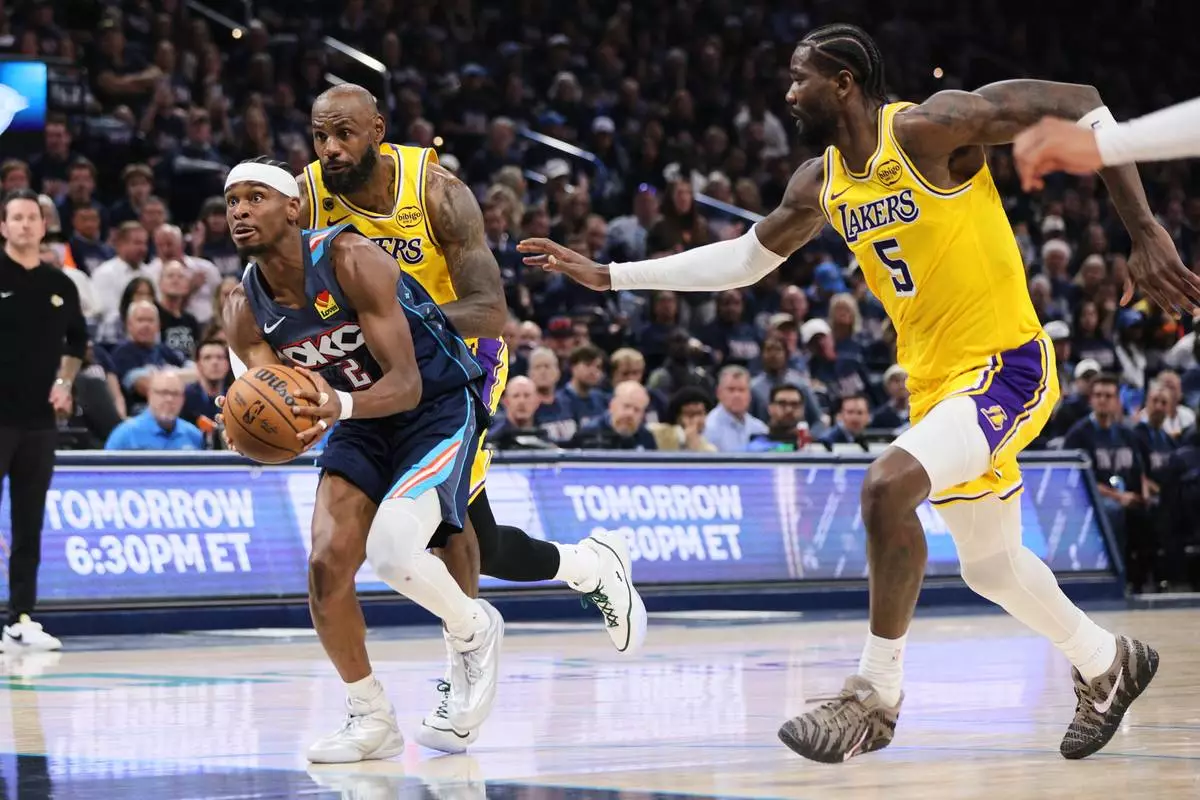
Oklahoma City Thunder guard Shai Gilgeous-Alexander (2) drives to the basket past Los Angeles Lakers' Deandre Ayton (5) and LeBron James, rear, in the second half of Game 2 in a second-round NBA basketball playoffs series Thursday, May 7, 2026, in Oklahoma City. (AP Photo/Nate Billings)

Oklahoma City Thunder center Chet Holmgren (7) works to the basket against Los Angeles Lakers forward Rui Hachimura (28) in the second half of Game 2 in a second-round NBA basketball playoffs series Thursday, May 7, 2026, in Oklahoma City. (AP Photo/Nate Billings)